The Origin of the Species
By Mark Dudzic
First published 14 August 2016 in:
First of the Month: A Website of the Radical Imagination
Back in the day, two knucklehead members of my old union local at a Union Carbide plant in New Jersey fashioned KKK hoods out of chemical filtration paper and paraded through the lunchroom on Halloween. The corporate HR executive sent to investigate summarily terminated both workers within hours of arriving at the plant. She loudly proclaimed the company’s “zero tolerance” to racial harassment.
Now this was very interesting considering that her employer was the prime suspect in the unpunished industrial murder of 764 mostly African American workers on the Hawk’s Nest Tunnel in the 1930’s and its current corporate chairman, Warren Anderson, was a fugitive from justice wanted by the Indian government in connection with the 1984 criminal manslaughter of at least 15,000 Indians in Bhopal. Over the next 15 years, the same HR exec who showed Phil and John the door was the point person in the shutdown of all three unionized Union Carbide plants in New Jersey, leaving behind a series of toxic waste sites contaminating communities throughout the state and 2,000 black, white and Hispanic workers, many suffering from uncompensated industrial diseases.
This episode comes to mind while contemplating the detritus of the Republican and Democratic conventions and the growing trope that the rage of the white (male) working class has propelled both the Trump campaign and the critique of the Clinton campaign from the left. The politics of race and gender often obscure much more than they reveal. It is true that individual white workers can be horribly racist and misogynist. But it is also true that the worship of “diversity” often serves as a cover for gross hypocrisy and ruthless class rule.
At the Democratic convention, diversity was rolled out in service of the status quo. Stripped of the soaring rhetoric of the Obama years, the neoliberalism of the Clinton variety fails to inspire or move people to action. “There is no alternative,” she proclaimed time and again during the campaign and at the convention, “so we might as well make the best of it and do what we can without upsetting the apple cart.” All of the energy inside and outside the convention hall came from the Bernie delegates who came prepared to fight for the issues and concerns of the people who sent them there. Even the concessions that the Clinton campaign made on platform issues had no real effect. No one really believes that Clinton will seriously oppose the Trans Pacific Partnership or work to institute a $15 living wage. Already she is moving to the right in an attempt to capture the refugees fleeing the new Trump-branded Republican Party. In more normal times, the rants of General Allen or, god bless them, the patriotic evocations of the bereaved Khan family, would have been much more at home at a Republican convention. Despite the deliberate celebration of diversity, we all left Philly knowing quite well what to expect over the next four years.
In Cleveland, the party of Trump was an altogether darker affair. Here diversity and it’s cousin “political correctness,” played the role that marginalized communities always play in right wing populist and revanchist movements: as a focal point for anger that would otherwise be directed against a social and economic order. Trump has mastered an appeal that combines Munich beer hall fascism with a kind of post-modern shock jock sensibility that doesn’t take itself all that seriously. It allows him to get away with the most outrageous statements that would have been the end of any traditional politician. He will never be president but he may succeed in destroying the modern Republican Party, which advanced a fundamentally pro-capitalist, neoliberal program by fanning racial and gender resentments, religious fundamentalism and populist anger at elites. To borrow a metaphor from Tom Frank, a whole lot of people don’t want to live in Kansas anymore.
It is interesting that many in the Republican establishment blame the white working class for the destruction of their party. The vitriol and sense of betrayal of the National Review crowd are truly remarkable. Trump certainly enjoys considerable working class support. For some workers, Hillary Clinton probably reminds them of that HR rep who forced them to attend “everyone is awesome” sensitivity training while secretly assisting in plans to move the plant to China (of course Trump not only symbolizes, he actually is that type of dickhead boss in the Frank Lorenzo-Jack Welsh-Carly Fiorina-Carl Icahn mold who runs the business into the ground while personally enriching himself and screwing everyone around him).
But the extent of Trump’s working class support is greatly exaggerated. Those workers at the Carrier plant in Indiana that Trump promised to stop from moving to Mexico? They’re members of the Steelworkers union who voted overwhelmingly to have their local endorse Bernie Sanders. Same with the Chicago Nabisco workers, primarily black and Latino and members of the Bakery Confectionary union. In fact, Trump voters have an average income about 20% above the median. I like to envision the typical Trump voter as an upwardly mobile fast food shift manager: making a crappy salary and working lousy hours with little hope for real advancement, but glad to be wearing a tie and away from the deep fryers, desperate to please the main office, envious of the life style of the local franchise owner and resentful and contemptuous of the lazy slugs they supervise who are constantly whining for more hours and better conditions.
Likewise, many in the Democratic establishment blame backward white workers for the success of the Bernie Sanders insurgency. Joan Walsh, among many others, opined that Sanders’ substantial support among white workers (who overwhelmingly supported Clinton in 2008) is because “she has been damaged by her association with the first black president”. And Paul Krugman, that eternal guardian of the left gate of the ruling class, pontificated that the Sanders campaign failed to understand the importance of “horizontal inequality” between groups. What the fuck does that even mean?
The “white working class,” like the “black community,” is an abstraction that does not exist anywhere in the real world. The U.S. working class is broad and diverse. It’s not even all that white any more and certainly not all that male. Its conditions are determined by its position within a political economy but, like everyone else, the experience and consciousness of individual workers is formed by a whole series of contingent relationships and experiences. The recent use of the trope of the angry white working class attempts to extract white workers from these class dynamics and present them as a demonized and marginalized natural group.
Adolph Reed has written extensively about the ideological and epistemological machinations that legitimize and stabilize regimes of hierarchy by transforming social relations into natural conditions. In the U. S., race, and its various ethno-subdivisions, has always been the great tapestry upon which this story has played itself out. Race science developed as an efficient sorting and control mechanism for capitalism and, in the 19th Century, embraced Darwinian and Lamarckian evolutionary theory to lend legitimacy to the ideology (late 20th century racialists incorporated more modern genetic theories into the mix). While the old racialist model persists to this day, the integration of various ethnic groups into the great American middle class and the successes of the civil rights movement compelled most mainstream ideologists to move to a newer version that incorporated speciation theory. This new model emerged in the 1980’s with the discovery of the black underclass. Just as Darwin’s finches evolved into unique species on their isolated Galapagos islands, so did social Darwinists identify a black underclass culturally and economically isolated from the rest of us (Trump, by the way, had a bit to do with naturalizing this new model. He made his bones as a rabid proponent of the “wilding” hysteria that, in 1989, helped to frame 5 black and Hispanic youths for the rape of a female investment banker who was jogging in Central Park.)
In the U.S., class relations per se have rarely been naturalized. Instead, the ideological consensus was that most Americans become subsumed into a broad middle class with the exception of a few culturally marginalized populations. But now we are witnessing the evolution of a new species: white, blue-collar workers unable or unwilling to transcend their dead-end jobs/communities who are acting out in self-destructive and dysfunctional ways that undermine the very foundations of political stability. The underclass descriptors are remarkably similar: OxyContin for crack, social security disability for welfare dependency, family dysfunction and sexual profligacy (Kevin Williamson’s stunning invective against a “white American underclass in thrall to a vicious, selfish culture whose main products are misery and used heroin needles” engaged in “the whelping of human children with all the respect and wisdom of a stray dog” could apply equally to either species).
Then there’s J. D. Vance’s best-selling memoir, Hillbilly Elegy. In a style that fans of every racial uplift story since Manchild in the Promised Land will immediately recognize, Vance relates the massive dysfunction of his working class Ohio background and his personal overcoming through pluck and hard work. As the New York Times points out in its review, Vance subscribes to the Obama “brothers should just pull up their pants/stop feeding Popeye’s to your kids for breakfast” school of thought that “hillbilly culture…increasingly encourages social decay instead of counteracting it.”
This new species has an irrational fear of globalization, a perverse sense of entitlement and a worldview colored by racial and sexual resentments. In the conservative account, they have only themselves to blame–social programs will just exacerbate the culture of dependency and only a strong dose of religion or family values backed by the punitive and carceral powers of the state can nip this inferior species in the bud, reintegrating its more robust members into the great American phenotype. In the liberal view, it is actually the evolved racism and other entrenched attitudes of this species that prevents progressive change. It’s as if my two knuckleheaded union brothers were actually the ones responsible for Union Carbide’s legacy of racist industrial homicide. There’s no real solution to this problem because this racism and sexism is actually part of the DNA of the species rather than embedded in a political economy. We can only hope that the species self-extincts as its more enlightened members move to Seattle and Silicon Valley to become baristas and uber drivers as the others obliterate themselves with drugs, alcohol and guns. Either way, one thing is clear. They. Are. Not. Like. Us.
The Sanders campaign was so disorienting to both conservatives and liberals because it did not embrace these naturalized categories but, instead, revealed them as social relationships established by real human beings and, thus, open to change through the application of political and economic policies. After stumbling a bit in the early months around how to give voice to the outrages of police violence and mass incarceration, it laid out a working class politics of hope that was both visionary and practical. In the process, it helped lay bare the actual mechanisms of capitalism that drive inequality. And it exposed the fault lines created by decades of neoliberalism that are impeding real change in the labor, racial justice and other social movements.
The tasks ahead should be clear: first decisively defeat Trump and everything he stands for. Then immediately pivot to attack the neoliberalism that will be at the core of the new Clinton Administration. Failure to do so will doom us to decades more of a politics of cynicism, divisiveness and corporate rule over every aspect of human existence.
One thing for sure, it’s going to be an interesting ride…
The Fight for $15 and a Union – A movement in the making?
By Peter Olney and Rand Wilson
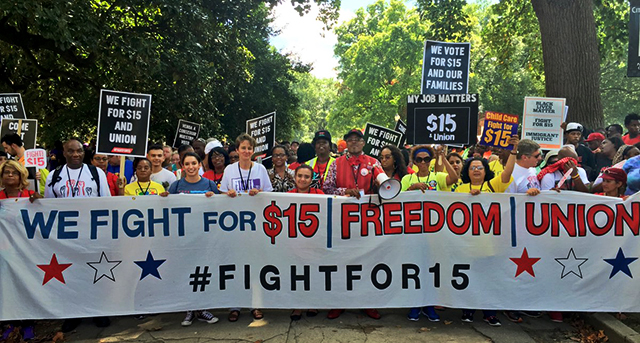
“Fight for $15” convention closed with a march on the Robert E. Lee monument that symbolizes racial supremacy. Photo: SEIU
After both the Republican and Democratic parties nominating conventions, there was a convention of a very different kind in Richmond Virginia on August 12 and 13. Thousands of low-wage workers and activists from all over the United States gathered for a Fight for $15 convention. The convention highlighted the links between the Fight for a $15 minimum hourly wage, economic equality and the struggle for racial justice. The selection of a venue in the capital of the Confederacy was no accident, and the convention closed on Saturday with a march on the Robert E. Lee monument that symbolizes racial supremacy.
This meeting was another movement-building step in the fight for a $15 per hour minimum wage. The Reverend William Barber, who only a few weeks before ignited the Democratic convention in Philadelphia with a blistering speech during prime time television, spoke at the closing rally and talked about the legacy of slavery and its connection to lingering poverty and other social problems.
The United States federal minimum wage was first established in 1938 at $.25 per hour. Over the years since, the minimum wage has been increased to $7.25 per hour, a totally inadequate living standard anywhere in the United States.
States (and some municipalities) are free to enact higher minimums, and states and cities with strong labor unions and progressive politics have done so. For example, the minimum wage in Massachusetts is now $10 and hour and in Michigan it is $8.50. The City of San Francisco has a $13 minimum wage. The states of the old Confederacy have the lowest minimums and have resisted grassroots efforts to raise them. Birmingham, Alabama recently raised its minimum to $10.10 but the raise was preempted by the Republican-dominated state legislature.
Both California and New York have recently raised their minimums to $15 per hour; phased in over 7 years to 2023 in California, and in greater New York City by 2021 and in the rest of the state in graduated fashion after 2021. While even these minimums are still a paltry income for struggling working class families, the change in minimums and the societal recognition of the need to drastically raise wages is a long overdue and welcome development.
The Service Employees International Union (SEIU) with almost 2 million members, mostly in the public sector, has been responsible for funding and leading the Fight for $15. Without its backing and national coordination, the one day strikes against McDonald’s and other fast food outlets would not have happened. One-day strikes began in 2012 and on August 29 of 2013 there were walkouts at fast food outlets in over 60 cities. The walkouts usually were by only a small percentage of the employees in each outlet, but members of SEIU and other unions along with community groups bolstered the strikes with large public rallies and demonstrations of support.
The actions were often characterized by observers as a “march on the media” rather than an actual march of the fast food workers themselves. Nevertheless, these actions generated a public “buzz” and put pressure on McDonald’s and the other fast food employers to raise wages. In early 2015 McDonalds’ announced that it would raise the company minimum for thousands of its employees.
the key to securing power for workers in this industry (as in other retail organizing) is building strategic power higher up in the industry’s supply chain
The Fight for $15 campaign has not yet been able to compel McDonald’s or any of the other fast food restaurants to recognize the union as the bargaining representative of its employees. It is often unclear how many workers actually remain involved in the day-to-day union organizing. Employee discipline and terminations in retaliation for supporting the union are rampant, and it is hard to defend discharged workers under U.S. labor law. Turnover in employment is high. Actual worker organization is thin. But the Fight for $15 driven by SEIU and supported by significant community-based forces has had a remarkable role in shifting consensus on US wage policy. No longer do the neo-classical supply side economists dominate the debate arguing that a rise in minimum wages will destroy jobs and the economy.
Historian and labor organizer Marty Bennett has pointed out that prior to the Fight for $15, there is a history of initiatives which have contributed to this sea change in public opinion:
• In 1996 the City of Baltimore, pressured by labor and community organizations, passed one of the first “Living Wage” ordinances mandating that businesses receiving city contracts pay more than the minimum wage. Los Angeles did the same in 1997.
• In 2011 “Occupy Wall Street” protests in cities throughout the U.S. targeted the growing economic disparity between the top 1% and the rest of the 99%.
• In 2012, the Fight for $15 and a union was launched with strikes at fast food outlets throughout the US.
• In 2013, SeaTac, a small city halfway between the cities of Seattle and Tacoma that encompasses the Seattle airport, passed a $15 minimum. In 2014 and 2015, San Francisco and Los Angeles followed suit.
• Bernie Sanders’ campaign for President explicitly called for a $15 federal minimum wage and pressured Democratic nominee Hillary Clinton to adopt $15 in the Democratic Party Platform.

Photo: SEIU
As Fight for $15 advocates gathered in Richmond, Virginia for their convention, they celebrated the remarkable advances they have made in shaping the national dialogue; moving it away from austerity and to a focus on economic inequality. They also celebrated their part in a larger movement to significantly raise the minimum wage, impacting millions of low wage workers through state and municipal increases.
SEIU has made a remarkable commitment, putting enormous resources behind the fast food workers so they can pressure their employers for higher wages. But despite its short-term impact and success, the campaign has yet to build sustainable worker organization. Clearly the high turnover and the huge number of scattered franchised job sites make an enduring worker organization extremely difficult to maintain.
From the standpoint of union organizers committed to building strong worker-led, democratic unions, the key to securing power for workers in this industry (as in other retail organizing) is building strategic power higher up in the industry’s supply chain. The better off workers in company-owned and third-party warehouses and trucking companies who supply the goods to fast food outlets may make for more sustainable organizing even if they are far less glamorous. In turn, these “pinch points” in the supply chain are where key workers once organized can exert the strategic leverage to win organizing rights for the millions of workers who labor in the fast food restaurant industry.
Our Revolution is just getting started
By Peter Olney and Rand Wilson

2016 Democratic Convention. Photo: Rand Wilson
Now that the Democratic National Convention in Philadelphia has ended with Hillary Clinton as the party’s nominee, Bernie Sanders’ campaign for “political revolution” moves to its next phase.
Everyone who supported Labor for Bernie is very proud of the of the unprecedented grassroots effort to rally rank-and-file members on his behalf. A network of tens of thousands of supporters (largely recruited via the Labor for Bernie website and social media), campaigned in nearly every union to get trade union organizations to endorse Bernie.
By the end of the campaign, six national unions and 107 state and local union bodies endorsed Bernie. Just as importantly, Labor for Bernie activists kept many Internationals and the AFL-CIO on the sidelines during the primaries; enabling their members to more actively support Bernie.
But it wasn’t just about endorsements. Labor for Bernie was an all-volunteer army; a movement of members and leaders who took on the labor establishment. Labor for Bernie activists formed cross-union groups in dozens of states and many cities. They generated strong working class support for Bernie’s candidacy and carried his message into thousands of workplaces. They worked independently of the Sanders campaign, but in tandem with it.
Particularly in the later primaries (WI, IN, PA, CA) workplace outreach helped to identify new Bernie supporters and get them to turnout on Primary Day. In many states, the majority of union households went for Bernie, often accounting for his margin of victory.
Democratic National Convention
More than 250 Labor for Bernie delegates from 37 states attended the Democratic National Convention in Philadelphia (and undoubtedly there were many more). Labor for Bernie leaders played a key role in fighting for a more progressive platform and for changes in the rules that could make the Democratic Party a more open and populist party in the future.
These changes were negotiated between the Sanders and Clinton campaigns just prior to the convention. As a result, there was little for the Sanders’ delegates to do at the convention. Yet despite the compromise agreement on the platform, there was widespread concern among delegates that the platform didn’t have strong enough language opposing the Trans-Pacific Partnership (TPP).
A Labor for Bernie leader from Illinois printed up 2,000 “No TPP” signs. The printer folded them twice so that our network of delegates could more easily smuggle them onto the convention floor.
When the platform came up for a vote, Labor for Bernie helped orchestrate “No T-P-P” chanting by the delegates that briefly brought the convention to a standstill. It captured the attention of the national news media.
Outside the convention there were spirited mass rallies in support of Bernie’s candidacy and the environmental and labor issues brought forward during the campaign. National Nurses United organized a forum on Medicare for All. Union supporters held a forum on organizing to stop passage of the TPP during the Congressional “lame duck” session after the November 8 election.
The small but feisty Working Families Party hosted a forum with speakers discussing ways to build an autonomous and independent faction inside the Democratic Party. Democratic Socialists of America had a standing room only session on the lessons of the Sanders campaign.
Delegates were grouped by their state both on the convention floor and in their hotels. There were obvious and deep differences in the political perspectives of the Sanders and Clinton delegates. One group apparently satisfied by the status quo in the Democratic Party, the other determined to change it. Sanders’ delegates often felt they were “crashing” someone else’s party.
Just prior to the start of the convention, WikiLeaks revealed emails showing widespread favoritism and manipulation by the Democratic National Committee to assist Clinton in the primaries. This confirmation of what many already suspected enraged many Sanders delegates and at times tensions flared in arguments both about the conduct of the party and debates on the issues.
The shared experience among the 1,900 Sanders delegates may be the one of the most important lasting outcomes of the convention.
The political revolution doesn’t end in Philadelphia
Union members allied with Labor for Bernie now face the dual challenge of decisively defeating Donald Trump and stopping the Trans-Pacific Partnership (TPP) treaty.
Yet, as Bernie argued at the Convention, we can’t allow this election to become only about the differences between Trump and Clinton. Wherever possible, we have to continue to inject our issues into this general election campaign.
And that’s where “Our Revolution,” a new organization that is emerging from the Sanders’ campaign, comes in. It will continue to bring together a new majority for economic and social change by supporting candidates at the local, state, and national level who support the mission, issues and values of the Sanders campaign.
Sen. Sanders will provide more specifics in a “live stream” video presentation set for the evening of August 24. Many of Bernie’s volunteers in the labor movement will be hosting events in their union halls or living rooms to help kick off “Our Revolution” and lead this effort.
The Sanders’ campaign showed how unions might engage in politics in ways that enhances membership involvement and organizational clout, rather than reducing it. When labor organizations decide to endorse candidates, after a democratic process open to the entire rank-and-file, it changes the whole dynamic of union-based political activism. As a labor network strongly in favor of this approach, there will be a continuing need at the local, state, and national level to back electoral campaigns inspired by Bernie’s run for president.
Wilson’s pictures from the convention are online here
Looking back, looking forward Resolving the left impasse over elections
By Kurt Stand
Prologue
“The policy of “the lesser evil” strengthens the feeling of power of the reactionary forces and is supposed to create the greatest of all evils: the passivity of the masses. They are to be persuaded not to make any use of their full power outside of Parliament. Thus the significance of Parliament for the class struggle of the proletariat is also diminished. If Parliament today, within limits, can be used for the workers’ struggle, it is only because it has the support of the powerful masses outside of its walls.
…
The most important immediate task is the formation of a United Front of all workers in order to turn back fascism. … Before this compelling historical necessity, all inhibiting and dividing political, trade union, religious and ideological opinions must take a back seat.”
Fascism Must be Defeated; Opening Address to the German Parliament, August 1932, Clara Zetkin, Communist Party of Germany (KPD).
Differences
Organizing success requires establishing a framework that enables individuals to express their distinct voices in combination with others in an expanding circle of mutual support. The goal – to form a union, stop police violence, prevent off-shore drilling, cut military spending – brings people together around a particular goal even though personal motives, immediate concerns, long-term aims will vary greatly. The success or failure in any given campaign resides in how close it gets toward its principle objective, and, crucially, whether people remain engaged after an initial effort meets with success or failure. Win or lose, the next step almost inevitably entails reaching out to those who stayed on the sidelines, advocated a different approach or stood in opposition in order to build strength for whatever follows.
Few activists would dispute the above – except when it comes to elections. Then the tendency is for activists to see those charting a course different than their own as opponents or roadblocks rather than as individuals or communities whose outlook and participation is needed for success, however measured. It is a blindness well in evidence this campaign season.
Bernie Sanders’ endorsement of Hillary Clinton is viewed by some as a long overdue acknowledgement that he lost the primary battle and as the needed last step to unify the Democratic Party and progressive opinion in order to defeat Donald Trump come November. From this perspective, those who refuse to go along are opening the door to the most dangerous right-wing demagogue we have faced in our time. The hateful speeches that characterized the Republican Convention only amplified that view. From another perspective, Sanders’ endorsement is a betrayal of his program, and of the voters who supported him. Such critics charge that he succumbed to a pragmatic opportunism which will reinforce corporate neo-liberalism. Clinton’s pick of Tim Kaine as her running mate, underlines her Wall Street agenda and give credence to those who argue that she is not a progressive alternative to Trump.
From either point-of-view, the need to create a “united front” across ideological lines, while rejecting politics of the “lesser evil,” remains not only unmet but barely acknowledged. Curiously, one salient fact is often ignored: Sander’s success in reaching millions, putting inequality at the center of politics, bringing the term socialism back into public discussion and generating widespread enthusiasm for a “political revolution” grew from working within the Democratic Party without being beholden to it. This inside/outside organizing helped establish a genuine unity (that is unity between those with clashing perspectives), without sacrificing principles.
It is a lesson lost when the valid point that there needs to be the widest possible unity of working people in order to confront and defeat Trump is joined to the argument that Clinton has now adopted the social justice policy positions she refused to previously advocate. An example of this thinking can be seen in an article by Sanders supporter Gene Grabiner:
“Hillary cannot run a center-right campaign. If she does, she will lose. And she knows that. And if she wins the election, she cannot govern as a center-right president. That’s because she’ll need to govern on a program which is substantially Bernie’s, and which responds to the needs of the masses of the people and the movement that Bernie’s candidacy has built. That being the case, Bernie will campaign for her. And she will have to deliver.” (To All My “Bernie or Bust” Friends: Worse Is Not Better)
Certainly there is nothing progressive about her projected foreign policy. Moreover, Clinton’s insistence that she would achieve the domestic aims outlined in her acceptance speech by reaching across the aisle to Republicans calls into question any guarantee of a progressive campaign or Administration. Sanders made a different argument – legislative progress on a progressive agenda is only possible through mass pressure. By contrast, Clinton undervalues the groundswell of activism by Sanders supporters and replaces it with a passive politics dictated by professionals. Beyond speculation as to how she might govern lies the reality that people were inspired by Sanders as an alternative to Clinton, so it is making a huge leap to expect them to see her now as the embodiment of their hopes.
Others argue that Trump can’t win or that it is a matter of indifference whether he or Clinton is in office next year. Behind this lies the disempowering notion that a candidate’s relationship to corporate power and elite opinion matter far more than popular opinion. An example can be found in an article by Steve Bloom (and signed by a number of other activists) who writes:
“A victory, with our support at the ballot box, for someone who espouses a less-blatantly racist imperial agenda still strengthens the hand of the imperial rulers of this country, and of the state which upholds their interests. This electoral tactic/strategy has been tried often. It has not once led to a leftward shift in the establishment political discourse as its proponents consistently insist that it will, not even when the candidate they call on us to vote for wins and takes office. Indeed, any such “victory” tends to simply compound the problem by making the calls by the rabid right even more strident. Note, as a clear example, the emergence of Trump after eight years of an Obama Administration.” (After Bernie – Electoral Strategy for the Left in 2016)
Of course, those eight years also saw the emergence of Occupy and Black Lives Matter –and Sanders garnering the support of millions. More important, this line of reasoning ignores the impact on whole communities – now as well as in the potential future – of his open racism, xenophobia and misogyny. Trump’s candidacy relies on mobilizing white voters to the exclusion of all who look, think or act differently; Clinton’s campaign relies on mobilizing a multi-racial, multi-ethnic coalition of women and men of different sexual identities, different backgrounds. Trump’s proposals on domestic and foreign policy, while within the standard right-wing frame, add a call to “defend” (white) workers against workers in other countries, against the interests of black and Latino communities in the US; whereas the Democratic Party platform, for all its limitations, puts forward a defense of existing social programs as providing security for all. These are distinctions that should matter to proponents of social justice, of socialism.
Moreover, Trump demonstrates open contempt for civil liberties with his advocacy of torture, of violence against opponents. Beyond the “liberal”/ “conservative” business as usual divide in US politics, Trump’s campaign needs to be confronted as a threat to democratic rights in and of themselves. To treat such rhetoric in a cavalier fashion reflects the liberal illusion that our rights – however limited they may be – can never be truly imperiled. And it treats concerns that might be raised by voices within communities targeted as a matter of secondary importance, an outlook unlikely to build a movement reflective of the working class in its full diversity.
Yet such criticism should not be taken as a dismissal of the legitimate anger behind the argument – to say that Trump needs to be defeated is not sufficient reason to ignore Hillary Clinton’s militarist assertion of US power abroad, her ties to Wall Street, her support for the death penalty, or her consistent opposition to universal New Deal type social programs in favor of means-tested plans that deepen inequality. Moreover, and a key difference between her and Sanders, is that Clinton rejects independent initiatives or critical opinions. Support from unions and other social justice organizations is welcome only so long as they stay “on message,” as though elections were sales campaigns. This has nothing to do with democratic participation or democratic accountability. Of course Trump is more dismissive of democratic norms, mobilizing people on the basis of fear, hatred, and his “infallibility.”
Defining a social justice agenda primarily in reaction to Clinton (oppose her, back her), or Trump (fight him, ignore him), allows the dominant two-party system to set the tone, reduces independent politics to slogans without substance. Failure to look at the whole political environment rather than any one aspect of it, has led to lost opportunities in the past.
Germany 1933
Oft-repeated as a warning sign of what to avoid was the inability of Social Democrats and Communists to unite to stem the Nazi march to power. The value of such unity is so obvious that it might behoove us to look deeper into the matter as to why it didn’t happen. Calls for joint action were made at the time by some leading Communists and some left-wing and simply open-eyed Social Democrats. So too independent left parties and publications in Germany called for unity as soon as the fascist danger became manifest. But such calls failed to gain traction as a political force because they were unconnected to existing popular currents.
Whereas, though flawed — and ultimately fatal — both the KPD and the SPD pursued reasonably coherent strategies that made sense to their supporters (reflected in the consistency of their respective areas of pre-1933 strength in the immediate aftermath of World War II). Communists focused on building a broad base of support through organizing mass public rallies and demonstrations, by establishing workplace and community organizations. The denunciation of Social Democrats as social fascists was a particularly short-sighted, self-destructive aspect of this, but the KPD’s tactics in the early 30s was consistent with their tactics in the early 20s when they sought agreement with the SPD and all other worker/Marxist parties in the country. During most of the Weimar years, no matter what the “political line,” German Communists acted on the belief that the working-class could be brought together across lines of division by maintaining the maximum degree of flexibility in action, flexibility unencumbered by limitations inevitable if parliamentary compromise was given equal weight.
Campaigns against rearmament, to end the nobility’s remaining privileges, for abortion rights, to prevent evictions or prepare militant strike action were practical applications of a strategy designed to mobilize around reforms of immediate consequence to working people. In practice, this entailed recognition of the need for compromise, for effective action in parliament. What they failed to recognize is that even success in particular struggles would not lead people in their majority to abandon those institutions and political parties of which they were a part. KPD calls for unity became hollow because the legitimacy of other perspectives and thus of other loyalties was denied. Over-estimation of the strength of mass action in a vacuum left them unable to effectively resist loss of the institutional space within which organizing took place – left them unable to see that those who worked strictly within the limits of constitutional order had a logic that needed to be acknowledged if a genuinely radical alternative was to prevail.
The Social Democratic Party of Germany (SPD) charted an opposite course. They believed that defending the Weimar Republic was necessary to protect or extend practical reforms enacted at its founding – improving public education, constructing working-class housing, providing unemployment relief, establishing union rights. But fearing the fragility of the parliamentary system, they rejected calls for popular mobilizations on behalf of their programs as they came under attack by big business interests, conservative and middle-class parties and “popular” fascist forces. The box they were already in narrowed once the depression hit. Bowing to the logic of the system they defended, the SPD pursued a politics of trying to limit rather than resist cuts. Even this was undermined for defense of social reforms without social upheaval led to their casting a blind eye at the danger (and fiscal cost) of renewed militarism. Thus the SPD became complicit in the process that undermined them as evidenced by their support of Hindenburg (who was to make Hitler Chancellor) in 1933.
Ultimately, the decision to compromise with existing power under threat of the destruction of Weimar made them intractable opponents not only of Communists but of all others on the left seen as furthering instability at a time when stability had become a goal in and of itself. But support for the then existing Constitution and the rights enshrined in it would have only been possible by uniting with those engaged in extra-parliamentary struggles. Joint action would not have made the profound differences with such groups vanish, but joint action to defend rights under threat could have allowed the parliamentary system and civil liberties survive. Privileging the existing order over all else meant condoning reactionary German nationalism, condemning other workers’ parties, it meant isolation. For the SPD a united front became undesirable, the only supporters wanted were those with shared politics.
The failure on each part did not lie so much in the pursuit of distinct strategies. Instead their mutual failure lay in the inability to include within their particular strategies the perspectives of each other. An understanding of the interdependence of parliamentary and extra-parliamentary politics could have created the basis for recognizing that the frequent contradiction between the two did not make their proponents enemies of each other. The retreat into a politics of either-or not only meant an inability to unite, it also meant an inability to break into the broad support the Nazis were able to gain within sections of the working-class and amongst broader sections of the middle-class – for the insularity of Communists and Socialists (even with their millions of supporters) left each without strength to make meaningful an alternative to those outside their circles of influence. Unity means not allowing real differences prevent solidarity and it means building outwards from whatever points of convergence do exist.
United States 1968
Divergence instead of convergence was found everywhere in 1968. One of the many dilemmas those opposed to the Vietnam War faced early that year: support Robert Kennedy or Eugene McCarthy. Kennedy had a base in the labor movement and the black community that McCarthy did not have – a clear reason to prefer him. But McCarthy was running largely outside the apparatus of the Democratic Party, opening up space for independent politics in a way Kennedy wasn’t.
In New York City, for example, a reform Democratic Party movement was challenging the entrenched machine over local issues ranging from low-income housing to school integration, but with an added dimension because reform/establishment lines also reflected division over the Vietnam War. Contra-wise, Kennedy’s past ties with that machine meant that he received their support. Most reformers therefore backed McCarthy, connecting the dots between local political corruption and the corruption of national politics.
But that was a logic that did not hold everywhere – one of the many counter-examples that can be cited was Kennedy’s clear and unequivocal support for the United Farmworkers, still in the midst of a national grape boycott. Farmworkers and their supporters saw Kennedy’s campaign as providing an opportunity to build progressive coalition politics in California, an opportunity McCarthy’s campaign did not afford as he stood largely aloof from movements of dispossessed communities (a history that gives context to Dolores Huerta’s support for Clinton this year).
So the decision to back an “uncorrupted” outsider or a liberal who could be “effective” wound up being defined more by local than national needs – choices that became absolute and thus exclusive. A decision to support Gene McCarthy would have been more meaningful if joined to a determined critique of the limitations of his program, of his base of support. So too, a decision to support Kennedy would have had more value if joined to an effort to unhitch his campaign from the Democratic Party regulars who sought to dampen independent initiatives. But there was no popular basis anywhere for such a scenario. Supporters of the two were not interchangeable and there was never any synergy between their campaigns – and only a very uneven connection to protest and resistance movements unconnected to the primaries.
The cost of organizing against each other became evident when the general election provided a different set of choices. Kennedy was assassinated and McCarthy’s single note anti-war campaign became ever more marginal. Their supporters splintered in a thousand different directions, some mainstream, others radical, many back into a non-political life. Police violence at the Democratic Party Convention in Chicago, the culmination of a season of growing reaction (which had already taken Martin Luther King Jr.’s life), added to the confusion over which way to turn.
A fearful Democratic leadership choose Hubert Humphrey as the candidate against Republican Richard Nixon. To support Humphrey meant accepting Lyndon Johnson’s anointed successor – a Johnson who looked much different at the time then today because of the Vietnam War, because of his attempt to control the civil rights movement. Humphrey’s anti-Communist liberalism, a liberalism that feared and decried grassroots mobilization, had the support of a labor movement under arch-reactionary leadership and a narrow crust of civil rights leaders unwilling to oppose the war. They formed a coalition that sought to stifle reform possibilities within the Democratic Party that opposed all manifestations of radical dissent.
Humphrey was the last expression of a liberal “consensus” that had completely fallen apart. He was unable to match the malevolence of Nixon who set into motion the break with post-war Keynesianism, laid the groundwork for weakening hard-won civil liberties/civil rights gains and helped create the legal and ideological framework for what would become, decades later, our system of mass incarceration. The roots of the Republican Party transformation into the party of Reagan was as much a consequence of Nixon’s six years in office as it was of Goldwater’s failed 1964 campaign. The drift to the right was also apparent in George Wallace’s independent bid for President. Running on a pro-war, segregationist, “law and order” platform he won 13% of the vote – anticipating in its own way the appeal of Trump.
Left independent candidates ran presidential campaigns as well: Peace and Freedom’s Eldridge Cleaver, Freedom and Peace’s Dick Gregory, the Communist Party’s Charlene Mitchell, the Socialist Workers Party’s Fred Halstead. Though each was associated with the surge of radical protest at the time, none came close to being an expression of that protest. Yet electoral insignificance notwithstanding, protest and liberation movements, in their challenge to the imperial system, to racism, to capitalist exploitation and alienation were able to advance the cause of reform and set in motion a process of social (and personal) transformations upon which subsequent movements – including those of today – stem. The radical left, however, failed to establish an institutional framework able to survive setbacks or changed social and economic conditions.
For the left and liberals alike, a failed opportunity that has come at a steep price.
A Return to Today
Choices on display in 1968 have been replicated ever since. Some work in the Democratic Party as an alternative to Republican misrule, others aim to reform the Democratic Party. Those who judge such reform impossible strive to build a progressive Third Party, or, instead, stay focused on workplace, community or issue-based organizing.
Yet, unlike 1968, those differences have been largely artificial, rarely spilling over into social movements. Even the Gore/Nader divide, for all the intensity of the argument between supporters on either side, did not lead to splits, internal upheaval or leadership challenges within social justice organizations. That reflects the arid quality of election time debates as they become repetitive. Such arguments trap people in time and inhibit the ability of progressive working-class politics to take the initiative away from neo-liberalism in its liberal or right-wing guise; contributes to our inability to go beyond resistance to social injustice toward social transformation. Politics are only effective and radical if they address society’s complexities and changes.
In today’s moment this means confronting and defeating Donald Trump; all sophistries aside, that can only happen by electing Hillary Clinton as president. Trump normalizes overt racism, and if nothing else, that is sufficient reason for taking seriously the choices for November. But support for Clinton should be combined with opposition to any part of her program that reinforces corporate economics, military interventionism, undemocratic policies and practices – opposition to TPP, support for Palestinian rights, a ban on fracking, solidarity with Honduras, should not be put on hold.
Saying this doesn’t make an enemy of those concerned that criticism of Clinton will help Trump, nor does it make an enemy of those who back Jill Stein. That logic, however, goes both ways. Supporters of Stein who aim their fire at Clinton supporters undermine any project for building a sustainable social justice movement, Clinton supporters who condemn all who don’t embrace her undermine their objective of unifying to defeat Trump.
We will find a path to organize against the neo-fascist danger posed by Trump without surrendering to Clinton’s neo-liberalism when we link election activity to ongoing activity within and through existing popular movements and social justice organizations. Doing so can also allow us to speak to some Trump supporters without making any concession to his racism, with according any legitimacy to his politics. Choices we make depend on circumstances not of our own making; independence flows from what we do with those choices — build solidarity rather than proclaim it, speak to popular intelligence rather than in slogans, connect our work toward improving life in the present to a strategy for a future that is free because equal, democratic because inclusive, secure because just.
And Tomorrow
A strategy to realize that vision, to contest for power, to sustain the “political revolution” long-term requires a national organizational form – a framework that combines seemingly opposed currents of activism, give unified scope to multiple voices, link multiple levels of engagement. Too often work in election campaigns dissipate almost as soon as concluded, win or lose – unlike in other kinds of organizing for reasons noted above. This time may be different, especially if Sanders’ planned initiative to maintain the network of supporters of the “political revolution,” can maintain a balance between independence and connections beyond itself. A small step in that direction was taken at the People’s Summit in Chicago this past June. Beyond that central to whatever takes place next must be an ongoing connection to the organizations that supported Sanders – the National Nurses Union, Communications Workers of America, Working Families Party, USAction, Democracy for America, MoveOn.Org, Progressive Democrats of America, Democratic Socialists of America and scores of other organizations, local and national, large and small.
Turning to the more recent past, we have an example of what such a formation could look like in the Rainbow Coalition, built around Jesse Jackson’s 1984/88 presidential runs which anticipated Sanders’ inside/outside strategy. The political self-conception of the Rainbow was defined by Jack O’Dell, a leading Jackson (and previously, King) advisor:
“The Rainbow Coalition represents the Peace and Justice movements for social change entering the electoral arena, as an independent force.
The Rainbow Coalition is a mass political movement, committed to an expansion of the definition and practice of democracy in our country including the realization of economic justice. As such it has to be bold enough to perceive itself as the historic replacement for the existing two-party system: one prepared to act as a “dual authority” carrying out political education, developing the public’s insights into the systemic character of many of the nation’s problems, and consequently proposing solutions to these problems that are germane.
The Rainbow should be guided by the strategic objective or goal of effecting a basic political realignment favorable to the ascendancy of the progressive trend and its political program.” (The Rainbow Coalition Organizational Principles, 1985).
Though not fully realized it achieved an enormous amount on the basis O’Dell articulated – reform within organized labor, gains for the women’s movement, expanding support for peace and global solidarity, new linkages for environmental organizations, connections to farming communities. Such impacts were beyond any reverberations flowing from Nader’s campaign, beyond the impact made by mainstream Democrats like Bill Clinton and Al Gore.
Yet the Rainbow didn’t survive, in large part because the changes which it helped further were still at too early a stage of development, thus individual leadership choices loomed too large in its growth and decline. The process of internal change within social justice movements and links between them have, however, become more rooted in subsequent years. Meanwhile, layers of inequality are more marked, more rigid, in the 21st century than in preceding decades, leading a new generation to understand that change to be meaningful must be systemic. And waves of activism since Obama’s election have demanded positive changes, a contrast to the Reagan era when such activism was on the defensive. Thus there is a stronger base within society as a whole to carry forward Sanders’ politics, as compared to what Jackson supporters faced during the 1980s.
But the Rainbow had strengths that Sanders lacked – it was truly multi-racial and multi-ethnic in its leadership, electoral support, activist base. This was not a matter of program – in many ways the Rainbow’s was similar to Sanders, centered on universal programs to advance economic justice and democratic rights. Rather it has to do with the fact that African-American, Latino, Asian-American, Mid-Eastern, Native communities were full participants in setting the Rainbow’s agenda and defining the movement.
Rootedness within a multi-racial coalition is key to posing solidarity against divisiveness, links social justice to the peace movement. Practically and ideologically opposition to racism and war are jointly intrinsic to any possible advance in working-class rights and power; not only as politics but also as vision. Jackson, in his opposition to the first Gulf War modeled what such a challenge can look like. Sanders never went as far as the Rainbow in incorporating cuts in military spending, in support for peace and global social justice into his program – it is a step any next step will need to take.
Sanders did widen his agenda during the course of his campaign, and spokespersons Adding issues, or including spokespersons like Cornell West or Ben Jealous or Native American tribal leader Deborah Parker, as Sanders did, while important, was not sufficient. Organizations and individuals rooted in those communities most excluded and most exploited need to be at the table at the outset of any next step — North Carolina’s Moral Monday Movement and similar initiatives that channel the kind of coalition the Rainbow had created. Rev. William Barber’s speech at the Democratic Convention was the expression of that vision and politics – if joined to Elizabeth Warren’s and Sanders Convention speeches, if joined to the politics and perspectives of Progressive Caucus co-chairs Rep. Keith Ellison and Rep. Raul Grijalva, we can see a movement with the strength to be independent, the base to be effective.
Prologue as Prelude
The need unmet in Germany on the eve of fascism lay in acknowledging distinct political logics amongst those working to protect democratic rights, to secure social and economic justice, challenge capitalism as a system. Zetkin’s call for a united front of workers that rejected the politics of the lesser evil reflected the long history of the German socialist left with which her life was identified; failure to attain it then speaks to the extraordinary difficulty in organizing that combines working people divided amongst themselves to act proactively and independently.
We have our own experiences with division as seen in 1968 and the unmet need of bringing together disparate communities of protest and resistance. But each such example attests to the continuing search to build such a movement, the Rainbow giving a brief glimpse of what a working-class movement in its full diversity and inner-differences could look like.
Lessons and legacies from these and other turning points, other moments of possibility lost, should help inform us as we seek today to build upon the momentum of the Sanders campaign. Sanders campaign resonated because individuals could envision changing their life through changing society, found engagement and self-expression through collective action, through a politics of solidarity that challenged corporate power.
But to build upon that means facing the limitations in those gains, acting within our existing context while changing it to create expanded possibilities. The complexity in each aspect of what we face as well as of the whole should inform our actions around the elections and beyond. If we do so, we can seize this moment to build social justice politics that are broad and transformative; if we don’t take the initiative, reaction surely will. The choice, individually and collectively, remains with each of us.
_____________________________◊◊◊_____________________________
Live from the Wells Fargo Center, It’s the Democratic National Convention
By Tom Gallagher
It ain’t easy sitting through an infomercial when you don’t have a part in it. We Bernie Sanders delegates came to Philadelphia having won about forty five percent of the elected slots. But when we arrived we had zero percent control over the agenda. On the heels of the public acknowledgment of what everyone already knew – that the Democratic National Committee tilted toward their chosen one, we were now subjected to four days of speeches on behalf of a candidate whose campaign we had battled through the entire year. Seemingly every fifteen minutes a speaker appeared live and on giant screens to tell us “And that’s why we need to elect Hillary Clinton president.” There were times when I thought this must have been how Manuel Noriega felt during “Operation Nifty Package,” when the U.S. blasted the Vatican Embassy in Panama with deafeningly loud rock music continuously for three days when the Panamanian General took refuge there. And certainly the events of the convention’s first day suggest that, if the DNC had actually been trying to drive Sanders delegates to distraction, the operation would have to have been considered a success.
For us, convention highlights were few. Sanders’s own speech, of course, and the nominating and seconding speeches. But there were no platform or rules debates, apparently the price paid for his getting a prime speaking spot on opening night. And efforts to mount a vice presidential challenge were so late and so minor that they were easily thwarted by a bit of DNC intransigence. Still, it was the first time since Jerry Brown stuck it out against Bill Clinton in 1992 that a Democratic Nominating Convention was forced to recognize the fact that there had actually been another candidate seeking the nomination. And think what you will about how some Sanders supporters conducted themselves, the fact is that speaker after speaker, right up to Barack Obama, felt obligated to acknowledge that there was another force in the house besides the Clinton campaign.
The roll call was bittersweet. Because we knew it was going to come out badly, of course, but also because when the super delegates were added in to the totals, many of the twenty-three states that we had won or tied in the primaries and caucuses came out looking like we had lost them. But still it was the official reading of just how far we had exceeded all expectations. For me, the high points were Bernie’s brother Larry calling out the total for the Democrats Abroad and the South Dakota spokeswoman citing the state as the home of George McGovern, whom I have always considered the greatest Democratic presidential nominee of my lifetime.
Figuring out anything that could usefully be done over the four days was not easy, but many of the California Sanders delegates labored mightily at it nonetheless, starting each morning following the official state breakfast with a caucus meeting reminiscent of Occupy, with speakers generally limited to thirty seconds and sonic reactions replaced by the hand signals of approval or disapproval used in that movement. (And by the way, in case you’ve gotten out of touch with just how big California is, we had 221 Sanders delegates – all elected, a number larger than the total number of elected delegates in every other state but Texas – and we lost the state!) On the last morning perhaps as many as twenty percent of those speaking teared-up during their thirty seconds, a level of emotional exhaustion I had never previously encountered in the course of attending many, many meetings.
On the morning of Clinton’s acceptance, we each received a text message from the campaign asking us, as a courtesy to Bernie, to extend the same respect to her that her supporters had extended to him when he spoke. And almost everyone did. I also think it’s fair to say that most everyone in our ranks recognized the symbolic value of a woman taking a major party presidential nomination for the first time. If she had represented Bernie Sanders’s politics we would have been delighted to be with her.
Other speakers, however, were greeted with chants about a number of issues. The one thing I take pride in from this convention is having been part of the group holding signs and chanting, “No More Wars” , throughout the speeches of Retired General John Allen and former Defense Secretary and CIA Director Leon Panetta. We were, of course, considered a major nuisance for doing this and were met by counter chants of “USA” – the powers that be apparently finding no irony in that juxtaposition. Our actions would virtually be the convention’s only critical acknowledgment that we have existed on a permanent war footing these last fifteen years.
On a personal level, like most other delegates, the preposterous price of the hotel rooms that the California Democratic Party secured for us caused me to seek roommates whom I met on the day before the convention – just like freshman year of college. Except in this case the pool of possibilities was limited to Sanders delegates, so we knew we would have something in common – enough, it turned out, to keep us up until 5:30 AM the last two days, also just like college. And then there was the group photo of about thirty delegates and that one last “Feel the Bern” chant in the hotel lobby at 4 AM Friday morning – the culmination of one of the great experiences of my life.
But it ain’t over folks: before Bernie’s speech to the delegates on the first day, we learned that the successor organization will be called Our Revolution, with the first nationwide video hook-up on a date to be determined in August. Be sure to watch.
_____________________________◊◊◊_____________________________
Tom Gallagher’s book “The Primary Route: How the 99% Take On the Military Industrial Complex” is available here
Between Accommodation and Abstention: Progressives and the Democratic Party in the General Election and Beyond
By Glenn Perusek
Throughout the twentieth century, liberal wisdom held that “socialism” or a social-democratic political formation could not be viable in America. Future historians may look back at the 2016 Sanders campaign as a great wave that swept away this old wisdom. But that new history will be written only if activists seize the opportunity before us to build, from the enthusiasm and activism of the Sanders campaign, enduring organizations. I want to argue here that building such organizations depends upon an appropriate understanding of the Democratic Party, steering a course between two seductive sirens, accommodation and abstention. Finally, I turn to the dilemma of the general election.
Accomplishments of the Sanders campaign
In June, after the important California primary (which Sanders narrowly lost), the Vermont senator could proudly list legitimate accomplishments:
● The campaign won more than 12 million votes, and was victorious in 22 state primaries and caucuses;
● 1.5 million people came to rallies and town meetings;
● hundreds of thousands of volunteers made 75 million phone calls;
● 74,000 meetings were held throughout the country;
● 2.5 million people made individual campaign contributions. Low income and working people, donations averaging 27 dollars each.
“In other words,” said Sanders, “our vision for the future of this country is not some kind of fringe idea….it is what millions of Americans believe in and want to see happen.” But, the senator cautioned, the fight for social and economic justice lives on beyond a particular electoral season. Sanders emphasized that this is a lesson from the history of trade unionism, civil rights, feminism and environmentalism.(1)
Whatever we call it—progressive politics, broad social democracy, a next left—conditions now appear favorable for the creation of a vibrant progressive tendency in American politics.
A powerful wave
Might future historians see the Sanders campaign as a powerful wave, washing away one of the firmest sandcastles of twentieth century American social science, the “American exceptionalism” argument? With a vision and a set of policy offerings placing it in the political space long occupied in Europe by social-democratic and left-social-democratic parties, Sanders’ presidential campaign appears to have demonstrated that in principle the United States is not the exceptional country it has long been thought to be. That is, the social democracy built in Europe in the late nineteenth and early twentieth century could be built in twenty-first century America.(2) It was thought in 2015 that Sanders’ campaign would raise a few issues and serve the dominant elements in the Democratic Party by activating the left base. But the Sanders campaign wouldn’t, indeed couldn’t, get far. The journalists who so opined were typically relying upon old social scientific arguments about “American exceptionalism.”
“American exceptionalism” has meant the line of argument that there are necessary limits left and right to political possibilities in the United States. Something about America—the frontier; the lack of a feudal past; racial divisions in the working class; the material standard of living; our polyglot immigrant population; electoral rules—or something about the activists—usually that they were either too radical or not radical enough—made European-style social democracy impossible.
A strong early statement of the “American exceptionalism” thesis was that of German sociologist Werner Sombart in 1906. His essential contention was that U.S. workers’ living standards were high enough to blunt social-democratic party formation.(3) Later in the century, the most important statement of the problem was that of Louis Hartz. With the Cold War raging, Hartz, a brilliant, mercurial son of Russian immigrants born in Youngstown, Ohio (thus distinctively equipped to comment on the U.S.-European divide in political culture), penned The Liberal Tradition in America (1955). Hartz’s basic argument was that something deep in the American political culture—the bedrock of Lockean liberalism—was so impenetrable that neither right-authoritarian nor left “socialist” tendencies could flourish.
But the campaign of Senator Sanders appears to have refuted the arguments of generations of social scientists. In essence, if a graying independent socialist from Vermont could poll as well as Sanders has in the 2016 Democratic primaries, then the ivory tower wisdom of the twentieth century (“how quaint,” they would chide from the political science department at the University of Chicago, “you still believe in an impossible dream”) may be wrong.
The Sanders campaign should be an empirical refutation of the long-held belief that it is impossible to ever create a political formation to the left of the Democratic Party. But no agreement exists on the left concerning how to proceed in the campaign’s wake.
Accommodationism
Clinton supporters have been beating the drum that “realism” necessitates trimming back our aspirations—universal health care or a right to a decent education or a good-paying job for every adult are utopian hopes. The left, the thousands of supporters of Senator Sanders, should “grow up” and thrown in uncritically with the Clinton campaign. In short, we should accommodate ourselves to the realities of the situation.
Corollary to this position is the idea that we must shelve our criticisms of presidential candidate Clinton.
Abstentionism
At the same time, there are those who contend that we should abstain from Democratic Party politics, or at least the corrupting influence of the Democrats’ corporate wing. Involvement with the Democratic Party or its corporate wing amounts to apostasy. The Democratic Party, runs this argument, is a capitalist party, the “bosses’ B team,” an instrument of capitalist rule. Any forces that are “inside the Democratic Party” are corrupted. Environmentalists? The Democratic Party, as a capitalist party, contributes to global warming, advocates fracking, builds the Keystone Pipeline, etc. Organized labor? Supporting the Democratic Party has gotten us nowhere, most clearly in the long, futile and essentially fruitless struggle for effective labor law reform. Yet, labor leaders remain cemented to the Democratic Party. Political independence is a goal, so runs the abstentionist argument—a socialist party, indeed a revolutionary party, must be built. If one is to accomplish this task, it is a principle to remain organizationally aloof from the Democratic Party.
Corollary to this position is the idea that we must be relentless in our criticism of the Democratic standard bearer.
Dilemma and proper framing
Thus the hundreds of thousands of activists who have supported the candidacy of Senator Sanders—and the millions who voted for him in the presidential primaries—find ourselves on the horns of a dilemma. Should we support the Clinton campaign in the general election?
Answering this question necessitates framing it properly.
1. What should be the project of the left? What should be our goals?
2. What is the nature of the Democratic Party?
3. What is the relationship between fundamental principles (grand strategy), strategy and tactics?
ONE. Goals of the left: It ought to be self-evident that a long-term goal of the left should be the creation of a political formation that expresses our fundamental ideas. Universal health care; a full-employment economy at a living wage for all, indeed, a mixed economy with a robust public sector; educational opportunity for all (in fact, not merely in rhetoric); surmounting racism and sexism and so forth can and should be principles. So should the idea that it is insufficient to establish a 501c3 non-profit group to campaign around a single issue. No—the left needs its own organizations—political groupings (not mere electoral campaigns which have become the norm in U.S. politics) that link together campaigns around single issues. Let us term this orientation—the building of a political formation that links campaigns together in a coherent but flexible permanent organization—social democracy. A social democratic organization that is firmly committed to fundamental principles but then tactically flexible could take the initial steps toward the formation of an independent political party of the social democratic type.(4)
TWO. The nature of the Democratic Party: The existing Republican and Democratic parties in the United States are not instruments for a particular set of policy offerings. They are not programmatically unified, as parties in Europe tend to be. Electoral rules in the United States—single-member districts and a lack of proportional representation above all else—reinforce the existence of broad party organizations that appear more as arenas for political conflict than as instruments for a particular set of policy offerings. Without proportional representation, minority parties in America find it especially difficult to establish an initial toehold in the electoral system. Whereas in a proportional representation system, a left-wing party could typically gain representation in the legislature with as little as five percent of the popular vote, in the American system the project of building an alternative to the left of the Democratic Party requires nothing short of a realignment—such as the cataclysm that brought about the formation of the anti-slavery Republican Party in the run up to the Civil War.
Over the course of the past generation, the New Dealist Democratic Party that was hegemonic since 1932 has collapsed. Thanks in part to Clintonism in the 1990s a new neo-liberal corporate wing has emerged and today dominates the Democratic Party. But that isn’t the extent of the Democratic Party. Labor, environmentalists, black activists, feminists, etc., all find themselves, like it or not, in the arena of the Democratic Party. Still, the corporate wing of the party is dominant. With the weakening of counter-institutions—above all else, organized labor—the corporate wing is ascendant.
Were American parties as programmatically pure as the abstentionist left contends, this would create a terrible obstacle to our aspirations for a social democratic formation. But that is not the case. The breadth of possible policy stances that a candidate or a tendency could stand upon and remain “inside” the Democratic Party should be clear to all: Urban party bosses; southern segregationists; socialists; etc., all historically have contended within the Democratic Party.(5) Calling oneself a Democrat in the U.S. context is like being a fan of professional football: It doesn’t say whom in particular you root for or why. You like the games on Sunday? Do you tailgate or do you watch at home on TV? You’re a Democrat.
In other words, treating the Democratic Party like a forbidden talisman might feel comforting. Abstentionism is always easier than engagement; maintaining oneself in a hermetically sealed world of ideological enclosure can bring with it a soothing renunciation of the world and its problems. Wading into the arena of Democratic Party politics, as the abstentionists contend, indeed brings with it the danger of accommodating to the corporate wing of the party. When organizations and individuals are weak and lacking in confidence, it is understandable that they would hive themselves off from “corrupting” influences. If you are an alcoholic lacking willpower, you shouldn’t hang out with your friends at the corner bar. You’ll be tempted to take a sip, and we know where that leads. American history is littered with labor leaders, environmentalists, feminists and others who start with left politics and are drawn inexorably into accommodationist logic: a decade later they are hanging on lampposts on K Street, their dreams of social transformation so many broken bottles at their feet.
It is undeniable that the corporate wing of the Democratic Party is today its dominant wing. Accommodating to this tendency is a danger for organized labor, environmentalists, feminists and the rest of the left. But participating in the arena of the Democratic Party scarcely necessitates such accommodation. The Sanders campaign is exhibit A that a radical politics of social democracy not only can exist in the Democratic Party arena, but they can reach a broad audience of supporters in the electorate.(6)
THREE. Principle, strategy, tactics: Fundamental questions of organizational orientation depend on getting right the relationship between principles (or, depending on the context, grand strategy), strategy and tactics. This is a difficult question since the language is systematically misused (and not only on the left).(7)
Principles are our underlying, fundamental, core values—in policy, program or organizational orientation. Standing for full employment is a principle. Building an independent social democratic party of some kind in the long run is a principle.(8)
Strategy refers to our orientation within a particular campaign. The word “strategy” itself derives from the ancient Greek. The strategoi were the generals responsible for planning campaigns. To say “strategy” is to say “campaign plan.”
But having a plan without engaging with allies and opponents is empty. Engagement is the realm of tactics. A million particulars fall under the rubric of tactics, another term that derives from the ancient Greek. Taktikē is like “tactile.” Tactics are where you touch the enemy, where you engage. How should we communicate with the public? Leaflet or social media? That is a tactical question. What should our slogan be for a particular banner? A tactical question.
Serious students of football understand implicitly the difference between strategy and tactics: Strategy is game plan. You watch game film; you figure out the strengths and weaknesses of your opponent (and yourself); you formulate a set of plays to exploit weaknesses. But a game plan is sterile alone. You have to play the game. Everything from pass blocking technique to the proper tackling technique to running disciplined pass routes belongs to the realm of tactics. Success on the field depends on both a solid game plan and systematically appropriate tactics.(9)
The 2016 general election
How does this distinction between principle, strategy and tactics inform us in the problem of orientation in the coming election?
I would like to contend that supporting a particular candidate in a particular election does not fall within the realm of principles. It is instead a tactical question, one which is predicated upon one’s principled or grand strategic objectives. Now, our long-term principled goal is the formation of a social democratic party (whatever we call it) and the systematic institution of our policy goals. But today we do not have such an organization, nor are we on the brink of implementing such policies. The formation a broad social democratic organization is a task not for a single electoral season, but for a generation.(10) Such an organization should have one foot in the arena of Democratic Party politics and one firmly in the camp of the social justice and labor struggles that fundamentally shape policy.
But the question of the day is the question of the general election. The 2016 general election finds a corporate Democrat contending against a far-right racist and misogynist (who also happens to have an ego the size of Uranus). We need not accommodate to the problematic politics of the former in order to suggest that the fundamental question is to defeat the latter. Racism has divided the American working class on myriad occasions in the past. Stable corporate dominance of the U.S. political system is indeed predicated on the power of exponents such as Trump to divide workers along racial and ethnic lines.
Would it be preferable to have a standard bearer of our own in the general election? Would it be preferable to be able to campaign for Senator Sanders this fall? Obviously. But that is not the case. We should fight Trump and his racism categorically. Realpolitik necessitates a forthright endorsement of the Clinton campaign. But such an endorsement need not be uncritical.
The great upsurge of popular left-wing politics today remains inchoate. The spirit of Occupy, the spirit of the Fight for Fifteen and the spirit of Sanders 2016 can signal a new phase in the history of the American left. The fight against economic inequality and its deleterious social consequences; the struggle against racism; working to stand up a new movement of organized labor; the fight for a sustainable planet; and the abiding effort to preserve fundamental political freedoms are battles that will endure. Our course after November will undoubtedly be to campaign around particular issues such as the Fight for Fifteen or against the Trans-Pacific Partnership (TPP) trade agreement. But we must do more: If we do not take steps today to build organizations that can link together disparate struggles, then the broadly social democratic left will be weakened. We will never be able to take on global capital unless we build a solid organizational edifice—both political and economic.(11)
We aren’t accommodating to Clintonism by supporting it against Trump, particularly when we hold fast to the view that our fundamental principled project is social-democratic organization building. But neither should we abstain from this struggle, for
in 2016, to do so would be to express, under different circumstances, an infantile disorder that so fatally crippled the left a century ago.
Among the hundreds of thousands of Sanders supporters, the great debate over how best to oppose Trumpian racism will not result in a single decision. Reasonable people—people of left-wing good will—are going to disagree. I believe the most effective effort against Trumpism in the run up to November is categorical (but not uncritical) support for Hillary Clinton. But I look forward to the first meetings after the November election, when we put aside our tactical differences over Clinton and come together once again to launch the elemental organizations of a next left on American terrain.
_______________________________________________________________
Footnotes
1) Bernie Sanders, “The political revolution continues,” speech, n.d. [June 16, 2016], (acc. June 24, 2016).
2) But of course the specific nature of social democracy in different developed capitalist democracies is different. National conditions do shape even international tendencies—in churches, parties or other organized movements.
3) Werner Sombart, Warum gibt es in den Vereinigten Staaten keinen Sozialismus? (Tübingen: J. C. B. Mohr, 1906), trans. Patricia M. Hocking and C. T. Husbands as Why is there no socialism in the United States (White Plains, NY: M. E. Sharpe, 1976). Sombart’s question put the United States in stark relief to European countries. By the first decade of the twentieth century, organizations of the Second International had built viable parties. In the 1903 German federal elections, the Social Democratic Party won the popular count with 3.01 million votes (31.7 percent). In comparison, Eugene Debs received 2.98 percent of the general election vote in 1904, the first year that the Socialist Party (US) stood a candidate for president. See http://uselectionatlas.org/RESULTS/national.php?year=1904 (acc. July 6, 2016).
4) What I have in mind is the longstanding tradition of social democracy that stretches back to the 1850s, the formation of left organizations at first, indeed, by the followers of Marx—the parties of August Bebel and Wilhelm Liebknecht and their co-thinkers. This will strike our friends on the far left as another expression of apostasy. For did not the failure of the parties of the Second International to steadfastly stand opposed to the Great War (1914-1918) indicate their reformist corruption? Well, let us deal with the ins and outs of the long winding road of the left in later articles. Since 1989, parties of the left all over the world have at least temporarily set aside the divisions that characterized the whole twentieth century. Whether our left wing formations are called Social Democracy or a Progressive Party or The Left is far less important than what the members of such a formation do, what they learn and how they orient and organize themselves.
5) This should be puzzling to any serious student of organizations, although abstentionists will quickly comfort themselves with the contention that the fact that the Democratic Party is home to Klansmen, labor bureaucrats, feminists, functionaries, place seekers, etc., simply confirms the corrupting influence of the party. They are like prohibitionists standing on a soap box, scorning everyone who enters the corner bar. But since abstentionists are afraid to go into the bar, to talk with patrons, to constructively engage, they have no idea what people inside think or say or do.
6) The difference between the vote for a Green Party candidate and Sanders—with essentially identical policy positions—should make it clear that a mass audience for social democratic politics does exist in the United States today and that the audience is not yet prepared to break from the Democratic Party. Constructive broadly social democratic engagement with this audience necessitates operating in the arena of the Democratic Party. Your objective may ultimately be to shut down the corrupting influences of the corner bar. But (in my admittedly tortured analogy) you aren’t going to be able to talk with the folks who can accomplish that act unless you go inside and engage with them.
7) For instance, we in organized labor regularly speak of “digital strategies,” that is, whole institutional departments dedicated to new social media techniques. But once we understand the difference between strategy and tactics, it is clear that digital strategies are in fact tactics. But the misuse of the terms strategy and tactics are ubiquitous: This is not a difficulty only for the left or labor.
8) In some of the literature on strategy, principles are spoken of as “grand strategy.” Writers such as Liddell Hart think of grand strategy as the long-run objectives of a state—the post-war world state leaders are attempting to create.
9) In most labor and social movement activism in the United States today, the problem of tactical engagement without strategic plan is actually more common than the sterile intellectualism of strategy alone. Often, elected or appointed leaders are insistent that action is called for and that results today or tomorrow are necessary—often to validate expending resources on organizing.
10) Historical experience confirms this. One need look no further than the historical development of the original social democracies of the Second International, for whom it could take two generations to build a sustainable party organization. See Geoff Eley, Forging Democracy: The History of the Left in Europe, 1850-2000 (Oxford: Oxford University Press, 2002); William Harvey Maehl, August Bebel: Shadow Emperor of the German Workers (Philadelphia: American Philosophical Society, 1980); August Bebel, Aus Meinem Leben (Berlin: Dietz Verlag, 1981).
11) One way to think about the distinctively American path would be to suggest that the social democratic impulse was channeled into economic organizations, especially after the CIO era. As most of U.S. labor organizations subordinated themselves to the Democratic Party after WWII, the party in some localities could be seen as quasi-social democratic. But, as our brothers and sisters in Scandinavia counsel, social democracy must stride forward on two strong legs, one economic (the unions) and one political (the party, or, in our case, initial efforts to form political organization).
_____________________________◊◊◊_____________________________
It is human rights.
By Myrna Santiago
Not all violence is equal. The difference matters. A civilian killing another civilian is a crime. A member of the police killing a civilian is an entirely different question, legally and morally. The police and other similarly armed bodies are direct representatives of the power of the state. Their duties and obligations toward civilians are qualitatively different from those of civilians. So are their actions, especially the violent ones. The armed forces of the state (police, FBI, SWAT team, National Guard, on-duty member of the armed forces, and the rest) are legally (and morally) obligated to protect the people of the country. That is their sworn duty: to protect the civilian population.
An armed representative of the state who kills a civilian, therefore, commits not just a crime like any other person. No, that official commits an abuse of power, a violation of human rights. The act itself is called a “summary execution.” The states who fail to stop violence against civilians on the part of their armed bodies are, rightfully so, labeled as violators of human rights. We are all familiar with the states so considered–repressive states that eliminate their political enemies through violent means (detention without trial, disappearance, torture, execution). But political opponents are not the only category of people who fall victim to state-sanctioned violence: historically, members of ethnic or racial minorities have also experienced violence at the hands of the armed bodies of the state. Guatemala between 1954 and 1996 comes to mind. There the military government carried out a genocidal campaign against the indigenous Maya population. Not all violations of human rights rise to the level of genocide. Not every government who engages in human rights violations is run by men in olive green uniforms. That is the case for the United States.
Police departments across the country routinely execute black and brown men in plain daylight. We do not know exactly how long those violations of bodily integrity have been taking place—until months ago, there was no daily video evidence for everyone to see. The African-American community has denounced “police brutality” for decades (centuries, really) but who listened to their voices? Even today, Americans refuse to believe that the country’s armed bodies commit such violence. Or, when the visual proof is impossible to dismiss, they defend the police, assuming the person “must have done something” that somehow forced the police to open fire until death.
American Secretaries of State echoed the denials — …”
But ask the question: Who deserves execution at a children’s park? Who deserves execution at a traffic stop? Who deserves execution for failing to raise their arms high above their heads? Who deserves execution for selling CDs or cigarettes? Does anyone deserve execution for talking back?
There was plenty of denial about detentions, disappearances, torture, and execution in Guatemala too. And in El Salvador. And Chile, Argentina, Brazil, Uruguay, and Paraguay since the 1970s. The elite of every single one of those countries denied their governments violated human rights.
American Secretaries of State echoed the denials — after all, every single one of those governments were US allies in the Cold War against the “evil empire” of the USSR, the state that embodied violations of human rights in the American imagination. That is to be expected. But many ordinary people throughout Latin America made the same argument. If pushed to admit what was in front of their faces, they murmured, “they must have done something.” Because they were not part of the groups experiencing the violence, they refused to accept that their armed bodies were structurally, criminally, systematically violent against Others in their societies. Because their privilege (class, political affiliation, ideological preference, light-skin) protected them from the men with guns, they made excuses for the violence. They supported their armed forces; some even believed the police were the victims. That is where we are in the United States right at the moment. Without a military regime, without the physical elimination of political opponents. No, in the US the armed bodies of the state execute men of color.
But it need not be that way. In contrast to common crime, violations of human rights can be addressed easily. The government knows who the culprits are. They are easily identifiable; they receive a paycheck from the government every month. All the government has to do to stop such behavior is to prosecute the culprits. And here the US can follow the lead of the governments of Argentina, Chile, and Guatemala. All three have made a turn and brought to justice members of their armed bodies for human rights violations. Even if some were abroad in Britain (remember Pinochet?) or Miami and Los Angeles, those governments are investigating and using extradition treaties to make sure those men face trails in the countries where they committed their crimes. By comparison, the US government has an easy task. No borders to cross, no international paperwork to file. Arrest officers responsible for executing civilians. Bring them to trail. And stop letting officers who execute civilians go free. Demonstrate the state is committed to protecting human rights. Because civilian lives matter. Because Black Lives Matter.
_____________________________◊◊◊_____________________________
Living the Life of an Organizer
By Bill Fletcher, Jr.

UFW co-founders Dolores Huerta and Cesar Chavez with Fred Ross preparing for secret ballot elections at DiGiorgio Fruit Corporation in 1966. Photo: Jon Lewis
The biographies of icons frequently fall into one of two categories. On the one hand they may be laudatory, in some cases turning the subject into a saint. At the opposite end, they can tend towards tell-all pieces, in some cases aiming to tear down the subject. What makes America’s Social Arsonist: Fred Ross and Grassroots Organizing in the Twentieth Century, Gabriel Thompson’s new biography of the legendary community organizer, unusual is that it presents a very balanced account of the life and work of one of the foremost progressive organizers of the 20th century, while at the same time offering very useful insights into the art and craft of progressive organizing.
In many respects, Ross’s life is the story of a significant segment of the progressive movement in California. He came of age politically during the 1930s; witnessing the great agricultural worker struggles of that era which came in the aftermath of the mass deportation of Chicanos and Mexicans in 1930s which came to be associated with the term, “Los Repatriados,” found himself face-to-face with the imprisonment of Japanese-Americans in concentration camps during World War II and his slow but steady emergence as an organizer and theorist within the Community Service Organization (and later, the United Farm Workers).

Maria Duran, CSO & International Ladies Garment Workers Union leader, with Fred Ross during fight to save Chavez Ravine in 1949. Photo: Don Normark
Although Ross and legendary organizer Saul Alinsky were quite close, and Ross actually worked for Alinsky for a period of time, Ross departed from his mentor in two important respects. First, central to Alinsky’s approach to organizing was the notion of building an organization of organizations. Through the Industrial Areas Foundation, locally-based coalitions were put together, frequently rooted in the religious community. This aimed to guarantee some level of credibility for the organizing effort. But Ross disagreed: He believed in the need to create new community-based organizations that were unencumbered by older leaderships who he frequently believed to be too passive or otherwise obstructive.
The other difference is that Ross recognized the importance of the Chicano movement in California and was prepared to engage in struggles that some organizers, influenced by Alinsky, would have concluded were far too divisive. The Community Service Organization, which he helped to build, was rooted in the Chicano movement, though open to others. It fought against police brutality that was directed at Chicanos and attempted to build Chicano political power in Los Angeles.
Although Ross did not present himself as a person of the Left (probably in part due to the Cold War persecution of leftists), his inclinations were clearly toward the Left. He mostly refused to engage in the sort of red-baiting that was common from the 1940s to the 1960s, even among many progressives.
This fact gave me pause. I have been highly critical of Alinsky and those who have followed in his wake for their de-ideologizing of organizing: an approach that suggests that it is almost unimportant what one organizes around; it is the act of organizing itself that raises the political consciousness of those engaged, and raises it in a progressive direction. This de-ideologizing by many of Alinsky’s followers made its way into the ranks of organized labor, particularly in the 1980s and 1990s and played a counter-productive role in efforts at labor renewal.
The Ross described by Thompson appears to have been a somewhat different sort of character. On the one hand, there is no attention to ideology and leftist political education in the organizing that he conducted. In that sense, there is a consistency with Alinsky. At the same time, Ross’s approach, as demonstrated by the sorts of struggles in which he engaged, seems more akin to a sort of “evolutionary leftism,” that through various forms of progressive organizing, we will naturally achieve the kinds of transformations we need as a society—no larger ideology necessary.
Such an approach eschews the importance of movement-wide strategic objectives, rooted in a larger political vision. Nevertheless, this appears to be a difference between Ross and Alinsky that was overshadowed by their close friendship over the years.
The other aspect of Thompson’s treatment that I especially appreciated revolved around the question of family. Ross’s family life was largely tragic. It is not just that his two marriages ended in divorce. Rather, Ross’s approach towards his organizing life was to put organizing before everything else.
At one point in history such an approach would have been considered noble, if not heroic. Yet, in reading about his ignoring his two wives, and spending limited amounts of time with his children (with the notable exception of Fred Ross, Jr. who followed in his father’s footsteps as an organizer), what was striking was both Ross’ sexism and his blindness to the multi-dimensional side to living the life of an organizer. The sexism was especially ironic because Ross made reaching women a priority in his organizing.

Fred Ross speaking at a nightly mass in Delano, California, during Cesar Chavez’s fast in March 1968.
Photo Credit: Courtesy of Walter P. Reuther Library, Wayne State University
In Ross’ era, it was frequently accepted that men could go off and save the world and the women should take care of the home front. We should be careful about judging a past period based on the norms of our current era. Yet one can conclude that, first, there were alternative courses even during that era, and, second, that the cost, not only to Ross’s two wives and children but to Ross himself, were severe.
In social movements there are intense pressures on organizers—paid and unpaid—to put everything else aside in the name of the cause. There are circumstances where that is necessary, if not unavoidable. I am reminded of a South African activist, Nimrod Sejake, who was exiled due to his anti-apartheid work, spending years in Ireland, the result being his missing out on years in the lives of his children. One cannot second-guess such a decision, made under extreme conditions. Yet the decision came at great cost. His family was very divided over whether his sacrifice had been worth it, a very tragic legacy for a person who committed so much for a greater cause.
For Ross, however, the idea of the organizer prioritizing organizing above everything—including one’s family—rose to the level of principle. It was not only about what one might be forced to do under extraordinary circumstances, but what an organizer should be prepared to do at virtually any point. In Ross’s case, this included ignoring his wife during certain key moments when she was recovering from polio.
The failure to recognize the need for a balance of family and a life committed to social justice inevitably led to dysfunctions in the way that Ross thought and operated. The movement became everything, and this meant, at certain key moments—as we would see when Ross worked with Cesar Chavez—a willingness to turn a blind eye to terrible, abusive practices carried out in the name of the movement. Ross failed to question the actions of someone who, even more than Ross, believed that he was putting the movement before everything else.
Thompson also offers an insightful and emotionally challenging look at the development of the United Farm Workers of America. Cesar Chavez, the legendary founding President of the union, was someone who Ross mentored. Over the years their relationship evolved, such that Ross came to not only admire Chavez, but to see him as the leader who could transform American society. This evolution took very tragic consequences when Chavez himself evolved into a leader filled with paranoia, anti-communism, and quite possibly, some level of anti-Semitism, as Randy Shaw recounts in Beyond the Fields: Cesar Chavez, the UFW, and the Struggle for Justice in the 21st Century.
Because of my family. I realized that if things kept going the way that they were going, I would not be part of the lives of my children as they grew up nor be a good partner for my wife.”
Ross witnessed firsthand the deterioration of the UFW, including the purges carried out against outstanding leaders and activists, such as the purging of two great leading figures in the UFW, Marshal Ganz and Eliseo Medina (the latter going on to become Secretary-Treasurer of SEIU), or the manipulation of a key vote at the UFW convention that led to the departure of many UFW activists, feeling betrayed. Yet he said nothing. Thompson proposes that Ross might have been one of the few people who could have successfully challenged Chavez as he descended into Tartarus, taking with him a union that in so many ways pointed in the direction necessary for broader U.S. labor renewal.
Thompson not only tells an excellent story, but he also, at key moments in the book, identifies certain lessons for organizers, drawing from the life and work of Ross. He does not editorialize as to whether he, in every case, agrees with Ross, but the lessons are clear. One example, noted above, was Ross’ awareness that women are generally the best organizers, and that if one wishes to get any substantial project off the ground, one must win over women. It was not clear, however, the extent to which Ross recognized that winning over women was not just about winning them in the initial organizing efforts, but ensuring that they have a full leadership role throughout the process of the construction and life of an organization.
Ross, additionally, promoted the notion of beginning with where people are, then moving them forward, a truism for organizing whether one subscribes to Alinsky or Mao Zedong. The book lists myriad of additional lessons that Ross drew from his own experiences and which he theorized, to varying degrees.
Ross did not believe in the concept of “burnout”. He believed that an organizer is either an organizer or they have given up and dropped out. In reading about this I was reminded of the famous story of the incident involving General George S. Patton—during World War II—where he hit a soldier who was suffering battle fatigue (an incident dramatized in George C. Scott’s remarkable portrayal of the general in Patton).
In both Ross and Patton’s case, there was a misreading of human beings. These were not simply examples of macho, whether applied to organizing or to war. It was a failure to understand how human beings cope with pressure and particularly over extended periods of time. Organizers do burnout. Some of them leave the movement entirely; others return full swing after a certain period; and others ‘renegotiate’ their relationship to the movement on different terms.
A good friend of mine stepped away from a leadership position in a major local union. I asked him why he did this. He replied: “Because of my family. I realized that if things kept going the way that they were going, I would not be part of the lives of my children as they grew up nor be a good partner for my wife.”
Ross might have described such an approach as what we used to call “half-stepping,” evidence of someone who wasn’t fully committed to the movement. I would look at it as more of an adjustment to the simple fact that involvement in the movement is a marathon. This is a long-distance race during which time one’s speed may vary or breathing may change. But one never loses sight of the final goal. Failing to appreciate the multi-dimensionality to the life of an organizer guarantees that instead of building and reinforcing organizers, we produce Blade Runner-type replicants or androids who may, at first glance, appear to be human, but have actually lost their souls.
In many respects, this is what appears to have happened to Ross. Yes, he was without question great and dedicated. But in failing to appreciate the marathon nature of our journey and the need for balance, he began losing pieces of the humanity for which he had actually been fighting for most of his life.
Gabriel Thompson has produced one of the most thought-provoking books on organizing and affecting social change that I have read in some time. In telling Fred Ross’ life story, Thompson has dared to push the envelope on matters that many progressives would rather ignore.
_____________________________◊◊◊_____________________________
Comment by Mike Miller on 13 July 2016:
Thanks, Bill, for this thoughtful review. Every young person entering the field, and every veteran as well, should read your cautions regarding “the life of an organizer”. As you appropriately warn, the single-dimension organizer, consumed by the work, runs the risk of losing his or her soul. You and I have seen too many who have.
Here I want to comment on the portions of your review having to do with Ross and Alinsky. As some readers know, making comments on Alinsky is something I’ve done rather frequently in the last several years–so first I want to say why I think it’s important.
There are now across the country a number of organizing “networks” that owe their origins to some degree or other to the thinking and organizing of Saul Alinsky. These networks, and the local affiliates or chapters that are part of them, are often viewed with suspicion, criticism and even outright hostility by many on “the left”. That is a tragedy for both parties. Here’s why I think that’s the case.
These groups are engaging in a wide range of significant issue areas, including: immigration reform, police-community relations and police killings in African-American communities, payday lending, affordable housing, environmental justice, education reform, job opportunities and living wages, tax reform, services for the elderly and disabled, gun control, and more. At the national, state and local levels, varying from place to place, SEIU, AFSCME, NEA, ATU and perhaps other unions are, or have been, in alliances with one or another of these networks and/or their affiliates.
In some networks, the form of organization is a rather tightly-knit together city, county or regional federation of “institutions”–congregations, local schools and an occasional union local; in others, it is a more loose-knit regional, statewide or national coalition; in yet others it is a statewide or national organization made up of individual/family membership local chapters. Some of the groups have broad and deep support, turning thousands of people out for their “actions”; others are just another group in their local scene and have a long way to go before they will affect policy or power relations.
Noticeably absent, at least for the most part, are unions or union locals whose leadership is “left”, religious congregations whose pastors’ orientation is toward “liberation theology” (rather than other theologies that support social change), and individual members who consider themselves “progressive” or “left”. That’s not good. The Alinsky-tradition organizations lose because the talents, commitment and numbers of those who don’t join them are absent. And the left and progressives lose because they are out of touch with an important and growing organizing tradition from which they might learn something as well as make a contribution.
Some comments in your review of America’s Social Arsonist: Fred Ross and the Grassroots Organizing Tradition in the Twentieth Century suggest that you might agree with my observations above. You call Ross a “legendary community organizer…one of the foremost progressive organizers of the 20th century…” You say of yourself, “I have been highly critical of Alinsky and those who have followed in his wake for their de-ideologizing of organizing…”
To square the circle—praise for Ross but criticism of Alinsky—you say Ross “appears to have been a somewhat different sort of character,” and you see his work as “akin to a sort of ‘evolutionary leftism’, that through various forms of progressive organizing, we will naturally achieve the kinds of transformations we need as a society—no larger ideology necessary.”
Ross and Alinsky believed that a deep understanding of democracy—far more than periodic elections in which voters are consumers to whom candidates are sold—was the basis for creating a just society. That, and commitments to social and economic justice and equality, and the freedoms of the First Amendment to the U.S. Constitution were at the core of their work. Within the “mass organizations” they created people of different faiths and ideologies could argue about what was required to realize these values.
You also emphasize the difference between Alinsky’s “organization of organizations…locally-based coalitions…frequently rooted in the religious community. This aimed to give some level of credibility for the organizing effort. But,” you say, “Ross disagreed: He believed in the need to create new community-based organizations that were unencumbered by older leaderships who he frequently believed to be too passive or otherwise obstructive.” Others have emphasized this difference as well.
The difference was tactical: it had to do with the fact that Los Angeles Archdiocese arch-conservative Cardinal James Francis McIntyre was, as Alinsky said, “an un-Christian pre-historic muttonhead”. The only credibility he would give to an organizing operation was his opposition to it. He had to be bypassed institutionally, but many a priest and nun provided Ross with the local legitimacy he required to talk with the overwhelmingly Catholic Mexican-American community. That’s quite a contrast with Alinsky’s Chicago experience where Bishop Bernard J. Shiel introduced Alinsky to local priests in the neighborhood adjoining Chicago’s stockyards, and urged them to join in the Back of the Yards Neighborhood Council, the organization that served as the continuing vehicle of cooperation between the Packinghouse Workers Organizing Committee (later United Packinghouse Workers of America), led by Herb March, an open member of the Communist Party, and the overwhelming Catholic neighborhood.
Indeed, Alinsky went international with this approach. Cardinal Montini of Milan (later Pope Paul VI) invited him there to discuss how the Catholic Church could respond to the Italian Communist Party’s power with the working class. Alinsky’s counsel?: Develop an organization where you can work together so that you can demonstrate your commitment to justice in an organization where you’re on a level playing field with the Communists. Alinsky met with Communist leadership in Milan to discuss the possibility as well. Not too different from what various Catholics and Communists in Italy were talking about around that time: a non-Cold War, small “d” democratic way forward. Alinsky concluded that the church was too enmeshed in the Christian Democratic Party for anything like Back of the Yards Neighborhood Council to happen in Italy.
Having directed (1967/68) one of Alinsky’s “organization of organizations,” I can tell you from my experience on the ground that these groups generated new leadership. Older leaders either joined in a mass-based, direct action, negotiations with the powers-that-be approach to change or were left behind. There were three people on my organizing staff. I “staffed” all our church members, a UAW black caucus at the Fisher Body Plant and CORE, among others. Another of our staff worked solely developing tenant associations in two major public housing projects. And the third organizer worked with senior citizen clubs and block clubs in the lower-income portion of Kansas City, MO’s large African-American community.
The economic and social justice traditions of the Catholic and Protestant churches, as well as of Judaism, use a different language than yours. Alinsky and Ross used the language of democracy, the right (and responsibility) of the people to be on going participants in the creation of their destinies, the antagonism to democracy of great concentrations of wealth, income and power to make it possible for people of all faiths, no faith, and Marxist understanding to work together in a common endeavor. Heirs to their tradition (and I’m not talking about the people in the AFL-CIO who call themselves “Alinskyites”—or whatever term they might use) now are building sometimes more- and sometimes-less effective contemporary versions of what Alinsky and Ross created from the late 1940s to the late 1960s. People on the left ought to be part of these organizations.
Mike Miller
Fellow Workers: Read this book!
By Peter Cole
Anatole Dolgoff, Left of the Left: My Memories of Sam Dolgoff, with an introduction by Andrew Cornell. AK Press, 2016. 400 pages.
If you want to read the god-honest and god-awful truth about being a left-wing radical in 20th century America, drop whatever you’re doing, pick up this book, and read it. Pronto! If you’re not crying within five pages, you might want to check on whether you’ve got a heart and a pulse. Anatole Dolgoff’s love, admiration, and memories of his father saturate the pages, making it required reading for folks interested in the Wobblies, anarchists, workers, unionists, New Yorkers, Americans, non-Americans, un-Americans, and every other human being, for that matter. Make no mistake, the seventy-nine year Anatole Dolgoff might be a first-time book author but he’s one helluva a brilliant story-teller.
Dolgoff met or was friends with Carlo Tresca (one of his closest friends before being murdered), Dorothy Day, Bayard Rustin, Murray Bookchin, Ammon Hennacy, David van Ronk, Elizabeth Gurley Flynn, Michael Harrington, Paul Avrich, and Peter Kropotkin’s only daughter, Alexandra. He had friends who knew Lenin, Mao, and Gandhi.
On the 50th anniversary of the state of Illinois’ execution of the Haymarket anarchists, in 1937, Dolgoff shared a speaker’s platform with Lucy Parsons, the legendary anarchist, revolutionary, Wobbly co-founder, and widow of Haymarket martyr Albert Parsons.
Dolgoff met Eugene Debs. He knew the writer Eugene O’Neill and the artist Diego Rivera. He was great friends with Dr. Ben Reitman, Emma Goldman’s on-again, off-again lover known as the “clap doctor” for treating street prostitutes who had sexually transmitted diseases in an era when no “respectable” doctor would.
Anatole Dolgoff’s middle name is Durruti, after Beunaventura Durruti, one of Spain’s greatest anarchist fighters who died defending Madrid from the fascists during the Spanish Civil War (more on Spain, later). The Soviet Union, China and Mexico, the Dominican Republic and many parts of North America figure into Sam’s life and Anatole’s telling of it.
The book is worth reading simply for the opening chapter. Set sometime in the 1940s, Anatole recounts walking with his father and older brother, Abe, from their Lower East Side apartment across lower Manhattan to get to the Marine Transport Workers Industrial Union 510 (MTW) hall in a decrepit, now-razed loft where they spent many Sundays with old-time Wobbly sailors. I’m a historian of the IWW but in this vignette, as in many others in the book, Dolgoff captured the essence of the Wobblies better than I ever have (I’m ashamed to admit).
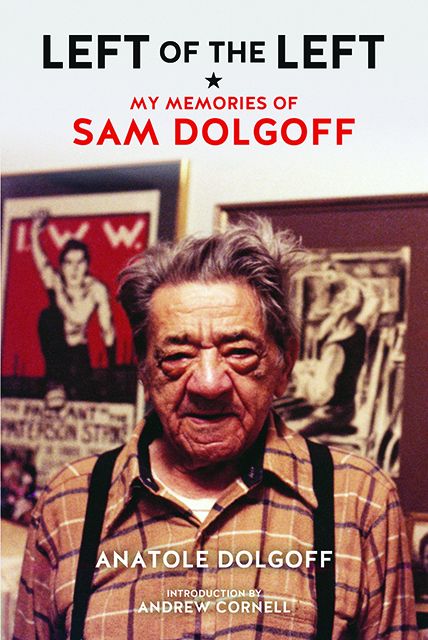
Full disclosure: it is because I researched and wrote on the Wobblies that I met Anatole Dolgoff. A few years after my Wobblies on the Waterfront, on Philadelphia’s interracial longhsore union, and an edited volume on Ben Fletcher, their “Black Wobbly” leader, I got an email from Anatole. He had known—as a young boy—Fletcher. Here was a man who could tell me stories about the most prominent African American in IWW history because his father and Fletcher were close friends. As a child, Anatole spent quality time with Fletcher and remembered him fondly and well. But let me also confess, and meaning no disrespect, that I had no idea that Anatole’s stories were this good or that he could write so damned well!
In addition to capturing the history but also—harder—the feel of many of the Wobblies and other anarchist/left individuals, organizations, and moments, this book is wonderful for those simply wanting to open a window into the past.
Take New York City, an incredible city that justifiably has received countless authors’ attentions. Dolgoff poignantly captures the feel of 20th century working class New York, a “lost New York.” Lower Manhattan, parts of Brooklyn, the occasional foray into the Bronx. New Yorkers and those who love New York will find much to love about this book as he walks “through lower Manhattan streets not to be gentrified for fifty years” along with the Puerto Rican, Italian, Jewish, and other residents.
Moreover, the language is, well, of a time and a place. Where else, these days, can one read words like “floor moppers” and “sonofabitch”?
As Dolgoff declared near his memoir’s start: “What I can do is tell stories: of my parents and their world, which spans seventy years of revolutionary activity…Hopefully it will add up to a history of sorts…Do not look for ‘objectivity.’ To hell with it. I have read many such ‘objective’ accounts of the anarchists and Wobblies, and few of them bear any resemblance to the flesh-and-blood human beings who broke bread with us or snored on our sagging couch. I’ve opted for the truth instead.”
Like so many others, Sam Dolgoff was the son of desperately poor Jewish immigrants from tsarist Russia. Like so many others, they ended up on Manhattan’s Lower East Side. As the oldest child, Sam went to work at the tender age of eight, delivering milk off a horse-drawn wagon before dawn. A few years later, his father apprenticed him to a house painter, a trade at which he worked for the next sixty years.
Dolgoff was working class through and through and proud of it, as were nearly all the Wobblies who toiled as Jack tars and timber beasts, gandy dancers and harvest stiffs. First drawn to the Socialist Party and the Young People’s Socialist League (YPSL), he abandoned their vision of evolutionary socialism and electoral compromises for the anarchists. A while later, he found his ideological home, the IWW, the great anarcho-syndicalist union founded in Chicago in 1905. Dolgoff believed that revolutionary industrial unionism was the only path to Socialism—at the point of production where workers, people, had real power. He committed himself for the next seventy years to that belief. Anti-capitalist and unrepentant, he never took a job that required him to fire or hire another fellow worker. Supporter of the underdog and the little guy. Hater of the 1% before such a phrase existed. Humanist. Wanting to build a society from within the ashes of the old. Willing to fight for it, strike for it, suffer for it, go hungry for it, help out someone who’s even hungrier.
To Dolgoff, capitalism, the State, and organized religion caused most of the world’s suffering which was why he became an anarchist. He hated hierarchy, oppression, and the institutions that both caused and perpetuated it so loved the Wobblies. He also loved to sing Wobbly tunes like “Halleliuah, I’m a bum,” “Solidarity Forever,” and countless other gems.
This historian of the IWW found it especially interesting that Dolgoff’s time in it began in the early-mid 1920s. That is, after its so-called hey-day, after the government had arrested and imprisoned most of its most important leaders and deported others, after many states had made belonging to the IWW illegal under unconstitutional “criminal syndicalist” laws, after many local and state police and vigilantes had further beaten and imprisoned Wobblies and shut down their halls, after the lynchings of Frank Little and Wesley Everest, after the Bisbee deportation and Everett massacre. And after the rise of the Soviet Union and Communist Party (CP) that did all in its power to undermine, co-opt, and destroy the IWW for presenting an alternative view of what socialism looked like.
We read about Wobblies in the interwar years, organizing the Unemployed Union in Chicago in the early days of the Great Depression. Anatole actually makes an argument that underneath, behind, to the side of many great Left actions, events, and organizations in the 1920s, 1930s, and 1940s were Wobblies. While perhaps overstating his case, undeniablely many unions, most obviously in the newly-founded CIO, and other progressive organizations were influenced by the IWW.
A great deal of this book is about anarchism, an ideology that attracted Dolgoff. Over time, he became a much-in-demand speaker, brilliant author, and even theoretician of anarchism.
Though only finishing eighth grade, Dolgoff evolved into a great intellectual, schooled by some of the greatest anarchists of the early 20th century. Familiar to precious few, the legendary Russian anarchist Gregorii Maximoff made Dolgoff into the man and reader he became. Anatole describes Maximoff this way: “a man who had faced down the power of Lenin; had come within hours of a ring squad; had conducted a successful hunger strike in the Cheka dungeons; had organized steel mills and peasant collectives; had served as an editor of important journals and, while in Berlin, helped found an international anarchist organization comprising—it may surprise you—several million people.” Maximoff and his fellow Russian anarchists who lived in permanent exile made Dolgoff read Bakunin and Kropotkin but also Marx and Lenin as well as Shakespeare and Twain. He read constantly—even after a full day of work and despite having a wife and two sons.
One of the pivotal times in Dolgoff’s life, as well as for others on the left was the Spanish Civil War. Recall Anatole’s middle name, Durruti. Predictably, Sam was not just a kindred spirit with the National Confederation of Labor (CNT), the anarchist union and spiritual sibling of the IWW. The CNT stronghold of Barcelona proved the high point, early in the Civil War, of the cause. Dolgoff was a leading supporter, propagandist, and fundraiser for the CNT and Spanish Republicans. For those interested in this tragedy and its long shadow, this book offers much.
Some chapters in the book, vignettes really, are amazing stories of people few ever knew about. Dolgoff knew I.N. Steinberg, the “Peoples Commissar of Justice in the Soviet government from December 1917 to March 1918 and a central figure in the drafting of the Soviet Constitution, [who] came to tell us of his private, face-to-face meeting with Lenin in that sparsely furnished Kremlin room where he [literally] forged the communist state. Steinberg had been there to protest the vicious crackdown of the Cheka on all dissent and suspected dissenters. Vanishing people, torture, murder—all without trial or even a hearing.” Steinberg was one of many anti-CP leftists who pepper this book.
Dolgoff never gave up on his beliefs nor stopped organizing. For instance, during the height of the Cold War, Dolgoff helped found the Libertarian League that proclaimed: “The ‘free’ world is not free; the ‘communist’ world is not communist. We reject both: one is becoming totalitarian; the other is already so.”
Anatole is not uncritical of his father, particularly his father’s drinking problems as well as poor treatment of his devoted, loving wife and life partner, or his falling out with his older son. Anatole also discusses, briefly, his own life and travails though he would be the first to admit that his life mostly has been a good one, greatly enriched by his father.
Anatole wrote this book, after retiring, because friends “urged me to put my ghosts and shadows down on paper. And so I have. I leave behind a record of my parents’ life and through them a history of sorts, the history of a culture, and of a chapter of American radicalism that few people know about. It is an incomplete and inadequate record no doubt.”
I cried at the beginning of this book and again at its end. Since its so wonderful, I will not reveal more details—no spoilers here—but suffice that the last few years of Dolgoff’s incredible life were as honest and compelling as his first eighty-five. Truly, there is no other way for me to end this essay than Sam Dolgoff, Presente!
_____________________________◊◊◊_____________________________
Verizon Strike Shows Effectiveness of Strike Tactic
By Peter Olney and Rand Wilson
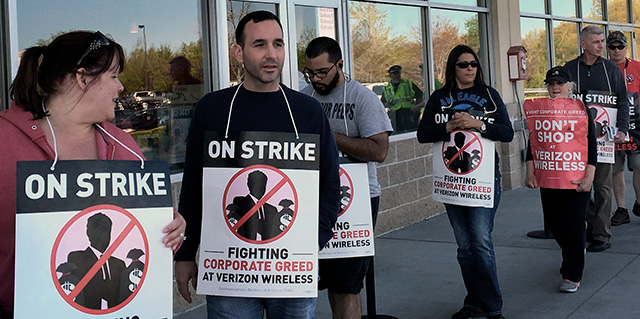
11 May 2016, Everett MA: Picketing the Verizon Wireless store. Photo: Rand Wilson
On April 13, 39,000 union members struck to defeat company proposals that would have wiped out their job protections, security, pension and health care. The two Verizon unions, the Communications Workers of America (CWA) and the International Brotherhood of Electrical Workers (IBEW) had been working under an expired contract since August of 2015.
The company, although incredibly profitable ($39 billion in profit over the last three years) wanted deep cutbacks and concessions such as:
• Higher employee costs for health care;
• Reduced retirement benefits;
• Outsourcing of 5,000 jobs;
• Right to force workers to travel out of state for work;
• Company unilateral scheduling power.
Verizon workers are some of the most militant workers in the United States. Negotiations for the last contract in 2011 resulted in a two-week strike. This strike lasted 49 days.
“This was our fifth strike at Verizon [and its predecessor telecom companies] in 30 years,” said Matt Lyons, a Splice Service Technician with 29 years of service who is Chief Steward at IBEW Local 2222. “We’ve won every single strike because of our numbers and experience: we know what we are doing.”
The strike was fueled by anger at the company demands and the arrogance of a CEO, Lowell McAdams, whose annual compensation is $18 million — 208 times that of an average Verizon line worker at $86,000.
Over those 30 years, the Verizon workforce has been greatly reduced due to new technology and outsourcing. However, in some ways the remaining workforce is stronger and now more essential than ever to the company.
“We actively disrupted business at Verizon Wireless stores up and down the East Coast and in California,” said Lyons. “It impacted the wireless side of their business which is their most profitable. I work in wire line special services with large corporate accounts. They were having a lot of trouble finding managers or scabs who could do my work.”
Union members have strong preservation of work language and make sure that managers don’t do bargaining unit work. “That left us in a strong position. They don’t really know how to do our jobs'” added Lyons.
Lyons and other Verizon strikers picketed aggressively at hotels and motels housing replacement workers. Some evicted the scabs after union pressure.
Lyons believes that getting Thomas Perez, the United States Secretary of Labor involved helped expedite a settlement (HERE and HERE). On May 24, Perez and the two unions announced that a tentative agreement (subject to ratification by the membership) had been reached.
The unions succeeded in beating back all but the increased cost sharing in health care. The tentative deal includes unionization for workers at several Verizon stores in Brooklyn, NY and one in Everett, Massachusetts. The company also agreed to hire 1,300 new call center workers.
Solid strikes like this one are still an effective strategy for defeating corporate greed if waged with total solidarity and strategic smarts.
“We achieved a crucial first contract at the Verizon Wireless stores,” said Lyons. “Now it’s up to us to leverage our strength in the landline side of the business and build on that victory to organize the rest of the stores. It won’t be easy but the wireless side of the business is where all the future growth will be.”
“We couldn’t have won without the strong support of the rest of the labor movement and the communities where we live and work,” concluded Lyons. “Solidarity has become our lifestyle. Hopefully it spreads.”
_____________________________◊◊◊_____________________________
This piece originally in Italian appeared in Lavoro e Societa’ a newsletter of the CGIL – Confederazione Generale Italiana dei Lavoratori