Once Again on the November Election and Beyond
By Glenn Perusek
From the point of view of the left in the rust belt—I am based in Cleveland—the November 2016 election is between two unacceptable candidates.
One is of the Washington establishment that has pretty systematically failed to understand the impact of its policies, such as NAFTA, on the rust belt cities like Lorain and Youngstown and Flint. She is the candidate of Wall Street and Silicon Valley.
But also, let us not forget, a candidate of reason and (a brand of) feminism.
Unfortunately, much of the progressive community (environmentalists; feminists; civil rights organizations) has taken an uncritical posture toward her. (This happens every four years with clock-like regularity).
Her opponent is an arrogant demagogue of the populist right, a man who plays to racist or at least xenophobic fears of his base (Mexicans are rapists and drug dealers; ban all Muslims), a candidate of unreason (“I’ll make up whatever facts I want”). A staunch advocate for the Second Amendment, sure, but the First Amendment? Not so much.(1) Peaceful succession from one regime to the next—a cornerstone of democratic society—is beyond him, as he indicated in the third debate. “I’ll keep you in suspense,” he said when asked about acceptance of the result.
Mr. Trump gets mileage with his base when he speaks of rigged elections in America, a breathtaking expression of how disaffected that base—a good twenty percent of the American population—is.
It also now appears that Trump is a boastful advocate and most likely a seasoned practitioner of sexual assault against women. Talk about setting a good example for the next generation.
Should Trump be elected, global capital will likely take flight to quality investments, crashing stock markets and throwing us into at least a momentary recession (this a prediction of international financial analysts and students of global risk, not me).(2)
How this man would handle the responsibility of the mantle of foreign policy leadership is beyond speculation (“we’ve got nukes, we should use them”).(3)
“It’s the economy, stupid”
True, Trump has been picking out tunes from Sanders’ economic populist songbook but he has been playing them in ugly, discordant keys. So, even here, where he often sounds good, his populist message is transposed into a selfish appeal to the worst elements of American society.
The vital issue for America—indeed, for the developed world—is the economic dislocation of working people caused by accelerated globalization and technological change.(4)
As a friend in Lorain, Ohio, a city hit hard by deindustrialization, said to me recently, “The Clintons have had their chance. Things didn’t get better around here in the 1990s. They got worse.” This is one of the reasons that Secretary Clinton is so unpopular with working class people.
But let’s be honest. Another part of why Secretary Clinton is unpopular with working- and middle-class men is that she’s a strong woman. This is worth considering carefully. She is a woman candidate—admittedly a Washington insider representing big capital—opposing an arrogant, sexist businessman who stokes racism.
Yes, Trump sounds an economic populist note. If Trump were a decent, reasonable economic populist; if Trump spoke in terms of uniting working class people instead of dividing them—if, if—well, then he wouldn’t be Trump. He would be Bernie Sanders. But Sanders is not on the ballot.
Taking a longer view
The economic problems that have brought us to this pass in 2016, with a good 40-50 percent of the electorate ready to throw over the mainstream of both major parties and back someone or something new—further left OR right—will only deepen in the coming decade. We will likely see more structural unemployment, more dislocation of workers.(5)
The hopelessness of the inner cities will therefore spread to working- and middle-class suburbs. Young people saddled with student loan debt will find it increasingly difficult to retire as decent-paying jobs for 20- and 30-somethings become ever rarer. Older workers will become discouraged in greater numbers, leading them out of the workforce.
All of the social problems attendant on large scale structural unemployment are likely to grow worse—demoralization; alcoholism; broken families; domestic violence, and so forth. I wish this were not the case and I look for countertrends but I’m afraid this is what is in store in the 2020s and 2030s.
It is not unreasonable to ask: Are we going to be running through a version of the interwar period of the twentieth century? The differences are clear—for instance, we have not been through anything as traumatic as the Great War (1914-1918). But economic dislocation characterizes both periods, as does the nativist response.
Elections don’t change the world, argue abstentionists. True, social movements and underlying economic metamorphoses are far more important in transforming fundamental economic, political or social conditions.
But elections do have an impact on the political mood of the country. A Trump victory would be a victory for the racists, the jingoists, the sexists, the “Second Amendment crowd.”
A Clinton victory should not be seen as an endorsement of Obama’s years in office which, let’s face it, have produced disappointingly precious little, legislatively. True, the Clinton center—including the middle-class feminists who are her strongest supporters—will tout this as the first election of a woman to the American presidency. True, that’s a milestone, just as Obama’s election was.
But from the point of view of the progressive left, there are stronger arguments for an anti-Trump vote than there are for a pro-Clinton one. Millions of voters will be turning out November 8 to vote against someone, not for someone at all. This should be a sobering wake-up call for the leadership of both parties. Instead, given their incapacity to plan much beyond the next legislative session, leading Democrats and Republicans will likely go back to the business of governing. They’ll be hiding their heads under the covers, hoping that’ll keep the scary ghosts from the heartland at bay.
But it won’t work. The ghosts, the potential for the return of a militant, class-based movement throughout America, have been stirred. The question for organizers on the left is: Will this opportunity be taken advantage of?
For the left to organize is a vital responsibility in the rust belt. The leadership of the Cuyahoga County Progressive Caucus—an organization that issued from a strong pro-Sanders grassroots campaign in Northern Ohio—argues that wherever they were able to put organizers into communities, they delivered votes for Sen. Sanders against Sec. Clinton. These were the same communities where candidate Trump ran so strongly on the Republican side.
In other words, working class people seek answers. Economic populism can be argued from the left and people can be won to a coherent progressive or social-democratic outlook.
But those same communities are breeding grounds for economic populism wedded to hate.
Vote for Stein?
The left abstentionist conclusion for November 8 is a protest vote for Jill Stein, the Green Party candidate. If this were connected with a sober effort to build a party-like organization of the left, it would make good sense. But I’m afraid the Green Party, at least in Ohio, has been studied in its unwillingness (incapacity?) to build solid grassroots organization. Greens should be part of the wider process of reassembling a social democratic left in America. But organizational chops matter. And one vital element of organizational capacity is the recognition that no matter how disaffected American workers are with the Washington establishment, they still are far from ready to break with the two-party system. The progressive left needs to be working in the arena of Democratic Party elections precisely because that is where its potential mass base is today. We need to create a pole of attraction around progressive political principles, in both electoral and issue-oriented campaigns.
Voting and organizing
I’m advocating a critical vote for Clinton (essentially a vote against Trump’s racism and sexism). But this vote must be connected with efforts, however tentative and preliminary, at forming a steady, solid, grassroots organization of progressives that will do far more than attempt to elect progressive candidates to office. We need an organization that mobilizes people of conscience for issue-oriented battles, from the “Fight for Fifteen” to the fight for clean energy, to the fight against violence in the black community. We need an organization that links these struggles together, that builds alliances, and that advances a worldview—a broadly social-democratic worldview—that makes sense of these disparate phenomena.
Young people in particular are calling for a kind of systematic political education that the left has not seriously offered in more than a generation.
Reasonable progressives disagree on what to do on election day. That’s fine, as long as we have a civil discussion of the issues, something that candidate Trump has proven most uninterested in.
The questions facing working people in the United States are not going to be answered on election day. The answers to the fundamental questions are to be found in the self-organization of working people and people of conscience.
That’s why the most important thing is what the left does after election day.
_____________________________◊◊◊_____________________________
Footnotes:
1) Adam Liptak, “Donald Trump could threaten U.S. rule of law, scholars say,” New York Times, June 3, 2016, (acc. Oct. 21, 2016).
2) Economist Intelligence Unit, “Global risk: Donald Trump wins the US presidential election,” October 19, 2016, (acc. October 21, 2016). The fact that the well-respected EIU puts a Trump presidency up there with a prolonged Chinese recession and the break-up of the European Union as threats to the global economy should give anyone with any concern about economic activity—and the lives of ordinary people who always suffer most in recessions—pause. Furthermore, “electing Trump could also start a trade war, hurt trade with Mexico and be a godsend to terrorist recruiters in the Middle East,” wrote Daniel Lippman, “The Economist rates Trump presidency among its top 10 global risks,” Politico, March 16, 2016, (acc. Oct. 21, 2016).
3) Matthew Belvedere, “Trump asks why US can’t use nukes: MSNBC,” CNBC, August 3, 2016, (acc. Oct. 21, 2016).
4) “It’s the economy, stupid,” was the stay-on-message mantra of James Carville, strategist for the presidential campaign of Bill Clinton in 1992.
5) For a more detailed treatment of the problem of technologically-based structural unemployment, see Glenn Perusek, “Cleveland: City of Tomorrow?” Belt Magazine, March 2015, (acc. Oct. 21, 2016).
Movimento 5 Stelle – The Rubber Hits the Road!
By Nicola Benvenuti
A wave of anti-establishment protest has swept the western democracies. These political protest movements have taken both a left and right wing form, shaking up the old traditional parliamentary party systems in many countries and rocking the two party system in the United States. In Italy, Movimento 5 Stelle or the 5 Star Movement, created by comedian Beppe Grilllo is the manifestation of the discontent with the traditional parties. But can such movements govern once they take power? What is their long term future? Nicola Benvenuti writes from Italy on M5S.
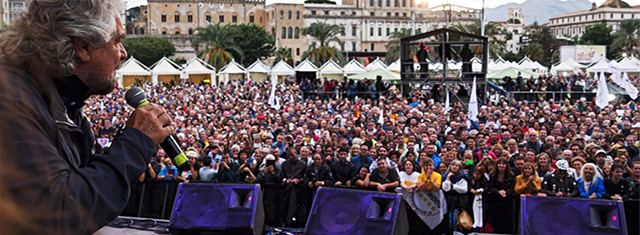
Beppe Grillo addresses a crowd. Photo: The Moveimento 5 Stelle Facebook page
The Five Star Movement (Movimento 5 Stelle or M5S) which celebrated its 7th birthday on October 4, is one of the most important developments in the chaotic Italian political landscape. It is a political formation that in a few years has matched in electoral strength the leading Italian party, the Democratic Party (Partito Democratico PD), and succeded in burying the bipolar scheme (Center Right Popolo della Liberta” of Berlusconi and Center left Partitio Democratico of Walter Veltroni) that dominated Italian politics in the 1990’s. M5S was founded by comedian Beppe Grillo, the owner of the brand and of the Beppe Grillo blog, which functions as the true voice of the movement. He is known for the biting satire of his one-man show against the Italian economic and political elite. His co-founder is Gianroberto Casaleggio, owner of a digital strategies consulting company (a mix that some say could hide a conflict of interest) and “guru” of the web. Casaleggio designed the M5S as an example of collective intelligence or crowd politics.
M5S was created with a “flat” structure”, devoid of hierarchies (each person is seen as an equal), in which Casaleggio and especially Beppe Grillo play the role of “noble leaders”, guarantors of the principles and the spirit of the movement, but not directly involved in politics.
In fact, in addition to challenging Italian and European politics, the M5S has targeted an Italian democracy based on parties which are considered an expression of the establishment and the bearers of bureaucracy and corruption, whereas M5S is counter-posed as democracy of the network based on egalitarianism and direct democracy.
The various analytical threads that underpin the culture of M5S, hold the negative view that “interprets politics and society as a tangle of special interests unmentionable and largely illegal, fueling the idea of a country prey to Mafia malignancies and endemic corruption ” (Michele Serra, staff writer of the newspaper “La Repubblica”), a vision that functions to hold together often conflicting aspirations, objectives and general values.
This approach is rooted in the economic and moral decline of Italy with a resulting crisis of political parties and national politics because of the growing role of supranational bodies and the blackmailing power of multinational organizations. Additionally, the weakness of European Union policy and its inability to revive development and take on complex issues like immigration, unemployment, the crisis of the countries of the southern Mediterranean, etc. This situation has stalled the Italian left which is on the defensive on the concept of Europe. The Berlusconi right also appears divided and disjointed in the absence of the “old leader”. This has solidified the crisis of old models of government and favors non-traditional political formations. Among these the Northern League (“Lega Nord”) of Salvini follows the French LePen model without much success, while at the moment M5S has experienced large growth rates.
M5S’s uncompromising criticism of the distortions of Italian politics and its support for the most irrational impulses of the right and left, has worked very well to forge consensus. In the latest municipal elections M5S won the mayoralty of major cities such as Turin and Rome thanks to a runoff ballot between PD and M5S, the two biggest vote getters. Thus the left and much of the right voted together in the runoff against the incumbent administration of the PD.
But now, everyone is waiting for the proof in the pudding for M5S as a governing party. In particular, can M5S accomplish the restoration of Rome, the city where the center-right administration of Alemanno (Here and Here) has fostered crime and malfeasance in the process polluting all the parties.
In fact, although the M5S had a considerable presence in the national parliament, and here and there the mayoralty of medium-sized cities, the movement’s growth has not been accompanied by the construction of a reliable and knowledgeable management team. The organizational structure is dominated by informal “meetups” and decisions made by the network, all on the electronic platform of Casaleggio Associates which Casaleggio manages with proprietary logic (starting with data on subscribers). This process has clearly not favored an effective selection of executives, while the in-determined politics, contrary to traditional political divisions and fueled by anti-political attitudes has hindered the growth of skills and expertise. No wonder then that the concrete policy of some mayors, although positive and effective, is often up against the intransigence of 5 Stars and Bepe Grillo.
Pizzarotti, the Mayor of Parma, recently collided with Grillo and was suspended by the M5S. The reasons are perhaps attributable to local choices, eg. Pizzarotti having supported the construction of an incinerator (which was strongly opposed by M5S) but the excuse was that the Mayor had not been transparent about an investigation of his appointments to the Royal Theater, an investigation that resulted in his acquittal.
Further nobody understands under what regulations someone can be suspended since the movement does not have the structure of a hated party. Nor does it have a structure for establishing legitimate internal decision paths and there are no strict limits, and no penalties, for violators. The suspension could be sanctioned by a vote of members in the network, but since Casaleggio Associates holds absolute control of the software and platform management, nobody knows what the actual results were, and how many participated. On October 4, Mayor Pizzarotti announced that he was abandoning the movement, accusing his former colleagues of unpreparedness, superficiality and even cowardice.
But the most explosive situation has been in Rome, where the M5S Mayor elect, Virginia Raggi, has not been able to form a government while city debt is exploding. The city M5S directorate (this is a national directorate delegated by M5S to help Major Raggi) composed of parliamentarians Di Maio, Di Battista, Fico, and Ruocco selected by Grillo at the end of 2014 (and confirmed by a network vote with the usual obscure procedures) was divided on everything, but without any “transparency” (another watchword of M5S) in their political motives. Citing incompatibility with the closest people to the Mayor, the most reliable and expert personalities designated by Raggi and even top City administrators, resigned. Raggi has been unable to hold together the different components of her majority, and has insisted on defending questionable collaborators, such as the deputy Paola Muraro (hit by an investigation for complicity with the speculators who made money on waste/recycling policy). Further she has been incapable of meeting the essential financial deadlines of the municipality (for which the Treasurer, Stefano Fermante resigned).
Everything is managed in complete opacity and a lack of loyalty and respect for voters. The only postive position taken, one useful in calming the movement, was the refusal to support the candidacy of Rome for the 2020 Olympics, fearing the corruption that would arise in promoting such a spectacle. The fractures and mutual misteps were such that the movement has distanced itself from Mayor Raggi. The role of the M5S directorate has been greatly reduced, and at the recent meeting of Palermo M5S (October 2), Grillo said he was “head” of the whole movement.
It is too early to determine whether this is the beginning of the decline of this political formation that has always claimed not to want to have anything to do with any other party or political group. From what we have seen it seems clear that the M5S is not the solution. However all the concerns about the influence that M5S could still have remain (October polls on the electoral strength of the Italian political protagonists show an unchanged success for the M5S). While the Renzi PD fails to consolidate a government, too many parties, right and left, look at the deteriorating political and economic situation as an opportunity for their own political relaunch from the crisis of the PD. And so the referendum on the constitutional reform of 4th December proposed by Renzi will play a decisive role in the Italian politics.
The Secret Struggle Against Apartheid
By Peter Cole
First published in Jacobin, September 29, 2016
In the 1960s, a group of leftists risked everything to revive the anti-apartheid movement in South Africa.
The struggle against apartheid in South Africa was perhaps the greatest transnational social movement of the post-World War II era. Figures like Nelson Mandela are rightly associated with this history, but the Left is less often remembered.

1970: Tom Bell, taken by his brother Ron, while they were in Cape Town, SA during their mission.
The book and forthcoming documentary London Recruits offers a corrective to this. Both serve as a reminder of the tremendous importance of leftists in the global struggle against apartheid. People like Tom Bell and his South African “trainer” Ronnie Kasrils, who organized the London Recruits, a group of international activists who embraced a working-class radicalism that was internationalist, cosmopolitan, anti-imperialist, and anti-capitalist — and most important, steadfastly opposed to legalized racial oppression in South Africa.
This aspect of the struggle remains largely unknown, in no small part because the missions were secret and many of the participants did not know each other’s identities until decades later. However, these men and women, nearly all of whom were leftists, helped keep the fight to overthrow apartheid going during a “quiet decade” in which ferocious repression temporarily had shut down domestic opposition.
The Mission
Though supportive of the Soviet Union and its allies, Bell belonged to a new generation of Communists emerging in the 1960s, both in the West and inside the Communist bloc, who rejected Stalinism. Bell and others like him in the British Young Communist League (YCL) wanted to combine Marxism with the vibrant pro-peace, anti-imperialist ideals of the youth generation rising in the 1960s across the planet.
Enter the handler. Ronnie Kasrils’s half-century of activism on behalf of racial equality and socialism is well known in his native South Africa, if far less so outside of it. Born to Jewish parents, Kasrils became radicalized in 1960 by the Sharpeville Massacre, in which at least sixty-nine unarmed black people were gunned down (mostly in the back) by the South African police. Their crime? Peacefully protesting the hated “pass laws,” one of apartheid’s primary enforcement tools.
After the massacre, Kasrils joined the South African Communist Party and helped found Umkhonto we Sizwe (Spear of the Nation, or MK), the underground, armed wing of the African National Congress (ANC) headed up by Nelson Mandela. Kasrils participated in MK’s first actions in 1961 and helped lead its efforts in Natal province.
Already banned from all political activity and witnessing the massive repression carried out against all anti-apartheid activists and organizations, the ANC itself went into exile under the leadership of Oliver Tambo, who along with Mandela and some other black activists, had reinvigorated the ANC in the late 1940s and 1950s. Tambo dispatched Kasrils to expand operations from London.
As Kasrils told me, despite being ten thousand kilometers from South Africa, London was “so dynamically connected with Johannesburg and South Africa” that it seemed much “closer” than ANC offices in Dar es Salaam, Tanzania and Lusaka, Zambia. London became “home” to South African exiles (black, Indian, and white), was the headquarters of British finance and mining corporations that invested in South Africa, and served as South Africa’s major transportation link to the world, via ship and plane.
To raise global awareness about the horrors of apartheid and increase pressure on the white minority regime, in the late 1960s Kasrils recruited and trained English and other young white radicals (from Europe and four, including Danny Schechter, from the United States). Usually in teams of two, they flew to South Africa, pretended to be tourists sympathetic to apartheid, and undertook missions to remind black South Africans that despite their suffering and the nearly complete destruction of opposition inside South Africa, they did not stand alone. The missions included everything from bold public actions proclaiming support for the ANC to transporting weapons for freedom fighters to helping those fighters sneak into the country.
The London Recruits’ mission was not insignificant. Kasrils provides the context inside South Africa: “Post [19]63–64 or so, the Rivonia Trial [that condemned Mandela and seven other activists to life in prison], the arrest of leaders (Mandela and company), the roundup of thousands, people in the prisons and in exile, the underground apparatus in the country absolutely smashed.” The ferocity of the repression resulted in what historians now refer to as the “quiet decade,” when many thought all opposition had been smashed.
This was a period when the movement regrouped; those not killed, imprisoned, or banned went underground, while others like Tambo into exile. As Kasrils recalled, “we needed to get a message across to our people that the ANC, the liberation movement, was alive, that people should not give up hope.” Leftist foreigners could help deliver that message.
Where did Kasrils find young white radicals like Bell? Some were trade unionists, others students at the London School of Economics, but most came from the Young Communist League. When Kasrils arrived in London in 1965, he reached out to the British Communist Party. They, in turn, introduced Kasrils to the YCL leadership, who identified recruits including Tom’s older brother, Ron.
Communists were familiar with “clandestine activities” and already internationalists. They were prepared for the kind of activism Kasrils believed was needed in the regroupment period.
Like Tom, Ron Bell was introduced to left politics by their Communist parents. In 1970, Ron asked his younger brother to pair up on a mission into the belly of the apartheid beast. Before going to South Africa, though, Tom had already participated in antiracist politics.
In the 1960s, like today, some white people hated the growing diversity of England — specifically black people from Britain’s former colonies in the Caribbean. Tory MP Enoch Powell delivered a notorious diatribe in 1968, now known as the “Rivers of Blood” speech. Powell lambasted England’s immigrant black people, fearing they would take over the country.
Only eighteen, Bell took to a soapbox at his local shopping center in southeast London to attack Powell’s racism. He believed that hatred between racial groups meant that those groups could never unite to fight for socialism, Bell’s ultimate goal.
Still in his teens, as an activist in the YCL, Bell traveled to Communist countries including Bulgaria, the Soviet Union, even North Korea. Once recruited by Kasrils, he needed a new passport because apartheid South Africa would never knowingly allow him into their country with such an array of stamps.
Tom remembers his first meetings with Kasrils, who possessed great charisma and that particular South African accent of English. Using his own MK training and experience in constructing, planting, and detonating explosives as well as carrying out propaganda incidents, Kasrils taught the Bell brothers how to build a bomb in a five-gallon bucket, designed not to injure anyone but to spread ANC leaflets in public places in South Africa, as well as how to rig a cassette player to spread messages via loudspeaker.
Their mission was extremely dangerous. Kasrils reminded the brothers, “If you’re caught, you’re on your own and it won’t be good.” (Indeed, though the Bell brothers’ mission went without a hitch, in 1972 several recruits were captured and suffered in a South African prison for much of the decade.)
In 1970, the two flew to Cape Town by way of Johannesburg. They spent a week establishing their credentials as tourists while getting the lay of the land and acquiring some equipment to supplement what they had smuggled into the country. They identified locations to stage their actions: a railway station and busy plaza, places where thousands of black people passed by in their daily routines.
Even during their short stay, the brothers witnessed the “madness” that was apartheid. They could not visit a “township,” where blacks and other nonwhites were forced to live, but they saw one. “Even at a distance one could sense the squalor, and the anger that accompanied it, rising from it like a fetid mist.”
Though its primary victims were those whom the apartheid regime called “non-Europeans,” the Bells also saw how apartheid hurt white people. While on a local bus, a white person suffered a heart attack, but the driver refused to deposit him at the closest hospital, reserved for blacks only.
Despite a major police presence, common during apartheid in order to survey black people’s movements, the Bells surreptitiously positioned their buckets and cassette players linked to loudspeakers. Then, during an afternoon rush hour, they detonated the bombs and enabled the audio devices, launching thousands of leaflets with anti-apartheid messages that quickly were collected by passers-by while listening to pre-recorded speeches of solidarity with the liberation struggle. Tom recently recalled to me seeing traffic getting snarled, while police sirens blared and people picked up the ANC materials, “I don’t think I’ve ever felt such euphoria.”
Before leaving the country, they learned that their comrades, other teams of London Recruits — who they knew existed but knew neither their identities nor plans — had launched similar actions in Durban, Johannesburg, and elsewhere.
The Bell brothers returned to London where they continued their work in the British anti-apartheid movement. Peter Hain, a South African exile, became the public face of the movement, leading a successful effort to get the South African cricket and rugby teams banned from Britain. Kasrils and others in the ANC operated more clandestinely, as one of the major nerve centers for global organizing against apartheid that grew in the 1970s and exploded in the 1980s, with multiracial democracy finally emerging in 1994.
The Goal
The anti-apartheid movement might be the most impressive global social movement in the post-WWII world. In recent years, historians and other scholars finally are devoting attention to this inspirational and transnational history. Among historians outside of South Africa, much more work has been done on religious groups, Pan-Africanist black people in the United States and elsewhere, students, and (to a lesser and insufficient extent) unions.
But the Left must be acknowledged in its own right for its crucial role in the resistance. It was no coincidence that Kasrils found Tom and Ron Bell ready, willing, and able to risk their very lives to fight apartheid. For people like the Bell brothers, Kasrils, and most in the liberation struggle, overthrowing apartheid was only the first phase of the revolution. The second would be the fight for socialism.
The socialist orientation of the movement dates back to its inception, nowhere more clearly than the 1955 Freedom Charter. The charter insisted not only on democracy and equal rights for all, but that “The People Shall Share in the Country’s Wealth!” which included “The mineral wealth beneath the soil, the Banks and monopoly industry shall be transferred to the ownership of the people as a whole.” And, “The Land Shall Be Shared Among Those Who Work It!” meaning “All shall have the right to occupy land wherever they choose.”
In anti-racist struggles around the world, the Left has played a vital part, from the American civil rights movement — historian William P. Jones highlights that the March on Washington for Jobs and Freedom in 1963 was “organized by a coalition of trade unionists, civil rights activists, and feminists, most of them African American and nearly all of them socialists” — to the anti-apartheid movement inside South Africa and beyond, which was led and populated by leftists including members of the Communist Party. (This explains why Ronald Reagan and Margaret Thatcher called Mandela a “communist” and opted to back the apartheid regime).
The London Recruits also were committed to this goal. The filmmakers at Barefoot Rascals, a Welsh company, are currently at work on a documentary on the subject, having interviewed most of the surviving London Recruits and undertaken several trips to South Africa to interview activists and witnesses to the recruits’ efforts. Their story deserves a wide audience.
Migrant Labor-4: What It Feels Like In El Norte
By John Shannon
In writing about migrants coming into Europe, the British critic John Berger once wrote (in The Seventh Man): “To see the experience of another, one must do more than dismantle and reassemble the world with him at its center. One must interrogate his situation to learn about that part of his experience which derives from the historical moment. What is being done to him, even with his own complicity, under the cover of normalcy?”
I try hard, but you know this is only conjecture, only an attempt at empathy.

You are Juan now. The terrible anxiety of the border crossing is behind you. Still there is plenty of anxiety to come. You rented a short-time call card from your coyote and made that one-minute call home to tell them to pay his henchman. You’ve made it to L.A. finally and by great good fortune you’ve found a hidey-hole. The famous Home Depot is almost an hour walk away, but you have your own small place now to be who you are. Seventy-five dollars a week in a garage partitioned into six spaces.
A closed area, a bed, a dangling string to hang shirts, two crates to store belongings—all these acquire a new meaning up here. Almost luxury. Mostly a refuge and safety from eyes, judging, disapproving, perhaps threatening eyes. Eyes of thousands of people you’ve never met, walking past you, on buses, driving in cars, always in a hurry. You have a place to retreat now and when you bend a partition closed and hook it shut like a door, you feel at least temporarily safe. There’s no foreign language to worry about. No angry shouts. No migra agents. Just lie back and think of your wife and children.
Nearby in the garage is an industrial washbasin you share and an open toilet that swirls away your shit all by itself. You also share two electric cooking rings on a small table. An old sheet of iron makes a comal to heat tortillas on the rings, and frijoles can be heated in the tin they come in. There is a tiny Mexican mini-market nearby where the Koreans speak bad Spanish and sell familiar food.
Your garage mates change often. Some speak the strange Spanish of Guatemala or an Indio language that is just noises to you. Still, most of you squat together by the cooking table in the evening and share experiences, share stories of your families, funny tales from home. You begin to collect useful items you see discarded in alleys or gutters, clothes hangers, felt for hot-pads, a bit of rope, anything really. You never know.
You also learn to beware. The city is not like your village. The village is based on always seeing people again. You learn the city is based on NEVER seeing people again. People try to trick you. One man, he seemed to speak like a campesino, sold you the address of a tile factory that needs regular workers, for twenty dollars. When you get to the address, helped by a kindly moreno bus driver who spoke halting Spanish, it’s only a tienda in a shopping area that sells women’s absurdly high-heel shoes.
As long as you’re “downtown,” you calm down and decide to look around, feeling a bit like a frantic chicken trapped inside a house. Your exploration is mostly looking into this new world through glass—fancy dresses, a barber shop, donuts, a whole tienda selling little glass animals and ceramic people – ¡Dios mio! – and at the corner, a small supermercado. Still, this place looks so big and impersonal you feel unthreatened going inside. The amount of things even in this small market is staggering, more than all the things on all the shelves in your village. People walk along the aisles with carts taking things with no expression at all, as if they’re stealing and trying not to be noticed.
Soon you realize people are paying for their collections at the cash register without saying a word. It’s so easy! You want to go crazy buying things, but it will take $1.75 on the bus to get near enough to walk home. You have two $20 bills to use. You have to consider the packages mostly by the pictures on them. You do know the word “chicken” and wonder how on earth they got a whole pollo into a small can beside the tuna cans. You put it in your cart just to find out. Beans in a bag. Red spaghetti with meat – the picture looks great. A plastic bag of large funny looking white tortillas. In a crate against the wall you find ordinary mangos and grab three.
You watch others paying and see how easy it is. You’re confident now. You make sure to watch the numbers increase on the cash register as the woman waves your packages over a magic window and you make sure to offer more dollars than that number.
The woman smiles and says “¿Quere usted comprar una bolsa?” “Do you buy a bag?” in very bad Spanish. “Yes, doña.” You nod and she puts all your purchases in a paper bag that will be handy to keep. There’s a clatter and she points to coins that have rolled into a kind of metal pig-ear.
There is so much to learn. You imitate gestures. You start memorizing the syllables of English words. You begin translating the signs you see, word by word. One strange thing you notice is that everything here is dead straight, or utterly smooth, or perfectly round. This world does not tolerate irregularity. Some of what you see shocks you, some impresses you.
One workday you lay rocks into a wall with cement, the next you paint a house or scrape a wood floor. Some days you are unfamiliar with the tools you are expected to know. A tile-cutter, a skill saw, or how to change the bit in a power-drill. Every day at the mosca (labor market), you are the subject of three calculations: a contractor’s, yours, and one neither of you knows about, how much capitalism needs its “labor reserve” today or this month or this year.
The men who hire you, or sometimes work with you, are mostly guëros – literally it means blondes, but to you it’s whites. (Clint Eastwood in “The Good, The Bad, and the Ugly” was as dark-haired as you can get but was called Blondie.) Most seem to resent you for some reason. You feel like you‘ve been kidnapped by the coyotes and dropped off in a hostile world. You are in an animal pen with hatred on all sides and no exit.
One day on the bus you hear, in very good Spanish: “Todos ellos llevan cuchillos. Ninguna mujer está a salvo.” (They all carry knives. No woman is safe.) You also find that the English words you learn change meaning without warning. You say “girl” very carefully, and they think you want a prostitute.
The jornalero pay from Home Depot keeps you going but it’s not enough to send much home. You need a real job and it’s time to make the jump to East L.A. and the factories, if only you can find a friend to help you.
Migrant Labor-3: The Situation of Labor in L.A.
By John Shannon
By the late 1950s, with something of a post-war truce between capital and labor, L.A.’s auto plants (GM, Ford, Chrysler, Nash, Studebaker, Kaiser) were second only to the Detroit area in car production. We had large branches of all the major tire companies, the major steel companies, aluminum, shipbuilding and ship repair, and of course most of aerospace. These had almost all been unionized in resolute CIO drives in the late 1930s and 1940s, the old CIO headquarters is still there at 5833 S. Avalon. Look for a three-story brick warehouse with a tower on the roof.
It was the last time the 1% were smart enough or pressured enough by their smarter members to realize that the labor truce benefited everybody (except the Communists of course, who were driven out of the CIO unions they helped build—thanks to the cold war and “liberal” organizations like the Americans for Democratic Action, ADA (Here and Here).
The GI Bill educated a generation, and good union wages meant American workers could afford homes and decent lives–like my own ex-GI working class dad. And the economy expanded regularly with only the usual short recessions, 1953 for ten months, 1958 for eight months, etc. (This is capitalism, after all.)
The Second Great Black Migration (Here and Here), from 1941 to the 1960s, attracted hundreds of thousands of southern African-Americans to south L.A. for good industrial jobs, and the CIO unions–influenced by the Communists and other radicals who had built them–in general welcomed blacks in.
But the oligarchs, let’s use that wonderful Russian term, like the Kochs and their 1% ilk wanted something else. (Their dad Fred C. Koch was a co-founder of the John Birch Society (Here and Here). These rich people play a very long game, involving foundations and PACs, secret financing and invite-only forums of CEOs, Supreme Court Justices and Republican senators and governors. They’ve been organizing hard since at least the Goldwater era to undo the New Deal and gerrymander Congress.
First, many L.A. factories were moved to the non-union South and then overseas. Not really a conspiracy. Just a way to increase profits, break unions and boost stock prices, and, oh yeah, boost executive compensation obscenely.
By the late 1970s, virtually every car plant, steel company, tire company and much of aerospace in L.A. was gone, with only a few holdouts. A persistent union struggle at Bethlehem Steel–Lady Beth–in Vernon helped keep the furnaces going until 1982. And GM-Van Nuys held out until 1992, making only Camaros there, and then they ran to Canada. (Remember the TV ad for the Camaro–after 1992: “What you’d expect from the country that invented rock n’ roll.” When did Canada invent rock n’ roll?)
Into the 1970s, L.A. also had strong building-trades unions, with their own training programs. L.A. carpenters were proud they could frame a house three times faster than anywhere else. Most of the huge housing tracts built in the post-war boom were union made. If a contractor tried to bring in non-union labor for anything, the workers would down hammers.
Then in the late 1960s along came the Associated Builders and Contractors, well known and hated in the building trades even today as ABC. This front group never enrolled more than 1% of the actual licensed contractors anywhere, but they had vast finances from the anti-union movement and its strategists, yes, including the Koch brothers and their sub-rosa ALEC right-wing task force.
The official ABC philosophy was, and is, to promote a “merit shop.” You can guess: just another euphemism for non-union shop with no security or seniority rights. By 2011, construction in L.A.–once almost entirely building-trades unions–was down to 14% unionized, and much of what remained was only because government contracts often require unions. The ABC also founded their own “Decker College” to replace union schools and apprenticeships. But Decker was such a for-profit sucker racket that the FBI shut it down in 2004.
Even with building-trades unions crushed and the big unionized factories gone, there are still thousands of small factories, warehouses and assembly shops in eastern LA County. When I worked in a mid-size factory in the 1970s the older union people called these smaller non-unionized factories “bucket shops.” According to Wikipedia the terms origin is: “from England in the 1820s. During the 1820s, street urchins drained beer kegs which were discarded from public houses. The street urchins would take the dregs to an abandoned shop and drink them. This practice became known as bucketing, and the location at which they drained the kegs became known as a bucket shop. The idea was transferred to illegal brokers because they too sought to profit from sources too small or too unreliable for legitimate brokers to handle.[9] The term bucket shop came to apply to low-class pseudo stock brokerages that did not execute trades (fraud)
Until the explosive growth of Chinese capitalism in the 1980s and the export of millions of US jobs, the two largest light industrial areas on the planet were eastern L.A. County, and mid Orange County (the Costa Mesa-Santa Ana-Irvine-Newport complex) where I once worked in a unionized (United Rubber Workers) factory called Voit that made high-quality basketballs and footballs. It was bought up by AMF, eventually moved to Mexico and China, and the balls became trash. The top Voit lines had once been used by the pros, but no more.
Los Angeles County, if it were a nation, would be the 20th largest economy in the world. There are still plenty of low-skilled workers, mostly Latino now, but most of the bigger unions are gone.
Latinos staff 100% of the farming labor in L.A. (there’s still quite a bit in outlying areas), 100% of the cement finishing, 90% of shuttle truck driving from the port and most of the janitors, food-service workers, and garbage-truck workers, and roughly the same for many other small industries like electronics assembly.
Some years ago, an acquaintance of mine, an experienced union and political organizer, worked with a group of community organizers, immigrant rights advocates and university people on a plan called LA MAP (Los Angeles Manufacturing Action Project). They worked out a detailed and realistic organizing plan that might have worked. The unions would all co-operate on community-based “drives” down the Alameda corridor—the heart of Latino working class southeast L.A. County–using every union and church and community organizer they could recruit.
Those who signed on would be funneled into the appropriate unions. Others would help in their own way. Mexicanos are not shy about unions. Mexico has plenty of militant ones. And the Justice for Janitors movement has worked wonders, as has UNITE-HERE for sewing and hotel workers—even though many of them bravely had to take part without a green card.
Okay, LA MAP might not have worked out–who knows? It got lukewarm union support, mostly from the Teamsters, which was later withdrawn. For most of the aging second-tier leadership of the bigger unions, it just wasn’t what they knew. They knew big single-shop organizing like the 1930s. Hot-target organizing, but not community organizing or anything else innovative. Pity.
This is the situation migrants step into in L.A., looking for work.
Next week Migrant Labor-4 of 4
Migrant Labor-2: Crossing the Border
By John Shannon

29 November 2007 Tijuana-San Diego US-Mexican border. The crosses represent the deaths of failed crossing attempts. Photo: Tomascastelazo
Of course it’s pretentious of privileged gringo me to try to walk a kilometer (or several hundred kilometers) in the worn shoes of a Mexican migrant laborer, but I had a little help on this. Let me rush through the obvious things.
His name is Juan and he has a wife and four children and there is no more work in the pueblito of 800 where he grew up. He used to work hard tending the elote (corn) fields, land that his father had to sell to CFoods after the flood of cheap U.S. (subsidized) corn from NAFTA.
The short-hoe work on vegetables earned him barely enough for rice and beans for his family. Then CFoods switched to growing only strawberries to bring in more money in North America and they only needed half of the workers. So Juan knew he had to go north just as many of his relatives had. He said good-bye to everybody he’d ever known. You know all this sad general stuff, don’t you?
Here are the things you don’t know, the advice that Juan had to learn over the years and from other experienced border-crossers.
First, never hire a coyote (border-crossing guide) near the border. They wait like proxenetas (pimps) at the bus station, and at the border walls and rivers. They can see who you are and they can take your money and kill you, or rape you, or hold you for ransom.
And never ever carry a package for a coyote. You can guess what’s in it and you could spend the rest of your life in an American prison. He won’t. If you even whisper his name, you and your family might soon be dead.
If possible, hire an amateur coyote near your home (experienced border-crossers are everywhere in Mexico.) In any case, make sure your family knows his name and where his family lives. Only wire the money or have your family hand it over when you telephone them to say you are safe in El Norte. Go with a small group so you can help one-another.
The going rate today is about $2,000 to cross from Mexico and get to a “safe-house” in Phoenix, a bit more to L.A. The migra has surprise checks many kilometers from the border, but a good coyote knows how to bypass them or knows when they are closed.
If the Mexican police catch you before the border (this is for Central Americans mostly), the going bribe is 1,000 pesos. Any less is insulting.
Practice a few English phrases over and over like “Get real, man, I’m from L.A.” so you sound like an annoyed norteño. Be confident, even cocky. It might work in a quick road check by a lazy migra.
Know a likely L.A. address to offer (try one in Hawthorne or East L.A.) Migras will pretend they don’t speak Spanish, but they do so be careful what you say.
Swimming a border river is not a good idea but if you must, pay the $5 for an inner tube. Too many border crossers have drowned. Don’t worry, somebody will be waiting there to sell it to you.
If you have to cross a desert in El Norte, and you probably will, fill a small backpack with two gallons of water, warm clothes and some food to eat on the run plus some painkillers. Wear dark clothes and two pairs of strong pants, for warmth at night and against cactus spines. Bring a U.S. baseball cap against the sun, preferably L.A. Dodgers.
If you go with a group, try to stay with them or retrace your steps to where you had to split up. Those who are alone and lost in the desert are the ones who die.
Also bring several packs of cheap cigarettes. If you need to sleep at night in the desert, you can crush the cigarettes and spread the tobacco around yourself to keep away rattlesnakes. It’s best to sleep in the day, but you must find shade, a tree or canyon or even a sheet of cardboard.
Hide some American bills, ones and fives, in your underpants. Put your name and home village in your underpants, too. If you die (God forbid), you can have a Christian burial at home. (300-500 migrants die every year, mostly of exposure and dehydration, but also drowning and being hit crossing freeways.)
When you get to L.A., try to dress like the locals you see–the young ones call themselves Chicanos but the guëros (blondes, but it’s polite for gringos) just call them Mexicans like you.
When you’re settled, try not to do anything at all suspicious in El Norte. Beware of loud parties, fights. Don’t ever let yourself get drunk outside. If you must, buy cheap tequila and go inside where you stay. Use your sense to stay as ordinary and invisible as you can. Sometimes if they notice you the police will call the migra for anything, especially in Phoenix. Not In L.A., yet.
Always keep an eye out for long-term jobs. Most of them will be east of the 110 freeway or with Mexicano contractors who won’t cheat you. If you need to try day-labor, stay alert at the Home Depot. Befriend the other migrants there and learn their advice. Remember names and phone numbers of any employers who don’t cheat you. Try to be their “good friend” even if they act like pendejos.
The going day-rate is slowly becoming $100, but $80 is still common, and the good ones will buy you a hamburger/taco type lunch. (Next year the new city minimum wage will take a day’s work up to $120 but it doesn’t apply to you and don’t remind these pickup truck-guys. They’ll just get angry and dump you.)
Many of these pickup-truck guys are cerdos (scumbags) whose whole job in life is fixing up old houses quickly and badly to resell or moving furniture cheap, but most of them will pay what they say, and some will use you again if they like you. Though don’t be astonished if one gives you the norte finger and just drives away without paying.
Never be alone or fall asleep or get drunk outside Home Depot. That’s doom.
Migrant Labor-1/4: Migrants Are Who We Are
By John Shannon
In my Jack Liffey mystery, No. 11 titled Palos Verdes Blue, I write about Latino day laborers living rough (as the British say) between the fancy houses in pseudo-rural, wealthy and horsey Palos Verdes in south L.A., living in tents and cardboard camps in the deep canyons. In fact, I have no documentation for this being true in Palos Verdes, but it would not surprise me.

Migrant Mexican farmworker living in a trench. Photographer and date unknown. Location: California
I know that hundreds of Mexicano farmworkers lived rough along the banks of the Santa Clara River in Ventura County as far back as the late 1920s. How do I know this?
Hundreds of their bodies were washed downstream after the catastrophic St. Francis Dam collapse and flood of 1928. Our celebrated city-engineer William Mulholland built this dam at a site that is now several miles east of Six Flags Magic Mountain to hold the Owens Valley water that the city basically stole. The dam was built over a fault line, one wing supported on a red conglomerate so crumbly they couldn’t get core samples to the test machine no matter how carefully they carried them and so water-soluble that a lump of it would disintegrate totally in a drinking glass in 30 minutes. The other wing rested on mica schist fantastically criss-crossed by slippage planes. The dam was up and full for one year—probably a world record in dam-brevity – before it collapsed in 1928.
The frothing 120-foot wave from 12 billion gallons of water released all at once churned at 20 MPH down San Francisquito Canyon toward the sea, obliterating several small towns, killing about 600 “named” people (local Anglos), plus roughly 430 unnamed (except to God) Mexicano farm workers camping near the river. Their bodies were still turning up or washing ashore as late as the 1950s. (I had a big concrete chunk of this dam for years as a souvenir and finally threw it away in disgust.)
And another instance. In the early 2000s, a good friend of mine who was fluent in Spanish worked for the San Juan Capistrano School District down the coast and was sent up into the local hills to talk Mexicano farm families living in makeshift tents and shanties up there to bring their kids down to the school system. Many finally did.
One more: I’ve just seen photographs of Latino workers living in plastic tents in the hills above the famous Carlsbad flower fields that draw thousands of tourists every year to north San Diego County.
Whether or not there are gardeners, houseboys, stonemasons and other laborers living in cardboard jungles in the canyons between the big Palos Verdes homes where they work, they’re definitely living in destitution somewhere nearby, ten to a room, trying to save a few dollars to send home.
We all see jornaleros (day-laborers) all the time at the moscas (labor markets) in front of Home Depots and lumberyards. Or do we see them? Are they invisible if we don’t need their labor right now?
First, why are they here at all? Here’s a big part of it: the best farmland in Northern Mexico is now owned by American agribusiness companies, who of course are underpaying and mechanizing. And American NAFTA corn (subsidized) is much cheaper than theirs.
Not unlike what happened to California’s central valley. Over the last half century and more, perhaps twenty giant agribusiness companies have taken literally trillions of dollars out of this intensively farmed fertile valley, the most productive farming valley on earth, they say. And here’s a surprise for you: it’s almost impossible to find out who most of the owners are, but you could start here and here.
Here’s what I do know: Individual owners, there’s J.G. Boswell and Red Emmerson, probably the two biggest of all. There’s Mobil Oil, there’s the successor to the Southern Pacific – the Tejon Ranch, then the King Ranch, Gallo and other grape empires, and there are a dozen giant combines that masquerade as “co-ops” of family farms but are really dominated by the biggest members: Dole, Provide, Sunkist, Blue Diamond, Foster Farms, Driscoll, etc. If somebody can get me a better list, please do. Virtually all these entities have their home offices in places like West L.A., Beverly Hills, Santa Barbara, San Francisco, and Sacramento. God forbid that the execs have to live near the abject destitution that they’ve caused.
What’s left behind after these massive fortunes are extracted from the dominated and cheap labor in the central valley? Impoverished small all-Latino towns with boarded-up downtowns, swap meets, and failing schools. Many don’t even have a supermarket, none have a tax base to speak of.
Instead of roaring through on Highway 99 and I-5, stop sometime in Maricopa or Buttonwillow, McFarland, Delano, Coalinga, and on and on. Try Chowchilla or Earlimart. Look around; richest farm valley on earth? Why do I see only poverty? You’ll see what rapacious and unscrupulous economic power can do when there’s no countervailing force. (The crushing and collapse of the farmworker unions, from the 1930s through the 1970s, is a story for another day.)
But I’m really talking now about the more recent arrivals, Latinos coming for city work, would-be town workers living at best in repurposed old Hawthorne motels, “hot beds” that swap three times a day in crowded back rooms and converted garages.
I want to talk about their plight later – how they cross the border and what it feels like to be an ignored jornalero – but for now here’s something important that we never consider. This migration north is an economic disaster for Mexico and Central America themselves.
· Who bore the cost of feeding, raising and educating the estimated 11 million Spanish-speakers who are in America without documents? People don’t sprout and grow by themselves, for free. The best estimate I’ve seen is that their upbringing to age 18 cost their national economies, in dollars adjusted over time, about $23,000 per person. Mexico and Central America paid this (you can do the math times 11 million persons) and now all this investment in future labor is lost to their home countries. Quite a gift to America. Okay, I’ll do the math for you: $253 billion dollars. And many don’t even stay to collect the Social Security and Medicare they paid into.
· In addition, because of the difficulty of the trek to el Norte, these are some of the most enterprising of their generations. It’s impossible to estimate what the loss of them means to their home countries.
· Whole villages have been stripped of their young and able-bodied men and become ghost villages of old people where farming continues to deteriorate.
· If the migrants do come home, they have few new skills and little to return to except migrating again to the largest nearby cities where there are jobs. This is why Mexico City has become arguably the most populous city in the world. Metro areas are notoriously hard to compare, but it’s between 17 and 22 million.
· And, ironically, much of the money they remitted home was spent on appliances and other commodities made in the U.S. or used in the U.S. Truckloads of old refrigerators head south every day from L.A., even old garage doors that are used to build shanties.
· I’m not competent to comment on what our banks, the IMF and other forms of international debt manage to extract from these countries for our benefit (or, really, the benefit of our banker-parasite 1% class.)
So what do I mean by the title: “Migrants Are Who We Are”?
Do you work in the town or city or suburb where you were born? I’ll bet you don’t. You had to go somewhere else to find work. It’s only an accident of history if you were able to go to a place that already speaks your language and has your culture. Migration and displacement are the human condition.
Next week, Part 2/4 of Migrant Labor
When I reflect on Labor Day
By Robert J.S. Ross, PhD
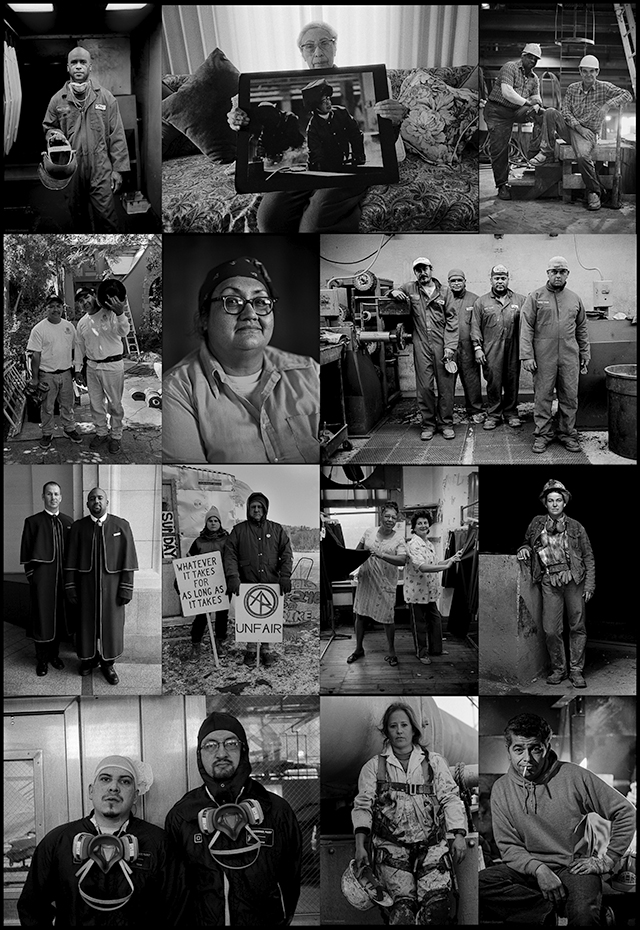
Photos: Robert Gumpert
When I reflect on Labor Day I think about time – time for work and leisure, and the time that spans the generations. How precious it is, and how time is, after all, all we really have. We celebrate Labor Day in September because we don’t celebrate it when most nations celebrate workers, that is May 1. And May 1 is all about the eight-hour day. Let me unpack that — briefly.
Grover Cleveland signed the federal legislation in August 1894 a few days after he had sent troops to brutally suppress the strike of railroad workers and Pullman sleeping car makers. Though 30 states had Labor Day holiday legislation, at the federal level Cleveland was trying to placate a constituency he had deeply antagonized. The bill chose September in part to avoid May 1 because May Day had become a day in which socialists and anarchists demonstrated their power and commemorated the deaths of the leaders of the Haymarket Strike and riot of 1886. Those 1886 events marked the start of serious agitation for the eight-hour day.
By 1938 that was achieved in federal law, and many unions and employers in fact use standard weeks of 37 or even fewer hours. Pause for a moment and reflect on the “Eight Hour” song from the mid-19th Century:
“We want to feel the sunshine,
we want to smell the flowers
We’re sure that God has willed it,
And we mean to have eight hours”(1)
When we respect work and the people who do it, we respect ourselves and our brothers and sisters.
Another less anonymous poet, James Oppenheim wrote it thus in 1911:
“Small art and love and beauty their drudging spirits knew.
Yes, it is bread we fight for — but we fight for roses, too!
…No more the drudge and idler — ten that toil where one reposes,
But a sharing of life’s glories: Bread and roses! Bread and roses!”(2)
As we reflect on the dignity of labor and importance of decent conditions of work many of our own stories reflect the accomplishments of the generations before us. L’Dor V’Dor (or in English, “From Generation to Generation.”)
When I was a boy I would walk to the subway station near the Yankee Stadium to wait for my father to come home around seven pm and we would chat companionably for the three blocks to our apartment. Why seven: because the hours from 4-6:30 were overtime, time and a half: a “good” job for a garment cutter was one in which there was consistent overtime – that’s what made our first car – a Dodge – possible.
I should add that however secular my parents were, on Friday evening my Dad brought home flowers –and to this day so do my wife and I. Setting aside the Sabbath as a day where no work is done is the world’s first labor legislation.
So limiting worktime and rewarding it – is a part of the story of labor and Labor Day from Generation to Generation.
There was a time when there was a Jewish working class. Irving Howe notes that in New York forty percent of Jewish families had someone in the garment industry alone. But then, with Joni Mitchell and Judy Collins, they looked at love from both sides. My paternal grandfather was an organizer and leader in the early years of the International Ladies Garment Workers Union. Comrade Borochowitz once said to my Dad, “the hardest thing to teach Jewish workers was that Jewish bosses were bosses.”
The Jewish working class was central to the building up of the institutions upon which 20th Century decency has rested. The garment workers invented the HMO; the men’s clothing workers were among the founders of the very first industrial union, members of the CIO and leaders in what we now call “social unionism”.
My mother was a New York schoolteacher. When we were young, she was a single mother. We were the working poor. Her marriage to my Dad relieved our penury, but when they grew older, the erosion of his union and industry meant that in his later work years he was in nonunion shops. The wages were ok – but there were no pension contributions.
But aha, in the intervening years New York City schoolteachers had won union recognition and negotiated good pensions. So in their later years my parents were all right. Remember Joe Biden’s great line about the plight of working families: Can you say, he asked, “honey, it’s going to be okay” Well, for so many of us the pressing question has been, Mom and Dad, “Will you be all right?” It was a blessing that mine were. That’s why I will never forgive those who tried to blame New York’s fiscal woes on my mother and her pension! L’Dor V’Dor.
As I reach the end of my academic career, I remember vividly its beginning. At the University of Chicago, we graduate students in Sociology felt the basis on which fellowships and assistantships were awarded was mysterious and we suspected a hint of favoritism. We were, simply, abject, powerless subjects. When we asked that the process become more transparent, we – I – became extremely unpopular with the senior faculty.
I have to laugh; graduate students at private universities have just won the right to be represented by unions.
Should they choose to protect themselves from whim and caprice there is now a means to do so. There are many lessons here, among them, amid looming threats: sometimes Good Things Do Happen! From generation to generation.
In the 1950s American workers achieved what centuries of alchemists and mystics could not: they turned the lead of working class status into the gold of middle class consumption. Or anyhow, that is what the mass media thinks. By “middle class” they mean household incomes that hover in a band around the 50% point, half above, half below. No matter that the half-way point is now way into insecurity, debt, and constant stress. In the Boston metro-area that is about $73,000. An MIT living wage calculator for a family of four is $78,000. How did that working class raise its standard of living, and how did they lose it?
In that era about one-third of the private sector labor force were union members or covered by union contracts; today that is around 7%, but there are higher rates among public sector workers, especially teachers. L’Dor V’Dor.
When Frances Perkins, a veteran of the progressive movement, Hull House and the longest serving Cabinet Secretary and Labor Secretary in history entered Roosevelt’s cabinet, labor issues were at the top of the agenda of her middle class allies. But only recently, through the “Fight for $15 and a union,” have folks re-imagined what is needed to insure decency. But our thinking still has blind spots.
Consider one of the criticisms of Bully Donald Trump’s declared child care “policy” (though I hesitate to grace it with such an elaborately worked word). He said childcare expenses should be deductible. Well, one voiced criticism was that poor people would not benefit because they don’t pay taxes anyhow. True enough and a criticism to note. But in the meantime, millions of families in the middle-income belt certainly do pay taxes and any way of gaining relief will be welcome. Working families need justice and social solidarity just as do poor people. From Generation to Generation.
When 146 women and men and girls and boys were killed in the Triangle Shirtwaist fire this was a searing event for Jews, for workers and for New Yorkers. And they and we have been ever mindful of our obligation of memory and solidarity. I am proud of the work done by the Jewish Labor Committee and the Massachusetts Interfaith Committee for Worker Justice and JALSA – the Jewish Alliance for Law and Social Action who have reached out to support the victims of the killing fires and collapses in Bangladesh and elsewhere.
Today our community is global — as is our understanding of our interests and values. Here is the way I think of it: Our grandparents and parents rose out of the sweatshops; we owe them our love and gratitude for their sacrifice and accomplishment. Around the world the workers of the rag trade still toil in those conditions. We owe them what we owe them.
Owning our time is to live free. After work, after rest, the Eight Hour song put it so succinctly; “Eight hours for what we will.” L’Dor V’Dor.
_______________________________________________________________
Footnotes:
1) Lyrics to Eight Hours
2) Lyrics to James Oppenheim’s “Bread and Roses”
Traveling Grey Dog Style
By Nelson Perez-Olney
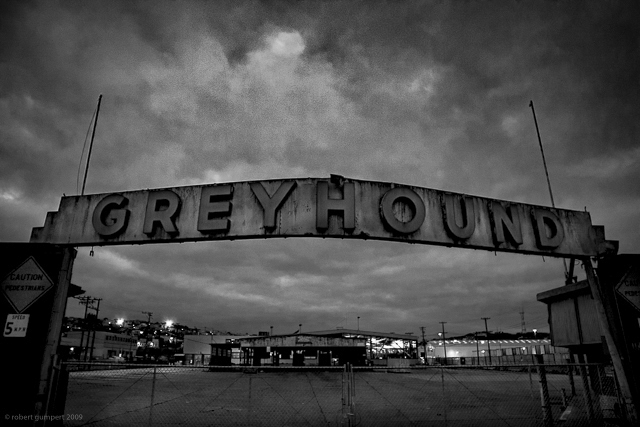
2009: San Francisco, CA. The old and unused Greyhound barn/maintance yard. Photo; Robert Gumpert
In mid July I packed a small backpack with 4 days worth of clothes and hopped aboard a plane to Dallas. I was beginning a two-week tour of the Deep South, my first ever trip to that part of the country. The plan, if it can be labeled such, was to arrive in Dallas and from there zigzag from city to city, spending a few days here and there until I reached Atlanta where I’d catch a flight home to San Francisco. I wanted to see the land of slavery, the civil war, Jim Crow, and civil rights. I wanted to see the states that figured into the worst stereotypes of American backwardness. I wanted either to challenge or affirm my notions of our southern neighbors.
Riding the Greyhound from city to city provided two advantages. The first was extreme practicality. I don’t think any other mode of transportation could have provided the type of flexibility and frequency of service that my plan required. The Greyhound, unlike airlines, trains, or even other bus lines, stops almost everywhere, and it does so at a very low price.
The second advantage was the feeling of actually having put in the miles. There is no “flying over” when you’re riding the Greyhound. I wanted to travel through the South, not over it. I didn’t want to limit my experience to just the cities. I wanted to see Texas flatlands, Tennessee woods, Louisiana swamps and wetlands, houses in the middle of nowhere, confederate flag bumper stickers and prolife billboards.
Some of my friends thought I was crazy. To them a Greyhound trip was a dangerous undertaking. Crazies ride the Greyhound. Someone might cut my head off while I slept. Others thought it would be a cool adventure; romantic in the way a cross-country motorcycle road trip is romantic, full of quiet insights and spectacular sunsets. I admit to feeling a mixture of their concern and excitement. Before leaving I wrote out a list of all the bad things that could happen to me in the middle of nowhere on a bus (dismemberment made the list). At the same time, I felt small stirrings of pride whenever anyone asked me what the hell I was thinking, crazy bastard.
I never lost my head and the only sunrise I saw hurt my sleep-deprived eyes. But the plan worked beautifully. I visited 9 cities in 18 days, and touched ground in every Deep South state except Florida. I saw plantations and battlefields, civil rights memorials, sites of tragic importance. I heard jazz bands in the street and got stuck in four torrential rainstorms. I saw a giant Trump billboard (only one). I even met a Buddhist gun enthusiast. And I was granted a few little insights.
But they didn’t come easy.
Selling Points
I would never recommend a southern Greyhound tour to anyone unless they are seriously committed to boredom and discomfort for a large portion of their vacation. Don’t get me wrong, it suited my purpose wonderfully, but I had already resigned myself to misery before I boarded my first bus. Let me explain.
The Greyhound is slow. The drivers have lead feet and fly down the highways and around turns at speeds that draw your attention to the bus’s top-heavy construction, but they still have to contend with traffic. Also they stop every 100 miles or so to pick up and drop off passengers. There is no copilot who can take over when the driver hears nature’s call. Oh, and god forbid your bus should be a scheduled connection for another bus route. It doesn’t matter how late the other bus is. There are no missed connections. An hour-long airplane trip becomes an 8-hour ordeal on the bus.
The Greyhound is uncomfortable. It’s not a cattle car like modern airplanes where the seats might as well be stacked on top of each other. There are usually fold down footrests, and there’s no seatbelt requirement. Most of the time everybody has a whole row to themselves. This doesn’t mean there’s really any room to stretch out. Even those who are flexible and small enough to curl into the fetal position and lie down are denied much rest by the constant bumping and lurching; the unending vibrations sent rippling across the bus frame by the powerful engine. For the most part, people sit up for the full trip, listening to music or staring out the window, heads bobbing with every dip in the road. Yes, planes are uncomfortable, but at least a flight only lasts a few hours. Most legs of my trip were over five hours long. Given enough time, even cushions will bruise an ass.
The Greyhound smells. I don’t care how clean people are when they start their trip. A lot of riders are making journeys over multiple days, camping out on station benches overnight, waiting for a connection, unable to do little more than wash their faces in a sink you wouldn’t want to wash your hands in. We all smell bad and the bus bears constant witness to our odors, carrying them for unending miles.
The Greyhound doesn’t really get you all the way there. In most of the places I visited the bus dropped us off far outside of downtown, so far that you can hardly be said to have arrived anywhere at all. Often I had to catch a cab or get on another bus to complete my trip. Only in the big cities was I dropped anywhere near an urban center, and usually it wasn’t exactly the kind of place you wanted to be as you took your first steps in a new town.
The bus drivers are… not always pleasant. Who can blame them? What I did for two weeks they do almost every day of every week, month after month, year after year.
No rave reviews. No two thumbs up. In spite of that the busses continue to roll down the highways 24/7.
Making Trail Ends Meet
In Dallas, the night after the police shooting, a huge section of downtown was cordoned off. The Greyhound station fell just within the bounds of the yellow tape. Everyone trying to catch a bus there had to travel ten miles to a remoter, smaller station southwest of downtown. The staff, tough to deal with even on normal nights, was mobbed with confused and panicking passengers. None of us really knew what was going on, where we were supposed to stand, what the status of the busses was. There was no point waiting in line to find out. It was too damn long. Calling Greyhound customer service didn’t help either since all they could do was recommend talking to the station agent. Plenty of people were waiting for busses that had not arrived yet, their delays stretching several hours. I didn’t know if my bus would be on time or even whether it would ever arrive at all. It was about 3 in the morning. A college aged white kid cast a tired, frustrated glare at everyone and everything. “I was trying to save money. My friends are already in San Antonio, but at this rate I won’t be there until noon. Next time I’m just buying a plane ticket. What a waste of a weekend.”
It was a totally understandable attitude. I’ve been in plenty of airports and experienced my fair share of air travel hiccups. I’ve stood around with fellow fliers as we shake our heads, cross our arms, and mutter “I cant believe this shit,” while airline employees scramble to extricate whatever wrench has been thrown in the works. Airlines lose baggage, over-book flights, lose reservations, and cancel flights. Customers complain and employees do their best to placate their angry clients, throwing in upgrades or not charging for bags. Because even though you’ll probably get gouged no matter which company you fly with, airlines compete for your business by making air travel as pleasant and smooth as possible. Customers talk, customers write reviews, and customers switch carriers.
The white kid in Dallas was making his dissatisfaction felt, casting it into the air where it would mingle with other people’s anger and hover over the ticket counter like a storm cloud, inspiring the staff to action. At least, that’s what might have happened in an airport. But it didn’t happen here.
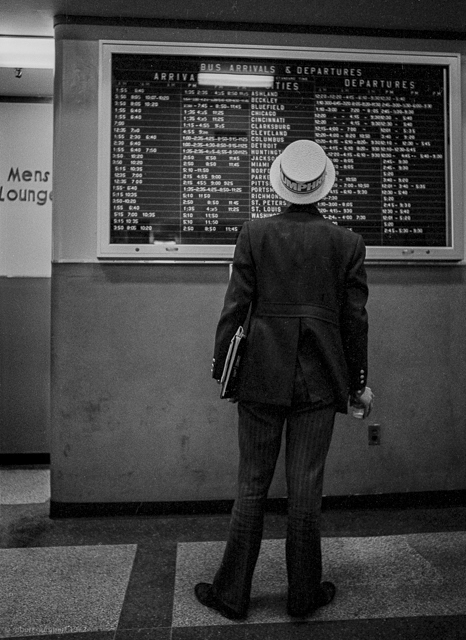
1972: Humprey Campaign worker in the Charleston, W VA Greyhound Station. Photo: Robert Gumpert
Everyone else bore his or her frustration in quiet resignation. For them, there was no other option, nothing else they could have done. If they could have flown, they would have. If they could have driven, they would have. I remember a tired looking woman in Houston trying to remain upbeat and excited for the benefit of her young son. They were traveling to New Jersey to visit the boy’s father, a trip that would take a few days at least. She didn’t seem too excited to see the man. And yet they were going. This wasn’t a vacation for her. It was life. They weren’t the only ones in for long rides. Some people in New Orleans were Chicago and New York bound, on their way to visit sick family members or old friends they hadn’t seen in a long time. Passengers in Memphis were making trips to the coasts, to destinations in Florida and California, their reasons for travel unspoken. I saw college students leaving small towns, whole families on their way to Mexico, boot-camp bound recruits, grandparents nervously studying the connections listed on their tickets, disappointed looking European backpackers.
The Greyhound is the way to go for poor people who need to travel. Greyhound knows it. Poor people know it. There are no bus attendants, no drink service or in-drive entertainment. The most a passenger can hope for is an empty row, mellow travel companions, no traffic, a good-humored driver, and a beautiful view here and there. It’s not cruel or mean spirited. It’s bare bones. They cant promise that the world will cooperate with your plans, and they wont move mountains should it decide not to. But if you need to get from A to B, and you need to do it on a budget, you cant go wrong with the Greyhound.
The Origin of the Species
By Mark Dudzic
First published 14 August 2016 in:
First of the Month: A Website of the Radical Imagination
Back in the day, two knucklehead members of my old union local at a Union Carbide plant in New Jersey fashioned KKK hoods out of chemical filtration paper and paraded through the lunchroom on Halloween. The corporate HR executive sent to investigate summarily terminated both workers within hours of arriving at the plant. She loudly proclaimed the company’s “zero tolerance” to racial harassment.
Now this was very interesting considering that her employer was the prime suspect in the unpunished industrial murder of 764 mostly African American workers on the Hawk’s Nest Tunnel in the 1930’s and its current corporate chairman, Warren Anderson, was a fugitive from justice wanted by the Indian government in connection with the 1984 criminal manslaughter of at least 15,000 Indians in Bhopal. Over the next 15 years, the same HR exec who showed Phil and John the door was the point person in the shutdown of all three unionized Union Carbide plants in New Jersey, leaving behind a series of toxic waste sites contaminating communities throughout the state and 2,000 black, white and Hispanic workers, many suffering from uncompensated industrial diseases.
This episode comes to mind while contemplating the detritus of the Republican and Democratic conventions and the growing trope that the rage of the white (male) working class has propelled both the Trump campaign and the critique of the Clinton campaign from the left. The politics of race and gender often obscure much more than they reveal. It is true that individual white workers can be horribly racist and misogynist. But it is also true that the worship of “diversity” often serves as a cover for gross hypocrisy and ruthless class rule.
At the Democratic convention, diversity was rolled out in service of the status quo. Stripped of the soaring rhetoric of the Obama years, the neoliberalism of the Clinton variety fails to inspire or move people to action. “There is no alternative,” she proclaimed time and again during the campaign and at the convention, “so we might as well make the best of it and do what we can without upsetting the apple cart.” All of the energy inside and outside the convention hall came from the Bernie delegates who came prepared to fight for the issues and concerns of the people who sent them there. Even the concessions that the Clinton campaign made on platform issues had no real effect. No one really believes that Clinton will seriously oppose the Trans Pacific Partnership or work to institute a $15 living wage. Already she is moving to the right in an attempt to capture the refugees fleeing the new Trump-branded Republican Party. In more normal times, the rants of General Allen or, god bless them, the patriotic evocations of the bereaved Khan family, would have been much more at home at a Republican convention. Despite the deliberate celebration of diversity, we all left Philly knowing quite well what to expect over the next four years.
In Cleveland, the party of Trump was an altogether darker affair. Here diversity and it’s cousin “political correctness,” played the role that marginalized communities always play in right wing populist and revanchist movements: as a focal point for anger that would otherwise be directed against a social and economic order. Trump has mastered an appeal that combines Munich beer hall fascism with a kind of post-modern shock jock sensibility that doesn’t take itself all that seriously. It allows him to get away with the most outrageous statements that would have been the end of any traditional politician. He will never be president but he may succeed in destroying the modern Republican Party, which advanced a fundamentally pro-capitalist, neoliberal program by fanning racial and gender resentments, religious fundamentalism and populist anger at elites. To borrow a metaphor from Tom Frank, a whole lot of people don’t want to live in Kansas anymore.
It is interesting that many in the Republican establishment blame the white working class for the destruction of their party. The vitriol and sense of betrayal of the National Review crowd are truly remarkable. Trump certainly enjoys considerable working class support. For some workers, Hillary Clinton probably reminds them of that HR rep who forced them to attend “everyone is awesome” sensitivity training while secretly assisting in plans to move the plant to China (of course Trump not only symbolizes, he actually is that type of dickhead boss in the Frank Lorenzo-Jack Welsh-Carly Fiorina-Carl Icahn mold who runs the business into the ground while personally enriching himself and screwing everyone around him).
But the extent of Trump’s working class support is greatly exaggerated. Those workers at the Carrier plant in Indiana that Trump promised to stop from moving to Mexico? They’re members of the Steelworkers union who voted overwhelmingly to have their local endorse Bernie Sanders. Same with the Chicago Nabisco workers, primarily black and Latino and members of the Bakery Confectionary union. In fact, Trump voters have an average income about 20% above the median. I like to envision the typical Trump voter as an upwardly mobile fast food shift manager: making a crappy salary and working lousy hours with little hope for real advancement, but glad to be wearing a tie and away from the deep fryers, desperate to please the main office, envious of the life style of the local franchise owner and resentful and contemptuous of the lazy slugs they supervise who are constantly whining for more hours and better conditions.
Likewise, many in the Democratic establishment blame backward white workers for the success of the Bernie Sanders insurgency. Joan Walsh, among many others, opined that Sanders’ substantial support among white workers (who overwhelmingly supported Clinton in 2008) is because “she has been damaged by her association with the first black president”. And Paul Krugman, that eternal guardian of the left gate of the ruling class, pontificated that the Sanders campaign failed to understand the importance of “horizontal inequality” between groups. What the fuck does that even mean?
The “white working class,” like the “black community,” is an abstraction that does not exist anywhere in the real world. The U.S. working class is broad and diverse. It’s not even all that white any more and certainly not all that male. Its conditions are determined by its position within a political economy but, like everyone else, the experience and consciousness of individual workers is formed by a whole series of contingent relationships and experiences. The recent use of the trope of the angry white working class attempts to extract white workers from these class dynamics and present them as a demonized and marginalized natural group.
Adolph Reed has written extensively about the ideological and epistemological machinations that legitimize and stabilize regimes of hierarchy by transforming social relations into natural conditions. In the U. S., race, and its various ethno-subdivisions, has always been the great tapestry upon which this story has played itself out. Race science developed as an efficient sorting and control mechanism for capitalism and, in the 19th Century, embraced Darwinian and Lamarckian evolutionary theory to lend legitimacy to the ideology (late 20th century racialists incorporated more modern genetic theories into the mix). While the old racialist model persists to this day, the integration of various ethnic groups into the great American middle class and the successes of the civil rights movement compelled most mainstream ideologists to move to a newer version that incorporated speciation theory. This new model emerged in the 1980’s with the discovery of the black underclass. Just as Darwin’s finches evolved into unique species on their isolated Galapagos islands, so did social Darwinists identify a black underclass culturally and economically isolated from the rest of us (Trump, by the way, had a bit to do with naturalizing this new model. He made his bones as a rabid proponent of the “wilding” hysteria that, in 1989, helped to frame 5 black and Hispanic youths for the rape of a female investment banker who was jogging in Central Park.)
In the U.S., class relations per se have rarely been naturalized. Instead, the ideological consensus was that most Americans become subsumed into a broad middle class with the exception of a few culturally marginalized populations. But now we are witnessing the evolution of a new species: white, blue-collar workers unable or unwilling to transcend their dead-end jobs/communities who are acting out in self-destructive and dysfunctional ways that undermine the very foundations of political stability. The underclass descriptors are remarkably similar: OxyContin for crack, social security disability for welfare dependency, family dysfunction and sexual profligacy (Kevin Williamson’s stunning invective against a “white American underclass in thrall to a vicious, selfish culture whose main products are misery and used heroin needles” engaged in “the whelping of human children with all the respect and wisdom of a stray dog” could apply equally to either species).
Then there’s J. D. Vance’s best-selling memoir, Hillbilly Elegy. In a style that fans of every racial uplift story since Manchild in the Promised Land will immediately recognize, Vance relates the massive dysfunction of his working class Ohio background and his personal overcoming through pluck and hard work. As the New York Times points out in its review, Vance subscribes to the Obama “brothers should just pull up their pants/stop feeding Popeye’s to your kids for breakfast” school of thought that “hillbilly culture…increasingly encourages social decay instead of counteracting it.”
This new species has an irrational fear of globalization, a perverse sense of entitlement and a worldview colored by racial and sexual resentments. In the conservative account, they have only themselves to blame–social programs will just exacerbate the culture of dependency and only a strong dose of religion or family values backed by the punitive and carceral powers of the state can nip this inferior species in the bud, reintegrating its more robust members into the great American phenotype. In the liberal view, it is actually the evolved racism and other entrenched attitudes of this species that prevents progressive change. It’s as if my two knuckleheaded union brothers were actually the ones responsible for Union Carbide’s legacy of racist industrial homicide. There’s no real solution to this problem because this racism and sexism is actually part of the DNA of the species rather than embedded in a political economy. We can only hope that the species self-extincts as its more enlightened members move to Seattle and Silicon Valley to become baristas and uber drivers as the others obliterate themselves with drugs, alcohol and guns. Either way, one thing is clear. They. Are. Not. Like. Us.
The Sanders campaign was so disorienting to both conservatives and liberals because it did not embrace these naturalized categories but, instead, revealed them as social relationships established by real human beings and, thus, open to change through the application of political and economic policies. After stumbling a bit in the early months around how to give voice to the outrages of police violence and mass incarceration, it laid out a working class politics of hope that was both visionary and practical. In the process, it helped lay bare the actual mechanisms of capitalism that drive inequality. And it exposed the fault lines created by decades of neoliberalism that are impeding real change in the labor, racial justice and other social movements.
The tasks ahead should be clear: first decisively defeat Trump and everything he stands for. Then immediately pivot to attack the neoliberalism that will be at the core of the new Clinton Administration. Failure to do so will doom us to decades more of a politics of cynicism, divisiveness and corporate rule over every aspect of human existence.
One thing for sure, it’s going to be an interesting ride…