Workers on Work: Clinical social worker and therapist
By Joe Sciarrillo
From time to time the Stansbury Forum will post workers talking about their jobs. Today’s post is by Joe Sciarrillo, a licensed clinical social worker and therapist. He works outreach with the unhoused and addicts in San Francisco, California.
.

I’ve been a social worker for about 9 years now. I’ve always wanted to be a social worker. I grew up in a family that was very influenced by Jesuits, and I got involved in the progressive side of the Catholic Worker, service orientated, the more liberal side of the Catholic Church. I had some teachers at my Jesuit school who were activists in the Tenderloin and that really influenced me to do something that addressed the inequality on the street.
Social work is great. It lets you have a therapist’s hat, but it also lets you get involved in the systems, connecting the dots among all the agencies that are supposed to be serving people.
I work with people who are mostly unhoused in the Tenderloin, Mission, Bayview, and SOMA neighborhoods. Mostly (I) do therapy on the street with people who are unhoused, and a little bit of case management: connecting people to housing, to doctors, to therapy, to job programs.
◊
Our organization’s motto is, “Come as you are”, so therapy on the street involves letting people approach you with whatever issues they’re going through, being non-judgmental and willing to listen. That often involves being attentive to someone’s trauma, possibly their depression, and anxiety. Being able to listen with compassion, affirm people’s identity, what they’re going through, and provide emotional support and encouragement, as well as to support people to make whatever next steps they need to make.
For me the most frustrating thing is knowing that in a city like San Francisco there are thousands of people who are in dire straits, and me talking to someone can be a positive interaction. But there is so much more support the city needs to provide. The city needs to do a better job of providing access to housing, access to medical care. The most frustrating thing is feeling like I’m just a band aide amidst many gapping wounds. There needs to be a lot more services, medical and housing, addressing the economic system that doesn’t fit for everyone.
◊

The common issue is someone having past trauma. Whether that being the jail system, being in foster care, a traumatic divorce, or an accident, and not having enough of a safety net, or support, to cope. Or being very isolated and struggling and that leading to depression. But all that is sparked by a trauma. They’re struggling to figure out how to heal.
It’s very common, but not always the case, for people to be using drugs as a way of coping.
◊
[Do you take all this home with you?] My wife would say yes. I would say I’ve always had these social injustices in the front of my mind, since I was a kid.
I think that by being involved in the work, being face to face with the issues, I’m able to compartmentalize it a lot more than when I wasn’t a social worker. I feel like I am able to do my self-care when I get home – go skateboarding, watch movies, watch music – and I can decompress. But I always need to talk to someone about what I’ve gone through throughout the day.
It was worse when I wasn’t doing this work, when I was just a student I would be consumed by reading the news and theoretical things about society and injustices. I was emotionally a lot more wound up in being frustrated back then than I am now.
◊

I’ve only formally been a social worker for 9 years. Before that, for 20 years, I was either a paralegal or a caseworker. I would say all of that was social work without the name. So, I’ve been doing it for over 20 years because it’s just ingrained in how I see the world.
It gives meaning to my life by feeling like I am a factor in trying to create positive change in society, or some individual’s life. And it’s reciprocal. I take meaning out of it, and I hopefully give meaning to someone, as well. That’s how I see the world.
It makes life so much more meaningful if we are there for each other. If we’re able to do that for our 9-5 job, that’s so much greater. So, I intend to do something like this for the rest of my life, if I can.
◊
I would just say that when people like me say the city should do more, I’m saying city agencies should do more, but also individuals, as well.
I think if more people saw people on the street as their neighbors, that would have a ripple effect how the average person interacts with someone on the street, even if it just means looking people in the eye and saying hi. That can have a ripple effect into what type of policies we vote for, how we put pressure on our supervisors, and city departments, to implement more humane programs.
As far as what needs to be addressed, the list could go on: affordable housing, more protections against evictions, more access to pro bono attorneys for tenants’ rights.
There needs to be more green spaces, more safe spaces for people to nap on the streets. More access to healthy food – not just soup kitchens – but more affordable healthy food. It’s been good to see more water fountains open.
There needs to be more public toilets, not just for the unhoused but for everyone who’s out and about during the day.
There needs to be safe injections sites. There are 700 people dying of overdoses a year and we just keep sweeping that fact under the rug. It’s not going to go away unless there is more of a safe community to support people as they go through their addiction.
We know even if they want to, they can’t quit right away. We need more crisis response teams, not just during the day but overnight.
Yeah the list can go on.
◊
About addiction, I never realized, up until this last year, how addiction can be so inexplicably difficult to step out of. I’ve been able to meet people that have gone through rehab programs – AA or inpatient treatment – that maybe worked for them for a few weeks, a few months, but didn’t work for them in the long-term sense. That opened my eyes because I always assumed that doing one or two rehab stints could be a long-term solution. But I’ve learned how complicated and nuanced addiction is.
There are so many variables to treating addiction that we have to have an open mind to harm reduction programs, [but] also to those more traditional programs that do work for some people. Addiction isn’t a one size fits all.
I have a lot more patience now with listening to different approaches to addressing addiction. I’m more humble about addressing it and talking about it, than I used to be.
◊
I think the biggest tool and skill is compassion, that’s the foundation when I’m encountering whatever traumas, or whatever social ills, injustices, sufferings people are going through.
Having my grounding in figuring out and believing that we are all connected. That we all have a purpose to help each other, to support each other, and that all comes from values that I’ve grown up with.
Listening! I think listening is a tool that is not talked about very much. Being able to be fully present with someone and listen more than you talk.
Compassion can be an issue when it connects to the issue of boundaries.
I’ve struggled with working overtime, and that bleeds into my family time, or people learning more about my personal life than they need to. And me sharing too much.
You have to balance the compassion with some type of self-care.
…
Silent No More
By Stewart Acuff
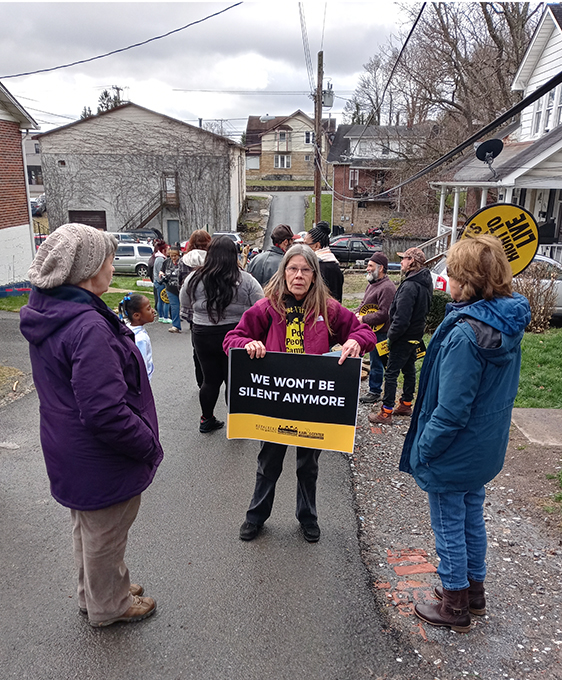
Marching through Beckley, West Virginia, on March 4, the crowd of 150 friends and families of Quantez Burks and Alvis Shrewsbury stretched a full block. I was there with others to honor the memories of the two men killed not far away in the Southern Regional Jail.
It was the first anniversary of Burks’ death. Shrewsbury had died Sept. 17, 2022, after he was in jail 19 days.
State corrections officials told Burks’ family that he had died of natural causes. But an independent medical examiner who examined the body of Burks found he died with numerous broken bones, including a broken nose, one leg and both wrists as though he had been handcuffed during the beating.
State officials haven’t publicly stated how Shrewsbury died, but before his death he told his family how he was beaten by other inmates who were stealing his meals.
Burks was in jail after being arrested for wanton endangerment after discharging a firearm in his home. Shrewsbury was in the Raleigh County jail serving 90 days for a second drunk driving convention. Neither deserved to be beaten to death. And nobody has been charged in their deaths or held accountable in any way.
Just this past year 13 men died inside the Southern Regional Jail, leading the state in that statistic. But it is the Eastern Regional Jail in Martinsburg that leads in the number of suicides occurring in state jails.
Massive heroin and opioid addiction that plagues all of Appalachia, including Jefferson County has crammed West Virginia regional jails far beyond capacity. Men sleep on concrete floors, have food stolen, use broken facilities and are denied medical care.
Now the Burks family and the Shrewsbury family have joined with the Poor Peoples Campaign to seek justice for their loved ones who were not adequately protected from attacks and abuse. The families, one black and one white, gathered before the march for prayer led by Pastor Walter Leach of St. Paul Baptist Temple. In his prayer the pastor promised, “We will not give in. We will not give out.” I heard that promise echoed over and over throughout the day.
While waiting for the march to start Alvis Shrewsbury’s fiancée, Justine Bradley, said: “I’m glad to be here and not let our tragedies be swept under the rug. It’s sad that animals in animal shelters are treated better than people in West Virginia jails.”
Mary Mullins, Shrewsbury’s sister-in-law, said while at the rally, “Jail is supposed to be for reform. Not killing.”
Under a sky spitting freezing rain with a cold whipping wind, Kimberly Burks, the mother of Quantez Burks, helped assemble the 150 marchers and stepped us off from the home of Quantez Burks at noon. We marched through the neighborhood and out to well-travelled thoroughfares and around the Beckley Police Station. We then lined a block of the main street through town holding and waving signs, some folks crying, others remembered the two men and the shock of their deaths.
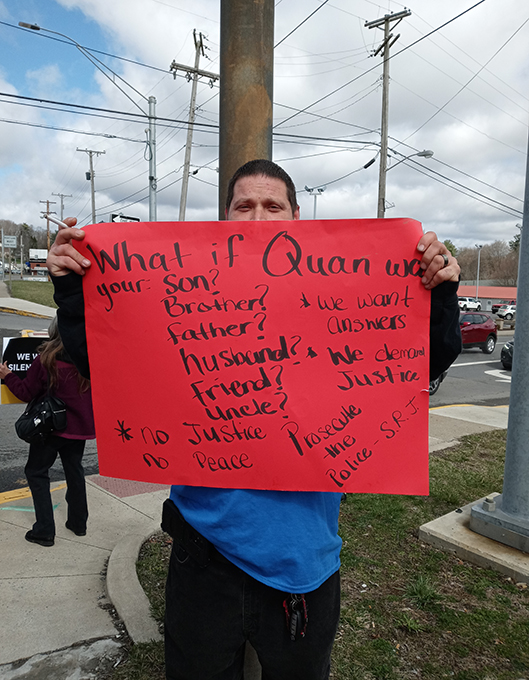
Josh Eagle, a friend of Burks, held a sign that read: “What if Quan was your son? Brother? Father? Husband? Friend? Uncle? We want answers. We demand justice.”
Rosetta Eagle, Josh’s mother, said, “I cried for days after Quan died. He was like a son.”
Quantez Burks’ daughter, Kiera Burks, is a 22-year-old senior at Ohio State University studying social work. Of her father, she said, “He was the best dad. Loving and caring. Always there for me. It’s heartbreaking. I miss him so, so much. I think about him every day.”
It is the families and friends of men who are beaten to death behind bars who suffer the longest. It is the deepest most evil corruption that covers and enables cruelty and torture unto death.
A class action civil rights lawsuit with dozens of family members of inmates abused and/or killed in West Virginia jails has been filed in the U.S. District Court for the Southern District of West Virginia. Stephen New and his law firm are representing the families.
Justice in these cases must include an acknowledgement by the state of overcrowding and abuse and public acknowledgement of what happened in every death or beating. Justice must include immediate relief of overcrowding using innovative sentencing alternatives such as community service. Justice would include prosecution of everyone involved in the jail abuses from other inmates to corrections officers to corrections administrators. Justice would include a complete overhaul of both the West Virginia Division of Corrections and Rehabilitation and the West Virginia Department of Homeland Security which oversees the corrections division.
Last Friday, March 10, national leader, and founder of the Poor Peoples Campaign (PPC) Bishop William Barber came to Charleston to stand with grieving families and former inmates to tell their stories of casual cruelty in West Virginia jails.
Led by mothers of beaten and dead inmates we marched inside the Capitol to confront the governor with terrible secrets of torture.
In the hallway of the governor’s office surrounded by police and state troopers each mother spoke truth to power to the governor’s staff. Then breaking down, crying as one cries for a dead son, they were followed by sisters, fiancées and one former inmate beaten but surviving; they all told everything.
Giving the staff the petition signed by more than four thousand we asked that the governor join our call to the U.S. Department of Justice for a full federal civil rights investigation.
The families, PPC and Barber promised one another to pursue this state outrage till justice is won.
…
Nerve Centers
By Nicola Benvenuti
My initial contact with a powerful and class concious labor movement came in 1971-72 when I was studying at the University of Florence in Tuscany, Italy. I witnessed massive marches of workers protesting the war in Vietnam and carrying the red banners of the Italian Communist Party! I also played on an Italian rugby team in Florence. One of my teammates was Nicola Benvenuti, at the time a miltant in the PCI – Partito Communista Italiano. He has remained a lifelong family friend, and I always go to him for interpretation of Italian current events. When we published Labor Power and Strategy, I immediately sent him a review copy because I value his wisdom on these matters. What follows are his observations on the book from the perspective of someone who has particpated in working class politics in a society where the PCI commanded the loyalty of the working class and polled 34.4% of the vote in 1976.
Peter Olney, Co-Editor of the Stansbury Forum and
Labor Power and Strategy
.
Labor Power and Strategy PM Press 2023 – A Review from an Italian Comrade, Nicola Benvenuti
The first thing that strikes me about this book is its title. It reminds me of political literature published in the year 1968. Two of the expressions it contains come across as especially reminiscent of those times: “Worker Power” and “Strategy”.
Workers’ Power (Potere Operaio) [1] was also the name of an extra-parliamentary self defined revolutionary student and workers’ organzation, that like other left political groups and parties, traced its roots back to an original Marxism, the concept of the working class as the general class embodying the values and principles for a radical reorganization of society. Worker Power was the vehicle for the socialist revolution: laborers could blockade the whole of society by choosing to abstain from work. The method of struggle deriving from that idea was the general strike, which presupposed the overall organization of the working class, or at least the majority of it, at both the union and the political level.
Everyone in those years associated the word “Strategy” with the effects of the workers’ actions. In this view, workers’ material needs, as theorized by the spontaneists, were leveraged to foster a natural class consciousness. Others emphasized the role of the revolutionary party as a collective intellectual capable of blocking the mechanisms of capitalist production and power, thus actualizing the workers’ power in new institutions and organisms.

This book, on the other hand, sets out to analyze a different type of workers’ “power” that concerns the ability to block the vital nerve centers of production in order to bend managerial resistance to wage and regulatory demands. In a situation of low unionization, the issue becomes whether a minority of workers in crucial positions can stop both production and profit-making processes. Emphasizing the term minority is hereby essential because this theme plays a central role in the history of all trade union movements.
In pre-Fordist factories, not only did the worker sell their brute physical force but also their skills and competencies, to the point that the more trained and qualified the workers were, the more they became valuable for production. In many cases, this category of workers was seen as a working-class aristocracy with better wages and greater accomodation toward their superiors. Consequently, they were generally viewed as the natural conveyors of reformist consciousness.
Although not entirely, in those years the decision to go on strike depended mainly on the workers’ self-awareness. The German unions, for instance, always kept a keen eye on the exchange market of local goods to understand when their company would receive new orders and become unable to afford a strike that would jam production. This power of the “worker aristocracy” certainly failed within the Fordist organization of production when a new type of worker was established. Such laborers, referred to in Italy as the “mass worker”, did not possess any particular qualifications but exhibited a solid work discipline. As recently as the 50s and 60s, in Piedmont, vast groups of workers who had immigrated from the south to work on the FIAT assembly line fled the factory because they could not bear the rhythms and constraints – i.e., its discipline – and would often end up pursuing a life of crime. Therefore, the laborer’s power depended on their being part of a mass rather than on personal skills. It was the time of large mass unions capable of mobilizing entire industrial sectors and exercising notable political influence.
Today the entire process of valorization of goods has been restructured in keeping with the global market to overcome market bottlenecks by customizing the product, relocating to take advantage of wage gaps, and outsourcing non-productive functions that have become increasingly important. Another effect of this process is the re-employment of workers previously expelled from production in functions such as those indicated above, e.g., in logistics, transforming employees into self-employed workers, and offloading the cost of labor through indiscriminate tax evasion. This reconversion often constitutes a defeat for the trade unions as well as for the political left, as proven by the outcome of several local political elections.
Although the book analyzes many of these points, the interview format does not appear to be the most suitable for expanding the themes dealt with. As global as its vision may be, some ideas within it have unfortunately yet to be developed. Even so, the book’s value and intent primarily suggest effective methods for a trade-union struggle. This also applies to active minorities that are essential to encourage workers to join organized labor. As well as highlighting the need for an accurate analysis of the work processes, with specific reference to the worker’s substantial experience, there comes a solid suggestion to adopt the Network Analysis Methodology typical of the Internet. This approach can accentuate the weight of the connections between the various centers involved in the articulated value chains, i.e., the hubs on which the operation of many nodes depends. Among these, the logistics node emerges pre-eminently, as shown during the historic 1934 strike of the stevedores in the port of San Francisco. Logistics also plays a vital role within the Amazon corporation, i.e., the true bete noire of US trade unionism, both inside the company and in distribution to external customers.
The research on the junctions and bottlenecks on which the unions can act to put the company in difficulty and force it to improve wages and regulations is therefore crucial. It is also interesting that the interventions reported underline the value of involving local communities and organizations. In this regard, I would add that winning a trade-union battle is certainly important but often not enough for the purpose of building a stable and solid support front for labor. The victories of the workers in the crucial nodes must be extended to all workers to prevent the formation of a privileged elite and ensure the continuity of the achievements acquired. The struggles and organizations must aim at the industrial level, not just the professional and the sectoral dimension, ultimately involving the other industries of the sector to contrast the competition coming from companies in the same sector with lower wages. Transitioning from the local to the national level means taking a crucial political step which can grant concreteness to the power of labor making it an active part of industrial policy.
[1] Workers’ Power (Potere Operaio), or PO, rejected the parliamentary politics of the Italian Communist Party (PCI).
Sin Fronteras
By Joel Ochoa
A note from Peter Olney Co-Editor The Stansbury Forum
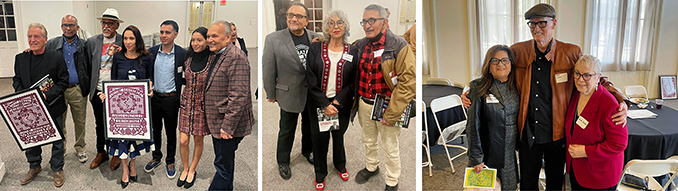
On the evening of the second Saturday in February, Christina Perez and I attended the first Sin Fronteras Awards celebration at Casa Pico in Los Angeles. Casa Pico was the mansion of the last Mexican governor of California who served until 1846. In its time the building was the tallest in Los Angeles at three stories high. The celebration, which featured food and music, honored the lives and contributions of four distinguished individuals who have dedicated themselves to the fight for social and economic justice for all: veteran Chicano movement activist Evelina Marquez, labor leaders Dave and Carole Sicker, the UCLA undocumented student organization “IDEAS,” and late civil and immigrant rights lawyer Jorge Gonzalez.
They were recipients of the first-ever Sin Fronteras Award, uplifting their relentless commitment to improve the lives of working people, students, and their families. The event was a lively and very moving evening, and the high point was the intervention of the UCLA student organization. A new generation of activists and organizers is rising!
The principal organizer of this event was Joel Ochoa, retired US labor organizer, émigré from Mexico and a member of CASA – Centro de Accion Social Autonomo. He has written a brief description of the Sin Fronteras initiative.
.
Immigrant workers changed the face of Labor in Southern California
On February 11 under the umbrella of the Sin Fronteras Committee we gathered in the historic Plaza Olvera in Downtown Los Angeles to honor some distinguish individuals for their lifelong commitment to the struggle to improve the life of all; and to announce the formation of this new network of community, academia and labor rights activists.
The concept of Sin Fronteras emerged during a 1974 meeting of the National Coalition for Fair Immigration Laws and Practices held in Chicago, Illinois, at the Shoe Makers Union Hall. The name of Sin Fronteras highlights the link between workers justice movements in the U.S. and Mexico.
Sin Fronteras was also the name of a bilingual newspaper of CASA Centro de Accion Social Autonomo (Autonomous Center for Social Action), the pioneer organization in the struggle for the defense and organization of the undocumented workers and their families.
CASA was founded in 1968 by a well-known and respected community and labor leader named Bert Corona. Its purpose was twofold: organize undocumented workers and their families to fight to legalize their status and to make Unions understand that workers are workers, regardless of their legal status; and as such, are part of the working class; Unions have a historical responsibility to bring them onto the House of Labor.
It was a revolutionary idea; but hardly a new one. With the formation of CASA, Corona was following a well-established tradition among Mexican Americans and Mexican Immigrants to fight for social and economic justice even under the most adverse conditions.
Mexican Americans and Mexican Immigrants were influenced by socialists and anarchists in the formation of some of the Mutual Aid Societies, especially in the Southwest of the U. S. This Mutualistas (here and here), as they were known, helped people at the community level to alleviate some of their basic needs, but also filled up a vacuum created by the AFL for their rejection to organize them. By nature, this mutualistas were anti capitalist organizations and the Unions they helped to create organized regardless of trade and nationality.
Mexican Americans and Mexican Immigrants had a clear understanding of the importance of trans border solidarity. Alliances formed by Emma Tenayuca, Luisa Moreno (Guatemalan) and Bert Corona are well documented and paved the way for future acts of solidarity on both sides of the border.
Based on this tradition young Chicano students and activists formed alliances with their counterparts in Mexico and the rest of Latin America; and it was precisely because of this alliances that many activists, first from Mexico and later from the rest of the continent, found shelter in places like Los Angeles, Chicago, and many other cities.
With the formation of the Sin Fronteras Committee we want to celebrate that tradition. And in doing so, we will honor the contribution of those pioneers who are still among us. We will also engage, by promoting conferences and debates, in acts of solidarity to support the struggle for social and economic justice for immigrants toiling and fighting in the U.S. And, last but not least, we will build support for the struggles taking place south of the border.
Here we are fifty-five years after the formation of CASA, demanding once again for Organize Labor, especially in the private sector, to be more creative and aggressive in their approach to organize immigrant workers. It is not only a question of survival of an institution, but rather way for a significant sector of the working class to find a tool, a collective bargaining agreement, in the struggle for economic justice.
We should all learn from our immediate past and remember the Justice for Janitors campaign, American Racing Equipment campaign and the Drywallers campaign as the moment when self organized, on two of the above mentioned cases, immigrant workers changed the face of Labor in Southern California and created a more inclusive, colorful and combative movement.
Los Angeles, CA. February of 2023
…
“Labor Power and Strategy” at the People’s Forum in New York
By Robert Gumpert
On Saturday, February 4 the People’s Forum in New York City hosted a discussion of the new book, Labor Power and Strategy from PM Press. Alex Press of Jacobin magazine moderated a far-reaching discussion between Peter Olney, Melissa Shetler and Gene Bruskin, three contributors to the book. The book published in 2022 consists of interviews with Harvard Professor Emeritus, John Womack and then the responses of ten of labor’s best educators and organizers. It is short – 152 pages – and truly a pocketbook that lends itself to discussion and debate. Here is a link to the February 4th panel:
…
Forgotten – an African American Soldier Turned Rebel Leader in the Philippines
By Jonathan Melrod
LONG LIVE THE MEMORY OF DAVID FAGEN DURING BLACK HISTORY MONTH!
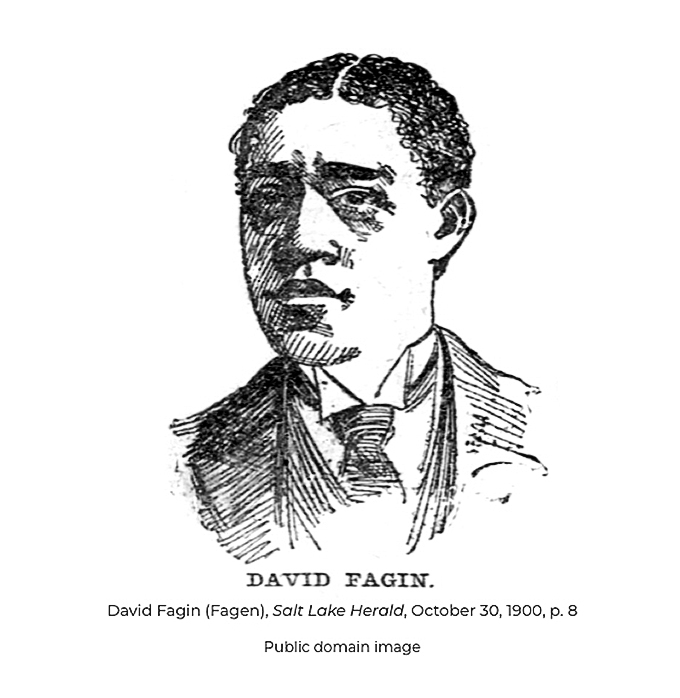
You won’t find this story anywhere else for Black History Month, but you should! By the mid-1900’s, a “Buffalo Soldier” named David Fagen was virtually a household name, particularly in the African American community. Fagen’s story makes myth of the false contention that African Americans offered little resistance to institutionalized racism from the Civil War until the end of WWII.
Was Fagen a hero or mad dog?
The answer is rooted in whether you believe that fighting against U.S. colonialism/imperialism in 1899, in this case the U.S. war of Philippine conquest, is righteous and worthy of giving rise to a true hero, martyr and courageous Buffalo Soldier, who deserted the U.S. side and joined the Philippine Revolutionary Army. The PRA was fighting to establish their own independent republic after the Spanish were kicked out.
In diaries and letters, Black soldiers posted in the Philippines. recounted how racism was endemic in the U.S. military, describing the racist abuses suffered by both African Americans and Filipinos.
Fagen was a native of Tampa, Florida, the youngest of 6 children of former slaves. He grew up where Jim Crow racial segregation laws prevailed. With the specter of lynching, race riots and the chain gang looming over Tampa’s Blacks, Fagen “lived in dread at all times.” Searching for any escape from Jim Crow, Fagen enlisted in 1898, being assigned to the 24th Infantry Regiment, a unit of so-called Buffalo Soldiers.
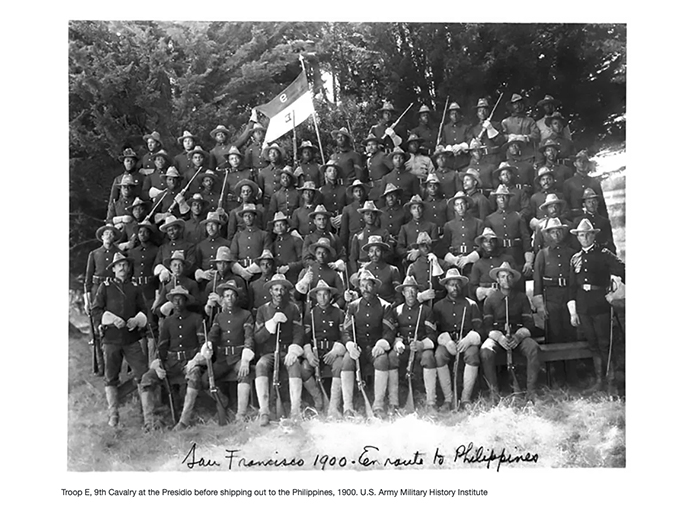
Expansionist America, intent on developing a global commercial empire, dispatched 6000 African American soldiers, including 2100 of the famed Buffalo Soldiers, to the Philippines islands per President McKinley’s assessment that the racial inferiority of Filipinos justified denying them sovereignty and engaging in a bloody war of conquest.
Fagen, now on the battlefield, detested his white commanding officer Lt. Moss, a West Point graduate. Moss and Fagen clashed repeatedly, with Moss eventually fining Fagen more than a month’s pay and sentencing him to 30 days of hard labor. Life was immutably altered when Fagen, after just a few months of battling Filipino rebels, turned his back on the U.S. army and joined Filipino revolutionaries who were fighting against American invaders.
At the time, there was a fierce debate in African American communities on their role in these foreign wars. Many saw the invasion of the Philippines as a ‘race war’, through which white settlers would inevitably repeat in Asia the wave of enslavement and genocide that had been inflicted on Native Americans and Black slaves.
Contrary to enlistment promises, African American soldiers in the Philippines were relegated to second-class status. Officers often ordered them to carry out ‘dirty jobs’ that no white soldiers wanted to do. They were also forced to serve as expendable “shock” troops on the frontlines, where lives were most at risk, while white commanders stayed back at a safe distance from the Filipino rebels.
Filipino insurgents put up posters and distributed flyers with messages encouraging ‘colored’ soldiers to join their cause, appealing to their common suffering at the hands of white Americans.
Historians studying the Philippine-American War estimate that at as many as 15 Buffalo Soldiers decided that their place, rather than helping to suppress the Filipinos’ struggle for independence, was in joining them in revolution. The supposed ‘deserters’ of the 24th infantry proved one thing: systemic racism and oppression by white Americans was enough to forge alliances across vast national and ethnic lines.
This may have been the very reason Fagen turned his back on the U.S. army, for a new life as a Filipino guerrilla. One night, Corporal Fagen snuck out of his barracks and met with a Philippine ‘insurrecto’ officer, who had arranged Fagen’s escape. The rebel agent had a horse waiting for Fagen outside the garrison, and together, they disappeared into the jungles.
Fagen was never captured or killed. Out of respect and tribute for his role as guerrilla leader, his Filipino compatriots addressed him as El General, although he was a Captain. Despite the wide respect and honor in which he was held by his fellow anti-imperialist insurgents, the U.S. army branded Fagen a deserter and traitor and expunged all memory of him from the annals of history. His racist white U.S. General, Frederick Funston, described Fagen as a “bandit pure and simple, and entitled to the same treatment as a mad dog”.
In this writer’s estimation, Fagen was anything BUT a ‘mad dog’, but a courageous resistance fighter who chose the right side in a battle against U.S. aggression and imperialism. I conclude with the aspirational belief, circulated by many, that Fagen fell in love with a Filipina woman and ran away to the mountains to live a peaceful life with her.
.
For more information on David Fagen, try these sites:
Zocalo Public Square; Wikipedia; Black Past; Esquire; UC Press; WUWF Radio; National Park Service
This piece orginally appeared in CounterPunch
…
21st Century Soldiering: Veterans of Post-9/11 Wars Reflect on Their Experience
By Steve Early and Suzanne Gordon

Review of Un-American: A Soldier’s Reckoning of Our Longest War, by Erik Edstrom’s (Bloomsbury, 2020); Pain is Weakness Leaving the Body: A Marine’s Unbecoming, by Lyle Jeremy Rubin (Bold Type Books, 2022), and Paths of Dissent: Soldiers Speak Out Against America’s Misguided Wars, edited by Andrew Bacevich and Daniel Sjursen (Metropolitan Books, 2022).
One frequent casualty of war is the confident belief shared by new soldiers that their cause is just and worthy of great personal sacrifice. After Al-Qaeda downed four civilian air liners and caused nearly three thousand deaths on September 11, 2001, US military recruiters were flooded with eager volunteers. Patriotic fervor, coupled with an urge for revenge and a desire to make the world a safer place, motivated many young men and women to enlist.
As the reality of simultaneous interventions in Iraq and Afghanistan began to sink in, many participants — like Vietnam veterans before them — became angry, embittered, and disillusioned. Some of them have turned to memoir writing that debunks the whole costly and disastrous $8 trillion project known as the “global war on terror.” Three excellent new book-length reflections on military training, socialization, and combat duty in the Middle East definitely won’t end up on the reading lists of college-level or Junior ROTC programs or even the US service academies.
But many civilian readers will benefit from the policy critiques and personal insights found in Erik Edstrom’s Un-American; Lyle Jeremy Rubin’s Pain is Weakness Leaving the Body; and Paths of Dissent, an edited collection compiled by Andrew Bacevich and Daniel Sjursen, bothof whom became historians after serving as career Army officers.
Like Bacevich and Sjursen, Edstrom attended West Point. Afterwards, he served as an Army Ranger, an infantry platoon leader and Bronze Star winner in Afghanistan, and a member of Barack Obama’s Presidential Escort Platoon. The grandson of a World War II veteran and product of a middle-class upbringing in a Boston suburb, he was part of the first post-9/11 crop of applicants to the Point, a place where “you couldn’t help but get excited at the prospect of shooting, bombing, and invading.” His second thoughts about soldiering started when his first-year class was immediately “isolated, separated from families and support networks” so that, during their “initial indoctrination,” they would be “sheltered from anything that could temper or make us question military dogma.”
Pray and Spray
As part of the process of getting “all-American swimmers, pious altar boys, cauliflower- eared wrestlers, nerdy class treasurers, and Eagle Scouts” ready for eventual deployments in Iraq and Afghanistan, West Point cadets were marched in cadence to this edifying chant:
“Left right, left, right, left right KILL!… I went to the mosque where all the terrorists pray, I set up my claymore, AND BLEW’ EM ALL AWAY . . . I went to the store where all the women shop, pulled out my machete, AND BEGAN TO CHOP! I went to the playground where all the kiddies play, I pulled out my Uzi AND BEGAN TO SPRAY!”
At the academy, Edstrom reports, “I was taught to think about how to win my small part of the war, not whether we should be at war.” Sent to Afghanistan, he soon discovered that “fighting terrorism” was a confounding task for soldiers up and down the “chain of command.” Many of his local foes turned out to be “teenagers or angry farmers with legitimate grievances…people tired of our never-ending occupation of their land and contemptuous devaluation of Afghan lives. When I searched my own soul, I couldn’t blame them for fighting back. Had I been in their shoes, I would have done the same.”
Lyle Jeremy Rubin took a more unusual route to becoming a junior officer disillusioned with his own “forever wars” involvement. As we learn in Pain is Weakness Leaving the Body, Rubin was a fervent Zionist in high school and a “pro-war activist” while a Young Republican in college. Skipping service academy training and ROTC at Emory University in Atlanta, Rubin first experienced the Marine Corps as a failed Officer Candidate School candidate who became a boot camp grunt. This gave him considerable insight into what he calls the “lance corporal underground” and “camaraderie of the enlisted ranks that adds up to a latent class solidarity.”
“As enlisted Marines are fond of remarking, they represent the majority of the military that ‘works for a living.’ The Marine officer corps, on the other hand, is made up of strivers, who’ve learned to compete at an early age and [end up] pitted against other in a cutthroat peer-review process and promotional system that follows…There was an earnestness to the enlisted existence, a conviction of collective duty and sacrifice, however barbaric its realizations, that was never allowed to congeal among the brass.”
Rubin was eventually tapped to be a first lieutenant doing signals intelligence work in Afghanistan. This followed a two-month stint at the National Security Agency headquarters in Fort Meade, Maryland, where he was briefed on a surveillance system “designed to make kill-or-capture missions as user friendly as possible.” As part of his training, Rubin learned about the NSA’s “pattern-of-life analysis of random Afghans at a Top Secret watch floor,” where it was hard not to feel suffused with a “god-like omniscience.”
Real-Time Targeting
As Rubin discovered later in the field, the US military’s ability to “eradicate anyone holding an earmarked SIM card” did not prevent tech-savvy Taliban commanders from “switching out their cards as a regular security precaution.” The same “real time” targeting capability was used thousands of times during his deployment “to finish off alleged enemy combatants, many of whom investigative reports have now concluded were civilians.” At the time, however, “battle damage assessments listed virtually all military-aged males as the enemy.”
The disconnect between “war on terror” propaganda and the reality of meddling in the affairs of a country long resistant to foreign occupation took a painful toll on Edstrom and Rubin. Upon his return to the US as an Army captain, Edstrom received “thudding back slaps and free beers from well-meaning civilians” for whom the war had become “elevator music.” Meanwhile, he had to live with the memory of soldiers killed and maimed under his command, and the knowledge that terrorism — in the form of “targeted assassinations, bombings, drone strikes, secret ‘black site’ prisons, torture, and wanton civilian murder” — was central to the “counter-terrorism” mission. All Rubin wanted to do, after coming home, “was stop the war. And short of that, commiserate with those who, at the very least, could see it.”
The fifteen contributors to Paths of Dissent shared that desire as well and often helped create organizational platforms for educating and agitating against US foreign and military policy. In his essay for the book, Jonathan Hutto describes his path from Howard University to the Navy, where he became a key organizer of the “Appeal for Redress.” This 2006 statement, backed by several thousand active duty, Reserve, and National Guard troops serving in ten countries around the world, called on Congress to end the occupations of Iraq and Afghanistan.
Following their military service abroad, both Joy Damiani and Vincent Emanuele found their way to Iraq Veterans Against the War and Veterans for Peace. With their guidance and encouragement, Damiani “learned more and more of the truth whose surface I’d barely scratched as a miserable, demoralized soldier” assigned, as an Army public affairs specialist, to “making PR look like news and an unwinnable war look like a victory.” A Marine who refused a third combat deployment to Iraq, Emanuele took his criticism of the war to Capitol Hill, where he testified in 2008 about mistreatment of prisoners and “rules of engagement” that endangered non-combatants.
Pathways to Dissent
Among the other notable voices in this outstanding collection are Matthew Hoh, a dissenter within the Pentagon and the State Department who resigned in protest in 2009, continued his anti-war activism, and ran for US Senate as a Green Party candidate from North Carolina in the most recent midterm election. In another chapter, entitled “Truth, Lies, and Propaganda,” former minor league baseball player Kevin Tillman recalls how he and his brother Pat, a National Football League star, became Army Rangers, deployed to Iraq and Afghanistan. Pat Tillman’s death during a 2004 firefight in Afghanistan was infamously covered up by the Pentagon. As his brother recalls, “the Bush Administration didn’t like the optics of a high-profile soldier like Pat being killed by friendly fire…So the government lied to us — his family— and to the American people with a manufactured story about dying by enemy fire and then used him to promote more war.”
In addition to co-editing Paths of Dissent, retired Army colonel and former Boston University history professor Andrew Bacevich and retired Army major Danny Sjursen both helped launch new vehicles for influencing public opinion about military intervention abroad. Bacevich cofounded the Quincy Institute for Responsible Statecraft, a Washington, DC-based think tank that is promoting “ideas that move U.S. foreign policy away from endless war and toward vigorous diplomacy in the pursuit of international peace.” As Bacevich told us when the Quincy Institute was launched in 2019, “I’m optimistic that we’re going to make a dent at least in the foreign policy consensus. That won’t necessarily send the military-industrial complex fleeing or surrendering, but it will have some impact.”
Like Quincy, the nonprofit Eisenhower Media Network, started by Sjursen, is dedicated “to educating Americans about the social, political, and financial destructiveness of the military industrial complex.” Now directed by retired Air Force Master Sergeant Dennis Fritz, the Media Network has assembled a distinguished roster of former service members who can offer media outlets an alternative perspective often missing from mainstream reporting and commentary on “defense issues.” (Eisenhower experts include Erik Edstrom and his fellow Paths of Dissent contributors Dan Berschinksi and Matt Hoh.)
By making well-credentialed Pentagon critics available to podcasts, tv and radio shows, national magazines, and newspapers, the media network is trying to reach “broad cross-partisan audiences,” rather than just activists already opposed to war and militarism. The authors of Un-American, Pain is Weakness, and Paths of Dissent have the same vital educational mission, which their readers can assist by spreading the word about these books and getting local libraries and bookstores to order and display them.
…
“We’re Not Allowed to Hang Up”: Harsh Reality of Working in Customer Service
By Ariana Tobin - Ken Armstrong - Justin Elliott /ProPublica
ProPublica is a nonprofit newsroom that investigates abuses of power. Sign up to receive our biggest stories as soon as they’re published.
<script type="text/javascript" src="https://pixel.propublica.org/pixel.js" async="true"></script>In their own voices, seven customer service representatives reveal what it’s like being caught between abusive callers and demanding employers.
Last year ProPublica wrote about the world of work-at-home customer service, spotlighting a largely unseen industry that helps brand-name companies shed labor costs by outsourcing the task of mollifying unhappy customers.
As we reported on the industry, we invited current and former customer service representatives to contact us. They did. We heard from more than 100 and interviewed dozens. Often, their stories disturbed us. One woman, afraid to take a bathroom break, kept a jar under her desk in case she needed to urinate. Another, afraid to call in sick, paused calls to vomit. A third, afraid to hang up on a customer, didn’t know what to do when she realized a caller was masturbating to the sound of her voice.These accounts captured how agents are simultaneously ubiquitous and invisible. Customers talk to them all the time but know little about their work conditions.
So we’re providing accounts from seven agents, many of whom describe the experience of being caught between abusive callers and corporate directives to appease. These seven are highly representative of the 100-plus agents we heard from, as well as the agents we interviewed in our first article. The agents, including some who told us they love their setups, laid out common themes, describing problems that people at various levels of the industry, including managers, have told us are endemic. We’ve also found echoes of these complaints in lawsuits and arbitration claims. Abusive callers are such a concern that, a few years ago in Canada, a union for telecommunications workers launched a campaign called “Hang Up on Abuse.” Airbnb, recognizing the emotional strain of taking such calls, offered their in-house customer service agents free therapy sessions.The reps we spoke to needed these jobs, which allowed them to work from home even before the pandemic. They included people with disabilities, caretaking obligations or limited opportunities in rural towns. Recruitment ads touted flexibility and the chance to be your own boss. But many agents discovered the roles came with limited hours, close monitoring and strict performance measurements that put them in constant fear of losing their jobs. A Department of Labor investigator concluded that one contractor, Arise Virtual Solutions, exerted an “extraordinary degree of control” over agents.
Most customer service agents are women. Many describe being sexually harassed. One said a caller told her, “I really like the way you type.” Their work belongs to a grim history of women in outsourced roles stretching back to the piecework manufacturing era. A half century ago, temp work exploded, driven by companies hiring women to cut costs compared with full-time employees. These magazine ads from 1970 and 1971 show how women temps were viewed at the time, and the attitudes have certain parallels to how customer service agents are viewed today. While many agents work full time, a growing segment are independent contractors who don’t get paid holidays, vacation time or fringe benefits.
The Kelly Girl “never takes a vacation … never has a cold … never costs you for unemployment taxes,” reads one ad reproduced by University of Buffalo sociology professor Erin Hatton in her book “The Temp Economy.” Credit: Courtesy of Erin Hatton
In the accounts below, most of the agents asked not to be identified, citing nondisclosure agreements that are common in the industry. (To work for some companies, agents must sign NDAs before they can even accept the job.) We’ve condensed for clarity and verified details wherever possible, collecting Facebook screenshots, email exchanges, company performance review forms, tax records and other proof of employment, along with contemporaneous recollections from agents’ relatives or friends. But there were instances in which we couldn’t get such documentation, owing in part to the premium placed on privacy and security by the companies. Some agents said they weren’t even allowed to have their personal phone in their workroom while helping customers. Some lost access to their email and the company platform when they quit or were fired, and they hadn’t made copies or screenshots beforehand. In every case we invited the companies that these agents worked with to comment.
Agent Taking Calls and Chats for TurboTax
Christine Stewart has social anxiety and depression. “I have a really hard time being out in public,” she said. She wanted to work from home, so she became an independent contractor for Sykes from 2017 to 2018. The company bills itself as “a leading provider of multichannel demand generation and customer engagement services for Global 2000 companies.” At Sykes, she helped customers using Intuit’s TurboTax.
“I was actually sick one day, I called, they have a supervisor line, and told them I was going to be [out] sick. And without actually saying it, the lady said, you’re going to be in trouble if you don’t show up. And me, I don’t like to get in trouble at work, I’m a good employee. I went to work. I kept hitting my mute button every time I had to throw up.”
During training, she said, “they told me if you wanted to work nights, you could work nights. If you want to work days, you can work days. Once you finish the training they’re like, ‘This is your schedule.’ I said I can’t work that and they were like, ‘Well, this is the schedule, and if you can’t work the schedule, you don’t want the job.’ I was like, ‘I need the job, I do want the job.’ I said, ‘I can do 8 a.m. to 12 p.m.’ They wanted me to do 12 to 12. I have to get my kids on the bus in the morning, I was like, ‘I need to take a five-minute break when the bus pulls up.’ Even that was a huge problem for them. They would say, ‘You can’t keep taking these five-minute breaks.’”Customers berated her. “One person called me the C-word. I’d call my supervisor. They’d say, ‘Calm them down.’ … They’d always try to push me to stay on the call and calm the customer down myself. I wasn’t getting paid enough to do that. When you have a customer sitting there and saying you’re worthless … you’re supposed to ‘de-escalate.’”
“There can be no background noise, no nature noises or cars passing by. I had a den. I had to insulate my den,” she said. (To confirm the expense, she shared a tax form with ProPublica that showed a $100 deduction.) “I had to turn the AC off; you could hear the AC blowing. They called me out on that. When I was training, the lady said she could hear the air conditioner in the background.”
One time, she said, “my kid broke his hand.” She dropped her call, dropped everything, to help him, but then she needed a story, because, she said, had she told her supervisors the truth — that her kid broke his hand and needed her help — “I would’ve gotten in trouble even if I had a hospital note.”
“I said my internet went down. I pulled the plug on everything, because it was their equipment. … I didn’t know if they had any kind of monitoring software that wasn’t on the webcam or anything. It was better not to take any chances and unplug the whole thing.”
Intuit told us that it “engages with vendors” able to deliver “flexible support,” and that it is “dedicated to providing a safe, ethical, and inclusive workplace for all of our employees and vendor workers.” (See the full statement.)
Sykes did not respond to requests for comment.
Agent Taking Calls for Bath & Body Works
She needed money for a medical procedure, so, during the pandemic, she began working for Liveops as an independent contractor, helping customers for Bath & Body Works. She worked from home.
For online orders, Bath & Body Works allows shoppers to use just one promotion per order. A customer, for example, can use a code to knock down the price of a particular item, but they can’t combine multiple codes. Customers can get upset when this is explained to them.
“We encounter customers who ordered the wrong items and want us to send them the right items for free. We receive calls from customers who have had their packages stolen. And then we get customers all the time who find out we don’t sell a particular fragrance anymore, and they can be just incredibly abusive.”
“I may as well say it out loud. We get called bitches all the time. One woman called me a ‘stupid fucking cunt.’”
“It can wear on you. We’re not allowed to answer back in the same way, nor are we allowed to hang up on them. Nor can we hang up on them after giving them one warning. The policy I am told is, we’re not allowed to hang up on any customer under any circumstances, even if they question our race or ethnic background or anything like that. My understanding is that we’re not even allowed to give people a warning.”
“We have to sit there basically and listen to these people until they run out of steam. It’s like they don’t see us as a person.”
With the pandemic, she said, a lot of agents are young women who lost their jobs and are desperate for anything. A lot of her fellow agents are Black women. “I’ve heard them say they were called ‘stupid n—–,’ ‘you stupid Black bitch.’”
Do You Work in Customer Service? We’d Like to Hear About Your Work-From-Home Jobs.
While some customer service reps are pressed to work more hours than they want, she got too few. Last fall, she signed up to work for four and a half hours during one day. She was paid 31 cents per minute of talking time. So when she wasn’t getting calls, she wasn’t getting paid. For those four and a half hours, she said, she sat there with her headset plugged in.
“No calls in those four and a half hours. Nothing. … I got some personal budget stuff done. Surfed websites unrelated to work. Familiarized myself with products on the website. I hate to say it, but I think I dozed off at one point.”
Were there other days in which you got no calls? we asked.
“Oh, yes.”
“How many?”
“I lost track.”
Liveops has quality auditors who listen to at least four of an agent’s calls per month, she said. They score agents using an audit form, which she shared with ProPublica. It says agents should make a “connected recommendation for each opportunity throughout the interaction” based on the customer’s orders. Say a customer buys soap. The agent should ask, “Did you want a soap holder, too?” If a customer buys candles, the agent should also pitch candleholders.
“A customer calls to say, ‘Hey, I didn’t get my package.’ So I’m supposed to say, ‘Hey, do you want to buy some more products when you still don’t have your package?’ Oh, for crying out loud. Really.”
The audit form has 20 questions. They include: “9. Did the agent compliment the customer’s selections, reassure about the fragrance choices and/or give general positive reinforcement about the items? … 18. Did the agent apologize when necessary, show empathy and/or recognizes customer emotion? 19. Did the agent let the customer know that we have ‘heard’ them, that we genuinely care, and did the agent remain engaged throughout the entire interaction?”
A Liveops document said that if an agent’s scores fall within the “unacceptable” range for three months in a calendar year, “the agent may be subject to removal from the program.”
She said she recently received an email saying she had used profanity on a call, so Liveops was terminating her contract. She didn’t remember saying anything profane. The company provided no recording for her to listen to. She emailed Liveops and called corporate to ask for details or a chance to hear whatever it is she was supposed to have said, but she got no response. (She said she didn’t make copies of these emails before her email account was closed.)
“No appeal,” she said.
Liveops told us that it does not comment on specific clients or agents, but said in a statement that agents choose their client programs and “have the freedom and flexibility to work around their lives.” The statement added: “All client programs have their own unique process for handling and dispositioning unproductive calls and significantly upset clients. There are controls in place to ensure that, to the extent possible, all calls are professional, and no customer or agent is subject to verbal abuse.” (Read Liveops’ full statement.)Bath & Body Works did not respond to requests for comment.
Agent Taking Calls and Chats for Barnes & Noble
She worked as an independent contractor for Arise Virtual Solutions, a company that bills itself as a pioneer in the work-from-home industry.
Customers, she said, “get mad at us. They start cursing at us. They start threatening to report us to the main office.” One customer, she said, told her he was going to keep her on the line until he got what he wanted; he “started with the F-word,” then apologized, then carried on. He “wouldn’t stop and wouldn’t stop” until finally, realizing the agent wouldn’t give in, he gave up.
At one time she handled calls from Barnes & Noble customers. “A lot of cursing, a lot of crying — crying — believe it or not. I’ve been called every name in the book. And I do mean from A to Z. Everything in between. I’ve been hung up on, threatened, told I’m going to lose my job. I had one woman tell me, ‘I hope you have a miserable day.’ You can’t laugh. I can’t laugh. I’m thinking to myself, ‘You ordered the Bible. You’re some Christian person?’ She’d ordered a Bible! Those are the worst! Those are the worst hypocrites! They scream, curse, yell, carry on, threaten. They’re the worst.”
“The women, their mouths are unbelievable. Or they start crying. They’re worse than the men. I’m like, ‘It’s a book, for God’s sake.’”
Arise told us that it does not tolerate harassment of any kind. (See the full statement.)
Barnes & Noble did not respond to multiple requests for comment.
Agent in a Call Center Taking Calls for Sprint
She was employed by iQor (pronounced I-core) as a retention specialist and sales agent, taking calls from customers for Sprint (which has since merged with T-Mobile). She worked in a call center.
“If the customer is angry and wants to completely cancel, you have 14 minutes to resolve their issue, get them to stay and sell them a new phone,” she said.
A unit called workforce management would push agents along. One workforce management monitor would sit at a computer, checking the length of each agent’s call. Another would walk the floor. These two would communicate by walkie talkie, one alerting the other to any agent whose call was running long.
“At 10 minutes you had somebody tapping on your shoulder. At 12 minutes you had someone tapping on your shoulder and saying, ‘Wrap it up, wrap it up, wrap it up.’ At 14 minutes, ‘What’s going on? You need to wrap this up. You need to move on.’”
“We had this guy who would run around on the floor yelling, ‘Move it along, people, all hands on deck, move it along, move it along.’”
Agents would have management in one ear and customers in the other. Customers would often be insulting, sometimes shockingly so.
She remembered one customer in particular. “He was very, very upset. And it’s personal. You get called names. ‘I hope you fucking die.’” Another Sprint customer told her: “‘I hope when T-Mobile takes over, you all lose your fucking jobs, your fucking families, your fucking homes, and you all kill yourselves.’”She said she was not allowed to hang up. Only a supervisor could do that. “Where’s the line where you no longer have to take that?” she said. “I spent more than one instance in the bathroom, crying, then shaking it off and going back to work.”
“I’m pretty thick-skinned, and I had nightmares. It beats you down. Everybody is angry. Eight out of 10 calls, they’re angry and they’re cursing by the time they get to you. Usually it’s the men who make it personal. That’s why I coined the term AngryWhiteManistan. ‘I have another resident of AngryWhiteManistan here.’ They’ll say things like, ‘Well, then, you better get me someone who is not incompetent.’”
In her nightmares, she said, she would be doing some mundane task, such as making dinner in the kitchen, when the phone would ring. She’d pick up and hear: “Are you done yet? We need to move on. We need to move on. We need to move on.”
T-Mobile, which merged with Sprint in 2020, told us it wouldn’t comment on Sprint’s prior practices. Since the merger, T-Mobile said, it has taken steps “to align T-Mobile’s Care practices across our team and all our partners to our award-winning Team of Experts (TEX) model, which heavily prioritizes customer and agent experience over more traditional call center metrics.” The company’s statement added, “We have a long-held policy that all of our experts do not have to tolerate abusive speech or behavior.” (Read the company’s full statement.)
IQor did not respond to requests for comment.
Agent Supervising Other Agents Taking Calls for DirecTV
She’s lived in “many, many states” and worked in many call centers. Now she lives out west in a rural setting where jobs, and options, are scarce. A few years ago she found a job that lets her work from home. She started as an agent at Convergys (since acquired by Concentrix), then became a supervisor.
“It’s just enough of a wage that you’re going to be ineligible for most public support. I’m not eligible for any financial aid whatsoever. And yet I go to the food bank every month because I don’t make enough money. … I don’t go to the doctor, even when I should.”
She said the job attracts a lot of new parents. And retirees. And people with medical issues. She said that in her experience, the turnover is “tremendous.” Within months, many people get fired, or “termed,” short for terminated. “We fire more than they resign. A lot more.”
Most firings are over attendance. What counts as an attendance infraction? “Anything. It doesn’t matter if it’s in your control or not. … Your power goes out and, bam, you’re absent. … Doesn’t matter if you had a hurricane.”
“You don’t know if you’re going to have a job tomorrow.”
Once, as a supervisor, she listened to a recording of a call that had been made to an agent working at home, answering calls from customers for DirecTV. “DirecTV had a policy, you never hung up on a customer, ever. You simply weren’t allowed to, no matter what they said.” (ProPublica interviewed another agent who also understood this to be the case.)
https://d37c22024108c65aef247958a612fa8c.safeframe.googlesyndication.com/safeframe/1-0-40/html/container.html“There was a guy who called in and masturbated on the phone. It was awful. … Just imagine being a woman in your office in your home, alone. And here’s this guy doing this, and it takes you a few minutes to figure out what that sound is, and when you do you’re horrified, and you don’t know what to do. All you know is, you’re not allowed to hang up the phone. That would be horrible. I felt so terrible for her.”
The agent, crying, asked if she could quit for the day without an attendance infraction. “We had the recorded call, it’s not like it was ever in doubt. My boss was a man, at first he didn’t understand why that was an issue.” He didn’t understand why the agent was so troubled. “I had to go to HR to get them to explain to him why it was an issue.” Only then could the agent stop taking calls.
Convergys was acquired by Concentrix in 2018. Concentrix said it does not disclose details about current or former staff out of respect for their confidentiality, but said in a statement: “We recognize that the work-at-home environment isn’t for everyone. … We take the health and safety of our staff very seriously and do not have a no hang-up policy. Our staff are given extensive training to manage each interaction with techniques to deflect and diffuse situations should they arise. If subjected to harassment or abuse they are trained and empowered to end the conversation.” (See Concentrix’s full statement.)
DirecTV told us: “The allegations are disturbing. We suggest you contact the agent’s employer.” In a written statement, the company said: “We don’t tolerate, and we don’t expect our vendors to tolerate, harassment of any kind. We have policies and procedures in place for our employees to escalate inappropriate customer interactions and the ability to terminate any customer interaction if and when that becomes necessary.” A DirecTV spokesperson said in a phone call that “to the best of our knowledge,” the company has not ever had a no-hang-up policy.
Agent Taking Calls for Home Depot
She’s in her 60s and wanted a work-from-home job to keep her family safe during the pandemic. She saw a company called Arise Virtual Solutions mentioned online, but she was skeptical. She would be an independent contractor, required to absorb substantial startup costs. (ProPublica’s previous article on customer service noted that Arise’s agents often spend more than $1,000 on training and equipment.)
Then she saw Bob Wells, a real-life nomad featured in the movie “Nomadland,” talking about Arise on YouTube. She decided to give it a chance. “I was like, ‘I need work.’ … I’d kind of given up on finding something more legit, frankly, because of the pandemic. So it was a pandemic Band-Aid for me.”
She answered calls from customers for Home Depot. One, a nurse’s aide, had ordered a portable toilet for a client. “This woman was like, ‘I have a 90-year-old lady who needs this thing like, yesterday, and you haven’t delivered it for three weeks, what is your problem?’” To the agent, this was urgent. “When it became a humanitarian issue, and there were plenty of humanitarian issues, especially during the pandemic,” she would send the matter to people above her, who would then send it to Home Depot to do something. The customer’s problem might then be resolved. “But my stats would go down,” she said, because she hadn’t resolved the matter herself. (She shared Arise’s performance metrics with us.)
On days when the phone didn’t stop ringing — and there were many — she couldn’t step away from her desk. “I had a bottle I kept under my desk in case I had to urinate. I never used it, but I had it there if I needed it. I’m in my 60s. … There could be an emergency.”
The work was isolating. She joined Facebook groups (and provided screenshots to ProPublica) and began to talk with other frustrated agents. She realized she was among the few white women in her work cohort. And she realized customers were nicer to her — an immigrant with a British accent. “When I first came to this country, I couldn’t believe people could tell the color of a person over the phone. That was a culture shock. … When people are calling in, I think they find it easier to yell at a Black woman. … I’m not the most evolved person, but I began to look at the work through a racial lens. … I answered the phone, and there were people who called, and right at the beginning of the call, they were full of white-hot rage.” Then they would hear her accent. “Well, the amount of comments I got from people who were like, ‘Wow, they’ve got classy people here!’ … I was born in a British colony. People think I’m a butler or a classy servant.”
Home Depot spokesperson Margaret Smith told us the company uses an escalation process designed to help agents handle difficult calls. “If a customer becomes irate or disrespectful, we ask the associate to either have their supervisor take over the call or transfer the call to the resolution queue,” she said. Agents who use this process are not supposed to be penalized, she said. (Read Home Depot’s full statement.)
Arise provided us with a statement about its network of agents, whom it calls service partners. “Arise does not tolerate discrimination or harassment of any kind,” the statement said. “Service Partners interacting with individual customers through the Arise® Platform are protected by both client and Arise policies and processes that include the ability to disconnect callers without penalty or transfer these calls to support resources if they are unable to de-escalate the situation.” (Read Arise’s full statement.)
Agent Taking Video Calls and Chats for TurboTax
Mara M. was a hairstylist and cosmetology teacher when her health began worsening. “Probably in about 2015, I started sleeping a lot. Any time I would stand up I would get really dizzy, really lightheaded. One of the requirements to teach hair is to be able to stand. I couldn’t stand up. It was a walker and wheelchair for me. … I have postural orthostatic tachycardia syndrome.”
Mara eventually discovered Concentrix, a global customer service outsourcing company, while searching for work-from-home jobs on Indeed.com. She signed on at age 23, hoping she might be matched with a company that sold beauty products.
At her orientation three weeks later, Mara learned which account — that is, which of Concentrix’s corporate clients — she would be matched with. She would be working part time, doing video calls and live chats for Intuit. She would be helping people use TurboTax.
Mara didn’t have an office. But she did have a closet. So she turned her closet into an office. (She sent us photographs.) “They sent me a blue screen to put behind my chair,” she says. That way, customers wouldn’t know she was working from home, much less from inside her closet. She bought a computer, a monitor, a headset.
“We were not supposed to hang up. … You’re supposed to hear them out, then empathize with them, then acknowledge that the problem was made. I had tried all that. They say, you know, apologize, but the people stay angry.”
One customer called her, moaning. “I was very uncomfortable. I couldn’t tell if he was sick; I couldn’t tell if he was watching porn in the background. I just tried to get through the guy’s questions.” Afterward she told a friend that she thought the man on the other end of the line had been masturbating. (The friend confirmed this conversation.)
She learned that agents were monitored. “We had a webcam, and [the monitors] can see you through the webcam. … I’m not sure how often you were watched. But the trainer did say you should shut down your computer after your shift because they can still see you. I was like, that’s really Big Brother. … That freaked me out because I spend a lot of time in my room.” And she learned there were no built-in breaks for part-timers. “You can’t step away when you’re on the clock.” She said it felt confining, like her closet was a prison cell.
She struggled to answer questions about complicated tax forms. She would Google for answers in a different window while trying to look confident to the customer, who could see her on the video call. “I had a nightmare so bad that I’d wake up at 6 in the morning over this job. I cried. I’m a sensitive person, so a lot of people probably wouldn’t have cried. … I didn’t know what I was doing. … I was like, ‘I finally have a job, but I don’t know what the answers are.’”
Mara didn’t feel like she could quit. For the most part, she said, her metrics were high. But customers weren’t responding to survey questions about her performance. And her lowest score was her “doc rate” — documentation rate — which penalizes agents for not closing out a chat with a customer. They get credit only when a customer says, “Yes, you have answered all my questions.”
“Some people don’t answer back after they get the answers they need. For those types of chats and everything, we couldn’t close those cases. My doc rate dropped because … I couldn’t close the case on some of them.”
Eventually, Concentrix emailed to say that TurboTax wanted her off the account, citing “a review of stats … done over the weekend.” (Mara shared copies of the exchange with ProPublica.)
“I do apologize for the inconvenience,” a Concentrix representative wrote. “Please feel free to apply for other Concentrix accounts!”
Intuit told us agents are “provided training to end calls with customers should they encounter abusive or threatening behavior.” Its statement also said that Intuit establishes performance standards with vendors such as Concentrix: “Vendors — not Intuit — are responsible for ensuring those workers they engage to support Intuit’s customers or our account meet those standards.” (Read the full statement.)
Concentrix, which said it does not disclose details about current or former staff, told us, “We take the health and safety of our staff very seriously and do not have a no hang-up policy.” (See Concentrix’s full statement.)
…
Ariana Tobin, Ken Armstrong and Justin Elliott – ProPublica
Mollie Simon contributed reporting.
ProPublica is a nonprofit newsroom that investigates abuses of power. Sign up to receive our biggest stories as soon as they’re published.
The Floor
By Robert Gumpert
Two “front of house” workers, a lead waiter and a bartender, speak about their jobs
For fullscreen view, click the little square in the righthand bottom corner next to the magnifying glass
Womack’s Labor Power and Strategy
By John Bowman
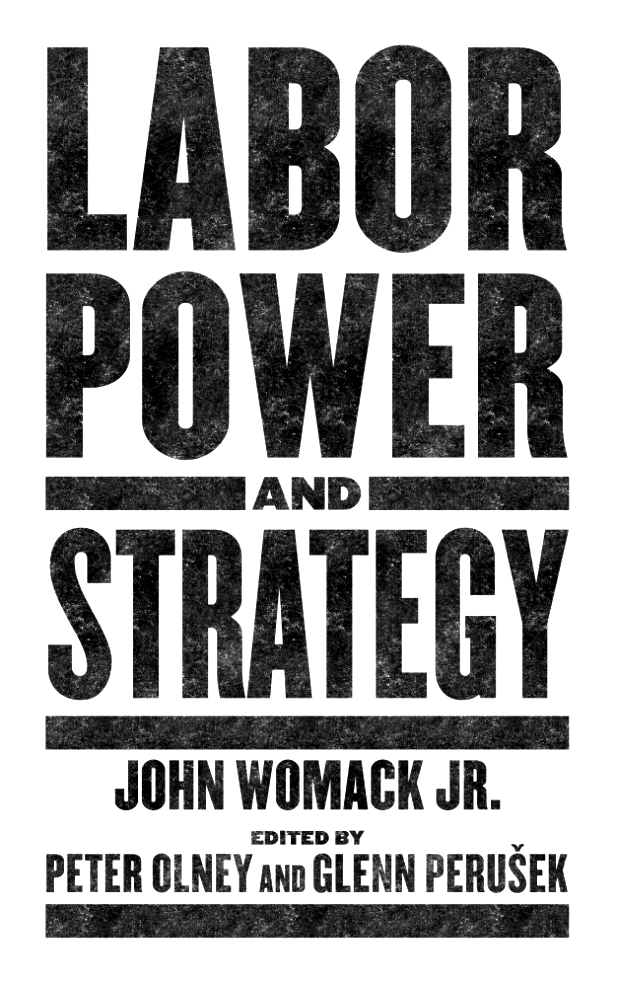
Labor Power and Strategy, order from: PM Press
Let me start with a confession. I am not affiliated in any way with organized labor or the labor movement. I have spent over 60 years as an editor of non-fiction works—American history, baseball history, art books, photography books, etc. That said, starting in my early teens I was expected to work at household chores (rolling coal ash can out to curbside, hanging storm windows). On my college vacations, one year I worked at a summer resort, another at the Monsanto chemical plant (then in Everett, Massachusetts, where the Encore casino now is), and another summer at a leather tannery in Woburn, Massachusetts (later charged with pollution—told in the book and movie, A Civil Action). And meantime, as a devoted reader of newspapers all my life, I have certainly kept up with the labor movement in our country.
In fact, indulge me in a personal tale that involves two items on my cv above. For some reason the tannery workers seemed to belong to the United Electrical Workers union (UE), then regarded as one of the more leftish, more radical unions. Every Friday a big stack of the union’s newspaper would appear. I watched to see if the workers would take an interest in the paper, but no—they grabbed a copy and wrapped their dirty clothes in it to take home to be laundered. I seemed to be the only guy who read it. So let’s say I write this as a fairly well informed American with a more than passing interest in the subject matter of the book under discussion.
The book is Labor Power and Strategy by John Womack Jr.—the highly respected Harvard professor and authority on the Mexican revolution. But although he is credited as the author, its two editors—Peter Olney and Glenn Perusek—played a major role in assembling the book, first by interviewing Womack for his contribution. Since the interviews took place in the Foundry, a restaurant in Somerville, MA, they are sometimes referred to as “The Foundry Interviews.” The editors then enlisted the ten individuals who contribute their responses to Womack’s extensive thoughts on the book’s subject—how to identify union power and use it—almost all with firsthand experience as union organizers and union actions. And by the way, not always agreeing with Womack—which is what makes this book especially engaging–and relevant. It is not just some Harvard professor’s highfalutin theoretical treatise.
It is a relatively small book –both in its page-size and page-numbers—but it is full of stimulating–and often provocative–ideas about the labor movement in our country over the last century and—above all– where it should be heading in the present century. If the book can be briefly characterized, I can do no better than quote the words of the historian Nelson Lichtenstein in the front of the book, where he poses the question at the heart of the book: “Are workers with vital skills and strategic leverage the key to a labor resurgence, or should organizers wager upon a mobilization of working people whose relationship to the economy’s commanding heights is more diffuse?”
In the course of the book, this is sometimes compressed to the structural vs. associational approach, and if Womack comes down on one side, it is the former. Structural in this instance refers to labor activists, union organizers, primarily going into the actual workplaces and seeking out what are called “choke points” — those crucial locations or processes that if stopped would bring the entire factory, workplace, delivery service, whatever, to a halt. The most prominent example of this is actually cited by one of the responders to the book—Gene Bruskin, who headed the campaign to advance the union’s demands at the Smithfield pork processing plant in Tar Heel, North Carolina. He describes how they identified a particular “choke point” in the process of converting live pigs into pork products and by ceasing to work there, a contingent of workers brought the whole operation to a halt. Their secondary demand focused on another “choke point” – where the trucks delivering the live pigs had to be unloaded.

A ”Womackian” analysis of the Smithfield case would stress that what was at work here was a structural approach: you just go straight into the workplace and disrupt the operation. But Bruskin explains that he also involved elements of the associational approach, launching a field campaign in the surrounding communities, seeking broad public support. And in fact, neither Womack himself nor any of the ten responders is an absolutist—all concede something to the opposing approach. Bruskin’s account of the Smithfield case—2005-2009—is the most detailed account of a specific union action, but numerous examples of such are cited, from the 1919 steelworkers strike to the 1930s automakers strikes, to the more recent strikes by West Virginia teachers and organizing among Nissan workers in Canton, Mississippi, and casino workers in Las Vegas.

I myself have a minor quibble with the book—or rather to Womack’s responses to the interviewer. He does go on, despite what I say above, with his theoretical ideas. And I might have wished that he discussed in a bit more “grounded” detail five of the factors that I, at least, see as bearing greatly on the labor movement in the decades ahead: the role of the waves of uneducated immigrants, the role of robots, the role of the Chinese, the role of electronification of work, and the role of the “gig” economy. But that’s for a different book–and perhaps a different author. This is Womack’s book. And if I, the individual described at the outset, can find it so enlightening and so engaging, then I think that anyone should appreciate reading it
.…
Please join us at one of a number of Labor Power and Strategy upcoming events with John Womack Jr. and contributors