The Stansbury Forum Resource List 01
By Robert Gumpert
With times being what they are we at the Stansbury Forum thought a resource list might be useful. This list is neither definitive nor singular: we, with your help, will update the list periodically.
Political Action
Swing Left
Knock Every Door
Town Hall Project
The Resurgent Left
Run for Something
Our Revolution
flippable
Sister District Project
Indivisible
Training
Know Your Rights
ORGANIZE Training Center
UC Labor Center
The Worker Institute
Highlander Research and Education Center
General Interest
Democracy Now
The Texas Observer
ProPublica
The Pew Research Center
Portside
The Pump Handle
The Intercept
Yes! Magazine
The Real News
VOX Topics
Alternet
Urban Institute
Open Democracy
Narratively
Pulitzer Center
London Review of Books
Arstechnica
Quartz
The Conversation
The Guardian
NY Times
LA Times
Washington Post
Lapham’s Quarterly
In These Times
Rewire
Sport
Edge of Sports
International
Asian Correspondent
New Mandala
Soufan Group
Social Europe
Understanding Society
US Labor Against the War
Transform Europe
Red Pepper
Morning Star
Spectrezine
Il Manifesto, Global Edition
Culture and Society
Aeon
Alt.Latino
Longreads
First of the Month
Oxford American
The Blue Moment
Texas Monthly
Huck Magazine
Appalshop
Politics
Crooked Media
TomDispatch
TruthDig
TruthOut
CounterPunch
Immanuel Wallerstein Commentary
ROAR Magazine
Moyers and Company
Border Criminologies
Color Lines
Southern Poverty Law Center
Kentucky Rural-Urban Exchange
Talking Point Memo
Think Progress
Committee to Protect Journalists
Economics
Americans for Financial Reform
Institute for Policy Studies
Labor
Labor Network for Sustainability
Labor Notes
Jobs with Justice
NYCOSH
National Domestic Workers Alliance
Sexworker Open University
International Labor Organization
Migrant Sex Workers
Teamsters for a Democratic Union (TDU)
NY Taxi Drive Alliance
Show Me 15
Los Angeles Garment Worker Center
International Transport Workers Federation
Union Solidarity International
Equal Times
RankandFile.CA
Talking Union
Criminal Justice and Law
The Marshall Project
Center for Court Innovation
Center for Justice & Democracy
Vera Institute for Justice
Prison Policy Initiative
Center for Constitutional Rights
Homelessness
National Coalition for the Homeless
Street Sheet
Human Rights and Immigration Issues
Human Rights Watch
ACLU National
Amnesty International
IRIN
Beyond Slavery
End Slavery
National Council of La Raza
Immigrant Defense Project
Center for Constitutional Rights
Anti-Slavery International
Edjustice
My Undocumented Life: Up-to-date information & resources for undocumented immigrants
Immigrant Defense Project
National Council of La Raza
Health Care
Introducing Vital Signs
Planned Parenthood
How the Super Bowl Trumped the Mexican Constitution
By Álvaro Ramírez
This week The Stansbury Forum is running three posts from Professor Álvaro Ramírez’s blog “Postcards from a Postmexican” where Profressor Ramírez tries as a twentieth-century person to make sense of the twenty first century with its transnational and post-national realities that many people live today in countries such as Mexico.
18 February, 2017: How the Super Bowl Trumped the Mexican Constitution
Last Wednesday, some students studying in Cuernavaca invited me to Tónic, a local hangout, to watch the Mexico-Iceland friendly soccer match. Besides a table with eight students and myself, and a couple other tables with six men, the bar was completely empty. What a stark contrast with the scene just a few days earlier on Sunday February 5, when the same bar, as well as many other restaurants and sports bars across the city, was filled to the brim with enthusiastic Mexican fans of American football watching the Super Bowl game between the Falcons and the Patriots.
You would think that now that so many are calling for Mexican national unity during these times of uncertainty brought on by the Trump menace, that Mexicans would be unified behind the national team that, as usual, was playing a friendly game in the United States and not in el Estadio Azteca (much more lucrative to play in Gringolandia). But no, Mexicans gave their team the cold shoulder, they didn’t come out in droves to watch the game (unlike the paisanos in the USA) and went about their normal daily lives, leaving my Mexican American students from California and Oregon disappointed and baffled.
Why so much enthusiasm for American football and so little for el fútbol mexicano? This attitude is peculiar to say the least since for weeks now the Mexican media has been pummeling Trump and his supporters. Everyday newspapers, radio, television, and all social media blare out negative stories: no to the deportation of immigrants, no to the Beautiful Wall, and we’re not paying por el pinche muro! Says Mr. Fox. The frenzy has been bewildering. Then, the sacred day, Super Bowl Sunday, arrived and everyone calmed down and for a day forgot about that damn wall and the paisanos that are suffering persecution on the other side of the border. Mexicans with the means to do so made reservations in restaurants and bars, some had parties at home, and still others somehow found time to sit in front of a modest television set to watch the game and root for…The Patriots! I could handle all of this if at least the majority had been on the side of the Falcons, but no, most of the Mexicans wanted Tom Brady and his coach, Bill Belichick (both Trumpers) to lead the Patriots to victory. Go figure.
What’s really comical is that as the Mexican fanatics jumped up and down with joy at the end of the thrilling game and talked about how great Brady was, I wondered how many of them knew that that same day Mexico was celebrating the one-hundred anniversary of the country’s constitution. Probably not many cared since to most Mexicans la Magna Carta has the value of a roll of Charmin paper. Few of them, I’m sure, had watched earlier in the day, around noon, as President Peña Nieto, his cabinet and all the other politicos representing the motley crew of useless political parties praised the equally useless, patched-up quilt of paper that is La Constitución Mexicana. The same pomp and baroque circumstance and discursos tan refritos that only give us lots of gas (y no del gasolinazo!).
But these fake Mexican patriots made sure to schedule the boring ceremonies early enough not to conflict with the true celebration that all of their non-compatriots were waiting for. So well before 5:00 pm, they put away the banda de guerra that had played the national anthem in front of el Teatro de la República in the city of Querétaro, where all these stale political theatrics took place. Then, the President, his cabinet and his generals, and the minions of the PRI, PAN, PRD, Morena and, let’s not forget the powerful, Partido Verde, they all scurried out of the theater and probably ran as fast as they could to their rich, confortable homes to sit in front of giant plasma televisions, surrounded by the best food and drink imported from the USA, and watched the football game and rooted and hollered for … The Patriots!
18 February, 2017: The Appearance of Mexican National Unity
Since the inauguration of Donald Trump, it has been great to see how the people of Mexico, from all walks of life, have suddenly found a reason to finally unite under a common cause other than when our national selection (some call it deception) soccer team plays a match against its despised American counterpart. Trump gave us the perfect pretext to create solidarity across the country. His negative image and words have penetrated deep within every aspect of Mexican society. How deep? Well, the other day some of my students who volunteer at a local primary school, La Esperanza, told me than when they met the children, who are indigenous and from the poorest sections of Cuernavaca, they asked the school kids if they knew any English words. The children quickly began to count from one to ten in English. And when my students asked if they knew any other words: many of the indigenous kids immediately yelled out, TRUMP!
Yes, Trump has made his way into the collective Mexican unconscious and has brought to the fore once again that anti-American sentiment which every generation that grew up under the PRI’s seventy-year regime learned well in school, a sentiment that has been disappearing with the NAFTA Generation who aspires to be American in cultural terms. It would seem, then, that Mexico has rediscovered its “other,” and it is none other than Trump and his republican followers.
Taking advantage of this newfound solidarity, some politicians and activists called for a national day of demonstration with the catchy name, “Vibra México,” that took place yesterday, February 12, in several cities across the country. The goal was to show the country’s repudiation of the Trump policies that, if implemented, will damage Mexicans, such as deportation of undocumented immigrants and the repeal of NAFTA. Pero, México no vibró, the people stayed home, only some 20,000 participated in Mexico City, a paltry turnout when you take into account that the metropolis has over 20 million people. The rest of the country did not see any larger turnouts either.
So, what went wrong? From the start some critics pointed out that the demonstration was way too late since in other parts of the world that are less directly affected by the new American president have shown their disagreement by demonstrating against Trump’s ideology since January 20, the day of his inauguration. Others asked: why not clean our house first? That is, protest against the violence, poverty, and corruption that have brought the country to its knees. Still others, didn’t want to participate for to do so, they argued, would amount to support Peña Nieto who is even less popular than the members of Congress in the United States.
So while Mexicans appear to have found the “other” that has reawakened their dormant nationalism, it seems that Trump does not have to worry much, at least for now. As usual, Mexican unity has proved to be an ephemeral event that last as long as a juego de fútbol. Even worse, as in other occasions such as during the Mexican Revolution, Mexicans have the tendency to unite momentarily against a common enemy, but that unity quickly disintegrates as they realize that the enemy, that is, the “other,” is also within. Poor Mexico, so far from God and so close to the “other.”
25 February, 2017: The Apotheosis of the Mexican Emigrant
A hundred years ago, as the Mexican government was unveiling its touted new constitution with lots of fanfare, hundreds of thousands of its citizens were desperately trying to reach the USA. By some estimates by the late 1920s, ten percent of the population of Mexico resided in El Norte. As such, the revolutionary state was born in a deformed state. One of its vital and most productive parts was, let’s say, delivered separately to the wrong national home. Maybe the stork got a bit confused because only 69 years earlier, the American Southwest was the Mexican Northwest. Be that as it may, the fact is that ever since, with the exception of the 1930s, roughly ten percent of the Mexican population has made the United States its permanent home.
It’s quite embarrassing when a so-called revolutionary state can’t entice its people to remain within the nation’s geographical limits. What pissed-off the Mexican government the most was that they were losing people mainly to the United States, which was supposed to be our rival and enemy, the threat that helped to coalesce the new, national, revolutionary society. Several strategies were used to stop the hemorrhage of people, but much to the chagrin of the government, the tactics failed and massive waves of migration ended up establishing two Mexicos: México de Adentro and México de Afuera. The first more or less bound to the Revolución, the second trying to bound itself to the USA.

US – Mexico border 1984. On the right the US, on the left, Tijuana, Mexico. Photo: Robert Gumpert
The relations between these two Mexicos were strained through most of the twentieth century with the Mexicanos de Afuera often being portrayed in Mexican literature and film as pochos, traitors, and malinchistas. The image during the Bracero Era (1942-1964) was perhaps less negative since most of these workers kept Mexico as their main home; but as soon as they were able to get their green cards after the program ended, these former braceros quickly moved their families to El Norte and were followed by another massive wave of circular migration, both legal and illegal, in the decades of the seventies and eighties. Most of these new emigrants established roots throughout the American Union after Ronald Reagan granted the undocumented amnesty in 1986, not out of his goodness but because he knew the Capitalist Machine needed them as workers and consumers. Los Mexicanos de Afuera had attained an economic clout that made us somewhat desirable in Gringolandia, not yet ready for primetime citizenship pero ya teníamos nuestro encanto económico.
In Mexico, the Mexicanos de Afuera began to show their newly acquired clout by transforming white adobe villages into reddish tabique towns. Tile floors and cement roofs with water tinacos became the sign of progress. Brand new cars and trucks of all makes with placas from many American states roamed the dusty streets of the Mexican countryside. Campesinos dressed in Gap clothes attended quinceañeras, bodas and bautizos. Our hard-earned dollars pumped new life into the sending towns and small cities of los Estados Unidos Mexicanos, but socially México de Adentro was ambivalent toward the flaunting of our migrant dollars: many viewed us with a bit of envy and refused to acknowledged we had made good in El Norte: “Todo ese dinero no nos quita lo naco, they said.” Naco (low-class, ghetto) the new adjective directed at us con desprecio, the new word that Mexicanos de Adentro flung at us along with the old favorites, pochos y malinchistas.
The government, on the other hand, wised up quickly when they realized that la gallina naca was laying lots of golden eggs in the form of dollar remittances and money spent on Christmas vacations, among other things. They had to find a way to keep us laying the golden eggs, that is, they wanted us emigrants to continue sending the monthly checks and coming back to our hometowns, even if it was only for a couple of weeks each year; so they launched an aggressive campaign under Salinas de Gortari: El Programa Paisano. Oh yeah!
First on the list, was to get rid of all the vampires at the border, that replica of Transylvania that made our life a big hellish mordida, and that we had to cross to get into Mexico. Now we were the paisanos that had to be protected at all costs from these Mexican border harpies and leeches. The change of attitude made it patently obvious that the government was trying to bring together the two Mexicos, to create a good relationship between its two peoples: no more pochos and malinchistas. Now, Mexicanos de Adentro y de Afuera were all paisanos. We could feel the love, but it wasn’t all there yet, something was still missing.
We could feel the love, but also the silence of México de Adentro when in 1994 Pete Wilson kicked Mexican immigrants around like a world-cup soccer ball. We could feel the love, but also the silence of our compatriotas mexicanos when the Clinton Wall went up at many border cities of the Southwest as part of the infamous Operation Gatekeeper policy forcing emigrants to cross through the gates of a hellish desert where thousands perished. We could feel a lot of love when in 2001 Vicente Fox and Jorge Castañeda were on the verge of negotiating the whole immigrant reform enchilada, which unfortunately ended up buried under los escombros de las Torres Gemelas de Nueva York.
Yes, we, the Mexicanos de Afuera, are now the darlings of the press and of the fake políticos of Mexico, we’re hailed everywhere as heroes of la Madre Patria.
In 2006, los paisanos living in the U.S. demonstrated that they not only had economic clout but also political power when they came out by the hundreds of thousands to protest and demand a just immigration reform. These actions forced los Mexicanos de Adentro to end their silence and finally show their full support for the other México. Suddenly, we were the object of lots of positive chatter in Mexican political circles and commentary in television programs and major national newspapers. We were no longer referred to as los emigrantes que se van al norte, now we were nuestros emigrantes para acá y nuestros emigrantes para allá.
The truth may be that Mexicanos de Adentro had no other choice but to accept us with our naquedad or naco-ness and all. It’s not just that a large percentage of México de Adentro has a relative in México de Afuera. No, what many have realized, especially government officials of all stripes, is the fact that los emigrantes form one of the important pillars of the Mexican economy. Hell, we may even be part of two main pillars: yearly remittances (27 billion dollars in 2016) and tourism (19.5 billion in 2016), for who knows how many billions of dollars we spend on our vacations in México throughout the year.
So, it’s only right that Mexican emigrants be treated with great respect in our country of birth. Gone are the days when many said that “sólo lo peor de México se va al Norte.” When Trump expressed similar sentiments, lots of Mexicans were pissed to the max. The reaction in Mexico’s press and political circles was to put us even higher on the pedestal: This man is offending “nuestros compatriotas, nuestros paisanos que trabajan muy duro del otro lado. We must unify behind our migrantes and protect them from los pinches gringos racistas.”
Yes, we, the Mexicanos de Afuera, are now the darlings of the press and of the fake políticos of Mexico, we’re hailed everywhere as heroes of la Madre Patria. Estamos de moda, trendy, the flavor of the month, but I got a feeling that this hero worship is due more to the fact that Trump is threatening the pillars of the Mexican economy that we represent. The Tasmanian Orange Devil’s immigration policies might kill the gallina que pone los huevos de oro, and the Mexican government is scared shitless and doesn’t know how to counter the move. For now they have only resorted to having Peña Nieto welcome repatriates at the airport: “Bienvenidos a su casa,” he says. “Here you’ll find lots of spaces for opportunities,” but we know this is all a political show.
Today, Mexicanos de Afuera are definitely on the hero pedestal. México celebrates us on December 18, “El Día del Migrante,” and soon there will be statues of us everywhere. I suggest that since Mexicanos de Adentro love monuments so much, what the government should do is erect one at the border similar to the Statue of Liberty; for instance, a giant China Poblana facing Gringolandia that welcomes returning migrants with an inscription that says:
“Send me my hard-working migrants to visit their land of birth, send me their huddled masses of children yearning to rediscover their roots on our teeming shores of Cancún, Cabo San Lucas, Ixtapa-Zihuatanejo, Puerto Vallarta and good old Acapulco, but don’t forget to come with your pockets full of money to spend, and, above all, don’t forget to send to me your billions of dollars every month for without them, México shall perish.”
Talking with a friend about Trump voters and how to reach them
By Garrett Brown
Dear Garrett: Yes. I’ve been having this nagging thought that while it’s important to resist, we’re still not getting the message that an awful lot of people voted for Trump and think he is doing a swell job. I still can’t see them. My former brother in law is one, but I have no idea how one would find common ground with him. But clearly, we lost all three branches of government, so what’s the message?
Abrazos, S
February 26, 2017
Dear S: Sorry for the radio silence – I have been tied up with various little projects that always seem to grow once you get into them.
Also I was thinking of how best to respond because I have been thinking about all this, the same as everyone. So, I will try not to go on and on, but I did want to reply about a couple issues.
I think there are multiple groups among the 63 million Trump voters. About half – 30 million or 10% of the US population – are straight-up racists or white supremacists or male supremacists or neo-fascists. These people are unreachable for us, and I am not that worried about that 10% of the population. If your former brother-in-law is in this camp, then I don’t think there is anything to say to him.
But the other half of Trump’s voters – another 30 million people – include various groups including people who voted once or twice for Obama and people who voted for Bernie. I do not consider these people to be white supremacists or neo-fascists, as much as I disagree with their votes.
What they did do was to overlook, tolerate or excuse-away the racist/misogynist/xenophobic campaign Trump ran. It is something worth pondering: how is it that things we think are automatically disqualifying and completely unacceptable, are somehow not that way for millions of people “who should know better.”
Reality is always 100 times more complex than theory, and we all know people who can and do hold conflicting ideas and attitudes in their head at the same time, which they often act on as well.
Having read 20-plus different articles and profiles on Trump voters, especially white working class voters rather than the right-wing ideologues, I think I had not really appreciated what the last 20-25 years of corporate globalization has meant for millions of working people in the “Rust Belt” and rural areas.
With the plant closures (due to automation and technology as well as “free trade”), with the decline of the union movement to its current 7% of the private sector, with the absence of any jobs with decent pay and benefits, and the tax base to pay for government social service – formerly Democratic working class people have seen their own lives, their families and their communities torn apart at the seams.
Moreover, all these communities were completely abandoned by the political class – Democratic as well as Republican – for years and years; left to twist slowly in the wind and told it was their fault that they were missing out. Some of the people interviewed said that they might have accepted that for themselves, but the thought that their children would have worse lives and a bleaker future than them was too much.
All they were promised by Democrats in this election was more of the same, with a slight technocratic tweaking that would do nothing to change the trajectory of corporate globalization that is immiserating working people in both developing and developed countries. Clinton epitomized the privileged, corrupt elite that is responsible for the destruction of their own lives, families and communities – which are now consumed by drug addiction, economic stagnation and early deaths.
It rang out from all the interviews that these people – Trump’s 30 million “reachable” voters – that they were convinced they are screwed, no matter which candidate won the election, so they might as well vote for the non-politician, “successful businessman,” who had the entire establishment lined up against him. This was a “hail Mary pass in the 4th quarter” – as one of them said – that was the “last, best chance” for a revival of their communities and families.
Their vote was in spite of the things that Trump said that were automatically disqualifying, unacceptable for us. So, while I understand the rationale for voting Trump – it ends up with a regime that will be worse for everybody, including the white working class voters who once belonged to a union, or who voted once or twice for the first black president, or voted for a self-described socialist.
On another point you raised, I also don’t think that the 30 million reachable Trump voters think he is “doing a swell job” – the racists, misogynists and fascist wannabes no doubt think he is not evil enough. But the polls – with whatever caveats are necessary – indicate:
• Trump’s transition had only a 45% approval rating;
• Trump started out his presidency with a 42% approval rating – the lowest of any president in the polling era;
• Trump made history again in generating a majority disapproval rating – again the polls may not perfect but the same questions have been tracked over years – in only 8 days as president. It took Bill Clinton 573 days, Reagan 727 days, Obama 936 days and George W. Bush 1,205 days to slip below 50% approval rating; and
• a majority of people polled from both parties (59% of Republicans and 76% of Democrats) say they are “stressed” about the future of the country under Trump.
At the same time, the Resistance is getting majority approval for both activities and issues:
• 60% approved of the women’s marches, with 33% strongly approving;
• 60% are opposed to building a wall on the southern border;
• 53% are opposed to halting refugee arrivals;
• 70% are in favor of offering illegal immigrants a chance to apply for legal status;
• more than 60% want the EPA’s regulatory powers maintained or strengthened; and
• 56% believe Wall Street is still a threat to the US economy.
Also the “bet” that the 30 million reachable voters made that their lives are going to get better with Trump is clearly not going to work out for them. Trump’s Cabinet of millionaries and billionaries are interested only in more inequality, and their policies can only bring more poverty, illnesses, and lives with no future.
A few thousand new manufacturing jobs – at reduced pay and minimal benefits – is not going to replace the 8 million good manufacturing jobs with decent pay and benefits that have disappeared over the last 20 years. Their families and communities will still be in the race to the bottom, invisible and abandoned – all so that corporate profits continue ever-upward.
So, for me the question about the 30 million reachable Trump voters is how long does it take for them to realize they have been snookered, who do they blame (could work our way or the other way), and what do they do about it.
Part of having it go our way when the Great Disillusionment occurs for the 30 million, I think is for us to pay more attention to and look for common ground with these 30 million and their families.
Obviously, we have to fight to protect all those vulnerable, and to fight every “turn back the clock” proposal out of the White House and Congress. But I think if we do not adopt the smug, patronizing, condescending attitude of the liberal elite toward working people, we can find common ground for discussion (for a start) and perhaps joint action on issues like:
• decent jobs with livable wages and benefits;
• access to quality health care, especially for diseases affecting rural and working class communities (of various colors);
• real retirement and pensions so people don’t have to work until their dying day;
• quality care of veterans (who are mostly working class of various colors in the “volunteer” military) – in terms of health care and jobs and homelessness; and
• the future of their and our children – most people care more about their kids than themselves, and this is something we can try to connect on in terms of the items above but also the environment and climate change (for those who have not gone back to the 13th century on science).
Sorry for being so long-winded, but I think we should not give in to the “fake news” that we lost, or that all Trump voters are unreachable, or that we cannot expand our majority with people (regardless of their 2016 vote) whom we actually share common ground, and need to win over if the country we want to live in and pass on to our children is to come about.
Un gran abrazo,
Garrett
Debating the Working Class 50 Years Ago in SDS: Lessons for Today?
By Joe Allen
Fifty years ago in August 1966 delegates from across the United States attended the annual Students for a Democratic Society (SDS) Convention in Clear Lake, Iowa. Located in north central Iowa and held at a local Methodist camp, it provided a bucolic setting to debate its future.
SDS was at a crossroads in 1966. It had evolved into the largest radical student organization in the United States and was going through a major membership and political transformation, according to SDS historian Kirkpatrick Sale.
For attendees, Clear Lake convention—350 delegates from 140 chapters meeting from August 29 to September 2—was symbolic. Leadership was now transferred from the original members to the newer ones; from those born in the left-wing traditions of the Coasts, to the middle-American activists. It was the ascendance of ‘prairie power.’
The biggest topic at the convention was what direction SDS should take.
The small delegation from the Independent Socialist Clubs (forerunner of the 1970s International Socialists) made a quite radical proposal to the convention.
“The socialist view of the working class as a potentially revolutionary class is based upon the most obvious fact about the working class, that it is socially situated at the heart of modern capitalism’s basic, and in fact defining institution, industry,” wrote Kim Moody, Fred Eppsteiner and Mike Pflug in Towards the Working Class: An SDS Convention Position Paper (TTWC).
It was one of the first attempts to orient the New Left around the rank and file struggles of U.S. workers. Stan Wier’s pamphlet USA: The Labor Revolt was the road map that socialists used to understand the burgeoning rank and file rebellion that began in the mid-1950s away from the media spotlight but by the mid-1960s was visible for all to see. It was front-page news.
The settings are very different, but are the debates from a half-century ago relevant today?
The year 1966 may best remembered as the year in which during the “Meredith March Against Fear” in Mississippi, SNCC leader Stokely Carmichael (later known as Kwame Toure) declared, “What we need is black power.” That slogan captured the imagination of a generation of young Black revolutionaries frustrated by the broken promises of U.S. liberalism who demanded a radical transformation of society.
Many other long oppressed peoples followed—Women, Chicanos, Native Americans, Gays and Lesbians, for example—took up the demand for “power” to liberate their communities.
Moody, Eppsteiner, and Pflug were no less interested in the questions of power and liberation. All three were veterans of the civil rights movement in Baltimore, and active in or around the Baltimore SDS at Johns Hopkins University. Moody was also active in the Baltimore SDS’s community project, U-Join (Union for Jobs and Income Now). Moody and Eppsteiner were members of the Independent Socialist Clubs (ISC) while Pfug was a member of “News and Letters”.
The ISC emerged out of a split in the rightwing of the Socialist Party led by the aging Norman Thomas. The political inspiration for the ISC was Hal Draper, a veteran revolutionary socialist and author of the extremely popular pamphlet “The Mind of Clark Kerr.” It was an examination of the president of the University of California system, and his ideas for the modern university. It became the bible of the Free Speech movement at Berkeley.
Later Draper also popularized the term “socialism from below” in the magazine New Politics, reclaiming the revolutionary democratic spirit of Karl Marx’s belief that socialism could only be achieved through the “self-emancipation of the working class.” “Socialism from below” was a quick and clear phrase to distinguish revolutionary socialist politics from the “socialism from above” of Social Democracy and Stalinism.
In an era when a revolutionary was thought of as a guerilla fighter with an AK-47 fighting in the jungles of a distant country, support for such “classical” Marxism was certainly going against the current.
The TTWC authors called themselves “radicals who support the concept of Black Power” but looked at the question of power and liberation from a different angle. “We, socialists and radicals, look to the rank-and-file workers as our potential allies,” they declared. A powerful example of this potential was the machinists’ strike that crippled passenger airline travel across the United States.
The TTWC authors wrote, “For those who have doubts,” about the willingness of workers to struggle for progressive ends, take a look at the recent airline strike of the International Association of Machinists (IAM). Not only did the strike hold out against the threats of a congressional injunction; but the rank and file had the guts to flatly reject a settlement pushed by President Johnson himself. A interesting political side light is that four IAM locals have recently called for a break with the Democratic Party and the formation of a third party.”
They emphasized, “Keep in mind that this was a struggle that occurred without the benefit of radical organizers; it was, in many ways, a spontaneous act.”
Relating to the labor movement but almost exclusively as outside supporters had its limits, according to the ISC authors:
“We believe that supporting strikes and organizing workers for independent unions or even existing unions is good, but it is not enough. Furthermore, there is a sort of hierarchy of value in these activities. Working on a union staff may provide good experience for a student or ex-student, but it cannot be a place from which political work can be done.”
They wanted to make clear to the delegates that they weren’t denigrating union organizing “but that you cannot do serious radical political work from that position.”
The TTWC authors argued, “SDS, as an organization, and SDS members should orient towards the working class as the decisive social sector in bringing about the transformation of American society.”
This was serious work that the TTWC authors didn’t want “romanticized” or seen as a “moral virtue” for those willing to organize in the industrial workplaces.
The setting was very different in 1966 for debating a rank and file perspective than today. Unions were major institutions—‘Big Labor,’ as it was called then—in U.S. economic and political life. The rank and file rebellion was causing major political concern and a crisis for the entrenched leaders of the U.S. trade unions.
The front cover of Life magazine captured the setting well with a headline of “Strike Fever” with a picture of a striker voting no with two thumbs and a side bar decrying “Labor Leaders in Dilemma” and “Rampant New Militancy.”
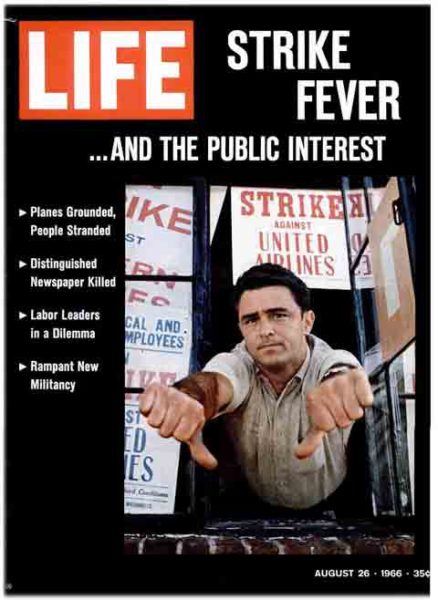
Despite the favorable circumstances, TTWC co-author Kim Moody told me, “Our position paper received little attention as the main underlying business was the transition from the ‘old guard’ leadership to the new ‘generation’ that was flooding SDS. We had hoped to influence some of the younger people entering SDS. “Toward the Working Class” actually appeared in New Left Notes in the Sept 9 issue –after the convention.”
It lost out to Carl Davidson’s proposal for a new student syndicalist movement that emphasized SDS’s focus primarily on the campuses. TTWC has almost been entirely ignored by historians of the New Left with the notable exception of Peter Levy’s “The New Left and Labor in the 1960s”.
While it was wrong to expect SDS to completely reorient itself in such a short period of time—there was still plenty of reason for a student movement to grow especially with the burgeoning antiwar movement on the campuses that SDS was in the thick of— yet, one cannot help but look back and feel that there was a lost opportunity here.
When the various communist and socialist organizations (that emerged from the New Left in the late 1960s and early 1970s) made a turn towards organizing in the industrial working class during the 1970s, was it too late?
During the last four decades the gut-wrenching changes to the industrial working class significantly weakened, if not destroyed, the once mighty industrial unions in many parts of the U.S. industrial economy. The left that attempted to build in the industrial unions were marginalized, if not destroyed by these changes.
However, one of the offspring of the political work of the International Socialists was a reform movement within the Teamsters in the 1970’s. Teamsters for Democratic Union (TDU) played a major role in the election of the Teamsters first reform president in 1991, the UPS strike of 1997, and the recent near-defeat of incumbent Teamster general president James P. Hoffa.
Today, once again a new generation of radicals is discussing the question of oppression, power and radical change. How do we have a similar debate today that SDS had in 1966 but with a broader audience?
The absence of even a small left in the industrial unions in the upper Midwest is part of the reason that Trump triumphed in the Electoral College. The popularity of Bernie Sanders among industrial workers and the victories of Zuckerman’s reform campaign in the Midwest, I think demonstrates this.
As I wrote in Jacobin of last December:
“For the broader labor movement and left in the United States, the Teamsters’ elections should counter some of the impact of Trump’s victory and with it much inane discussion of the American working class. A befuddled Paul Krugman wrote in his most recent column, “To be honest, I don’t fully understand this resentment [that elected Trump].” Yet the states that gave Trump the presidency also voted overwhelmingly to toss out Hoffa.”
Today the modern industrial economy revolves around the logistics industry. As Kim Moody wrote last year:
“Eighty-five percent of the nearly three-and-a-half million workers employed in logistics in the United States are located in large metropolitan areas–inadvertently recreating huge concentrations of workers in many of those areas that were supposed to be “emptied” of industrial workers. There are about 60 such “clusters” in the United States, but it is the major sites in Los Angeles, Chicago, and New York-New Jersey, each of which employs at least 100,000 workers and others such as UPS’s Louisville “Worldport” and FedEx’s Memphis cluster that exemplify the trend.”
If Amazon makes good on its promise, by 2018 it will add another 100,000 workers to its U.S. workforce bringing the total number to over 200,000. It will be one of the largest employers in the United States and one of the largest non-union employers. A new generation socialist activists have to learn how to organize these workplaces.
A New Left is emerging in the United States. The millions who participated in the huge demonstrations that greeted Trump’s first weeks in office is the most visible and spectacular sign of this. The rapid growth of the Democratic Socialists of America (DSA) is one of the most visible signs of this along with widespread interest in general socialist ideas, history, and organizations. Moshe Marvit and Leo Gertner in the Washington Post capture the spirit of rebellion at the moment and advocate its spread to the workplace, “Though often overlooked in America, the workplace can be as much a focal point of resistance and protest as the streets.”
However, we shouldn’t underestimate the obstacles we face. We are challenged with the daunting task of creating a new socialist movement and a new industrial union movement virtually from scratch.
While I believe that the politics of “socialism from below” will be the most important political contribution to the formation of next New Left, we need to bury the legacy of Stalinism once and for all. I would argue that we need to begin modest campaigns advocating socialist ideas and organizing in the logistics industry in select cities.
Such an effort must begin modestly but they must begin. Trump’s triumph in the Electoral College demonstrates the peril of an absence of socialism in the industrial working class.
Former SDS Chicago organizer and ISC member Wayne Heimbach warns us about lost opportunities. “In 1966 it was the ISC people who had the high ground in SDS on working class politics. Within a year or two this would transfer over to Progressive Labor and its Worker/Student Alliance,” he told me. PL’s cartoonish and thuggish politics were one brand of the many varieties of Stalinism that came to dominate and wreck the post-1960s left in the United States.
Looking back on the debates at the 1966 SDS convention SDS leader Jeff Shero told Kirkpatrick Sale, “We wanted to build an American left, and nothing less than that”. The question today is the same, but I would add, What kind of American left do we want to build?
After a Trump Month, a Few Thoughts…
By Mike Miller
The outpouring of anger and frustration in the present period is understandable, and necessary. It provides a sense of solidarity that, one hopes, will help people for the long march through the institutions that lies ahead.
The success of the Right is not new, nor is it particularly American. We need to understand why that is. To blame it on xenophobia, racism, sexism or any other “ism” is insufficient. Why are people voting against their economic interests? Why are people voting against government programs that often serve them, their neighbors and their children? Why are people enthralled with the visible display of wealth rather than considering it morally repugnant?
— As I understand the election results, a majority of white women voted for Trump. What does that say about the historic women’s movement? And if a lot of them didn’t vote, what does that say about the fact that Hillary–whatever her deficits–was the first woman to run with a real shot at getting elected?
— As I understand the results, the stay-home vote in the African-American community was as large, and perhaps even larger, than the number of those who voted. Yes, I know about all the voter suppression activities taking place in many red states, if not all, but in most cases I doubt that would have restrained those who stayed home when Obama ran.
That Hillary Clinton got close to three million votes more than he doesn’t tell us anything, especially when we consider the fact that conservative Republicans have been winning elections all over the country for the last dozen or more years.
— Why haven’t people taken the problems of white working class people, males in particular, seriously for the past 50, or at least 40, years? Yes, I know about white privilege. But it’s pretty hard to convince someone whose job has been shipped to some low-wage market, who sees on TV news (however erroneous it may be) what he believes is “everything is being done for women and minorities”, that he’s “privileged”. And it’s even harder to convince those who never had good union jobs–like Appalachian, whites where there is now a decline in life-span, and rampant drug and alcohol abuse, that they’re privileged. Plus, unlike women, GLBTQ and racial/ethnic minorities, these “whites” had no social movement of which they could be a part so they would have a feeling of solidarity about their circumstance, as well as solidarity with others. Unfortunately, Trump provided that.
— Why aren’t these new movements digging in to the constituencies for which they claim to speak? Martin Luther King’s SCLC was rooted in the black church. SNCC sought to organize low-income blacks by going door-to-door, much as ACORN later did. People who were students dropped out of school to become full-time organizers and rooted themselves in “the base”. Who’s doing that now?
–We can complain about media, money and other benefits the establishment/status quo has on its side (though Trump doesn’t!), but won’t we be better off assuming those as givens and then figuring out how to respond? After all there are examples of both ballot propositions and candidates who were outspent by large amounts (in the case of the defeated a PG & E initiative in California 30:1), yet still winning? What did they do that was right? I don’t see a lot of people carefully examining that question.
The answer to all these questions requires more than demonstrations, whatever the number of those marching. The fact is that Trump did get elected. He campaigned in states where the Electoral College votes he needed were to be found. That Hillary Clinton got close to three million votes more than he doesn’t tell us anything, especially when we consider the fact that conservative Republicans have been winning elections all over the country for the last dozen or more years. They now control both houses of Congress, and a large majority of state legislatures and governorships. And there’s no discrepancy in these between popular vote and election result.
My major point: The “movements” haven’t deeply rooted themselves in the constituencies for which they claim to speak. At its heart, that requires building human relationships, one-by-one; listening to people and their interests rather than “educating” them about how they should think; fostering relationships that bridge historic lines of division among “the people”, rather than creating ever-increasing silos of particular interests (each legitimate in its own right) that use invidious distinction to separate themselves from others–particularly with the foundations or wealthy patrons upon whom they depend for their financing.
Membership-based fundraising is required because nothing has more debilitated promising movements and organizations than dependence upon foundation, corporate and government funding for their core organization budgets. The means for accomplishing this kind of fundraising are well known. In fact, their use can contribute to solidarity and organization building. Contrast this with the self-perpetuating board of directors non-profit that has a narrow agenda and its own particular patrons whom it jealously guards against encroachment by other, similarly constituted, “community-based nonprofits”!
We need multi-issue organizations that are membership based. Multi-issue because different people experience different problems at different times in their lives. The way relationships are initially formed is when they negotiate how to support each other in relatively small, but important to them, issues that may not be important to others, but they aren’t opposed to them. These are called “you scratch my back, and I’ll scratch your deals.” As solidarity forms among diverse groups it is possible to join in larger, and longer-term, campaigns that address issues more deeply embedded in the status quo.
All that is proposed here can be framed in a small “d” democratic language that is the language of A MAJORITY of Americans. It is a strategy for reversing the present dangerous times in which we live.
Resistance to Trump will separate progressives from neoliberals
By Peter Olney and Rand Wilson
… progressives must find their voice by systematically deconstructing the Trump program on issues like jobs, health care and retirement security
On a cold day in Washington, D.C., on January 20, Trump was sworn in as the 45th President of the United States. A ceremony that seemed very far-fetched as recently as three months ago confirmed what was considered unthinkable: the billionaire con artist and proto-fascist is President, and his hands are now on the levers of police and military power of the American empire.
While his inauguration was marked by cultural defections; only a handful of artists of any consequence were willing to perform at his ceremony, even as president-elect he has already wielded the power of his “tweets” prior to his swearing in.
In his inauguration speech Trump boldly denounced the elites and their politicians, many of whom were seated behind him on the stage, and said that his administration would be about the people and their prosperity. At his first press conference on January 11 he highlighted three issues: jobs, the price of pharma drugs and veterans’ health care. These issues resonate with his base and particularly in the key states that gave him his electoral margin of victory. Yet the response of the press was distracted, focusing on Russia and his ties with Putin. This demonstrates the challenge we face: Trump is a walking outrage, but a skillful communicator who grasps the issues that resonate with many working class people.
A righteous and raucous Women’s March of over 500,000 took place in Washington, D.C. the day after his inauguration, which by far eclipsed the crowd that celebrated his swearing-in ceremony. Women and their supporters descended on Washington, D.C., bused in from 48 states and flown in from Hawaii and Alaska. Hundreds of other rallies were held in other US cities with simultaneous marches in solidarity held around the world including at the Pantheon in Rome.
The huge size of these protests bodes well for a vigorous movement. Many more marches and protests will surely follow against attacks on immigrants and people of color, and in defense of the Standing Rock pipeline protestors and the Black Lives Matter movement that has forcefully targeted racist police attacks on the black community.
While these battles must be joined and supported, in order to really sustain a much longer-term struggle, progressives must find their voice by systematically deconstructing the Trump program on issues like jobs, health care and retirement security.
A well-organized response to these and other important issues falls squarely on the chief organization of the working class: the trade unions. Yet instead of aligning with the popular resistance, many national union leaders have done nothing but cozy up to the new president. The task of union resistance will hopefully be taken up by the six national unions that supported Senator Bernie Sanders and his “socialist” campaign for the Democratic Party nomination. These unions (APWU, ATU, CWA, ILWU, NNU, and UE) have the resources and resolve to carry a message of popular and economic democracy to the heartland and explicitly challenge the neo-liberal orthodoxy that permeates the AFL-CIO and so much of the labor movement. Most already support Sen. Sanders’ new formation, Our Revolution, that will engage in electoral politics at the city, county, state and national level by running anti-corporate candidates against neo-liberal Democrats in primaries or non-partisan races.
A proposed “beyond Bernie” labor formation can also reach out to more than 100 local unions that supported Bernie and the nearly 50,000 union members who publicly endorsed him. It has the potential to attract many more national and local unions and will hopefully result in a working class-led political coalition that can offer a real alternative to the Trump agenda and the tepid pro-corporate response of many Democratic elected officials.
The challenge is immense. One only needs to look at Senator Corey Booker as an illustration of the bankruptcy of the corporate Democrats. Senator Booker, the first African American Senator from New Jersey eloquently broke protocol with his Senate colleagues and testified against the racist nominee for Attorney General, Senator Jeff Sessions. Booker detailed the racist offenses of Sessions as an Alabama prosecutor and a US Senator. But in the same week that he rose valiantly in a Senate committee hearing against Sessions, he also rose to defend the pharmaceutical industry from the importation of low cost, generic drugs from Canada! He voted against legislation sponsored by Senator Sanders that was a concrete step to fight price gouging by big pharma and a brilliant political move to expose the hypocrisy of Trump’s rhetoric.
Passage of the amendment would have been a huge benefit to the multiracial working class. Even a handful of Republican Senators voted for it. Yet the bill was defeated because twelve Democrats — including Sen. Booker — voted against it. Its defeat exposes and discredits Booker and his neo-liberal colleagues and further boosts the demagogic, phony populism of Trump. The election showed that America’s working class can be easily seduced. They are fed up with neo-liberal rhetoric and the main stream Democrat’s empty promises. Going forward it remains to be seen if labor and the left can meet the Trump challenge with a convincing program to truly advance working class interests.
First published in Italian in Sinistra Sindicale
Building Trades Leadership Undercuts Activists
By Len Shindel
“[Mr. President] Your address on Friday [Inauguration Day] was a great middle class address. It hit home for the working class people who have been hurting. You said it. People here in Washington have [unintelligible]. The working class people had to hear something like that. At that venue—being up there at your inauguration and laying it down—that was a great moment for working men and women in the United States.”
–Doug McCarron, International President, Union of Carpenters and Joiners of America
Jan. 25 had to be the best day yet for Kellyanne Conway and Sean Spicer. Surrounded by some key leaders of North America’s Building Trades Unions (NABTU), their boss was relaxed and smooth. In a silken tone, Trump thanked the Sheet Metal Workers for work they did on his hotel down the street (even as an electrical contractor was suing his company for allegedly getting stiffed on the job). Union leaders clapped loudly as Trump announced he was trashing the Trans-Pacific Partnership.
Trump told the leaders their members would soon be building new Ford plants and pharmaceutical manufacturing facilities for companies like Johnson and Johnson and they would be needed to complete a load of new projects as he terminates “disastrous” trade policies that had sent jobs out of the country. The regularly combative president even cut his predecessor some slack, saying bad trade policies preceded President Obama.
According to some blogs, Sean McGarvey, president of the NABTU, asked if the new administration would continue wage protections of construction workers who work on federal projects, provisions of the Davis-Bacon Act. Nonunion contractors had sent a letter to President Trump on Jan. 10 asking him to set the law aside. Trump said he “knew a lot” about Davis-Bacon. But he made no commitment to continue to protect construction workers wages from a race to the bottom.
As participants got up to leave the room, Doug McCarron, president of the Carpenters, said he had one more message for the president. Trump said, “I love Doug.” The president called everyone back in the room, asked a member of the press covering the event to join them and handed the floor to McCarron who gushed about Trump’s inaugural address, calling it a “great moment for working men and women in the United States.” McCarron looked pleased. The meeting was over.
Conway and Spicer, sitting directly behind the president, beamed like newlyweds on a honeymoon who just rolled out of the sack to find they had hit the lottery. In short order, a Fox News anchor asked a colleague: “Did anyone ever think for a minute that a Republican president would be inviting unions into the White House on his second official day of business?”
For Sean McGarvey, visiting the White House was like a kid’s first hour at Disney World. “The respect that the President of the United States just showed us… was nothing short of incredible,” he told the media. “He took the time to take everyone into the Oval Office and show them the seat of power in the world.”
Then McGarvey went further than McCarron in giving Trump his imprimatur. A press release from NABTU stated, “In politics, there are people of words, and people of deeds. North America’s Building Trades Unions are grateful that President Trump is a man who puts actions behind his words.”
On the blogosphere, NABTU leaders were immediately criticized for praising Trump. Erik Loomis, a blogger on “Lawyers, Guns and Money,” posted a story, “Building Trades Allow Themselves to be Played Like Fools,” contending that the leaders not only failed to secure any concrete guarantees on Davis-Bacon, but—in their effusive praise of Trump—further isolated themselves from political progressives. Loomis outlined the “deeply cultural” gulf between a large swath of building trades’ members and members of the wider progressive movement on issues from immigration to the environment.
“The problem,” says Loomis, is that “McGarvey, Terry O’Sullivan (president of the Laborers) and some of these other union leaders aren’t trying to educate their members on these issues.”
Hamilton Nolan, a blogger on The Concourse, posted a story, “Unions Don’t Do This” about the White House Meeting. Nolan listed topics Trump chose not discuss with the leaders: “His avowedly anti-union Labor Secretary nominee; his stated support for ‘right to work’ laws that could decimate union membership in America; his tax plan that will primarily benefit the very rich and exacerbate economic inequality; his statement that American wages are ‘too high,’ or the actual union busting campaign that his company ran against its workers in Las Vegas.”
“Don’t credit the guy who reacted to the jamming without giving a shout-out to the jammers.”
Now, I don’t pretend for one minute any labor leader’s job is easy after the defection of so many union members to a Republican Party that has never buried its animosity toward unions.
Trump brilliantly exploited the Democratic Party’s support for neoliberal trade policies, NAFTA and the TPP and drove the stake in deep. And, since the election, Trump has even hired guys like Robert Lighthizer, who had previously worked closely with AFL-CIO economists intent on strengthening the Obama administration’s trade negotiations.
It would make a big mistake for any labor leaders who oppose the Republican’s anti-worker agenda to take pot shots at Trump’s trade agenda as Les Leopold states so well in his article, “If Progressives Want to Defeat Trump They Must Win Back Workers.”
But McGarvey’s and McCarron’s fawning over Donald Trump’s attention to trade and infrastructure mimics the Democratic Party’s failings on those issues—the illusion that by treating your adversaries well, you can bend them to your agenda. It can get ridiculous.
Members of the Laborers International Union of North America (LIUNA), have said that International President Terry O’Sullivan, who was also in the White House meeting, was very worried about LIUNA members who participated in the “Women’s March on Washington” were wearing their bright orange union T-shirts. Better, he thought, for them to bury their union identity.
And why the hell would union leaders praise Trump without simultaneously crediting the years of struggle by the nation’s best trade union activists, lawyers and economists to turn around trade policy? Trump and Pence, for instance, scored a load of points cutting a deal to keep some jobs that were destined for outsourcing at Carrier in Indiana. What was soon forgotten was the excellent media work done by the United Steelworkers (USW) and the YouTube video of union members shouting down the executive who told them their jobs were going to Mexico. Don’t credit the guy who reacted to the jamming without giving a shout-out to the jammers.
My original anger over this stuff has turned to sadness. Thirteen years ago, after 30 years as USW activist and local union leader, I went to work for the International Brotherhood of Electrical Workers (IBEW) hired as a communications specialist in the union’s Washington, D.C. headquarters.
I marveled at the strong identification members in the union’s construction branch had with their trade and their union. But I also learned that this pride sometimes came with the evil twin of nepotism and exclusivity. So I gained even greater respect for the inspirational and courageous IBEW activists and leaders who were working to broaden the union’s reach and diversify its base.
I was honored to write stories about former gang members in South-Central L.A. recruited by the building trades, transforming their lives and contributing to their communities. I took pride in helping promote the work of apprenticeship instructors who were incorporating the principles of solidarity and fairness into their curriculums. And, while I had deep differences with the IBEW on fossil fuel policy, I took heart in the work of locals unions that promoted jobs and training in renewable energy and working with, not against, environmental advocates.
These forward-looking IBEW activists are not alone. They exist within O’Sullivan’s LIUNA and McCarron’s Carpenters. Members of both unions have worked to reach out to and recruit tomorrow’s workforce and mentor new leaders, including large numbers of Latino workers. In fact, McCarron built his reputation supporting Latino dry-wall installers in his native California, bringing them into the Carpenters. There is so much fertile ground for growing the building trades’ density in previously ignored or excluded sectors.
When McGarvey, claiming to speak for all the trades, kowtows to a president who launched his political career attacking the legitimacy of the nation’s first black president and stereotyping Hispanics as “rapists and murderers,” he undermines the work and the morale of dedicated activists and potential members, the future of the U.S. labor movement.
I would hope a critical re-assessment of NABTU’s messaging and strategy toward the new administration might turn around these problems. But I know that will take a struggle and much courage on the part of other building trade leaders and activists.
Sometimes internal polarization is necessary for a movement to win. McGarvey and McCarron have compelled this reality.
MLK’s Advice on Strike Strategy Still Relevant Today*
By Rand Wilson
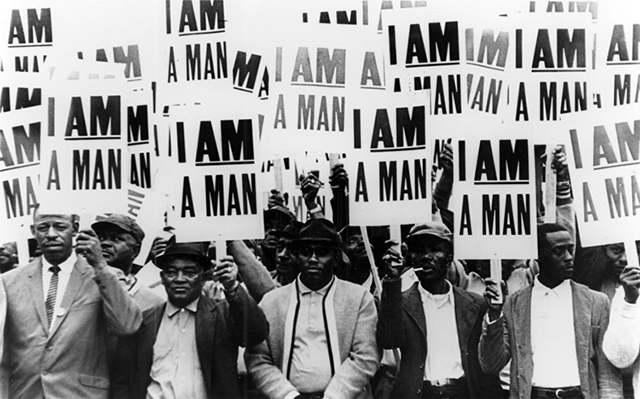
Striking members of Memphis Local 1733 hold signs whose slogan symbolized the sanitation workers’ 1968 campaign. Credit: Copley, Richard L., “I AM a Man,” I Am A Man, accessed January 18, 2017.
After 1965, Martin Luther King Jr’s thinking about poverty evolved from racial equality to more of a class perspective. He proposed a Poor People’s Campaign to challenge the government to end poverty and a broad coalition to support it. But building a coalition to back his program for economic justice proved more difficult than he imagined. It made his funders and even his closest advisors nervous. A proposed national march on Washington had to be postponed and King was growing frustrated.
Sanitation workers in Memphis, TN had been trying to get organized and win recognition from the city for years without success. After two workers were accidently crushed to death in one of the garbage trucks, a majority of the workers decided to strike on February 12, 1968 for union recognition and a contract.[1]
The strike had been going on for months with growing frustration. Incidents of violence were increasing, mostly provoked by the racist and brutal Memphis police.
King recognized that the strike provided with an opportunity to demonstrate how the civil rights and economic justice movements could come together at the local level. He proposed bringing the campaign to Memphis.
Expand the Strike
King first went to meet with the strikers in Memphis on March 18. He spoke to 1,500 workers and supporters. King was well received and the crowd’s mood was militant and eager for action.
King said, “If America doesn’t use her vast resource of wealth to end poverty and make it possible for all of God’s children to have the basic necessities of life, she too is going to hell.” And he went on to describe how their strike was part of new direction for the civil rights movement:
“Now our struggle is for genuine equality, which means economic equality. It isn’t enough to integrate lunch counters. What does it profit a man to be able to eat at an integrated lunch counter if he doesn’t earn enough to buy a hamburger and a cup of coffee?”
As the crowd cheered, King saw an opportunity to grow the movement by expanding the strike. He called for a general strike in the city of Memphis! Plans were made and a strike date was set. The tactical escalation was highly controversial.
Unfortunately, due to a freak snowstorm, the strike was called off. Amid growing threats to his life, King hurriedly left Memphis. However, he was not to be deterred and vowed to return.
Boycotts and economic action
King returned to Memphis on April 3, 1968 to support the strike again. At a rally with strikers and area clergy he gave his, “I’ve Been to the Mountaintop” speech — one of his most famous and fatefully his last.[2] This is the speech where King predicted his own assassination.[3]
However, the main subject of the speech was winning the sanitation strike. King advised they should use the power of the boycott to, “Always anchor our external direct action with the power of economic withdrawal.”
“We don’t have to argue with anybody. We don’t have to curse and go around acting bad with our words. We don’t need any bricks and bottles, we don’t need any Molotov cocktails, we just need to go around to these stores, and to these massive industries in our country, and say, “God sent us by here, to say to you that you’re not treating his children right. And we’ve come by here to ask you to make the first item on your agenda fair treatment, where God’s children are concerned. Now, if you are not prepared to do that, we do have an agenda that we must follow. And our agenda calls for withdrawing economic support from you.”
Making our pain, their pain
When workers go on strike, it almost immediately involves personal sacrifice. As the weeks and months go by, that sacrifice becomes real pain inflicted on the strikers and their families. King’s quote from his last speech is particularly relevant to most every strike situation:
“Up to now, only the garbage men have been feeling pain; now we must redistribute the pain. We are choosing these companies because they haven’t been fair in their hiring policies; and we are choosing them because they can begin the process of saying, they are going to support the needs and the rights of these men who are on strike. And then they can move on downtown and tell Mayor Loeb to do what is right.”
One day longer
King knew the importance of winning, of keeping spirits up and sticking together. He said, “We’ve got to give ourselves to this struggle until the end. Nothing would be more tragic than to stop at this point, in Memphis. We’ve got to see it through.”
Solidarity forever
To the clergy and other civil rights supporters, King delivered a powerful message of solidarity: “And when we have our march, you need to be there. Be concerned about your brother. You may not be on strike. But either we go up together, or we go down together.”
Near the end of the speech, King used the “Good Samaritan” parable from the bible to implore everyone to make even greater sacrifices to help the workers win. He concluded with words that have an uncanny relevance to our time:
“Let us develop a kind of dangerous unselfishness… Let us rise up tonight with a greater readiness. Let us stand with a greater determination. And let us move on in these powerful days, these days of challenge to make America what it ought to be. We have an opportunity to make America a better nation.”
King’s strategic advice to the striking Memphis sanitation workers is still useful for workers seeking to improve their lives with direct action today. Once on strike, expand the struggle beyond the immediate company to its corporate allies and suppliers; use boycotts and economic action to involve supporters; transform the pain inflicted on strikers, to pain inflicted on executives, board members and investors; be prepared to stay in the struggle one day longer with “dangerous unselfishness”; and perhaps most importantly, winning requires placing the struggle in a larger context that challenges elected officials and government at every level to make America a better nation!
*Adapted from remarks by Rand Wilson on January 16, 2017 at the Capital District Area Labor Federation’s 20th Annual MLK Labor Celebration in Albany, NY. In nearby Waterford, NY there are 700 workers on strike at Momentive Performance Materials and in Green Island, NY, dozens of workers have been locked out at a Honeywell aerospace plant for more than nine months.
Footnotes:
[1] Memphis sanitation strike
[2] I’ve Been to the Mountaintop
[3] “Like anybody, I would like to live a long life. Longevity has its place. But I’m not concerned about that now. I just want to do God’s will. And He’s allowed me to go up to the mountain. And I’ve looked over. And I’ve seen the Promised Land. I may not get there with you. But I want you to know tonight, that we, as a people, will get to the promised land!”
Analysis of the NO vote in Italy
By Nicola Benvenuti
The Stansbury Forum has received a lot of interest in the article we ran by Leopoldo Tartaglia from the CGIL on the Italian NO vote on December 4. Many news commentators have characterized the NO vote as akin to the Trump victory in the US and the Brexitt vote in England in June of 2016. Our readers have asked for the specifics of the actual proposed constitutional amendments and the demographic character of the NO vote. Nicola Benvenuti and Leopoldo have graciously agreed to help clarify these issues for our American readers. Nicola and Leopoldo have analyses that differ on YES or NO but agree on some of the underlying social and political demographics.
We are proud to continue to present political perspectives from Italia Bella and we will be covering additional Italian national referendums to be held in the spring on labor reform.
The December 4 referendum on constitutional reform in Italy was of great importance. There was a high turnout, more in keeping with candidate elections than referendums that historically had drawn fewer voters. Commentators have attributed this turnout to the reckless gamble of Prime Minister Matteo Renzi who made the referendum a plebiscite on himself and his government. On the one hand he was counting on the fact that the reform reduced the cost of government by eliminating the salaries of the new Federal senators, and by changing the powers of the regions and reducing the salaries of elected regional councils. In truth these savings were for “populist appeal” and would have had little impact on the high cost of Italian government. On the other hand the referendum was about the unanimously recognized need to streamline political processes, in particular by reforming perfect bicameralism. At present the House and Senate have the same legislative powers – which means double the time for the approval of laws. The referendum also sought a revision of the system of checks and institutional counterweights, created in 1947 to ensure the coexistence of radically different positions such as those that emerged from the East-West conflict. These “safeguards” have now become opportunities for blackmail and the backroom deals typical of Italian politics.
“Forces that are totally antagonistic”
However a disaggregated analysis of the vote shows the social character of the result: a high percentage of young people and unemployed voted NO, with the highest NO votes in the South and on the islands (Sicily and Sardegna): a sign that the promises of Renzi to rejuvenate – or “scrap” – the ruling groups so as to make way for a new generation, new ways of thinking and new solutions to the problems of the country, had no effect on youth unemployment (in July 2016, + 2 points, reaching 39.2%), nor have his policies curbed the fall of the middle class into poverty (A decline of almost 8% of the population, with an increase of 141% in ten years). The referendum vote very dramatically highlights the separation between politics and the actual social situation.
From a political point of view the situation created by the referendum vote is as follows:
1. “YES” was supported by only the Partito Democratico (PD) despite the fact that the constitutional law (voted in Parliament) had also been supported by the opposition center-right (but not Five Stars), while “NO” was supported by: a) Five Stars, b) the right c) the left inside and outside the PD. Forces that are totally antagonistic. Hence the assessment that, politically, “NO” was not an alternative project but only a vote against Renzi and the Democratic Party government, without much real consideration of the merits of the constitutional reform. Renzi noted that the vote had meaning beyond the reform and resigned to leave the field to a very similar government to achieve electoral reform with votes in the Senate that has maintained its previous power because of the NO vote in the referendum. (In 2015 the Parliament had passed a law only in the Chamber of Deputies, anticipating the modification of the Senate on December 4).
2. This begins a period of instability and political uncertainty, something that the country does not really need given the difficult international and economic choices that lie ahead. Italy needs stability and a sense of responsibility, not political infighting. Germany achieved this stability with the Grand Coalition policy. In Italy there was a unity of purpose because of the danger of financial failure and international pressure, but only with a “technical” government, the government of Monti ( November 16, 2011 – April 28, 2013) supported by the whole parliament. The Monti government passed emergency measures, but also passed political reforms, like the one that provides for the extension of the age for retirement, that no party had the courage to make alone. The Renzi program, from the constitutional reform project and the movement of the party towards the center in an attempt to strike a deal with Berlusconi, was precisely to establish the political conditions for incisive action in this dramatic emergency situation.
3. The vote has sanctioned a fracture in the left and in the PD based in part on internal opposition and an attempt to regain control of the party more than on the merits of the legislative measures put in play. Renzi, who is also the Secretary of the PD has turned a deaf ear to corrections required by the internal opposition that voted against the reform. Even if this rift is overcome a restructuring of the left is inevitable. The former Mayor of Milan Pisapia of Sinistra Ecologia Liberta (SEL), a political organization to the left of the PD, formed an alliance between the radical left, PD and personalities of the center, and managed to maintain a center left government in that city while the PD lost the Mayor’s races in both Turin and Rome. Pisapia has proposed an independent aggregation of left forces with an explicit program of conditional support for the policies of the Democratic Party from the outside. But it is still too early to say what will happen.
Beyond political alchemy, the Italian situation is such that the public debt does not offer great margins for economic or social maneuvers, and the danger once again is that the radical differences and fracturing of political forces pushes everyone to avoid the grave and unpopular responsibilities necessary to escape the crisis.
Please scoll down to read the second article on the Italian referendum by Lepoldo Tartaglia
The Italian referendum No vote: contents and context
By Lepoldo Tartaglia
“Everyone can agree that a Constitution is the fundamental pact building a society and a State and that any change has to be evaluated carefully… That was not the case”
The Renzi government’s crisis was fixed in about ten days. A new government, led by Paolo Gentiloni, former Foreign Minister, obtained a confidence vote, from the Chamber of Deputies (the lower chamber), and the Senate (the upper chamber). Most of the ministers have been confirmed; the parliamentarian majority is the same; “continuity” is the word used most often in the policy speech of the new prime minister. None of the financial disasters predicted before the vote in the case of a No victory have happened; actually, the Milan stock exchange did better than before.
Nevertheless, the political earthquake was important and fresh elections are around the corner.
Two important events are coming. On January 11th the Constitutional Court will decide whether the three referendums that the CGIL has proposed that would delete the worst rules of the so called “Jobs Act” and previous labor market laws, can go forward. On January 24th, the same Court will decide on the electoral law pushed for by the Renzi government, in an attempt to resolve the unconstitutionality of the previous electoral law. Many predict a new negative decision, due to the fact that the so called “Italicum” (the Renzi made law) replicates the problem of too many parliamentary seats being given to the party with the largest percentage of the vote, and the fact that voters under Italicum have little chance of voting for the candidate of their choice, rather than a person decided on by the parties’ leadership.
In order to go to fresh elections, the Parliament has to approve a new law, based on the upcoming Constitutional Court decision, and establish an electoral system for both chambers, given that the Italicum assumed that only the Chamber of Deputies was elective – which would have been the case in the event of a YES victory in the December 4th referendum.
What was really at stake in the constitutional referendum? Why did a significant part of the left and the center left (including the minority of the Democratic Party, the Renzi party) and the most important leftist social mass organizations stand on the NO front? What are the linkages between the vote and the social situation of the country?
1) The reform’s contents
While the vote was charged by many political meanings (see below), there was widespread opposition to the reform’s contents. This begins with the method of its approval, which also explains why we went to the referendum.
Everyone can agree that a Constitution is the fundamental pact building a society and a State and that any change has to be evaluated carefully by searching for a large consensus in the parliament and in the country. That was not the case: the reform law had been approved only by the parliament’s majority (very narrow in the Senate), and with recourse to a confidence vote, reducing the scope of the debate also inside the majority itself.
The national referendum was not a nice democratic concession by the Renzi government: it was compulsory, according to the Constitution, because the reform didn’t reach the required two third parliamentary vote to pass directly without the need of electoral validation.
“… this would lead to dysfunction in the regulation and management of essential public services …”
Renzi propagated a myth that the “old” Constitution had never been modified in 70 years. In fact, the Italian Constitution was promulgated in 1948 and has been changed many times. The last change, in 2012 happened with a practically unanimous parliamentary vote, under the Monti government and it changed Article 81, introducing the obligation to balance the State’s annual budget. In 2001 and 2006 people were called to vote on constitutional referendums, again because the majority coalition changed the Constitution without the necessary parliamentarian approval. In 2001, the reform was backed by the center left, and the majority of voters confirmed it (with a very low turnout, about 30%). In 2006, the popular vote defeated the reform that had been approved in Parliament only by the Berlusconi majority (turnout 52%).
The Renzi reform was the largest one, so far, regarding 47 articles of the second part of the Constitution (institutional organization of the State). The core of the reform was to fix the present “perfectly bicameral” system, where the parliament upper and lower houses have equal legislative powers. Renzi wanted to replace the directly elected Senate of 315 seats, with a smaller chamber of 100 members, chosen by the Regional Councils from among their members.
Along with many other constitutional changes, the second most important “reform” regarded the relations between the central State and the Regions; taking away much of the authority of local governments that the 2001 center left reform had given them. And in the opinion of many constitutional scholars (including many former members and presidents of the Constitutional Court – most of whom stood on the NO front), this would lead to dysfunction in the regulation and management of essential public services delegated to the Region, and to a huge increase in authority disputes between the Regions and the Italian State.
“ … the majority of the population, particularly young people, workers and those living in southern Italy, has not seen any positive change …”
Also the supposed elimination of “perfect bicameralism” was unclear, due to the confusing nature of the proposed new regulation and the capacity of the Senate to call for the review of any proposed law it wanted to examine. The only clear new rule on the relation between the two chambers was that a confidence vote in the government was given by the reform solely to the Chamber of Deputies – leaving Italy with a parliamentary system, not a presidential one.
There is an important institutional question that also fueled the NO position, even if it was not directly included in the reform: the linkage between the new role of the Chamber of Deputies and the new electoral law. The electoral law called “Italicum” states that the party that wins the election (with 40% of the vote in the first ballot; or wins the second ballot between the first two parties, regardless the percentage of vote in the first run) gains the 54% of the seats (332 out of 615). So, due to the Italian institutional system, as a result of the reform, that party (which might be very small in terms of real representation), would have been able not only to elect the prime minister and the government, but the President of the Republic and the Constitutional Judges (elected by members of both the Chamber of Deputies and the Senate).
So, the constitutional reform was seen by the leftist opposition (and not only) as a big concentration of powers: from Regions and local authorities to the central State; from Parliament to Government; from Government to the party winner of the elections (in a context of reduced representation, given the very high majority premium guaranteed by the new electoral law).
In the opinion of those on the left who opposed the reform, there was a clear continuity with the last institutional and electoral reforms in Italy, that were mainly pushed by the center-right parties and international financial powers, and aimed to concentrate political power, reduce the representativeness of the parliament and reduce the space of the opposition in order to sterilize the voice of the working class. In fact, in the last 25 years, several changes to the electoral laws and a push toward a “de facto” presidential system, denied by the Constitution, contributed to the restriction of the people’s political participation and, particularly, to the progressive exclusion of the radical left from the parliament (obviously, with a huge assist from the litigious leftist organizations themselves).
2) The vote’s political meanings
In a normal scenario, a constitutional reform is an issue largely in the hands of Parliament, with the Government less involved, or not involved at all. However, in this case, it was the Renzi Government playing the game, with two clear objectives: build up a more centralized institutional system and give more power to the government; realize a resounding victory in the referendum as electoral validation for a government and a leadership never chosen through a popular election. As you might remember, Renzi was not a parliamentarian and he became prime minister after his victory in the internal primary vote for the Democratic Party’s leadership and he pushed his own party parliamentarians to withdraw the confidence in then Prime Minister Enrico Letta, member of his same Partito Democratico (PD).
However, despite the clear signals of popular discontent – particularly in the June 2016 municipal elections, when the PD lost 19 out of 20 second ballots – Renzi launched the referendum campaign as a vote on him and his government, claiming that his government had obtained amazing results on the economy, employment, political renewal and so on.
Yes, the effect was truly amazing: he was able to coalesce not only previous voters of the opposition parties – those of the divided centre right, the small far left and, over all, the Five Star Movement, which actually was the largest vote getter in the 2013 political elections – but also a large number of people disaffected from politics, who in recent years had deserted the polling stations.
The popular rejection of the government and its policies and the opposition to the reform’s contents added up reaching together more than 19 million votes.
3) The demography of the vote: a class “revolt”?
Is there a social configuration of the vote? Yes, off course.
Firstly, it’s worth noting that, despite the Renzi propaganda on the “new”, on the YES vote “for the future” against the NO as the return to the past, the NO vote was particularly large among the young generations. While the YES prevailed only among the over 65 years old (56% against 44%), the largest NO vote was among the 25 – 34 years old voters (72% against 28%).
The YES vote won with a narrow margin only in three regions out of twenty (Trentino Alto Adige 53.9%; Tuscany 52.5%; Emilia Romagna 50.4%) which are regions traditionally on the centre left and PD side, but also among the better off regions in Italy. On the contrary, the largest NO results came from the southern Italy regions (Sardinia 72.2%, Sicily 71.6%, Campania 68.5%), notoriously the poorest part of the country, affected by a huge level of unemployment, and a high gap in terms of incomes and living conditions in comparison with the center and the north of Italy.
According to a survey of the Istituto Cattaneo, a think tank based in Bologna, specializing in opinion polls and research on electoral behavior, there was an apparent link between the vote and income. Considering that Bologna itself was one of the few towns were the YES vote prevailed, the difference in the NO vote there ranged from 51.3% for people earning less than 18,000 euros yearly to 40.1% for people earning more than 25,000 euros yearly.
In many districts, particularly in the largest towns and in regions where there was strong support for the rightist parties there was an apparent link between the NO vote and the presence of a relatively large number of migrants, meaning also a rejection of government policy perceived as too open to immigration.
So, what all the commentators argue – and, at the end, Renzi himself admitted before the steering committee of his party, is that the vote was largely a vote against the social and economic policies carried out by his government. Despite the optimism enthusiastically spread by Renzi, Italy is still in the midst of the crisis, with a very low rate of growth, large unemployment, particularly among the youth, a rising rate of poverty and inequality. Nor was Renzi’s attempt to distinguish himself from the unpopular austerity policies led by the European Commission seen as authentic.
The major social reforms the government claimed – particularly the so called “Jobs Act” (Renzi titled the law in the English language) – resulted, as unions and Cgil in particular said from the beginning, in making work more precarious, without any visible growth in jobs.
In general, in a stagnant economic landscape, the majority of the population, particularly young people, workers and those living in southern Italy, has not seen any positive change in its situation and doesn’t have any confidence in the political establishment, although the rulers attempted to disguise themselves as anti-casta (anti establishment).