Privilege
By Ivette Morales
I didn’t cry.
I kept it together,
They talked about class/social status,
I bit my tongue.
They talked about their privileges,
Their disadvantages,
It made me want to scream.
I kept my mouth shut.
It’s not our fault,
We are dealt the hand that Life gave us,
And with that we do what we can.
I don’t want to hear your pity,
Your guilt or your sorrow.
I don’t want to feel your pain.
I get sick just by listening to their guilt.
Their guilt means nothing to me,
They still have every advantage that I don’t.
They get to go back to their precious lives,
While I go back to struggling for money for mine
All they have to do is look in their bank account, and it’s there
While I stay up all night trying to figure out how my family is going to get through the week.
They say they understand their privilege,
But the truth is that they don’t.
They don’t understand the power that money has over someone,
They don’t understand what money means.
Money is security, a safe place to sleep,
It’s food on the table, a stable home,
A warm bed,
It’s the toys we never had as children,
The nice house we never got to live in,
It’s our own bed’s that we didn’t get to have.
Money is opportunity,
The chance to travel,
to see the world that we so desperately yearn for.
It’s seeing our parents happy,
Instead of crying,
stressful,
And depressed.
Money is education,
An education that we all deserve to have
But that we so rarely receive.
They complain that they have so much, and they wish they could share it.
I’m tired of listening to their complaints,
I don’t want to hear them talk,
I want to see their actions,
I want to see things done.
Django: The Good, The Bad and the Ugly
By Stewart Acuff
“Django Unchained” shows all the sadism and inhumanity and evil and barbarism of what some once called the peculiar institution of American slavery. “Django Unchained” repeats what others have said about the existence of slaves,”She is my property and I can do as I please with her. ”
The movie also shows the absurdity and ridiculousness and cruel silliness and vapid nature of white, wealthy slavery culture.
Some disclaimers are in order. I am a southerner. Like many southerners my forefathers and foremothers include the Scots-Irish, Chickasaw and Cherokee Native People, and African-Americans. I am fortunate and grateful that the family tree split relatively recently within the memory of the living. I am a movie philistine and as an art form I have no business reviewing any movie. And, generally, I hate Quentin Tarantino’s work. I hate his typical gratuitous violence and seeming love of gore. I hate his total rejection of any Hollywood responsibility for the violence in our society.
But in this case, Tarantino’s faults serve him, the movie, and the movie-goer well. Slavery was every bit as horrible and more so than this movie shows. To Tarantino’s credit, he tries in one movie to demonstrate in every way possible the total lack of humanity in slavery–from gang rape of “comfort women” to allowing dogs to rip a runaway to death, to forcing men to fight one another to death, to the intentional splitting of slave families, to the forced hatred of one’s race.
This last consequence of slavery may be its most enduring. Some of the most racist among us are the closest to the race they denigrate. I loved my mother. Her eyes reflected part of a heritage from Sierra Leone. But when she told me Big Mama wouldn’t let her own brother dismount his horse in her yard and enter her house because he was too dark and Big Mama was passing for white , my mother said one side of our people were Black Indians, just very dark Indians. We all know Strom Thurmond raped or had sex with his family’s Black housekeepers.
Almost as importantly, “Django Unchained” shows the ignorance and stupidity of white slave culture from Leonardo DiCaprio’s character of an incredibly sadistic plantation owner who likes to put on the airs of a Parisian gentleman and demands to be addressed as Monsieur but who speaks no French to the overseers whose sport and entertainment is sadism.
I will leave it to others to talk about the things reviewers are supposed to comment on. What is important here is the reflection of our nation’s past. As great Mississippi novelist William Faulkner said, “The past isn’t over. It isn’t even really past. ”
I don’t know if or when America will ever get beyond its slavery past and the racism that served as its foundation. Clearly the modern Republican Party gained its base in the South with year after year and election after election of blatant and sometimes coded racism. Huge elements of our nation’s entertainment and “news” culture still rely on racism to attract viewers and listeners–Rush Limbaugh, Sean Hannity, Glenn Beck, and many others.
Progress is possible and we are making progress, but progress requires constant vigilance not only of our culture but of our own hearts.
We owe a great debt of gratitude to Tarantino for making this gruesome movie and telling the truth.
I Wish I Was in New OrleansKen Colyer’s Journey to the Birthplace of Jazz
By Martin Colyer
In 1952 Ken Colyer was a young would-be jazz trumpeter. His drive and determination to become a better musician led him to travel from London to the fountainhead of the style of jazz that he loved—New Orleans. He had no idea of how to make it happen or what he’d find when he got there, but his hunger outweighed the obstacles that stood in his path, and in October of that year he arrived there. Ken’s remarkably eloquent letters from New Orleans give a vivid impression of how things were in the early fifties before integration was permitted. It was a revelation for the young visiting white Englishman, made extraordinary by the affection he was shown by members of the black community. This momentous pilgrimage became the catalyst for the birth of skiffle in Britain, giving the world Lonnie Donegan, and kickstarting a phenomenon which led to thousands of youngsters (amongst them Lennon and McCartney, Jimmy Page and Mick Jagger and Keith Richards) picking up guitars, making tea-chest basses and forming groups. But before getting to Louisiana, a little background from Ken’s older brother, Bill…

Left to right: Ken and Bill Colyer
Bill Colyer: The same way that George Lewis and the New Orleans kids who grew up with those sounds from the cradle—Ken’s was the same sort of background; he’d got sounds in his head…
Bill Colyer was an obsessed jazz fan, sending off for records from the USA and hunting down jazz 78s, which in the late thirties were difficult to find. He joined the army in the early forties. When Bill was off fighting (at D-Day, and then on through France and Germany) his sister had written, telling him that his brothers were playing his records.
Bill Colyer: I get home with all this gear—your kitbag (there’s your whole life in your kitbag) and your rifle and your five rounds of ammo—and I chastised Bob [the middle brother] and then I was going to belt Ken, and all of a sudden I thought, “Hold on.” I said, “What records did you play?” I was knocked out. He’d done the Sleepy John Estes; he got into the blues records. The names, they’re all legendary: Sister Rosetta Tharpe, Red Nelson, Champion Jack Dupree and many more. Well, it turned out that Ken had mainly played all my blues 78s, the Brunswicks and the Vocalions. What would he have been then? Twelve years old and he’s already steeped in this music. He had heard them played by me—that’s probably why he picked them out—but for the twelve weeks I was away, the ones he’d been playing were the blues records. What a grounding he was getting.
Post-War, Bill and Ken both joined the Merchant Navy, and travelled widely.
Bill Colyer: I’d been playing with Ken all that time in the Merch. Seven days a week when he came off duty, he went down to his cabin and practiced, played his horn. The chippie [carpenter] would be on a guitar they bought in Canada, the baker would hold his guitar and pluck the bass string and I would be on wire brushes on a stainless steel kettle and a suitcase.
On one trip, Ken landed in New York and sought out a jazz club, where he was told: “If you stick around ’til about one-thirty, Oscar Peterson usually looks in after he has finished his hotel job.”
Ken Colyer: I had never heard of Oscar Peterson, and I doubt if anyone else had in England at that time, as he was a Montreal boy and about the same age as myself, around nineteen. I was sitting sipping my beer when a man came in wearing an expensive-looking gabardine. The barman knew him and they started talking. The man did most of the talking. From the gist of the conversation it appeared that a gang were after his blood. “I’ve been to the police for protection but they won’t. So I’ve brought my own protection.” With this he reached inside his coat and produced a .45 automatic. The bartender quietly said, “Now put that away and calm down. They are not going to come for you here.” The man said something else and left. Time went by and they opened up upstairs. I went up and sat at a table and ordered another beer. Girls began turning up—they were dancers in the floor show. A slim, dapper, well-dressed Negro arrived. “Snookums!” they all cried. He was the star singer of the show. He made a dramatic entrance with the lights dimmed down and a white spotlight. It was very effective. He did some patter then went into Shine. He said he was now going to do a number that had made him famous sometime in earlier years: Brown Boy, Chocolate Boy. He was very good and got a big hand.
As I was having a drink I noticed that there was a hush in the place. A whisper rustled round the room: “Oscar’s here.” I looked around and then saw this giant of a Negro walking toward the bandstand. They all greeted him warmly. The pianist immediately left the piano and the front line got off the stand. Oscar sat down at the piano, looked over at the drummer and Cheekum. Then the place started to rock. He was powerful and used both hands, all ten fingers. The rhythm section was swinging superbly. As he warmed up, his massive frame leant further over the keyboard. The atmosphere was electric. “You see them fellows standing behind him?” someone said. “They’re all pianists trying to watch his hands.” I had never heard piano playing like it and the place was in an uproar after each number.
Bill Colyer: Ken brought a 78 back of Oscar doing two Albert Ammons numbers. Of course, he started as a boogie man, a real left hand. Ken was on leave and he and I walked round Charing Cross Road (London), where there was a load of music shops, to take this record round and rave about it, but none of them were interested. That really hurt me and Ken because by then we were deep jazzers and we’d heard this piano. We had some good piano players here, but nothing of that stature. So there’s Ken, only into his teen-age, hearing all this, and he knew all the names because I would tell him personnels. I was a bible. I knew every personnel; I was a walking mine of information; that’s why I ended up in that first jazz store.
Ken’s trumpet playing was improving and he joined The Christie Brothers Stompers, a band that, in Ian Christie’s words played “all the good places. Sunday nights in various towns where they had cinemas—films during the week, then they’d have a concert on Sunday. We were very big in Liverpool. We played the Cavern before those guys with guitars came in. Ken played the music that we thought was New Orleans jazz better than anyone we could speak of—that kind of style. He played like, let’s say, Mutt Carey. He could play all that lovely shakey stuff. Exciting, kind of vibrant.” But Ken was getting dissatisfied. One of the band, Ben Marshall, said that “Ken felt he had taken a wrong turning down the road to the ideal band that he had in his head” and, some three months after joining, Ken said he was leaving to rejoin the Merchant Navy in the hope of getting to New Orleans.

Ken Colyer: The brief brilliance of the Stompers was short-lived. I was down in the dumps, Everything’s Wrong, Ain’t Nothing Right (Lil Armstrong). We had been getting the American Music’s recorded by that marvellous man William Russell—Bunk Johnson is the greatest teacher I have ever had. Then I thought: These men were still playing in New Orleans—they weren’t that old—they must still be playing, so the logical thing was to get there while they were still playing.
I checked into the visa business. The problems were insurmountable. Unless you were a man of means, you had no chance. The only way I could think of at the time was to rejoin the Merchant Navy and somehow or other find a boat that took me to New Orleans. The big snag was very few British boats went to the Gulf ports. They were looking for crew for the Empire Patrai which was sailing out of Mobile, Alabama—that’s near enough, this is as near as I’m going to get. I made my decision.
I went to the Victoria Docks to see about getting signed back on the pool. The Seamen’s Union reared its ugly head. I went to the union office. I tried to argue that I had been a member of the NUR and the MU for some time, but with the “brotherly love” that these people have for the workers they said I would have to pay the back dues from the time I had left the Merch up to the present. Bill helped me out and I paid up and got reinstated.

Ken Colyer, in the “merch”
After a while I thankfully got a standby job on the Port Lyttelton. The guys gave me a farewell session at Cranford and I took the train to Newcastle, getting aboard the ship in the early hours of the following morning. The Lyttelton was to me a brand-new ship. She was a motor ship built in 1947 and very civilised compared with some of the tubs I had sailed on.
This was the start of a succession of ships that would take Ken to the Empire Patrai in Mobile.
Ken Colyer: The weather was fine and we sailed back to Mobile for another cargo. I had some New Orleans phone numbers… Somebody had discovered a phone book in the Westminster Public Library [in London], and had made a note of all the men he knew. Among them was Doctor Edmond Souchon’s. I thought it worth a try and [when we docked in Mobile] phoned him from the Seamen’s Club. He was

Ken Colyer’s notebook
completely bewildered as I tried to explain to him who I was, and how I came to be in Mobile. Eventually he told me there was to be a session at the International House, Gravier Street, if I could make it. Mobile is about 160 miles from New Orleans and I didn’t know how long it would take to get there. When we finished work I got ready as quickly as I could… then went to the Greyhound Bus Station.
It took longer than I expected to get there, and part of the session was over when I got to the International House. Doc was a nice fellow with a bluff, hearty manner. He had played guitar with the Johnny Wiggs band. Paul Barbarin’s band was there with Kid Howard and Albert Burbank. Richard “Abba Labba” Maclean on bass was the most powerful man I had ever heard, playing with a big tone and plenty of drive. I was in a daze. I had finally made it. It had been a long haul but I was finally there talking and listening to the men.
Ken Colyer letter to Bill Colyer, Friday, 10 October 1952, 1.50 pm: Am taking a flying visit to New Orleans, will get hell for it, as the boat’s due to leave at any time—but I guess it’s worth it. Just talked to Dr. Souchon on the phone again. I am going to meet at Journalists’ reception at International House, Gravier Street. George Lewis Band will be there, and another

New Orleans: Ken sits in with the George Lewis band, colour bar not withstanding.

New Orleans: Newspaper with news of Ken Colyer’s arrest and jailing.
group. Will give you results of trip as soon as I can… Doc Souchon was irascible but lovable. He blew hot, he blew cold. He was an eminent figure in New Orleans and a practising surgeon. He showed me great kindness at times. He took me round the old historic places. The ruins of Spanish Fort, where Armand Piron used to play. Bucktown, which he assured me was really wild in the early days, and several other places of interest. Where Mahogany Hall had stood. Doc remembered his young days well. He said he was a heller until he knuckled down and studied medicine. He remembered King Oliver in New Orleans and also heard him in Chicago. He maintained that the band was never as good in Chicago as it was in New Orleans. He saw Tom Brown’s Band off on a northern trip before the O.D.J.B. went north. He remembered booking Jelly Roll Morton’s band for his college dances. He said they had to treat Mr. Morton with respect, even then. Jelly would take no truck from anyone.

Lizzie Miles, New Orleans 1958. “Best wishtes to Ken Colyer who plays my kind of music”

In London. Left to right: Ken Colyer; Alex Korner; Lonnie Donegan; Bill Colyer (on washboard); and Chris Barber on bass.
Thanks to Ken’s widow Delphine, Chris Stotesbury, Kay and Tony Leppard of the Ken Colyer Trust, Mike Pointon and Ray Smith.
Useful Links:
Ken Colyer: here, here and here
The book “Goin’ Home: The Uncompromising Life and Music of Ken Colyer” can be ordered from you local bookstore.
Marikana, South Africa
By John Womack
A brief note on the following post: In October of last year Peter Hall wrote a piece for us on Marikana and what it might mean for South Africa. HIs piece has been receiving a number of comments. Then about two weeks ago John Womack sent us his thoughts and while I posted them as a comment, we at the Stansbury Forum felt his response really warranted a post of his own and it follows below.
Hall’s thoughtful, informed reflections on the Marikana massacre last August make several enlightening points that we who are not South Africans (or South Africanists), but who are for the governing “tripartite alliance” (the ANC, COSATU, and the SACP), need to study to understand better how to support it. Of his points I think the two most important for us at the start are (a) that the ANC tends not to the left, but to “the centre” of South Africa’s “political spectrum,” and (b) that the mightiest economic forces in the country, great foreign mining companies, have created a hellish labor market, with hellish social consequences, on which see, e.g., http://www.bench-marks.org.za/research/rustenburg_review_policy_gap_final_aug_2012.pdf. It was from these conditions, as Hall writes, that the raw conflict among workers in the platinum minefields broke into the slaughter at Marikana.
I have to observe that his precis of the article he cites (above, Bezuidenhout, Chinguno, von Holdt) misses a significant turn in the article’s explanation of the conflicts among workers in platinum mining. The article, brief but highly interesting on industrial relations, the structure of work, and the technically strategic position of drill operators in platinum, makes clear that the conflicts among workers were not originally and have not been essentially between “rival” unions, the established National Union of Mineworkers (the biggest union in South Africa) and a new Association of Mineworkers and Construction Union. The conflicts have come rather from wildcat strikes, especially among migrant workers, over wage differentials and housing, and they began months before Marikana. The NUM, defending collective contracts, has mostly tried to stop them. The AMCU, essentially a corporate operation to break the NUM, has either instigated them or rushed into them to lead a charge against the NUM. There is now a rivalry, but it is between an established national industrial union (with many problems) and a capitalist movement to use justified labor grievances (which it has provoked) for its own subversive purposes.
This awful episode leaves much to study. More than any other event in South Africa since 1994, it has cast terrible, ever brighter light on the contradictions not only in the government that the ANC-COSATU-SACP alliance forms, but also between these organizations and within each of them. It is therefore now critical that we who from abroad support the alliance keep in mind certain points that South Africans (and South Africanists) may not make because they take them for granted.
Here I would make six points. Hall suggests a couple of them, but I want to give them a different twist. The others I do not see in his reflections, maybe because he takes them for granted, or maybe because he does not think they are right or worth making. Anyway, here they all six are, as briefly as I can make them, some obvious to South Africans (and South Africanists), but probably none I believe obvious to most US American readers, and hopefully all helpful to the tripartite cause:
1. The ANC, the COSATU, and the SACP, though in alliance, are very different organizations, with different origins, histories, forces, constitutions, membership, programs, directions, and trajectories. And none of them has ever been the kind of tight machine each has sometimes (for good or ill) pretended to be, or the dictatorship their enemies have usually represented them to be. This is most true of COSATU, since from the beginning of the mining industry in South Africa to date it has like a pack of bloodhounds sought migrant labor for its live productive force.
2. The “tripartite alliance” involves overlaps and cooperation among the organizations and among their members, and it constantly promotes “unity.” But it remains an alliance, really, despite the hopes and propaganda for “unity,” more in the nature of the deal among the UK, the USSR, and the USA during World War II, than a definite bloc, like the old Labour Party in the UK, or an indefinite bloc, like the present Democratic Party, NOW, AAJ, and AFL-CIO in the USA. It started and remains a combination of political organizations (only the SACP actually a political party) with different bases, in different positions, and after different goals, but each judging it in its interest to maintain as much cooperation as they can, because the various alternatives to the alliance would almost certainly be much worse for all three and for their country’s exploited people.
3. Hall seems to me too innocent in his statement of “hope for a democratic South Africa.” The tripartite alliance is explicitly for “the national democratic revolution” in South Africa, but this is impossible for US Americans to understand if they think they have the “democracy” that the ANC-COSATU-SACP is struggling for. Most US Americans for South African “democracy” are badly in need of a good South African education in the meaning of “democracy” there. US American culture fosters an Easter-Bunny, Carl-Sandburgian notion of “democracy,” of natural popular harmony, folkish anthems, “middle-class” dignity and contentment, happy Rousseauvian communities, equality of “opportunity,” individual and collective rights (no duties), freedom of “choice,” and all resolved in “free and fair elections.” I know not everybody here carries this confused notion. But from long, bitter experience I know it is the dream from which the great majority of US Americans come, which they find it hard to get over, when they awake to discussions of “democracy,” in the USA or elsewhere. Typically, a honest discussion between US American friends of a “democratic national revolution” elsewhere and the fighters for this revolution, in a country in Latin America, say, or in Africa, who do not imagine how shallow typical US American notions of “democracy” are, has been a dialogue of the deaf, or better said, a dialogue of the mutually uncomprehending. And over the last 15 years it has grown much worse, as Washington has adopted the vocabulary and some tactics of “democratic revolution,” for New York’s purposes. South Africans who want “the national democratic revolution” in South Africa have (among many other tasks) to teach their would-be friends in the USA to overcome US political ignorance, provincialism, delusion, and presumptions about “democracy”–and to recognize and discredit Washington’s “democratic revolutionary” operations. The core of the problem is the typical US American ignorance of what class, class in the socialist sense, means for democracy. This, I think, is the ignorance that in particular COSATU and the SACP should not try to use, but to overcome and dispel, insofar as they have any influence in the USA.
4. Most of the commentaries I have read (including Hall’s) on the Marikana massacre omit consideration of the forces most dangerous to the tripartite alliance and its three parts. These are the US government, the British government, and the Israeli government, a foreign tripartite alliance, serving great New York-London corporate interests. Since 1994, behind their expressions of friendly support, respectful questions, and democratic, humanitarian concern for South Africa’s “national democratic revolution,” whatever the honesty or sincerity of individuals inside or apart from these governments and cooperating private agencies, Washington, London, and Tel Aviv-Jerusalem have been waging a war of low-intensity (like that in Central America in the 1980s-90s) against the South African tripartite alliance and severally against the ANC, COSATU, and the SACP. These organizations have plenty of problems of their own making. But the foreign triple alliance through its operations in South Africa adds to their problems and aggravates them at every opportunity. And on this strength, that is, on the opportunities it gives to foreign business in South Africa, the mining companies can deliberately scheme to divide the ANC, subvert and destroy COSATU, and totally isolate and finally evaporate the SACP. (Consider their public promotion of the AMCU before the Marikana massacre, for examples: http://www.miningweekly.com/article/emerging-amcu-mine-union-favours-competitive-coexistence-joseph-mathunjwa-2012-06-06; http://www.miningweekly.com/article/new-amcu-mining-union-on-recruitment-drive-2012-06-07; http://www.miningweekly.com/article/joseph-mathunjwa-2012-08-03.) If it is impossible to understand the hellish conditions in which the South African poor try to get jobs, work, and survive, without taking into account the mining industry and its enforcement of migrant labor, it is impossible to understand the frequent, manifest, miserable difficulties of the ANC, COSATU, and the SACP, without taking into account the foreign triple alliance’s constant war on them.
5. To begin to understand the problems of South African tripartite alliance and of its three parts, especially the problems of COSATU and the SACP, we here have to recognize the tremendous, endlessly complicated difficulties of having the responsibilities of a national government professing leftist inclinations in the face of greater powers foreign and domestic, the difficulties of honestly (never mind dishonestly) trying to make changes leftward happen, but not being able to do it, the inability to force the changes on greater powers that do not want them. What do you do? Do you hold onto positions that it would be a plunge most probably into oblivion or martyrdom to abandon, and in those positions keep trying, despite all the frustrations and disappointments and factionalism and subversion, to stay true to some laborite or socialist goal? Or do you take your chances on unarmed protest against right-wing ANC elements, protected by state security? Or do you try armed revolution, against the foreign triple alliance and South African state security? Or do you just quit? I do not mean that to recognize these difficult questions is at once to understand them, much less to have an answer for them. I know they require terrible debate. I know too the debate could be eternal, so useless. But if there is any course worse than eternal debate, or making honest mistakes, it is ignorance of the difficulties, indifference to them, flippant disregard of them.
6. My last point is, in learning more about South Africa, its injustices, the structural reasons for the miseries of its working classes, and the struggles there for the exploited, we can learn more about the rest of the world, including the USA, so that we could better struggle for justice and against exploitation here, which would do much good for such struggles elsewhere.
“Just Cause”: Isn’t it time for all workers to have some job security?
By Rand Wilson
During World War Two, employers were prohibited from raising wages because of wartime Wage and Price controls. With labor in short supply, employers and union leaders sought ways around the government limits and agreed to new health insurance benefits as an alternative to increased compensation. Thus was born our odd system of employer-based health insurance.
That seemed like a good idea at the time because union leaders could achieve through collective bargaining what had been elusive through government reform: health security for their members.
Over the next thirty years or so, health insurance benefits expanded. As more and more workers were covered by private insurance plans provided through their employers, the urgency of winning broad political reforms diminished and labor backing to win universal coverage faded. Our failure to expand the health benefits achieved through collective bargaining to the entire working class eventually left union members in a vulnerable position. At a certain point, union health benefits for the relatively few union members were far more generous than what most workers had. Faced with out-of control health costs employers sought to make cuts and throughout the 90s and 2000s union members increasingly were not able to defend them.
The final result is the very mixed result of ObamaCare, a plan that is sadly not universal and now is actually being used by employers to attack so-called “Cadillac Plans.”
“The United States is alone among industrialized countries in allowing at-will employees to be terminated for arbitrary reasons.”
That lesson shouldn’t be lost as we face what I predict will be the next collective bargaining battleground: the job security provisions of union contracts, including the “just cause” clause.
Instead of waiting for such an attack, we should seize the opportunity to champion passage of “Just Cause” standards into state laws. It’s a labor law reform proposal that will appeal to all workers while putting employers on the defensive.
It’s long overdue. The United States is alone among industrialized countries in allowing at-will employees to be terminated for arbitrary reasons. Governments such as France, Germany, Japan and the United Kingdom require employers to have a “just cause” to dismiss non-probationary employees. Just cause appeals to basic fairness, just as due process does in court.
Just cause marks the dividing line between employees with job security and “at-will” employees. At-will employees have no job security: they can be fired for a mistake, an argument with a supervisor, a critical comment about the enterprise or management, taking a sick day, a complaint about working conditions or pay, or involvement in outside political campaigns* – all activities that just-cause covered workers can take part in without worry.
One state has passed a law. The Montana Wrongful Discharge from Employment Act was passed in 1987. Applicable to non-union non-probationary employees, it prohibits discharges without good cause, allows workers to sue for up to four years of back pay, and provides a method for workers to recover attorneys’ fees. Despite fear-mongering by opponents, the Big Sky state’s robust economic growth has not been affected. Statutes in Puerto Rico and the Virgin Islands also prohibit termination without “good cause.”
Winning “just cause” legislation would certainly not be easy. But building a movement to win it offers union leaders and activists an opportunity to champion an issue that would benefit all workers and also help union growth. Short of state or federal legislation, local unions, CLCs (Central Labor Councils) and workers’ centers could seek to enforce a just cause standard through workers’ rights boards and / or community pressure.
A “just cause” campaign would potentially engage working people at many different levels. One can imagine communities declaring certain areas, “Just Cause Zones” and fighting to enforce it as a community standard with employers. Other supporters could be involved using the proposed legislation as a “litmus test” for labor support in electoral campaigns. Still others could be involved in holding hearings on the importance of achieving a “Just Cause” standard and lobbying for passage with city councils and state legislatures.
If “just cause” campaigns succeed, workers will have more security to participate in union campaigns. Union leaders and organizers will be able to make the point that they are experts at enforcing just cause protections and can provide representation at hearings etc.
Even if campaigns for just cause do not succeed, millions of non-union workers will learn about the concept (especially if campaigns are based on ballot referendums) and the increased security it could bring to their lives. By popularizing the “Just Cause” concept, more workers may respond by thinking, “If we can’t get this important protection through the legislature, let’s get it by forming a union!”
Meanwhile, if employers do seek to roll back the just cause articles in our contracts, union members won’t be in the same position we were with the attacks on health care. Instead, we will have laid important groundwork to win broad public support and the employers’ attack can be parried, perhaps even used to strengthen the broad campaign.
Imagine the labor movement leading a campaign to win Just Cause protections for all workers. The sooner we get started the better!
Readers interested in learning more about the Just Cause standard should read Robert Schwartz‘s new book, “Just Cause: A union guide to winning discipline cases.” The book lays out seven tests that are the guiding principles for discipline and discharge in most union workplaces. With reform, those same standards could apply to everyone. More info got to Work Rights Press
*As reported in Think Progess. Or this Examiner.com piece titled “Report: Multiple CEOs and businesses threaten workers over Obama’s re-election“.
Poems
By Martin Marquez
“These eyes of mine”
These eyes of mine
Have witnessed the innocence of young children dying
Boys and girls knowing about the latest fashion designs,
Partying, violence, and sex before the age of nine.
How I wish I can hug em all
As if they were all mine
And show them
The beauty of being a child during this time
I remember kids…
Running freely in the park,
Giggling when they would hear someone fart,
Hysterically laughing as they got higher and higher
Swinging on the swings
Spreading their arms out,
Imagining they had wings.
Feel liberated…little one
Your imagination is one of the best things in
Life that is free.
They grow up fast
Leaving their childhood in the past, and oh so far.
Listen to the media that only tears them apart
Telling girls to
Look just like Rihanna, Megan Fox, and Beyonce
Cut your hair off, wear less clothes,
Practice Miley Cyrus’ performance of “Party in the USA”
Like she did at the Teen Choice Awards
On that stripper pole.
Parents then say, “They’re fine, it’s just a phase.”
Telling the boys to
Act like Kanye, Eminem, and Lil Wayne.
Repeat and memorize the lyrics and imitate their swag
So you won’t be made fun of for carrying a handbag.
Say, “Fuck em’ ALL!” to release the hidden anger and pain.
It didn’t matter what the color of their skin was or what was their race
Because they were always surrounded by the smiles
Coming from other kid’s face.
Now they have their identity to embrace
Because in schools and groups in society
They are seen as jokes and wasteful space…
Being judged to never succeed, and grow up lame.
There was a girl who
Hated what she saw in her reflection
Doing anything she could do to not receive rejection
She would throw up everything that her stomach had stored.
Thinking about the crush she had on a boy
Shoving her finger down her throat,
Making the chicken nuggets, skittles, and apple she had the whole day
Leaving her body and system by force.
There was screaming and arguing coming from the kitchen room
Realizing that her parents would be getting a divorce soon.
Trying to mute the sound
That came from their mouths
She took a thick razor…
Cutting so deep into her veins
Until she was about to faint.
Blood so dark, so cold, and so red
Tilts her head back
Gets up and slowly cries herself to bed.
The scares are now visible on her arms.
Connecting them like dots or like the stars.
13 years of age,
Surrounded by her families rage
Living in a body were she doesn’t feel accepted
But caged.
Cutting so deep to take away the pain.
Esssssssh…The innocence is dying.
There was once
A little boy.
One day,
He finds, on the floor,
A loaded gun
Grew up being torn apart and now wants to
What he thought was his revenge and fun.
Using it at first to
Pose in front of his bathroom mirror
Reflection so clear…
But all that really showed
Was the soul, inside, that lived in so much fear
He stared stealing candy from the corner store,
Jacking change from the younger kids for food he would buy to
Satisfy his stomach a little more.
All of a sudden
BANG!
Shots go off
Shakes his neighborhood with fright.
BANG!
A 4 year old boy falls off his bike.
BANG!
An old woman’s scream disappears in the dark night
BANG!
A woman with a baby in her hand gets shot in the head
BANG!
A brother runs to his younger sister and
Sings her a song so she can go back to bed.
BANG!
Little boy with gun, having some fun
BANG! BANG! BANG!
There he was
Standing alone. Dead.
Roaming around the city, feeling his body slowly decaying.
He looks at the beautiful stars that
Are reflecting on the bay.
His heart is now hardening like clay.
Only 11 years old…
Tears in his eyes
Knowing he will not see the day
When the sun is shining bright
And turns 12 this coming May.
Police sirens are near
Now everything became clear
Says softly to himself
“Take my own life…
So I can disappear like a firework in this empty, dark, and sad sky.”
BANG!
The once free soul,
Who wanted to be bold.
Now lies dead
Shivering cold.
*Whisper “bang bang bang…” the innocence is dying.
“How I wish”
How I wish
They didn’t use violence to belittle your character
Shoving their force into you like an excruciating splinter
Making you feel as cold as the winter
How I wish I were in your shoes
So I can know the horrific feeling of being vulnerable, confused
By that significant one that you thought loved you.
How I wish I could tell them all to leave you alone
To stop looking at you as just a sexual object, a satisfying toy,
To rape…no more
How I wish they didn’t put the blame on you
Saying that because of the clothes you wore, your intake of booze
All led to you being misused and abused.
How I wish you didn’t have to suffer with this permanent tattoo
This scar, painful growing bruise,
That you have to live with because everyone defuses your views
This is something that you didn’t choose,
To be refused of your dignity, your beautiful confidence that you once knew,
All of which have been reduced.
How I wish, how I wish…
You can walk comfortably alone in the night moon light
To not be filled with fright,
Knowing that you are going to be alright
And not think or question if you will be having to fight for your life.
How I wish you can feel safe
At parties, bars, your campus, and any other place
Seeing that you are more than just a pretty face,
That you are a woman filled with virtue and grace
How I wish more males were in this room
To know the reality that many of you go through,
To stop being ignorant about the rape and violence that is TRUE.
Overlooking the marks on your face that are purple and blue
Neglecting the fact that the rape that happened at school could have been you
All because you have a smile on your face that makes it seem as if everything is completely fine and cool.
How I wish your pain can fade away
Stopping the tears in your eyes from raining down your face.
That you didn’t feel like such a waste,
How I wish you didn’t go through this.
That you would once again trust the beauty of a genuine kiss
And that you once again feel appreciated, loved, and remember your existence.
How I wish I can be in your shoes
Just to see what it is to be you
Experience what you go through…
How I wish, how I wish
This can all stop.
Living Post Racial
By Shane Koss
First a note from the the Forum folks: In the aftermath of the 2008 election there was much talk of a post racial America. Well that didn’t prove to be true. With the election of 6 November and the reelection of President Obama the “chatters” have discovered America is shockingly multicultural and ethnically mixed. And that the young in fact vote. So we thought it might be interesting to post up a couple of essays over the next couple of weeks from college students on living in this recently discovered “new” United States. The first is “Living Post Racial” by Shane Koss.
Despite our generation’s young age, we have faced several pressing issues such as still not yet living in a post racial society. I believe this is the most significant problem that our generation is facing because it has existed in all previous generations in America and has submitted countless groups of people to violence, hatred, and other forms of discrimination. But, our generation just may be the one that ends this problem. Many people will cite Malcolm X and Martin Luther King Jr. as the two who helped put an end to racial discrimination. They did, but only on paper can we be truly called a post racial society because everybody, regardless of race, gender, or nationality is equally protected under the law.
Some would argue that we do in fact, live in a post racial society and may present President Obama as proof. If we truly did live in a post racial society, then why did so many people during the 2008 presidential election accuse Obama of being a Muslim as if it were something terrible or shameful? The very fact that so many people would be in shock that if Barrack Obama was actually a Muslim is strong evidence that they are uncomfortable and most likely have prejudices against Muslims as well as any people that might look like Muslims, namely people of Middle Eastern heritage. Another example is the racial profiling done by Transportation Security Authority agents after the 9/11 terrorist attacks. Even to this day, a man wearing a turban or a woman wearing a hijab can seldom get through airport security without scrutiny.
Unfortunately, racism is perhaps the toughest habit to break because it is passed down from generation to generation and it can be near impossible to go against the grain in some extreme cases. This is why the South tends to exhibit, both overtly and covertly, racial prejudices. In some cases these ignorant viewpoints have been passed down for generations, some from the start of slavery in America. But, the truth is that if left unchecked and unchanged, progression towards a post racial society will slow and eventually stop.
Our generation can be the one that makes people of all origins equal within everyday society. Although this task spans the entire country and perhaps the entire globe, this can be the one issue that can solve many social problems within today’s society. The benefits of an entire country being able to look past the color of a person’s skin on a social level are enormous. Racial violence would be a thing of the past and the unemployment gap between blacks and their white peers would begin to close.
Making sense of Marikana
By Peter Hall
It wasn’t supposed to be this way. Almost two decades after the end of Apartheid, with a modern constitution and seemingly endless goodwill, policemen shouldn’t be killing striking workers. But it happened, and now we have to try to make sense of it all.
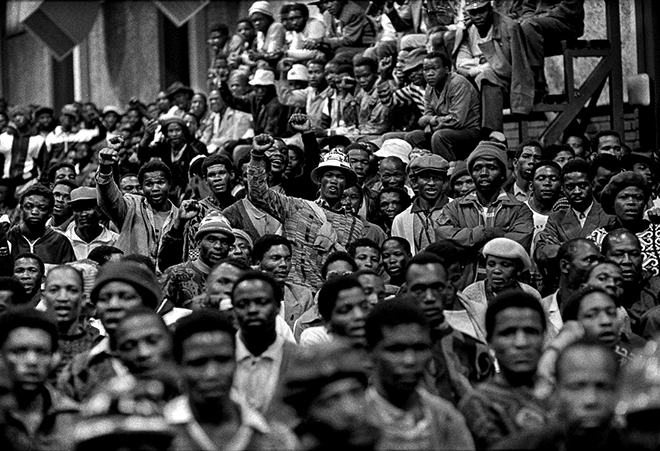
1991:South Africa: Meeting of miners on a wildcate strike in Republic of Bophuthatswana, a fictional country that was granted independence by South Africa’s apartheid-era rulers in 1977. Copyright 1991 Robert Gumpert
To start, it’s important to put this story in its global context. The great recession, playing out in a resource-based economy with structural inequality, class divisions and neo-liberal policies, probably gets us far in understanding how the conditions for the August violence were laid. South Africa is not the only country in this situation. I emphasize this point because like many Americans, South Africans often play the exceptionalism card; for instance, both nations have their contradictory, colonial myths about spaces of unrecognized potential populated by savages. South Africa’s transition from Apartheid left its own mythologies; even the notion of ‘peaceful transition’ is a claim of exceptionalism that belies the death and destruction visited upon Angola, Mozambique as well as on citizens at home. And there is a powerful myth that South Africa has only a race problem, not a class problem. So, yes, some part of the Marikana story is the same story that is also playing out in Peru, Indonesia, China, Greece, the world.
But that’s not a very satisfying explanation for those of us who had, and who still have, so much hope for a democratic South Africa. It also doesn’t help us understand the particular form this violence took. A great deal of ink has been spilled reporting on the massacre of August 16th at Lonmin’s Marikana mine, though it is hard to get a clear picture of events. The strike at Lonmin – not the only strike in the South African mining sector this year – started on August 10th. Clashes in the week before the massacre between rival unions left several people, including some policemen, dead. It is unclear whether the police were actually directly threatened by the strikers on August 16th, but it seems reasonable to say both that they felt their lives were in danger and that they over-reacted. Since then, more people have been killed, including a local ANC councillor and a National Union of Mineworkers (NUM) official. In response, the army was sent in patrol the area, and bizarrely, charges against the striking miners for causing the death of other massacred miners were first laid and then dropped. Expelled ANC youth-leader, Julius Malema, got in on the act, rallying miners and his supporters against President Zuma. When pressed, the current South African president can talk a good populist game, but so far his government has defined itself mostly for continuing the same neoliberal policies of the Mbeki administration that preceded his presidency. A commission of inquiry is now underway; perhaps a full account of the events will yet be told.
“this is especially a story about a union that is increasingly perceived to be establishment-oriented, both at the shop-floor level and also by virtue of its alliance with business elites in the ANC-led government”
In one of the best articles I’ve read, academics Bezuidenhout, Chinguno and von Holdt (download article here) argue that the two institutional failures lie behind the tragic events. First, industrial relations institutions failed to contain workplace conflicts in a context of gross inequality. Both mine management and the NUM lost the trust of rock drill operators. In part this was because of decentralized bargaining in the platinum mining sector, which created large disparities in earnings amongst miners doing the identical, dangerous, work. But this is especially a story about a union that is increasingly perceived to be establishment-oriented, both at the shop-floor level and also by virtue of its alliance with business elites in the ANC-led government. Exhibit A is Cyril Ramaphosa, former NUM Secretary General, ANC heavyweight and Lonmin board member; Ramaphosa is now at the center of a controversy over email he sent to government officials on August 15 urging a crackdown on the striking workers. At several platinum mines, the rival Association of Mineworkers and Construction Union has been able to displace NUM on the strength of genuine worker unhappiness. Second, the academics point to the failure of local governance institutions in the informal settlements around the mines. Whereas in the past, migrant miners were likely to be housed in compounds, those miners with the least attachment to place are increasing the portion of their earnings they can remit to rural areas by moving into informal settlements. In the absence of functioning governance systems, from policing to sewage, these places have failed utterly to ensure a decent quality of life. It is no surprise that the violence took place next to one of these settlements.
So while there are global dimensions to the events at Marikana, they also reflect and will shape the particular conditions in which they occurred. All of this leads me to three observations about how the weight of history is reflected the events at Marikana, and what may happen next.
“…is this what happens when one party holds state power for almost 20-years?”
First, there’s nothing new or unusual about the ANC and its allies trending right and then being pulled left by events. The ANC’s ‘natural’ political tendency is at the centre of the political spectrum. I know, I know, the ANC is in an alliance with the South African Communist Party and it got support from the Soviet Union during the struggle against Apartheid. But that is because communists were among the first white anti-racists, and because this was how the cold war alliances played out in Southern Africa. The ANC was started by an urban intellectual elite and it has always embraced non-racialism and a mixed class character. In 1960, Nelson Mandela was pushed into the armed struggle in part to capture political territory lost to the successful pass-burning campaigns of the Pan African Congress; in 1973 and 1976, frustrated workers and students took matters into their own hands and again pushed the ANC to act more boldly against the Apartheid state. That is part of the story of the ANC’s incredible, century-long success. Indeed, I will take it as a sign of the ‘weakness’ of the current ANC leadership if they cannot exploit Marikana to re-incorporate worker-based organizations and others on their left flank through a series of populist concessions. Conversely, perhaps the unwillingness of the ANC leadership after Mandela to act in a more populist way suggests that something more fundamental has changed; is this what happens when one party holds state power for almost 20-years?
Second, that state which granted so many privileges to generations of white South Africans continues to exert inertia. Part of the Marikana story is about ill-equipped and frightened policemen getting incomplete or outright bad orders. Changes in the leadership and composition of the police, or indeed other organs of the state are important, but they do not quickly translate into changes in operating manuals and training practices, let alone organizational cultures and deeply ingrained stereotypes. Changing the name of the South African Police Force –as it was known under Apartheid, with its overtly militaristic connotation – to the South African Police Service was a necessary step, but not the sufficient one. And what of the doctrine of common purpose under which some miners were charged with causing the death of the other miners shot by the police? In the initial reporting of these charges, a lot was made of the fact that this same doctrine was used in the Apartheid era against people participating in protests that resulted in the deaths of councillors, policemen and others accused of aiding in oppression. But the problem was then, and is now, the application of the doctrine by state officials, not its existence. ‘Common purpose’ doctrine makes sense in the context of South Africa’s legal system which combines both legal code and case-based precedents. With or without Apartheid, you still need a way to charge someone who holds another person down while they were being strangled. Charging the strikers for causing the death of other strikers was spectacularly stupid; but let’s not imagine that changing state institutions is easy.
“… there is a long history of racist laws in South Africa – from well before the formal start of Apartheid in 1948 – that were designed to encourage rural workers to migrate to work in mines, factories and homes, but to never become permanent urban residents.”
And third, the events at Marikana reveal yet another instance of incomplete urbanization. Numerous factors have contributed to the persistence of circulatory migration in Southern Africa. These factors include everything from a legacy of British colonialism that attached all subjects to a notional rural homeland, to cultural practices which value traditional lands and social attachments. And, there is a long history of racist laws in South Africa – from well before the formal start of Apartheid in 1948 – that were designed to encourage rural workers to migrate to work in mines, factories and homes, but to never become permanent urban residents. Numerous apartheid laws sought, unsuccessfully, to reinforce these patterns. Today, over three-fifths of South Africans live in urban areas, but the legacy of incomplete urbanization can be seen in housing and service shortages, and in rampant urban unemployment, that have proven remarkably resistant to improvement. It is unfair to say that successive ANC governments have not tried to address these problems and that there have been no successes; but it is also inaccurate to say that enough has been done. Marikana is an extreme example, but across the country, so-called ‘service protests’ occur with regularity. The nation – and its cities in particular – still await truly transformative development.
Marikana was a tragedy that shocked and saddened me, but it probably should not have been unexpected given the institutional failures, structural inequalities and the weight of history I have tried to highlight here. The most likely scenario is that the ANC will temporarily shift in a leftward and populist direction to contain the problem. It may work at first; yet, somehow, the short term solution feels especially inadequate this time around.
Additional reading: SA Social scientists on Marikana Massacre
Peter Hall
Jerry R. Tucker – Labor Warrior and Educator 1939-2012 – I just learned of Jerry Tucker’s passing on Friday, October 19
By Peter Olney
Jeff Stansbury brought his friend Jerry Tucker to the ILGWU hall in Los Angeles in 1988 to meet the staff and elected leaders of the union. Jerry was on the precipice of winning the job of UAW Region 5 Director. We all sat around the boardroom across from Macarthur Park as Jerry explained the history of his candidacy and why he had run for director of a vast region that extended from Missouri to Texas with 80,000 members. Jerry would be seated as Regional Director in October and would become the lone dissident voice among twenty-two members of the UAW Executive Board.
Jerry and Jeff had worked together in 1978 in a campaign in Missouri to defeat a Right to Work initiative on the state ballot. They barnstormed across the state visiting farmers and rural folk coalitioning with them to make sure they understood whose interests were served by the anti-worker ballot proposal. The initiative was defeated.
Jerry taught that workers could stay at work, get paid and engage in inside actions that would bring the employer to heal.
Jerry was responsible for introducing the “Inside Game” into the lexicon of labor organizers. At contract time rather than dutifully walking out on strike upon expiration of the collective bargaining agreement, Jerry taught that workers could stay at work, get paid and engage in inside actions that would bring the employer to heal. He successfully implemented these strategies in several facilities in Region 5 of the UAW when he was Assistant Regional Director.
Jerry was a big picture guy. Beyond advocating for strategic initiatives in the workplace that placed worker action first and foremost, Jerry was about labor playing a big role on society’s stage. He was a founder of US Labor Against the War (USLAW) on the eve of the Iraq invasion and he was a big advocate of Labor for Single Payer, the attempt to get universal national public financing for health care.
The ILWU benefited from his advice as we employed the “inside game” at our battle in the Mojave Desert with Rio Tinto Corporation in 2009-2010.
After he was defeated by the UAW Administrative Slate in his run for reelection in Region 5 Jerry spent the rest of his years teaching and mentoring. The ILWU benefited from his advice as we employed the “inside game” at our battle in the Mojave Desert with Rio Tinto Corporation in 2009-2010. Similarly when ILWU Organizer Carey Dall confronted German giant pharmaceutical Bayer over the contract for 500 workers in Berkeley California Jerry was there on the phone patiently probing, questioning and advising on how to move workers to act without a contract.
I wish I could have gotten to know Jerry and his family better. I do know that Jerry spent some time in his youth in San Francisco with the beats in North Beach, and I know that he was a fanatical St Louis Cardinals fan. He was very disappointed when they traded away Albert Pujols, but very happy to see them running deep into the playoff this year.
Jerry’s ideas have influenced a whole generation of trade unionists. For his courage and steadfastness he certainly paid a price. If he had only “waited his turn” he would have had a secure career in the UAW. When the AFL-CIO’s Industrial Union Department published their handbook for organizers entitled, “The Inside Game”, they were forced by UAW big shots to air brush out any mention of Jerry Tucker as the man on the ground who had pioneered these strategies.
Jerry will be missed, but we will carry on his memory in the work we do.
Peter Olney
Organizing Director ILWU
From Robert Gumpert
Mother Jones said “Injustice boils in men’s hearts as does steel in its cauldron, ready to pour forth, white hot, in the fullness of time.” That is how I remember Jerry Tucker and Jeff Stansbury. They continue to be inspirations. Lou Segal has posted a piece on Jeff and how he inspired Lou . You can read it and much more at LaborLou.com.
Mexico’s recent elections: From cynicism to hope to despair
By Myrna Santiago, Lola Ruiz Gonzalez, Nelson Perez-Olney, Álvaro Ramírez and Manuel Callahan
Moderator Myrna Santiago
Even before the recent elections in Mexico brought back the Partido Revolucionario Institucional (PRI) to the Presidency, the process elicited the full spectrum of emotions, from cynicism to hope to despair. Commentators of all political stripes analyzed the candidates and their platforms seeking to divine what the results might mean for Mexico’s near future. Most were pessimistic, to say the least, given the challenges facing the country, its people, and its leadership. Our three contributors, María Dolores Ruíz González, Alvaro Ramírez, and Manolo Callahan join the reflection on the topic, writing from perspectives that range from the very local to the global. María Dolores, a life-long resident of Mexico City, regales us with four vignettes about how her neighbors experienced the electoral process and reacted to the dust it kicked up. Alvaro Ramírez, who spends half the year in northern California and the other half in Cuernavaca running a study abroad program for American students, challenges us to reconsider the questions observers were posing on the eve of the elections. He comments not only on the political scene in Mexico, but also on the commentators and their perceptions. Manolo Callahan broadens the scope of the commentary by focusing on alternative movements and discourses that seek new possibilities not only for Mexico but for the United States a context of increasingly restrictive political and social spaces. The public is cordially invited to join the discussion and add more points of view.
Webmaster note: I have grouped the English translations together. The originals in Spanish follow.
English translations: Nelson Perez-Olney.
Election Stories I: Our Survey
“The women gathered expressed irreconcilable stances and the debate was heating up even more that it had around the topic of abortion”
Estela is an ordinary citizen, about to turn 50. She has short hair, she is skinny and taller than is common, always dresses in comfortable clothes (jeans, shirt, and white coat) and though she doesn’t boast, she owns a micro business. She owns a beauty salon in Colonia Narvarte. With 20 years in the area, her salon is continually visited by her female clients (very few men come to her salon) who profess a surprising loyalty to her. She knows her business. She addresses every woman by name and takes time to remember their last conversation to ask, “did everything work out?”
The women who come are well taken care of and listened to even more. In the interminable hours that pass between the base, dye, highlights, and pedicure, the women talk among themselves with familiarity as if they’d known each other for many years. The salon becomes a kind of forum where every woman can –perhaps without intending to– take a stance on an issue.
They have debated trivial things like showbiz, outrageous events like the case of the Big Flirt, even controversial topics like the decriminalization of abortion in Mexico City.
Estela moderates the discussion and she does it well. She always knows how and when to change the topic, especially if the discussion escalates.
However, this didn’t happen last week. The theme of the day was Josefina Vazquez Mota and her candidacy for the presidency. I confess my weariness of political campaigns and seeing what was coming I tried to immerse myself in the reading of a very dense text. It was useless. The women gathered expressed irreconcilable stances and the debate was heating up even more that it had around the topic of abortion.
Rosali, who is employed in a prestigious grocery store, argued that Josefina didn’t have the tiniest possibility of winning in such a sexist country. Also her figure projected fragility. Doña Gabriela (a retiree from the Department of Education), who didn’t agree with Rosali, forcefully asserted that now was the time for women and that Josefina was the only real chance the country had for a female head of state, since previous female candidates belonged to smaller parties that didn’t have a chance of winning the presidency. Araceli (a salaried worker) muttered, “it wasn’t as simple as that.” She wouldn’t give a blank check to Josefina just because she was a woman and finished by saying that more attention should be paid to her poor performance as a legislator. Doña Gabriela spun off with the theory that we women show no solidarity for each other and asked if men, when they ran for office, were asked for proof of excellent performance. Estela tried to divert attention towards other topics without success. Then Selene, the girl employed by Estela, expressed what I thought was the youth’s opinion because, of the previously mentioned women, two of them were in their forties and Doña Gabriela was in her seventies. Selene said that she didn’t understand, that “gender equality” had been talked about in this space and that the same women who had praised the concept an hour ago were now discrediting Josefina. To her it didn’t seem like a bad idea that a woman should govern Mexico, but she didn’t like Josefina’s conservative politics, nor did she like the image she projected that made it seem like she wanted to look really young with those pins in her hair.
“She wondered how it was possible that a party that was conservative and, on occasion branded as archaic, had nominated a woman…”
Estela decided to go with the flow and expressed her own opinion. She made it clear that for her Josefina’s struggle to reach the top of her party had been very tough, even more so because her opponent was the President’s successor and for that Estela respected her. She wondered how it was possible that a party that was conservative and, on occasion branded as archaic, had nominated a woman, something that no other party had done. She pointed out the example of Mexico City, governed by a left party that had nominated a handsome young lawyer without experience in partisan fights, leaving to the side the female coordinator of the deputies in the legislative assembly. What got her attention was that the villains in the story were all women: Josefina and Elba Esther, and before, she concluded, the villain had been Martha Sahagún, the former President’s wife.
The room looked to me. I hadn’t expressed my opinion yet. I took a breath and began to express my approval of Josefina’s appointment, my incredulity at the beating she was taking, including from people in her own party. “Beginning with the people in her own party,” Estela corrected me. I went on saying that, for women, arriving at these positions of power was twice as difficult as it was for men, that indeed male candidates were not asked for an impeccable personal and professional history. It seemed to me that what caused distrust of these women is that they played by the same rules as the men, they didn’t fit the roles that women normally played according to social norms, but most of all they had a very real chance of occupying positions of power and decision-making. I added that although the discourse of gender equality was politically correct and politically advantageous, women in this country were still far from achieving equality in electoral contests.
“In this electoral contest two factors of the utmost importance were coming together…”
And I retook part of Estela’s analysis with respect to the “villains of the story.” The women that were not dismissed as ugly, corrupt, or opportunists, were labeled bitches and easily overcome by emotions, using pseudo-biological theories to justify the inconvenience of having women as political actors with real access to power. Hence the controversy generated among certain social sectors due to Josefina’s appointment as presidential candidate. In this electoral contest two factors of the utmost importance were coming together: one, a woman being nominated by the governing party and two, her having serious prospects of winning the race.
Here our survey began. Araeli spoke up. She said she would not vote for Josefina. Doña Gabriela, on the other hand, said she would. Rosali said she was on the fence and that on certain things she agreed with Estela and myself. Selene said that she would vote for Andres Manuel Lopez Obrador. Estela smiled, relieved that the intensity of the discussion had subsided, and announced her support for Josefina.
I said I wanted to abstain, that it seemed to me that Josefina’s platform and the platforms of the other candidates were a list of good wishes and that I wouldn’t cast my vote for any of them.
There followed silence which Selene broke when she told me, “your hair needs to be washed.”
The other ladies immersed themselves in the reading of “Hola” and “Quien.” Estela went out to the street to smoke a cigarette.
Election Stories II: Onofre, the Cabbie
“Because of this he spent almost a month at the taxi’s headquarters, washing cars”
Onofre Armando Martinez is a Mexico City figure, a taxi driver at the spot where I often catch a cab.
Onofre is brown skinned, short, with very straight hair and black eyes. His smile is wide and warm. He isn’t the owner of the cab he manages, only an employee. He works the morning shift from six in the morning to six at night. He could earn more on the night shift, but he’s been assaulted three times and the last time, in his own words, “was a close call.” They pulled a gun on him and he offered them his cab. Because of this he spent almost a month at the taxi’s headquarters, washing cars.
“Before I was a taxi driver,” he begins his story at almost the exact same time he turns on the fare meter and starts off down Las Aguilas Avenue, “I was a merchant in Ocotlan, over in Oaxaca, but when my kids started getting older, I had to look for other work. I closed my shop and I came with my wife to live with some relatives in Colonia Santo Domingo, near the Ciudad Universitaria Metro stop. There my wife’s brother-in-law connected me with a guy who owned taxis and that’s how I started this job, turning in my cab fares and a full tank of gas every day.
Since he came highly recommended (“I can vouch for him,” his wife’s brother-in-law told the cab owner) they didn’t ask him for a deposit.
“…the worst are the inspections that the car has to pass. Even if the car is fine they always find a way to take money.”
Onofre is very proud when he mentions that his two sons are in school. Armando is in high school and Joel is in 6th grade. “They did get to go to school.”
After ten years as a taxi driver, Onofre knows a lot about what’s going on in this great city. “I know this city very well.” Now he’s driving along Avenida Rómulo O’Farril. He lives it, he travels it, he suffers it daily. “Teacher, you should see when they change streets to one-way without warning, when the teachers have a rally, or when I got into a fist-fight down on Avenida Revolución with some guy who was tail-gating me the whole time.” He says confidently, “those are daily occurrences.” We are almost at Avenida Patriotismo when he assures me, “but the worst are the inspections that the car has to pass. Even if the car is fine they always find a way to take money.” He shakes his head in disgust.
The journey continues with relative calm, when suddenly his abrupt braking almost crashes the cab.
“Be careful!” I demand, frightened.
“I’m sorry Teacher,” is his response. “It’s just that with so many posters hanging everywhere, visibility is lost. They practically put them on top of the stop lights.”
Somewhat calmer now, I agree with him. He is still indignant, “It’s not fair! The whole city is full of that garbage they’re hanging on the poles, the trees. Now you’ve seen they even use stop lights! They’re pure photo-ops where candidates for all races are hugging or greeting the presidential candidate as if they were old friends. It’s a total circus!”
“On the TV and the radio they’re always talking about the elections, and they only talk to us about the party disputes. None of the candidates say how they are going to create jobs, lower the price of gasoline. All they do is fight.”
““Who do you want to win?”
Maliciously I ask, “Who do you want to win?” He assures me that he’s picked his rooster and when I ask him, “who is it?” he says slyly, “the vote is secret” and smiles. I continue the game and I say that’s fine, that I won’t insist because he could report me to the federal elections office, alluding to the commercials sponsored by the Attorney General’s office about reporting alleged electoral crimes.
“Has anyone done a survey with you?” he asks looking at me through the rear view mirror, “because I honestly don’t know where they get their polling numbers. Nobody’s asked me, not on the street, not over the phone, nothing. He shrugs and says, “for me the best survey is the one on the 1st of July.”
“In that moment I feel truly important. As if I believed my vote counted!”
He stops when the stop light turns red and he turns to tell me, “when Fox won, I thought that the PAN would put an end to the corruption everyone blamed and still accuse the PRI of practicing, but after more than ten years we’re even worse off than before.”
“That’s why,” he continues as the car advances along Circuito Interior, “when Calderon tripped up on employment issues and Obrador was doing who knows what, Peña Nieto seemed to me to be a serious candidate, but he hasn’t convinced me yet… The problem is he’s with the PRI, even if he is from the young ones.”
His face lights up when he says “You know, Teacher, when you go in the booth and mark the ballot and feel like there’s a hole in your stomach? In that moment I feel truly important. As if I believed my vote counted!”
“Of course it counts Mr. Onofre!” I reply, infected by his emotion.
“I’ve voted before and my candidate has never won. I hope that this time he does.” He stops finally in Colonia Cuauhtémoc. “That’ll be 70 pesos, Miss,” he says, smiling as always.
Election Stories III: Cheli
““I’m still beautiful, you disrespectful child,…”
It’s hard to think of aunt Cheli as a sex symbol. Once, rooting through the family photo album, I came across some old pictures, most of them worn with time, some in black and white and others in color, and I discovered a young and attractive woman with an enviable figure in fitted black leather pants and a very short, hot-pink blouse, with beautiful, golden hair.
“Is this really you, Tia?” I asked incredulous.
“Of course it is” she replied as she released her classic guffaw.
“You were very beautiful,” Gisela said, her eyes widening.
“I’m still beautiful, you disrespectful child,” Cheli said as she sat with us at the dinner table in the house of our dead grandparents and gifted us with her wonderful smile.
““And why would I want a candidate card?”
Cheli is part of family legend. It was always said that she was a great woman, decisive, poised and determined. However, now she’s known for other things. I think of her as a “little ball of tenderness,” as much for the roundness of her body, hands, arms, and face as for her good nature. She still has her beautiful golden hair, now with a few grey strands that according to Cheli “aren’t even noticeable.” Smiling, she sees the positive in the worst tragedies, she is always ready to help anyone in need and above all else she radiated tenderness and caring. That’s why it’s so easy to talk to her. Cheli loves dogs. She’s had many, some of them very fancy like “Cherie,” a beautiful French poodle, and right now “Nicolas,” a little mutt who is her great companion.
Every afternoon she takes Nicolas for a walk along the streets of Colonia San Pedro de los Pinos, but this afternoon something special happened. Martha, her next door neighbor, came up to her, very excited…
“Cheli, they’re giving out congressional candidate cards!” she burst out.
“In exchange for what?”
“And why would I want a candidate card?” Cheli asked as she tugged at Nicolas with his leash because he wanted to go to the park just like every other day.
“Well, to go to the store, whichever one you want. You can buy things, clothes, food– not wine–and they’ll give you credit for up to 800 pesos,” replied Martha with a knowing gesture.
Cheli looked at her amazed and asked “In exchange for what?”
“That you vote for him for delegate. Give me a copy of your voter ID card and I’ll give it to Loretito who works for the party. She’s collecting them,” she said with a convincing voice.
“I don’t know where I left my voter ID card, and I can’t go get it. I have to take Nicolas to the park.”
“If you want, I can help you find it when you come back from walking the dog,” offered Martha helpfully. And then to justify the urgency with which she was asking for the document she said as if she were giving a lecture.”
“we women are much weaker than men and…”
“We must turn in copies of lots of IDs so that they take us into account and support us like the group of vulnerable women that we are.”
“Vulner… What?” Cheli asked, stunned by the language.
“Vulnerable,” Martha Reiterated. “That’s what Loretito says our group is called.” Continuing her speech, “we women are much weaker than men and on top of that there are a lot of single mothers in the district. Because of this they included us in the report of party beneficiaries.”
“Oh, well, if it’s for the weak, that’s fine!” Cheli said, nodding her head in acceptance.
“But I’m not a single mother and if Gonzalo finds out that they’re giving me delegate cards to buy things he’ll get mad. No, I better not,” Cheli responded fearfully.
“Well then don’t tell him. Anyway he’s not even here,” advised Martha firmly.
“True, but when he gets back from Michoacán and finds out from somebody that could create a mess for me.”
“Who’s going to tell him?” Mischievously, Martha whispered, “wouldn’t you like to go to the mall to buy something other than food? For example, you who love your dog so much, you could buy him snacks and a sweater? Besides, this is really easy. You just have to check off the Party’s box on election day. That’s it!,” she insisted looking at Cheli sympathetically.
“…he also faced the stiff competition from the Chinese, who made products similar to the ones Gonzalo made but cheaper.”
It was very tempting for Cheli. Although she didn’t live poorly, it was true that every day it was difficult to go to the market and buy anything more than food, always looking for special offers, because she never had enough money for more.
Gonzalo was a craftsman. A great craftsman! But his business wasn’t making as much as it had when he started. It wasn’t because Gonzalo didn’t hustle, for sure. Gonzalo spent a lot of time looking for clients with poor results, and to make matters worse he also faced the stiff competition from the Chinese, who made products similar to the ones Gonzalo made but cheaper.
Cheli thought it over for a few moments, and then smiling she made her decision. “Well, I was going to vote for him anyway,” she told herself as justification.
On the eve of the election, Martha came to look for her. She knocked timidly at the window, because she knew that at this hour Gonzalo would have come home and she didn’t want to cause problems for her neighbor.
“Cheli,” Martha said quietly, “They’re giving out the cards now.”
Cheli signaled for her to close her mouth. “Gonzalo is here. He’s just arrived and gone to bed to take a nap. I can’t leave,” Cheli argued, glancing inside.
“It’s just that they only give the card to those on the list,” Martha insisted. “I can’t get it for you.”
“How long will they be giving them out? When I take Nicolas out to the park I can go get one. Before that I can’t,” Cheli replied, who was now starting to grow weary of her neighbor’s insistence.
“YOUR DELEGATE THAT UNDERSTANDS YOU”
“But there’s going to be a meeting to make sure we’re agreed about voting,” Martha answered back. “They’re going to explain to us how to vote. They say that it’s very complicated now with coalitions.”
“Better that I don’t get one. What if I get confused and mark the wrong box and they charge me for the card?” answered Cheli fearfully.
“No. What are you thinking? That’s why you should come to the meeting. It’s going to start soon.”
“I can’t. Thanks for everything, Martha, but truly I don’t want any problems. This thing with the cards just keeps getting more complicated,” Cheli replied, practically closing the window on Martha’s annoyed face.
Gonzalo got up and asked Cheli, “Who are you talking to?”
“No one,” was her response.
Like every other evening when Gonzalo found himself in Mexico City, Gonzalo turned on the TV and set himself to watching his favorite show. Cheli took the opportunity to take Nicolas out for a walk. That night before the elections she was in a hurry to leave. She didn’t even put a sweater on Nicolas! She walked quickly along the street. “I hope they haven’t left,” she thought tensely. When she finally arrived at the somewhat rickety party building, she brushed against a poster hanging at the entrance. It measured some two meters by two and a half meters, was discolored by the sun and bore the smiling image of one Epigmenio Velázquez, who promoted himself as YOUR DELEGATE THAT UNDERSTANDS YOU, like that, with capital letters.
Cheli went up the stairs as fast as her extra weight allowed and knocked at office 201.
“It’s open,” said a woman’s voice from inside the office.
“I’m here for the meeting,” Cheli said firmly as she caught her breath.
“You’ll have to wait, it’s at 8:00 p.m.,” answered the woman behind the counter without looking up.
“I can’t. I have to take care of someone who is sick,” Cheli countered firmly.
“If he wins they’ll put 800 on the card and then you will be able to go and buy in three markets near the district.”
The woman looked up and through heavily made-up eyelashes she questioned Cheli, who was now less agitated.
“What section are you from?”
“Section? I don’t know.”
“Did you bring you ID?”
“Yes,” and she handed over the card.
The woman consulted a list and “sang the name” out loud. “Celina Márquez Peña!”
“That’s me.”
“Did you bring anyone else?”
“I am here alone,” was the response.
“Mmmm. That’s okay. I’m going to give you the gift card. I’m sorry for whoever put your name down. Since you came alone, she won’t get credit for you signing up,” the woman grumbled. “I’ll give you the express training,” she said, annoyed. Then she took from her box a newspaper with a drawing of the ballot that would be used for the election. She showed it to Cheli and began the “express training.”
“Look Celina, you have to go and vote and mark this box on all the ballots. We want this candidate to win, and we’ll know the following day. If he wins they’ll put 800 on the card and then you will be able to go and buy in three markets near the district.” She extended the paper to Cheli. “Look. Here are the addresses of the stores,” and finally offered a smile.
“Thank you,” Cheli said, leaving the building quickly with the card stashed safely away in her pants’ pocket.
“she remembered many of the phrases that the candidates had made fashionable…”
Nicolas’ walk was very short, sadly for him, but Cheli didn’t have time to go to the park.
Returning to her house, she remembered many of the phrases that the candidates had made fashionable: that the vote is secret, that he whom the people choose will win, he who is with the poor, that the candidate is a different woman, that the candidate is committed, even one that wanted to make alliances riding in a van. In reality Cheli didn’t know much about politics. She left that to Gonzalo, but on this occasion she would vote with pleasure. Finally they had taken her into account for being a “vulnerable woman,” as Martha had said to her.
Now back home she found a smiling Gonzalo who hugged her as he said “Saturday we’re going to Carécuaro. My comadre Queta just called to say that Fermin arrived from Tucson!”
“But… the election?” Cheli replied, somewhat anguished.
“We’ll vote there. That’s what the special voting booths are for,” said Gonzalo very didactically.
“But… our vote for the delegate?”
“That ass? What about him? What matters now is who becomes president, Cheli!” Gonzalo concluded.
Elections Stories IV: We Are More Than 132
“The candidate wants to know how many people live in every city lot and if they want to support his campaign.”
Yesterday some young people knocked at my door. I’m not speaking figuratively, nor am I making mention of the events that are suddenly organized with educational institutions or directed to serve this neighborhood. A young girl literally carrying her baby in what in my time was called a “kangaroo” baby sling, asked with a wide smile if I would participate in a survey. Infected by the racket that has been created by the “132” movement, I of course accepted.
The first thing I did was ask her if she was with any polling association, but that wasn’t the case. Maria Alejandra (that is the name written on the name tag she wore on her chest) was “carrying out a census in the district.” “Census for what?” I asked. “The candidate wants to know how many people live in every city lot and if they want to support his campaign,” she replied as she shifted her arms a little to better support her baby and her survey clipboard.
My facial expression must have alerted Maria Alejandra, because she hurriedly blurted out, “but if you don’t have to give information if you don’t want to.” In that moment the robust baby with his almond shaped eyes and his curly hair had won me over with his smile. “What information do you need?” I asked her. She continued the balancing act of holding her baby, writing on her clipboard and smiling all at the same time.
I provided the information she needed and I asked her if carrying her baby made surveying complicated. Maria Alejandra said yes, that it was quite complicated and tiring, but that they paid her for every survey and the more surveys she completed the better her pay. On top of that she didn’t have anywhere to leave her baby because her family was all doing the same thing, but in other neighborhoods.
“And now, unexpectedly, they were fixing it just like that.”
She asked me for a glass of water and told me she would sit on the sidewalk under the shade of a tree to rest a bit. It was almost 11 in the morning and it was starting to get hot. I sat down to talk with her as she drank the glass of water.
My neighborhood looks like a war zone. At the last minute they told us that they were going to repair the pavement, something we had been asking the Delegation for over the past three years without success. And now, unexpectedly, they were fixing it just like that. Crews of men arrived in the district and began to break up the sidewalk and with paperwork on hand they told us to call a telephone number and ask to have the repairs done, so they could fix our portion of the sidewalk. The neighbors, who had come out to see what was happening, a bit suspicious, were asking, “how much will it cost?” The man who seemed to be in charge of the crew and who wasn’t wearing a uniform nor a county nametag replied that the service was free and that the instructions he had were to take care of every neighbor who turned over his city lot file number.”
Maria Alejandra and I watched the scene play out from below the cover of the tree. Then, from between trenches formed by the rubble of the sidewalk, you could say, there appeared many more young people who, like Maria Alejandra, were trying to convince the neighbors to participate in the survey. Not all of them were successful. One of them came up to Maria Alejandra and told her that at two in the afternoon they would be meeting in a park in the neighborhood with the surveys they had managed to carry out. He thanked me very ceremoniously for my cooperation and then left. That was when the dialogue between the young woman and myself started.
Maria Alejandra is a single mother. She is 19 years old. Camila, that’s her baby’s name, is barely six months old. Before the baby was born, Maria Alejandra attended an institute, but when she got pregnant she couldn’t continue to attend. “I was ashamed to go to school like that,” she said looking at me fixedly. “And a few female classmates gossiped about me.” She shifted her shoulder-length dark hair and continued her story.
“My mother helped me until Camila was born, but the costs have doubled and this opportunity to work for the elections came up. I only work four hours, Monday to Saturday, and today is payday.”
“I didn’t know about it, but I assure you that in the office alone there are more of us than that.”
“The people aren’t aggressive in this neighborhood,” she continued. “It’s been going well for me. In every house I’ve knocked at, the people have completed the survey. It’s not like that for my mother and brother who are knocking on doors in the neighborhood across the avenue. They almost beat up my brother! It’s because of the political parties. They get mad that they come to do surveys, because they say there that they know who is going to win the elections and they don’t need anyone bothering them.
“And you? What do you think of the elections?” I asked.
“Well, I think they’re good. Thanks to them we have this job, and the bad thing is that it will only be 15 more days. Afterwards we don’t know if we’ll have any more work. They did tell us that if they do have work it will only be for youth.”
“Why is that?”
“I think because we put up with more. This thing of going around the streets of the city in the heat, they don’t give that to just anybody. You have to be strong.”
“And after the elections?”
“They say they’re going to open a lot of jobs for youth, that there will be more opportunities for us. Right now the important thing is what we think, which is good because before the elections they didn’t take us into account.
“Do you know there is a movement called the 132, and that only young people participate in it?”
“I didn’t know about it, but I assure you that in the office alone there are more of us than that.”
She said goodbye and walked down a street full of rocks and dirt, carrying Camila. At two in the afternoon she would meet with the other young people, with her peers, because it was payday in the park.
Spanish text
Nuestra Encuesta, por Lola Ruiz Gonzalez
Estela es una ciudadana común y corriente, está por cumplir los cincuenta años, usa el cabello corto es delgada y más alta de lo común, siempre viste con ropa cómoda -pantalón de mezclilla, blusa camisera y su bata blanca-y aunque no se jacta, es microempresaria, tiene un salón de belleza en la Colonia Narvarte, con 20 años de existencia en la zona, su local es visitado continuamente por sus clientas (son muy pocos los varones que atiende), quienes le profesan una fidelidad sorprendente, ella conoce su negocio, le llama a cada mujer por su nombre y se dá tiempo para recordar la última conversación sostenida para preguntar ¿siempre se arregló su problema?.
Las mujeres que acuden se saben bien atendidas y mejor escuchadas. En las interminables horas que transcurren entre; la base, el tinte, “los rayitos”, el pedicuro, las mujeres conversan entre sí con una familiaridad tal como si conocieran de muchos años atrás, el salón se convierte en una especie de foro dónde cada mujer puede-tal vez sin proponérselo- posicionar un tema.
Se han debatido cosas triviales como las noticias de la farándula, otras indignantes como el caso del “Coqueto” y hasta polémicas como la despenalización del aborto en el D.F.
Estela modera la discusión y lo hace muy bien, siempre sabe cuándo y con que recursos, cambiar el tema, sobre todo si la conversación va escalando.
Sin embargo, esto no ocurrió la semana pasada, el tema que surgió fue Josefina Vázquez Mota y su candidatura a la presidencia, confieso mi hastío ante las campañas políticas y al ver lo que venía, intenté abstraerme en la lectura de un texto bien denso, no fue posible, las mujeres ahí reunidas manifestaban posturas irreconciliables y el debate se acaloraba más aun que con el tema del aborto.
Rosali –empleada en un prestigiado almacén – afirmaba que Josefina no tenía la menor posibilidad en un país tan machista, que además su figura proyectaba fragilidad, Doña Gabriela(jubilada de la SEP), no coincidía con ella, afirmaba contundentemente que era el momento de las mujeres y que Josefina era la única posibilidad real que se presentaría en el país de que fuera gobernado por una fémina, que las anteriores candidatas lo habían sido por partidos pequeños y sin chance de llegar, Araceli (trabajadora asalariada en activo) rezongó: “no era tan sencillo”, ella no daría un “cheque en blanco” a Josefina sólo por ser mujer y remató diciendo que habría que poner atención a su bajo desempeño como legisladora, Doña Gabriela reviró con la teoría de que las mujeres no somos solidarias entre nosotras y lanzó la pregunta de que si a los hombres cuando contendían les pedían pruebas de excelente desempeño, Estela trataba de desviar la atención, hacia otros temas, por cierto sin éxito, entonces intervino Selene, la joven empleada de Estela, pensé, la opinión joven porque de las anteriores mujeres dos cuarenteaban y en el caso de Doña Gabriela sesenteava, Selene dijo que ya no entendía, que se había hablado en ese espacio de la “equidad de género” y que a la mera hora las mismas que alabaron el concepto, ahora descalificaban a Josefina, que a ella no le parecía mala la idea de que una mujer gobernara México, pero que no le gustaba la postura conservadora de Josefina, ni su look que pareciera que quería verse muy jovencita con esos prendedores en el cabello.
Estela se rindió ante la inercia y emitió su opinión, manifestó que para ella la lucha de Josefina por llegar a las finales en su partido fue muy dura, más aun habiendo tenido como contrincante al delfín del presidente y que por eso la respetaba, que cómo era posible que un partido conservador y en ocasiones hasta tildado de arcaico hubiera optado por posicionar a una mujer, cosa que ninguno de los otros partidos habían hecho, señaló el caso del Distrito Federal gobernado por un partido de izquierda que había optado por un joven y guapo abogado, sin experiencia en las lides partidistas dejando a un lado a la coordinadora de sus diputados en la Asamblea Legislativa, que le llamaba la atención el que ahora las malas del cuento eran mujeres; Josefina y Elba Esther, ya antes, concluyó, la villana había sido Martha Sahagún.
El auditorio me miró, faltaba yo por expresarme, tomé aire y comencé a expresar mi beneplácito por la designación de Josefina, mi incredulidad ante el golpeteo de que era objeto, incluso por la gente de su partido, -empezando- me corrigió Estela, continué diciendo que para las mujeres llegar a esos espacios de poder era el doble de difícil que para los varones, que efectivamente a ellos no se les pedía una trayectoria laboral y personal impecable y que, lo que en mi concepto, causaba desconfianza de estas mujeres, era que utilizaban las reglas de juego de los varones, eran distintas respecto a los roles que deben seguir las mujeres según el mandato social, pero sobre todo con verdaderas posibilidades de llegar a ocupar un puesto de poder y decisión, que si bien el discurso de la equidad de género era políticamente correcto y muy rentable, las mujeres en este país, todavía estábamos lejos de alcanzar la equidad en la contienda electoral.
Y retomé parte del análisis de Estela respecto a las “malas del cuento”, a la que no tachan de fea, corrupta, arribista, la tachan de puta, de dejarse llevar por el sentimiento, y esgrimen teorías biologicistas como justificantes de la no conveniencia que una mujer tenga asuma un papel protagónico y acceda realmente al poder. De ahí la controversia generada en algunos sectores de la sociedad hacia la designación de Josefina. En esta contienda electoral se reunían dos condiciones importantísimas; ser postulada por el partido gobernante y con reales expectativas de triunfo en la contienda.
Ahí comenzó nuestra propia encuesta; Araceli se pronunció, dijo que no votaría por Josefina, Doña Gabriela en cambio comentó que ella sí lo haría, Rosali dijo estar en la franja de los indecisos y que en algunas cosas coincidía conmigo y con Estela, Selene dijo que ella votaría por AMLO, Estela sonrió ya más aliviada de que el calor de la discusión hubiera cedido y se pronunció por Josefina.
Yo comenté que deseaba anular, que me parecía que las plataformas de la candidata y los candidatos eran una suerte de buenos deseos y que no avalaría con mi voto a ninguno.
Se hizo un silencio, que rompió Selene cuando me comentó, -hay que lavarte el cabello-.
Las demás mujeres se enfrascaron en la lectura del Hola y del Quien, Estela salió a la calle a fumar un cigarrillo.
ONOFRE, por Lola Ruiz Gonzalez
Onofre Armando Martínez, es un personaje de la ciudad de México, es chofer en el sitio de taxis a donde solicito el servicio habitualmente.
Onofre es un hombre moreno, bajo de estatura, con el pelo muy lacio y ojos negros, su sonrisa es amplia y cálida. No se crea que es dueño de la unidad que maneja, sólo es empleado, trabaja el turno de la mañana de las 6 de la mañana a las 6 de la tarde, podría ganar un poco más en el turno de la noche, pero ya lo han asaltado tres veces y en la última, según sus propias palabras, -la vio cerca- le sacaron un arma y prefirió que se llevaran la unidad. A raíz de ese incidente pasó casi un mes en la base, lavando coches.
-Yo antes de ser taxista- inicia su relato casi al mismo tiempo que prende el taxímetro y se enfila por la avenida de “Las Águilas” – era comerciante en Ocotlán, allá en Oaxaca, pero cuando empezaron a crecer mis hijos, tuve que buscarle por otro lado, cerré el tendajón y me vine con mi mujer a vivir con unos parientes a la colonia Santo Domingo, cerca del Metro Ciudad Universitaria, ahí mi concuño me conectó con un señor que tenia taxis y así comencé en este trabajo, entregando diariamente la cuenta y el tanque de gasolina lleno -.
Como era recomendado -yo quedo por él-, le habría dicho su familiar al dueño de las unidades, no le pidieron fianza.
Onofre se pone muy orgulloso cuando comenta que sus dos hijos estudian; Armando la secundaria y Joel el sexto grado, -Para ellos si hubo estudio-.
Después de 10 años de taxista, Onofre sabe mucho de lo que sucede en esta gran ciudad, -Conozco muy bien la ciudad- ahora circula por la Avenida Rómulo O´Farril- , la vive, la transita, la sufre a diario, -Debería ver maestra cuando cambian de sentido las calles sin avisar, o cuando hacen una marcha los maestros, y hasta cuando me bajé en plena Avenida Revolución a madrearme con un fulano que se me venía cerrando a cada rato- comenta convencido – Son cosas de todos los días-, casi llegamos a Av. Patriotismo cuando me asegura- Pero lo peor son las revistas que tiene que pasar el coche, aunque esté bien siempre encuentran la forma de sacar dinero- y mueve la cabeza molesto.
El trayecto continúa en una calma relativa, cuando de pronto un brusco enfrenón hace que casi choque la unidad,
¡Ponga más cuidado¡- reclamo muy asustada-
Disculpe maestra -es su respuesta- es que con tanto cartel colgado, se pierde la visibilidad, además los ponen casi encima de los semáforos.
Más calmada le doy la razón, él continua indignado, -¡No se vale¡ Toda la ciudad está llena de basura que cuelgan en los postes, en los árboles, ya vio que hasta en el semáforo, son puros fotomontajes dónde aparecen los candidatos a diferentes puestos, abrazando o saludando al candidato a la presidencia como si fueran viejos amigos, ¡Puro circo¡-.
-Todo el tiempo en la tele y en el radio hablan de las elecciones, y solo nos hablan de los pleitos entre partidos, nadie de los candidatos dice bien a bien como le van a hacer para que haya más empleos, para que baje la gasolina, solo se la pasan peleando-.
Maliciosamente pregunto: -¿Quién quiere que gane?-, afirma que ya tiene su gallo y cuando le pregunto -¿Quién es?-, me dice socarrón -el voto es secreto- y sonríe. Yo le sigo el juego y le digo que está bien, que no le insistiré más porque podría denunciarme a la FEPADE, aludiendo a los comerciales sobre denuncias de presuntos delitos electorales que ha implementado la Procuraduría General de la República.
¿A usted ya la encuestaron? -Pregunta mirando a través del retrovisor- por que yo la verdad no entiendo de dónde sacan los resultados de las encuestas, a mi nadie me ha preguntado, ni en la calle, ni por teléfono, ni nada- Levanta los hombros y afirma – Para mi que la encuesta buena es la del 1º de julio-
Se detiene cuando el semáforo marca rojo y voltea para decirme -Cuando ganó Fox, yo creí que el PAN acabaría con la corrupción de que tanto acusó y acusa al PRI, pero después de más de diez años estamos peor-.
Por eso-continua al tiempo que el carro avanza sobre Circuito Interior -cuando fracasó Calderón en el tema del empleo y Obrador andaba quien sabe en donde, Peña Nieto me pareció un candidato serio, pero no acaba de convencerme…….. es que es priista, aunque sea de los jóvenes-.
Su rostro se ilumina cuando dice – ¿A poco no maestra, cuando entra uno a la casilla y tacha la boleta se siente como un huequito en el estómago? En ese momento me siento verdaderamente importante, ¡Como que me la creo que mi voto vale¡.
¡Claro que vale Don Onofre¡-le contesto contagiada de su emoción-
– Antes he votado y nunca ha quedado mi candidato, espero que en esta, si quede- se detiene al fin en la Colonia Cuauhtémoc- Son 70 pesos señora- me indica sonriendo como siempre.
CHELI
Cuesta trabajo pensar en la Tía Cheli como en una “sex symbol”, una vez, husmeando en el álbum familiar encontré viejas fotos, en su mayoría maltratadas por el tiempo, algunas en blanco y negro y otras en colores y descubrí a una joven y atractiva mujer de figura envidiable enfundada en ajustados pantalones de cuero negros y una blusa muy cortita de color rosa mexicano, con una hermosa cabellera dorada.
-¿A poco eres tú, Tía?-pregunté incrédula.
-Por supuesto que sí-, me respondió ella al tiempo que soltaba su clásica carcajada.
-Estabas bien guapa- comentó Gisela abriendo lo ojos-
-Sigo estando guapa niña irrespetuosa- añadió Cheli al tiempo que se sentaba con nosotras en el comedor de la casa de los fallecidos abuelos y nos regalaba su maravillosa sonrisa.
Cheli es parte de los mitos de la familia, siempre han dicho que era una mujer monumental, con decisión, presencia y determinación, sin embargo ahora su imagen es otra, yo la defino como “bolita de ternura”, tanto por la redondez de su cuerpo, sus manos, sus brazos, su rostro, como por su buen carácter, conserva de aquellos tiempos su hermosa cabellera dorada, ahora con algunas canitas que según Cheli, ”ni se notan”, sonriente, mira en positivo las peores tragedias, siempre está dispuesta a ayudar a quien lo necesite y sobre todo irradia ternura y cariño. Por eso es muy confortable conversar con ella. Cheli adora a los perros, ha tenido varios; algunos muy finos como la Cherie una french poddle muy hermosa, y ahora Nicolás un perrito criollo que es su gran compañero.
Todas las tardes saca a pasear a Nicolás por las calles de la colonia San Pedro de los Pinos, pero esa tarde algo especial sucedió, Martha la vecina de al lado se le acercó muy excitada…
-¡Cheli, andan repartiendo tarjetas del candidato a delegado¡- le soltó a botepronto.
-¿Y para que quiero una tarjeta del candidato?- preguntó mientras jalaba la correa a Nicolás que ya quería irse hacia el parque como todos los días.
-Pues para comprar en el Almacén, en cualquiera, puedes comprar cosas; ropa, comida, menos vino, y te alcanza hasta para $ 800.00- le contestó Martha con un gesto de sapiencia.
Cheli la miró asombrada y preguntó -¿A cambio de qué?-
-De que votes por él para delegado, pásame una copia de tu IFE y yo se la entrego a Loretito la que trabaja en el partido, ella las está juntando- le dijo con voz convincente.
-No sé dónde dejé mi IFE, y no puedo ir a buscarla, tengo que llevar a Nicolás al parque-
-Si quieres te ayudo a buscarla cuando regreses de pasear a tu perro- se prestó Martha a ayudarla-.Y para justificar la premura con que le solicitaba el documento dijo como si diera una cátedra.
-Hay que entregar copias de muchas credenciales, para que nos tomen en cuenta y nos apoyen como grupo de mujeres en vulnerabilidad que somos-
-¿Vulne…que?- Preguntó Cheli, asombrada por la palabrita.
-Vulnerabilidad, -recalcó Martha- Así dice Loretito que le pusieron a nuestro grupo- y continuó su alocución- es que las mujeres somos más débiles que los hombres y además hay muchas madres solteras en la colonia, por eso nos incluyeron en la relación de beneficiarias del partido.
-Ah, bueno si es por débiles, ¡Está bien¡ -al tiempo que movía la cabeza aceptando el argumento- Pero yo no soy madre soltera y si se entera Gonzalo que me andan dando tarjetas del delegado para comprar cosas se va a enojar, no, mejor no- Respondió Cheli temerosa.
-Pues no le digas, al fin que él ni está acá-le aconsejó Martha con firmeza.
-Eso sí, pero cuando regrese de Michoacán y si se entera por alguien puedo meterme en líos-
-¿Quién le va a decir?- y pícaramente le susurró- ¿A poco no te gustaría ir al centro comercial a comprar algo más que comida? Por ejemplo, tú que quieres tanto a tu perro, podrías comprarle su alimento y un sweater? Además es bien fácil esta “movida”, sólo tienes que cruzar el escudito del partido el día de las votaciones, ¡Y ya¡-Insistió mirándola con simpatía-
Era mucha tentación para Cheli, si bien no vivía mal, era cierto que cada vez era más difícil ir al centro comercial a comprar algo más que comida, y siempre buscando las ofertas, porque no alcanzaba para más.
Gonzalo era artesano, ¡Un buen artesano¡ Pero su negocio ya no dejaba ganancias como al principio, por ganas no quedaba le constaba que el hombre la pasaba buscando clientes con pobres resultados, y para colmo tenía encima la fuerte competencia de los “chinos”, que producían artículos muy similares a los fabricados por Gonzalo, pero más baratos.
Cheli permaneció pensativa unos instantes, y después sonriendo tomó la decisión. –Bueno, al fin que de todas formas iba a votar por él- se dijo a manera de justificación.
La víspera de las elecciones, Martha vino a buscarla, tocó tímidamente por la ventana, porque sabía que para esa hora ya había regresado Gonzalo y no quería causarle problemas a su vecina.
-Cheli- habló Martha en voz baja-Ya están dando las tarjetas-
Cheli le hizo la seña para que cerrara la boca, -Ahí esta Gonzalo, llegó apenas y se acostó a dormir la siesta, no puedo salir-argumentó mirando hacia adentro de su vivienda.
-Es que la tarjeta sólo se la dan al interesado- insistía Martha- Yo no puedo recogerla.
-¿Hasta que hora van a estar?, cuando saque a Nicolás al parque podría recogerla, antes no-respondió Cheli, quien ya se empezaba a cansar de la insistencia de su vecina.
-Pero es que hay una junta para ponernos de acuerdo en lo de la votación- replicaba Martha- van a explicarnos cómo votar. Dicen que porque está muy complicado ahora con los de las coaliciones.
-Mejor y no la recojo, ¿Qué tal y si me equivoco y tacho otro escudito y me cobran la tarjeta?- contesta temerosa Cheli.
-No, ¿Cómo crees? Por eso ven a la junta, ya va a comenzar-
-No puedo, gracias por todo Martha, pero de plano no quiero líos, cada vez se complica más lo de la tarjeta-respondió Cheli cerrándole prácticamente la ventana en las narices a una Martha molesta.
Gonzalo se levantó y preguntó a Cheli
-¿Con quién hablas?-
-Con nadie- fue la respuesta.
Como todas las tardes cuando se encontraba en el D.F, Gonzalo encendió la televisión y se dispuso a ver su programa favorito, entonces Cheli, aprovechó para sacar a pasear a Nicolás, esa tarde anterior a las elecciones ella se apresuró a salir, ¡Ni siquiera le puso el sweater a Nicolás¡-Caminó de prisa por la Avenida, -Ojalá que no se hayan ido- pensó tensa. Cuando al fin llegó al edificio un tanto desvencijado del partido, se topó con una manta colgada a la entrada, debía medir aproximadamente unos 2:00 x 2:50 Mts, lucía descolorida por el sol y contenía la imagen sonriente de un tal Epigmenio Velázquez que se promovía como TU DELEGADO QUE TE ENTIENDE, así con mayúsculas.
Cheli subió las escaleras -todo lo rápido que el sobrepeso le permitió- y tocó en el despacho 201.
-Está abierto- dijo desde dentro una voz femenina.
-Vengo a la reunión- comento con firmeza Cheli, mientras tomaba aire.
-Tiene que esperar, es hasta las 8:00 de la noche, -le contestó la mujer detrás del mostrador, sin siquiera levantar la mirada.
-No puedo, tengo que ir a cuidar un enfermo- reviró Cheli con firmeza.
La mujer levantó la mirada y a través de sus pestañas llenas de rímel le preguntó a Cheli, que ya estaba menos agitada.
-¿De que sección es usted?-
-¿Sección?, no lo sé-
-¿Trae su IFE?
-Sí- y le dio la credencial
La mujer revisó una lista y en voz alta “cantó el nombre” -¡Celina Márquez Peña¡-.
-Soy yo-
-¿Trajiste a alguien más?
-Vengo sola- fue la respuesta.
-Mmmm, está bien, te voy a dar la tarjeta, lo siento por quien te apuntó, al venir tu sola, a ella no le tocará nada de tu inscripción-rezongó la mujer- Yo te daré la capacitación exprés-dijo con enfado. Acto seguido sacó de su cajón un periódico donde venía dibujada “la boleta” que se utilizaría para las elecciones. La mostró a Cheli y comenzó con la “capacitación exprés”.
-Mira Celina, tienes que ir a votar y tachar este escudo en todas las boletas, queremos que gane el candidato, y eso lo sabremos al otro día, si gana te depositarán los 800 en la tarjeta y ya podrás ir a comprar en tres centros comerciales cercanos a la colonia, -le extendió un papel- Mira, aquí están las direcciones de las tiendas- y le brindó por fin una sonrisa.
-Gracias- contestó Cheli saliendo apresuradamente del local con su tarjeta guardada en la bolsa del pantalón.
El paseo de Nicolás fue más corto, lo que resintió el perro, pero Cheli ya no tenía tiempo para ir al parque.
De regreso a su casa, en el trayecto recordó muchas de las frases que habían puesto de moda los candidatos: que si el voto es secreto, que ganaría el que elija el pueblo, el que estaba con los pobres, que si una mujer diferente, que si el que se comprometía, hasta uno que quería hacer alianzas subido en una combi, ella en realidad no sabía mucho de política, eso se lo dejaba a Gonzalo, pero en esta ocasión votaría con gusto, ¡Al fin la habían tomado en cuenta por ser “mujer vulnerable” como le dijo Martha¡
Ya en casa se encontró a un Gonzalo sonriente que la abrazaba al tiempo que le decía.
-¡El sábado nos vamos para Carécuaro, me acaba de hablar la comadre Queta, que Fermín llegó de Tucson¡
-Pero… ¿ Y las votaciones?- respondió Cheli un tanto angustiada.
-¡Votamos allá, para eso son las casillas especiales mujer¡- dijo Gonzalo muy didáctico.
-¿Pero…y nuestro voto para el delegado?-
-¿Ese guey que? ¡Ahora lo que importa es quien quede de presidente Cheli¡- concluyó Gonzalo.
SOMOS MÁS DE 132
Ayer tocaron a mi puerta los jóvenes, no hablo en sentido figurado, ni hago mención a los eventos que de repente se organizan con instituciones educativas o dirigidas a atender a este sector. Literalmente una jovencita, cargando a su bebe en lo que en mis tiempos se llamaba “canguro”, con una gran sonrisa solicitó encuestarme, contagiada por la algarabía que ha despertado el movimiento 132, por supuesto que acepté.
Lo primero que hice fue preguntarle si venía de alguna casa encuestadora, pero no fue así; María Alejandra (ese es su nombre en el gafete que trae sobre el pecho) esta “levantando un censo en la colonia” -¿Censo para qué?- pregunté, -El candidato quiere saber cuántas personas viven en cada predio y si desean apoyar su campaña- me contestó al tiempo que hacia malabares para sostener a su bebe y la tabla de las encuestas.
La expresión de mi rostro debió alertar a María Alejandra, porque en seguida espetó- Pero si no desea dar los datos puede negarse-, para ese momento la robusta bebé con sus ojitos rasgados y su cabello rizado ya me había ganado con su sonrisa -¿Que datos necesitas?- le pregunté, ella seguía con sus juegos de equilibrio para cargar a la bebé, escribir en la hoja de papel que estaba en la tabla y sonreír al mismo tiempo.
Le proporcioné la información que necesitaba y pregunté si no se le complicaba levantar las encuestas y traer a su bebé; María Alejandra dijo que sí, que era un tanto complicado y cansado, pero que le pagaban por cada encuesta y entre más encuestas levantara sería mejor la paga, además de que no tenía donde dejar a su bebe porque sus familiares andaban en lo mismo, pero en otra colonia.
Me pidió un vaso de agua y me dijo que se sentaría bajo la sombra del árbol que está en la acera para descansar un poco, eran casi las 11 de la mañana y el sol comenzaba a calar. Ahí me senté a conversar con ella mientras bebía el agua del vaso.
Mi colonia parece campo de batalla, a última hora nos avisaron a los vecinos que iban a cambiar las banquetas, situación que habíamos venido solicitando a la Delegación durante casi tres años sin éxito y que ahora inesperadamente se solucionaba, así, llegaron a la colonia cuadrillas de hombres que comenzaron a levantar banquetas y con oficio en mano nos dijeron que llamáramos a un número telefónico y solicitáramos el servicio para que ellos pudieran arreglar nuestra porción de acera; los vecinos que habían salido a ver que estaba sucediendo, un tanto desconfiados preguntaban; ¿Cuánto costaría eso? el hombre que parecía ser el jefe de la cuadrilla y que no traía ni uniforme ni gafete de la Delegación, respondía que el servicio era gratuito y que la instrucción que traía era que a todo vecino que entregar su número de folio se le atendiera.
María Alejandra y yo observábamos la escena bajo el cobijo del árbol, entonces de entre trincheras formadas con los restos de la banqueta, podría decirse, aparecieron muchos jóvenes más que al igual que María Alejandra trataban de convencer a los vecinos de dejarse encuestar. No todos tuvieron éxito, uno de ellos se acercó a María Alejandra y le dijo que a las 2 de la tarde se reunirían en el parque de la Colonia con las encuestas que hubiera logrado levantar, muy ceremoniosamente me dio las gracias por mi cooperación y se despidió. Fue entonces cuando inició el dialogo entre la joven y yo.
María Alejandra es madre soltera, tiene 19 años, Camila, que así se llama la bebé, tiene apenas 6 meses; antes de que la niña naciera, María Alejandra asistía a un Cetys, pero cuando se embarazó no pudo continuar; -Me daba pena ir así a la escuela- comentó mirándome fijamente -Y es que algunas compañeras me criticaban- se acomodó el cabello oscuro que le llegaba a los hombros y continuó el relato.
-Mi mamá me ayudó hasta que nació Camila, pero los gastos se han duplicado y se presentó esta oportunidad de trabajo por las elecciones, sólo trabajo 4 horas de lunes a sábado, y hoy es día de paga-
-En esta colonia la gente no es agresiva- continúa su relato- me ha ido bien, en casa en que he tocado, en casa que me han contestado la encuesta-, -No como a mi mamá y a mi hermano que les tocó en la colonia del otro lado de la avenida -¡Casi golpean a mi hermano¡ es por lo de los partidos, se enojaron porque llegaron a encuestar, porque dijeron que ahí ya saben quién va a ganar las elecciones y no necesitan que nadie más se meta-
-¿Y tú, que opinas de las elecciones?- pregunto.
-Pues que están bien, gracias a ellas tenemos este trabajo, y lo malo es que sólo serán quince día más, después no sabemos si tendremos más trabajo, eso si ya nos dijeron que de haberlo sólo será para jóvenes-
-¿Por qué motivo?-
-Yo creo que es porque aguantamos más, esto de andar recorriendo las calles de la ciudad con el calorón no se le dá a cualquiera, tienes que estar fuerte-
-¿Y después de las elecciones?-
-Dicen que van a abrir muchos trabajos para jóvenes, que serán más las oportunidades para nosotros, ahora lo importante es lo que opinemos nosotros, y que bueno porque antes de las elecciones no nos tomaban en cuenta-
-¿Sabes que hay un movimiento que se llama el 132, y que son puros jóvenes los que participan en él?-
-No lo sabía, pero le aseguro que únicamente en la oficina somos muchos más- se despide de mi y se aleja por la calle llena de piedras y tierra, cargando a Camila, a las 2 de la tarde va a reunirse con los jóvenes, con sus pares, porque hoy es día de paga en el parque.
THE WITCH WASN’T DEAD AFTER ALL, OH MY!
By Professor Alvaro Ramirez
“even Dorthy turned out to be one of the evil witch’s biggest supporters…”
Twelve years ago, Mexico got rid of the political monkey on its back when the PAN candidate, Vicente Fox, ousted the PRI from the mythic presidential chair. We all remember with a bit of nostalgia the euphoria that engulfed the nation as most Mexicans danced around singing about the 70 year-old witch being dead. Our Dorthy, Vicente Fox, looked sharp in his red shoes as the people, enthusiastic and full of optimism, followed him up the Yellow Brick Road. We did not know, however, that the road was circular, that it didn’t lead to the beautiful city of Oz, but would lead right back to the wicked witch who, to our surprise and dismay, was alive and doing quite well. The PRI had somehow regained most of its powers and was scaring the crap out of many munchkins across the land who thought they had witnessed its demise in the summer of 2000. And to top it off, even Dorthy turned out to be one of the evil witch’s biggest supporters and tried to convince everyone that the PRI had undergone a transformation or better yet a reincarnation: el Partido de la Reincarnación Institucional was now a benevolent witch, a fairy godmother ready to look out for the welfare of all the people. Well, on July 1, the PRI regained the presidential chair, which it seems the Panistas, Fox and Calderón, were only keeping warm for them. The elections and the reincarnation have left many people in disgust and disbelief. The PAN is crying foul, mostly against its former leader and hero-turned-villain, Vicente Fox, who turned out to prefer his eggs Benedict style and joined the dark side. The PRD (a.k.a. the Perderé Party when it comes to presidential elections) is singing the same protest song they wrote and sang in the post-election days of 2006 when Calderón eked out a photo-finish win over the leftist candidate. And this time around a contingency of university students from a variety of institutions has also taken to the streets to protest, mostly because su gallo politico (López Obrador) didn’t win, again. No need to click our collective heels to wake up and get out of this mess. This is not a movie. Welcome to our Mexican political nightmare.
How in the hell did we get into this horrendous situation? Why didn’t anyone foresee this terrible and surreal outcome? Well, in the last twelve years there were plenty of signs that should have been heeded along the way, but few paid attention to them. For starters, the defeats of the PRI presidential candidates in 2000 and 2006 appeared to be a sure sign that the infamous dictadura perfecta was a thing of the past. Much of this was wishful thinking on the part of the left and the right, for maybe the dinosaurs seemed headed for extinction, but the fact is that Jurassic Park conditions continued to exist throughout Mexico; the political organization and terrain cultivated and perfected for seventy years wasn’t going to disappear so easily, or its lumbering inhabitants. After its presidential election defeat in 2000, the PRI continued to hold sway in much of the country at all levels of the political spectrum. For example, on average it has held on to about twenty governorships and, in the last years, even regained the governorship of Michoacán, the cradle and stronghold of the PRD. In fact, the momentum the PRI was building in the last few years created expectations that in 2012 it would win not only the presidency but also a majority in the congress, which Jorge Castañeda and Hector Aguilar Camín thought would even do the country some good since, they argued, it was the only way some badly needed structural reforms could be achieved. The question is: Why did so many fail to recognize that the PRI was still a viable political power? Why did they refuse to acknowledge that every day when they woke up, the dinosaur was still there (apologies to Monterroso)? The people refused to look at it the eye and hoped it would just fade away. But the Priistas were not old generals à la McArthur, they were aware that their base was strong and that they had the organization and resources to maintain their gains, although the presidency eluded them once more in 2006, which was possibly the lowest point in the party’s history. Subsequently, the PRI took measures to create the right conditions for a comeback worthy of Bill Clinton.
“Gel Boy”
After Roberto Madrazo’s disastrous results in 2006, many in the PRI seemed to have realized that maybe the old dinos were not be ready to become extinct but surely they had to be put out to pasture; a change of the guard was in order. As most Mexicans do these days, the Priistas looked to their northern neighbors for their models, in this case, the political kind. They promptly took a page from the Great Communicator, Ronnie Reagan, and went for style and image over substance. They found the perfect specimen in Enrique Peña Nieto, governor of the important state of Mexico. Pena Nieto’s administration was not stellar, but with the help of some poderes fácticos, especially Televisa, Milenio, and TV Azteca, an image of him was fashioned that projected strength, youth, vitality, and modernity. Like the Reagan of 1980, Peña Nieto’s appearances in all kinds of venues highlighted his charismatic presence and ability to articulate ideas and give his audience a sense of optimism; in a word, he was able to communicate with people. Other similarities to Reagan: Peña Nieto’s connection to the entertainment world through his wife, his impeccable handsome appearance and, of course, his signature coiffure which has garnered him the moniker, “Gel Boy”. And thought he made some major gaffes, such as when he revealed that reading books isn’t one of his fortes, which received much attention in the press, this wasn’t enough to persuade too many of his followers to abandon him. Scores of women especially continued to ignore the fact that Peña Nieto was an intellectual incompetent: “That may be true” said a friend of mine, “but you can’t deny that he’s a bonbón.” Image trumps substance, a lesson from the Reagan years that the PRI assimilated well and has deployed with great results in the last few years.
While the Priistas were busy rehabilitating their image, people paid little attention, not only because everyone gave them up for dead, but also because since 2006 two events have garnered most of the attention of the press, television, and social media: Andrés Manuel López Obrador’s Gran Berrinche and Vicente Calderón’s disastrous war on the drug cartels. López Obrador had every right to challenge the razor-thin results of 2006; however, his tactics, especially his extended occupation of Reforma Avenue and his auto-proclamation as el president legítimo (a claim he finally retracted in a television program prior to the 2012 elections) were over the top, turned the process into a circus, and eventually appeared to be nothing more than an enormous political tantrum by a sore loser. Throughout Calderon’s sexenio, López Obrador continued to beat his protest drum, supposedly visiting every municipality of the country. But instead of winning supporters, he lost the political good will of many people and wasted the opportunity to build on the major gains he had achieved among the general electorate in 2006. Worst of all, his tantrum also led to a split within the left, leading to years of infighting which was most obvious during the internal elections for the leadership of the party that ironically demonstrated how the PRD was well-versed in the same corrupt tactics supposedly used by the PAN to steal the presidency from López Obrador. The result: the Perredistas lost a great deal of prestige and López Obrador was often ridiculed and portrayed as a messianic figure; then the PRD got crushed in the interim elections and lost a large amount of seats in congress, many of which were luckily regained in July 2012, one silver lining for them in the elections.
“…the PAN was perceived as having little to show for the twelve years it had been in power; except, of course, for the 50,000 thousand dead Mexicans and perhaps thousands more from Central America.”
The war on drugs was another factor that turned aside the nation’s attention while the PRI went through its reincarnation. Whether or not Felipe Calderon ordered the army into Michoacán in December 2000 as a distraction to avoid dealing with the charges of an illegitimate presidency (a fact disputed by Panistas, especially since the ex-governor of Michoacán, Lázaro Cárdenas Batel, has admitted that he asked Calderón to deploy the troops) will probably never be settled to anyone’s complete satisfaction. What is important is that the war became the central defining issue throughout Calderon’s sexenio and as such has dominated the lives and news of Mexicans no matter if they live in areas considered safe or in highly dangerous border towns such as Ciudad Juárez. Although the war has enjoyed the support of a large portion of the population, the press has had a field day criticizing it, which has led Calderón’s administration to spend most of their political capital defending the war and its strategy, but the casualty count has been too high and the people have not bought into the idea that the government is winning, at best it is seen as a stalemate (as opposed to Obama’s administration who see the army winning the war. Go figure.) Therefore, despite the fact that the economy isn’t doing too bad, the PAN went into the election year in a very weak position. Calderon’s sexenio was lumped together with Fox’s administration; and, in the end, the PAN was perceived as having little to show for the twelve years it had been in power; except, of course, for the 50,000 thousand dead Mexicans and perhaps thousands more from Central America. More important, the PAN had lost the moral high ground it had enjoyed as an opposition party. For as the party in power it had followed closely the footsteps of the PRI: especially in the manner in which corruption ran rampant as usual and violation of human rights continued to be the order of the day. Given this scenario, it is no surprise that the party fielded one of its weakest presidential candidates in recent memory, Josefina Váquez Mota, whose candidacy was doomed from the start. There were just too many obstacles to surmount. The hard-core Panistas stuck with her, but the party leadership gave her only tepid support. Perhaps most indicative of Vázques Mota’s weak candidacy was the fact that former president, Vicente Fox, and former president of the PAN, Manuel Espino, jumped ship and publicly declared their support for Peña Nieto!
With the PAN mired in an enormously controversial war and the PRD fighting its own internal civil war, it was inevitable that the PRI would take advantage of the situation and attempt a comeback. Both, the PAN and PRD, had helped to clear the political road; the PRI would have been fools not to exploit the golden opportunity they were handed. It is tempting to speculate what would have happened if López Obrador had not thrown his Gran Berrinche in 2006. If he had accepted his defeat, even reluctantly, he could’ve have taken the high road to visit every municipality, as he eventually did, and in this way continue to build on the good will and support he rightfully won in 2006. Moreover, he could’ve avoided sending the PRD into the tailspin from which it hasn’t extricated itself, and the party could’ve then focused its energies to keeping the PRI in check. The PAN wouldn’t have been a problem since they were self-destructing with the war on the drug cartels. It is safe to surmise that if López Obrador had taken the high road, es muy possible que hoy otro gallo politico le cantaría a México. But the sad fact is that he took the low road with all its negative consequences and, as result, even more that the PAN, it was he who unwittingly helped to pave the road for the return of the PRI.
“Now what?”
Ok, so the witch is back and that’s a fact. Now what? The reaction from the opposition has been diverse. The leftist political analysts are the most stunned. For months they spent a lot of their time writing in newspapers and magazines and commenting on television and radio shows on the perils of the return to power of the PRI. I don’t know what hurts them more: the fact that most of the people favoring Peña Nieto weren’t persuaded by their arguments or that they found out perhaps only a slight minority of the population (probably other politólogos) reads and listens to their political commentaries. This shouldn’t be surprising in a country where reading newspapers (or books for that matter) is the activity of a small minority, or where people rather view American Idol or movies such as Batman, Spiderman, and The Avengers than watch a television program like Primer Plano. But the university student coalition, #Yo soy 132, claims otherwise, of course. They strongly believe that Peña Nieto is a candidate imposed by the poderes fácticos, especially Televisa and Milenio, and this, they say, is reason enough to prevent his ascendancy to power. I don’t deny that these media had a hand in building up the PRI candidate, but as I describe above, I believe there were other important factors which allowed the Priistas to make a comeback. Needless to say, the student leaders are probably as rankled as the political analysts since their movement didn’t cause a majority of people see the light: that López Obrador was the best candidate. As to the discontent of the Perredistas, it is mostly of their own making. In this election, it was painfully obvious that the PRD would have been better served if López Obrador had stepped aside in favor of Marcelo Ebrard, the outgoing mayor of Mexico City. Ebrard’s star is clearly on the rise and lacks all the negative baggage burdening López Obrador. His candidacy, moreover, would have provided a counterargument to Peña Nieto’s image-is-everything campaign: Ebrard emphasizes substance without neglecting image: he has gravitas. He comes across as the new face, the future of the party; unlike López Obrador who frankly is beginning to look like a dinosaur. This image became more pronounced when he invited Manuel Barlett Díaz (a PRI stalwart who had a huge hand in the election fraud of 1988 against the founder of the PRD, Lázaro Cárdenas) to run as a Movimiento Progresista candidate for a senatorial seat in the state of Puebla . Whether or not one sees López Obrador as a dinosaur or as “un lastre” (deadweight), as he was recently called in an opinion piece in the Spanish newspaper, El País, it is time he step aside and let the new blood, the younger politicians with a modern outlook— such as Marcelo Ebrard or the mayor-elect of Mexico City, Miguel Angel Mancera—take the leadership of the party. Failure to do so puts the PRD at risk of repeating its pattern of failure in presidential elections. In a word, continue to be known as the Perderé Party.
“Mexico today is part of a sophisticated, international web of political, economic and cultural relations”
The final question: How afraid should we be of the big bad witch? Well, not much, I believe. There has been a lot a talk as to whether the PRI, under Peña Nieto, will return to its authoritarian evil ways, some fret and worry that Mexico will retrograde to the pre-1968 years. If they took a deep breath and sat back and looked at the situation sensibly, they would realize that it is nearly impossible for that to happen. Forty four years haven’t passed in vain. Today the country’s political, economic and cultural terrain is dramatically different from days of upheaval in 1968. Mexico has undergone a process called globalization that has transformed the country in ways that few would have imagined at the time. Nationalism is clearly on the wane and many Mexicans are selling their souls to the Americans. This is why it is useless to compare the #Yo soy 132 movement with student protests that led to the fateful October. The students themselves remind us of this every time they underscore the role that social networks play in their organization. They remind us that Mexico today is part of a sophisticated, international web of political, economic and cultural relations. There are too many foreign interests at stake; thus, the world will be watching every move Pena Nieto makes. For this reason, it shouldn’t be surprising that Obama and many leaders from around the globe (to my amazement, even Evo Morales!) quickly recognized Pena Nieto’s victory. Their actions legitimate and tacitly acknowledge the relative fairness of the elections, but in return Peña Nieto will have to govern accordingly. He will have to play the fairy godmother much more so than the wicked witch. But just in case it turns out to be the other way around, we’ll keep a bucket of water nearby.
Democratic Renewal in Greater Mexico
Manuel Callahan
Mexico’s election excitement seems to have passed with the final verdict about corruption declared by Mexico’s Electoral Tribunal, dismissing any claims of voter manipulation through carefully orchestrated financial incentives and the controlled media environment of the Televisa and TV-Azteca “television duopoly.” The YoSoy132
The most provocative point of reference continues to be the Zapatistas. The “long journey of the Zapatista movement,” Zibechi reminds us, has been marked by a “dual dynamic: the daily, continuous construction of local autonomy and the national and international struggle to change the balance of power” (Zibechi, Territories in Resistance, p. 127). In both instances, the Zapatistas claim a considerable amount of political achievements despite the forces arrayed against different parts of the movement. Even the more recent attacks directed against Zapatista communities in Chiapas, in some ways, speak to the Zapatistas as an important political force. The Caracoles and the Juntas de Buen Gobierno have made a critical impact advancing Zapatismo and introducing democratic alternatives in the region and beyond. This explains, in part, the renewed effort to dismantle community cohesion through intensification of low intensity war manifest most recently in the violence directed at the communities of San Marcos Avilés and Francisco Sántiz López and through the Sustainable Rural Cities project (see, “The ABC of Rural ‘Sustainable’ Cities in Chipas”
“…to propose a politics of encounter –the political space that celebrates the capacity of people committed to dialogue to solve local problems through collective decisions in assembly…”
The Zapatistas helped us “name the intolerable,” linking narco violence to state sanctioned nationalist violence –a permanent war in service of unrestricted primitive accumulation, individualism, and consumerism. But, the Zapatistas have not only engaged militarily. To the contrary, the Zapatistas’ disciplined preparation and intervention made it possible for them to propose a politics of encounter –the political space that celebrates the capacity of people committed to dialogue to solve local problems through collective decisions in assembly. Moreover, the Zapatistas countered political cynicism with strategic democratic spaces in 1994 (CND), 2001 (the March for Indigenous Dignity), and 2006 (La Otra) that went beyond electoral politics. In the process, the Zapatistas have made available two critical political “technologies” of participatory democracy, preguntando caminando (walking we ask) and mandar obedeciendo (lead by obeying), and two political banners, “going beyond solidarity” and “learning how to learn a new way of doing politics.” The Zapatista strategy, from below and to the left, makes it possible to confront the political impasse that Colectivo Situaciones argues defines the current conjuncture –the tension between active autonomous projects and the persistence of state determined politics and vanguards.
The Movimiento por la Paz con Justicia y Dignidad’s (MPJD) has given voice to a cross-section of Mexican civil society who have declared, “estamos hasta la madre,” with Calderon’s catastrophic and now Pena-Nieto’s failed “drug war.” Echoing the “que se vayan todos” of Argentina’s December 2001, the MPJD “names the intolerable” while at the same moment making the drug war’s victims, especially those who have been criminalized in the process, visible. Unfortunately, with the exception of a few groups already organized to monitor the impact of U.S. militarism in the region, e.g. School of the Americas Watch, WOLA, and the Americas Program, the MPJD has generated little interest amongst U.S. activists. However, the MPJD has peeled back the intricate levels of corruption between Mexico’s political and military elite, drug cartels, and U.S. financial and military interests and created a context to examine the attacks on Mexican opposition groups such as human rights defenders, a group more easily victimized in the confusion of drug related violence by an alarming rise of militarized agents. The MPJD’s growing network of adherents has also made it possible to not only archive the number of victims treated as “collateral damage,” but also to analyze the impact of increasingly privatized violence throughout Greater Mexico.
The recent MPJD caravan through the southern part of the U.S. and concluding in Washington D.C. was an important opportunity to place community safety and de-militarization of local communities on the political agenda. On a practical level the caravan increased the momentum in reclaiming public spaces and weaving a more dense network of communication and resource mobilization for that purpose. Additionally, the hosting of the caravan at different cities adds to our knowledge about how communities are mobilized against the intersection of militarization, criminalization, and securitization within a context of capitalist crisis. Unfortunately, the MPJD caravan also exposes how poorly understood the “Drug War” has been in this country. Although the MPJD’s U.S. caravan attempted to facilitate a dialogue to debate alternatives, the focus of the conversation still seems to be organized around “solidarity.”
“…the question of solidarity is further undermined by the almost exclusive focus on the Drug War as exclusively Mexico’s Drug War…”
Unfortunately, the question of solidarity is further undermined by the almost exclusive focus on the Drug War as exclusively Mexico’s Drug War or Calderon’s Drug War and not as one war among multiple, interconnected wars that include the War on Terror, the War on Youth of Color, the War on Immigrants, and, the less well-known War against the Social Factory in the form of the persistent feminicides on both of Mexico’s borders. The ultimate challenge with solidarity –and this creatively posed by the Zapatistas– is how we confront the impact of these wars in our communities as we also fulfill obligations to comrades throughout Mexico and Latin America. The U.S. expansion of joint military training operations in Colombia and Chile, the revival of Plan Puebla Panama, Merida, and Colombia, and the expansion of border militarization efforts all work together as part of a war, what the Zapatistas call the 4th World War –an on-going conflict that does not respect borders and boundaries. A too narrow focus on the national –the emphasis on Mexico with a bilateral plea to U.S. solidarity– without a local confrontation of U.S. strategic command strategies throughout the region does not call into question a historic and political project to convert Mexico into an enclave economy of the U.S. Nor does it challenge the use of the Drug War as consistently reported by Laura Carlsen and others at Americas Program, as an orchestrated attack on progressive political mobilizations throughout Greater Mexico. Yet, scholars, policy makers, and non-profit activists insist on narrowing their focus to one “war” and the victims and culprits associated with each rarely generating an analysis regarding the intersections between the multiple sites and sources of state and non-state violence that threaten the self-organization of communities throughout Greater Mexico.
“…expansion of detention centers have become one of the main growth areas of the Prison Industrial Complex…”
Wars of racial discipline, or what W.E.B Du Bois called “democratic despotism,” are less obvious to some, but to others unmistakable. Acts of “race war” appear everyday. The recent killing of two migrants by an armed group of camouflaged vigilantes just outside of Eloy, Arizona underscores a permanent war at home executed by just about any fanatic with a gun eager to “patrol the border.” Violent assaults, custodial misconduct, and police and border patrol shooting deaths operate alongside preemptive prosecution through Alabama’s HB 56 and Arizona’s SB 1070. Attacks and exclusions have reached a level dangerously in sync with political processes more common to fascism when books are banned and ideas made illegal as in the well-funded and orchestrated campaign against Mexican American Studies in Tucson. Targeted use of I-9 raids directed at selected factories spreads terror to key portions of the ethnic Mexican workforce. Increased deportations alongside the expansion of detention centers have become one of the main growth areas of the Prison Industrial Complex and insure its longevity. Despite local law enforcements disfavor and, in many notable cases resistance, to S-Comm, a nation-wide dragnet continues to terrorize whole communities with a devastating impact on families that are increasingly torn apart due to alarming rates of deportations that have increased under the Obama administration. The severe criminalization of undocumented status promised in HR 4437 and S 2611 that mobilized over two million protesters in 2006 has become de facto if not de jure.
Communities are organizing opposition to the 4th World War in local efforts to creatively re-weave the social fabric by protecting the environment, de-militarizing communities, and exposing the collusion between dominant political structures and criminal elements. Courageous librotraficantes, for example, defy the outlawing of Mexican American studies by “smuggling” books to restricted areas. Local activists in Oakland’s Fruitvale district reclaimed a long abandoned city library and opened the Biblioteca Popular Victor Martínez complete with community garden and shelves of collected books and pamphlets. But most importantly, people are reclaiming democratic processes in the form of occupations and people’s assemblies such as the “We All Count” Southern Movement Assembly to be held in Lowndes County, Georgia, September 21-23 and the less well-known Convencion Nacional contra la Imposicion to be held in Oaxaca, September 22 and 23. But, it remains to be seen if democratic alternatives outside the liberal electoral system can be constructed in such way to minimize electoral spectacles and work together to put an end to the 4th World War.