Uber, Taxis, Independent Contractors, and Unions
By Giuseppe Eroico

In examining the current regulatory framework and models of organization of the taxi industry and the effects of Uber and the other Transportation Network Companies (TNC’s) disruption of the status quo, there is going to be a substantial restructuring of the individual for-hire transportation system.
The taxi industry has historically been heavily regulated for a number of reasons. Foremost has been the safety of passengers and the public. Municipal governments have extensive functions devoted to ensuring that those who are licensed to drive for hire, have no criminal or civil violations that would indicate they might pose a risk to the public or passengers, and in particular, more vulnerable members of our communities such as senior citizens and others. It should be kept in mind that when one enters the car of a stranger, they are forfeiting a certain amount of control and therefore security. Beyond the immediate concerns of personal security, the regulated taxi industry has civic responsibilities. The taxi companies fulfill obligations to serve communities with services that left to their own devices they would likely not provide such as access for the disabled and to serve lower income areas where senior citizens depend on for-hire taxi services.
In contrast, Uber has ushered in the beginning of change in urban mobility as the millennial generation is more inclined to live without owning a personal automobile with all its attendant costs and impact on the environment such as emissions and parking. Albeit, this has come at the costs of eschewing first, passenger and public safety and avoiding regulation by the subterfuge that they were a ride-sharing service, and second, by reducing driver earnings after dominating a city market. Being able to dodge the financial burdens of traditional taxis in capital, facilities, and regulatory overhead has enabled Uber to bring the prorated price of for-hire transportation down to the point that a young person confronted with the high costs of purchasing, insuring, and parking a vehicle in an urban environment finds “Ubering” a competitive alternative.
“Now that Uber has reached market dominance, it has been slashing rates for drivers. And the drivers have reacted”
The reality now is that Uber is a titan, with a market valuation of $62 billion, and there is no going back. What urban elected leaders and municipal governments will confront moving forward is how to even out the levels of regulation, and corresponding cost, between the sectors of taxis and Uber/TNC’s. Will the taxi industry regulation and cost be reduced to reconcile a system of fair competition? In Los Angeles, Mayor Eric Garcetti has asked the Taxi Commission to “take all steps necessary to ensure equal competition.” Or will Uber/TNC regulation be increased so they have the same burden of safety and security? The California Public Utilities Commission has in recent times questioned if TNC’s should be regulated by them. Should the taxi cab and TNC industries be regulated by the same authority? In California, municipal governments regulate taxis, however the State Public Utilities commission regulates TNC’s. They will each have to become more like the other: in the case of taxis, for survival; in the case of Uber because local governments have an imperative to ensure safe and secure transportation for the citizenry.
In the creation of a new expanded for-hire urban transportation sector, Uber, Lyft, and Sidecar now have upwards of close to 200,000 independent contractors driving for them. According to information from Uber, approximately 30% drive fulltime. In Los Angeles there are approximately 22,000 Uber drivers. Hence, about 6,000 drive fulltime. There are approximately 2,300 taxi drivers licensed in Los Angeles. Now that Uber has reached market dominance, it has been slashing rates for drivers. And the drivers have reacted. They have begun to organize among themselves and are forming fledging groups uniting drivers. They have been mounting various protests such as strikes at La Guardia Airport in New York and in San Francisco leading up to the Super Bowl.
In some cities, local unions have been doing organizing work with Uber and taxi drivers to a lesser or greater extent. For the most part, Teamsters seem to be applying the same organizing model they have struggled with for many years with port truckers by concentrating the fight on having them converted to employees. Labor and others seem to be waiting on the outcome of the class-action lawsuits that seek to convert Uber drivers from independent contractors into employees. Organized labor is in a unique position as the entire urban for-hire transportation system is restructuring. This restructuring is happening largely without the voice of those who do the work. That organized driver voice needs to be part of the process as broad regulatory decisions are being formed about the future of the industry. The taxi and Uber drivers both have a common cause to level the playing field. Otherwise the TNC operators such as Uber will continue to drive wages and regulations downward. The history of how Uber has dominated this industry is rife with lawless disregard for civic regulation to the extent that they are banned in a number of cities and countries around the world. Navigating legislation and policy with the collective will and voice of workers is what unions do.
“…recent developments of the gig economy in the states of Washington and California are breakthrough moments…”
One place where Uber and taxi drivers in a union are waging this fight for a fair and just system with collective bargaining is Seattle. Teamsters Local 117 has been successful in developing defensible legal positions for independent contractors to have the right to collectively bargain. The Seattle City Council voted to create a groundbreaking Ordinance establishing a process of collective bargaining for Uber and taxi drivers.
“This could be a game-changer,” said Charlotte Garden, a Seattle University professor specializing in labor law, in the Seattle Times. “You could see cities like Seattle and states run with this model in all sectors of the economy. The legal fight over this would be intense.” One challenge often quoted is that federal labor laws govern collective bargaining exclusively. However, independent contractors are outside the scope of the National Labor Relations Act, which applies only to employees. This is in effect Seattle creating a law in the absence of any federal labor laws regarding these “Gig Workers” as they have come to be called.
The other challenge that this new model will encounter is federal antitrust law price-fixing. Garden states that under a “state action defense… sovereign states, and then by extension, municipalities, should be able to pursue a range of policies in the public interest — including policies that might otherwise be anticompetitive,” Garden continues, “There are certain requirements that have to be met in order for the state action defense to apply in a case like this, including that the ordinance be drafted pursuant to a clearly articulated state policy, and that there be governmental oversight of the process and final result.”
It is widely discussed that as the model in Seattle overcomes challenges, it will be taken up in other states and cities. That momentum is already stirring in California. Assembly Member Lorena Gonzalez is planning to introduce the California Self-Organizing Act. This bill is reportedly being written to specifically encompass independent contractors who operate through a business platform or app. As in Seattle, California is building defensible structures to move forward and to give people who work in the exploding “gig economy” some basic protections and a union because at the end of the day they are workers. Various estimates are that approximately 10 to 15 million workers in the country are independent contractors. This massive increase in gig workers certainly has a correlation in the decline of union membership. Unions have been ambivalent in organizing independent contractors. It was only in the last several years that the New York Taxi Workers Alliance was affiliated and welcomed into the house of labor. There is much history of various organizing with a focus on waiting until the workers are employees. Now, the recent developments of the gig economy in the states of Washington and California are breakthrough moments of change and not only within the for-hire transportation industry.
We might want to examine the reality of the aforementioned sheer size and percentage of the gig economy workforce as well as the fact that a substantial number of those workers wish to be independent contractors for various flexibility and entrepreneurial motivations. A number of legislators, worker advocates, and business leaders are starting to acknowledge and agree a third classification is needed that allows for flexibility and protections. Senator Mark Warner told Bloomberg BNA “The fundamental nature of work is changing and I don’t believe in the future that it’s just going to be a binary choice between a 1099 worker or a W-2 worker”. Union leaders such as Laphonza Butler and David Rolf from SEIU are co-authoring positions advocating comprehensive portable benefits with people like Nick Hanauer an entrepreneur, venture capitalist, civic activist, and philanthropist.
Part of the reason drivers love taxi work is because of its entrepreneurial nature. They decide how to structure their work times and places. However, people in these roles and jobs still absolutely desire and need protections for their livelihoods, healthcare, conditions of their relationships with very powerful organizations, and all the things all of us need as workers. It does not matter if we are employees or independent contractors; we still all get out and work every day. Are there huge challenges to organizing gig workers? Yes. But there were also massive challenges to labor’s Fight For 15 campaigns. Waiting on the sidelines to see if these new legal theories would work is not the way we won in the past. We need to fight in the city halls and state houses to make it work. In the spirit of generations of labor union solidarity, we in labor need to take these workers as we find them. We need to take people as we find them, not as we wish they would be. We band together with all our brothers and sisters that work to demand fairness, equality, dignity, humanity, and respect.
___________________________◊◊◊___________________________
Labor for Bernie Activists Take the Political Revolution into Their Unions
By Rand Wilson and Dan DiMaggio
Last June a small group of volunteers kicked off a network called “Labor for Bernie.” Their goal was to build support inside their unions for Senator Bernie Sanders’ presidential campaign.
Since then, Sanders has come a long way—racking up primary wins in nine states, including a major upset in Michigan. The all-volunteer Labor for Bernie operation has come a long way too, growing to include tens of thousands of union members.
So far they’ve helped Sanders win the endorsements of more than 80 local unions and four national or international unions, including the Postal Workers (APWU), Communications Workers (CWA), and National Nurses United.
CWA made its endorsement after polling its members online — and after Sanders rallied with Verizon workers who are battling for a contract. The candidate is a longtime advocate for postal services, which impressed the Postal Workers. He’s also a lifelong proponent of single-payer health care, NNU’s signature issue. Nurses have crisscrossed the country on their union’s “Bernie Bus,” talking to voters.
The latest big union to endorse Sanders was the Amalgamated Transit Union. In a March 14 press release, President Larry Hanley cited the senator’s “longstanding fidelity to the issues that are so important to working people.”
One of Labor for Bernie’s top achievements has been to block an AFL-CIO endorsement, once presumed to be in the bag for Hillary Clinton. President Richard Trumka announced in February that there would be no endorsement at the federation’s winter executive council meeting.
Labor for Bernie had submitted 5,000 signatures last summer urging the executive council not to make an early endorsement. While many international unions have endorsed Clinton since then, Labor for Bernie has helped publicize opposition in the ranks and push local endorsements for Sanders.
The lack of a primary endorsement “means that union members and other working Americans are not going to be facing a coordinated campaign from the AFL-CIO for the other candidate,” said former CWA President Larry Cohen, who has campaigned for Sanders across the country. “It’s a green light for people to do what moves them, and that’s what democracy looks like.”
LOCAL ENDORSEMENTS
Labor for Bernie has been a central clearinghouse for members campaigning for their local unions to endorse Sanders. Its website offers a model endorsement resolution, workplace leaflet, and sign-up sheets for supporters. It’s also using social media to promote the Sanders campaign with union members, garnering 25,000 “likes.”
Ariana Eakle, a third-year apprentice with Electrical Workers (IBEW) Local 124 in Kansas City, tailored a version of the resolution for her local. She estimates she’s had members of 15 IBEW locals around the country contact her to get a copy.
After hundreds of IBEW members signed a Labor for Bernie petition last year, new President Lonnie Stephenson announced the International would not make an early endorsement. More than 30 IBEW locals have since endorsed Bernie, thanks to grassroots organizing by members like Eakle.
In every case, said Local 153 member Carl Shaffer, “it’s been a part of a democratic process. None of these endorsements represent a top-down action by a couple of leaders on their own.”
Shaffer has helped coordinate the campaign within the IBEW. He said in past elections it was unusual for locals to endorse. “You didn’t dare do anything like endorsing on your own,” he said. “There would have been a phone call, there would have been an international rep coming to see you, there would have been a lot of pressure to rescind.”
BUCKING THE INTERNATIONAL
Some Sanders supporters whose national unions endorsed Clinton have taken to social media and the press to challenge top-down, undemocratic decisions.
The Food and Commercial Workers came out for Clinton in January. But a month later, Northern California UFCW Local 5, whose 28,000 members work in grocery and food processing, endorsed Sanders.
The executive board vote was 30 to 2, according to Mike Henneberry, the local’s director of communications and politics. He said the local hasn’t gotten any pushback from the International. “For us, it was not a very difficult decision,” he said. “Compare an individual who’s been supporting workers since he was mayor of Burlington with someone who’s been on the board of Walmart.”
Some Service Employees members too have struggled to reconcile their union’s strong support for a $15-an-hour minimum wage with their International’s endorsement of Clinton, who only backs $12.
SEIU Local 1984, New Hampshire’s largest public sector union, bucked the International and came out for Sanders in November.
“I never thought I would see involvement like there was when Obama ran,” said Vice President Ken Roos, who works as a Medicaid administrator for the state. “But people were stopping me in the hall at work, or even in the street—they would say, ‘Bernie’s the man, we gotta go for Bernie.”
LUNCH BREAK TALKS
The campaign has collected tens of thousands of email addresses and other contact info for union members who pledge to support Sanders. A recently created workplace flyer includes a tearoff pledge card. Info from the cards is entered into a database so that supporters can be reminded to go out and vote.
Local “Labor for Bernie” groups have sprung up in dozens of states and cities, bringing together members of various unions to strategize about how to expand support for Sanders in their local labor movements.
In Seattle, hundreds of union members—including Machinists, teachers, and public employees—turned out to a February kickoff where they heard reports from Cohen and local union leaders about the campaign.
Metro Detroit Labor for Bernie formed a speakers bureau that sends members to local union meetings to talk about the campaign.
“We understood that, in order to have conversations with people, we had to talk about more than Bernie,” said Asar Amen-Ra, a member of Auto Workers Local 1248 who got involved with the group last fall. “We had to talk about the principles he represented—a living wage, universal education, universal health care.”
Amen-Ra’s local represents workers at Chrysler’s Mopar facility in Centerline, Michigan. He and his co-workers built on the organizing they had done for a “no” vote on the recent Chrysler contract. A core group of six original organizers grew to 20.
“We just said, ‘Hey, we’re going to have a conversation at lunchtime about politics, about this presidential campaign,’” he said. “And we would get anywhere from two to 10 people at a time.”
There’s nothing wrong with traditional canvassing and phonebanking, Amen-Ra argues, but unions should go further. He’s taking the time to have detailed one-on-one conversations with co-workers about politics “because we want to organize beyond these elections,” he said.
“We want to build a political transformation, and that means building a community—and you can have that community in the workplace.”
Another place to find community is where you live. Kevin Mack, who’s active in IBEW Local 58’s Minority Caucus, helped get a dozen members from his local to knock on doors in their own Detroit neighborhoods.
“When you stick at home, people can relate to you,” he said. “They see you at the grocery store, or with your kids. You can say, ‘Hey, I live right down the street. That’s my mom’s house over there.’”
Mack is 28. Pundits are largely crediting young voters’ high turnout and pro-Bernie enthusiasm for the surprise win in Michigan. Sanders won 81 percent of the 18-to-29 vote there.
WHAT’S NEXT?
Labor for Bernie’s focus now is on the Democratic primaries. The network is trying to mobilize support among union members in the remaining primary states. Supporters in states that already voted are phonebanking to get out the vote.
Meanwhile, Labor for Bernie organizers are also trying to chart their next steps. This is the first time in decades that a national movement of this scale has come together around a candidate with an unapologetic allegiance to working class concerns and aspirations.
It’s evident that there’s broad support in unions for Bernie’s platform—and that many members, fed up with their unions’ legacy of “blank check” support for corporate Democrats, want a more inclusive, democratic process for deciding endorsements.
Can the unions backing Bernie agree on an ongoing strategy to build working-class political power? Once the presidential nomination is wrapped up, will they opt to carry this “political revolution” into contests for elected office in thousands of municipal and state-level races?
Those questions will be on activists’ minds at a national meeting of Labor for Bernie activists, part of the upcoming Labor Notes Conference.
“Our endorsement for Sanders is the best that we’ve ever made,” said Myles Calvey, business manager of IBEW Local 2222 in Boston, “and most certainly the most enthusiastic one for our membership.”
___________________________◊◊◊___________________________
A version of this article appeared in Labor Notes #445. Don’t miss an issue, subscribe today.
Labor for Bernie 2016, is a volunteer effort that’s neither funded nor directed by the Sanders campaign.
Reflections on the body of work that is Inkworks Press’ posters
By Lincoln Cushing

Cover – Design Action, Oakland
This recently appeared as the Afterword in Visions of Peace & Justice: political posters from Inkworks Press, Volume 2.
This second volume of exemplary posters printed at Inkworks Press closes an important chapter in movement media history. The first book covered the years 1974 to 2007; this supplement brings us up to 2015. A lot has happened in the world during those years.
Some qualities of these posters are invisible to the reader, but reflect hugely on the changes in print media that have taken place. Most posters made until the early 1990s were created by graphic artists “the old fashioned way” – they were drawn with ink on paper, the typography and headlines were sent out to a professional and pasted up, and the photographic elements were sized and shot – in short, a complex and tedious process. Behind the scenes, skilled workers at print shops like Inkworks would receive all the parts, put them together, and hope that the pre-press proof was correct. All that before ink ever hit paper.
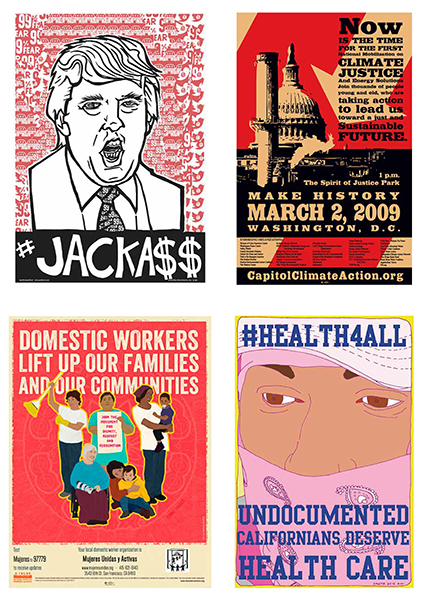
Top L-R: Visions2-Ch3-51-1 “#Jacka$$” Jon-Paul Bail, 2015; Visions2-Ch6-78-1
“First National Mobilization on Climate Change” Cesar Maxit, 2009. Bottom row L-R: Visions2-Ch1-16-1 “Domestic workers lift up our families and our communities” Rommy Torrico, 2015; Visions2-Ch3-39-1 “Undocumented Californians deserve health care” Chucha Marques, 2015
But the digital revolution utterly transformed that. By the mid-1990s designers, with affordable computers and scanners, could create art with their own typography, their own photos, their own proofed documents, ready to reproduce. The costs of color reproduction dropped. Some of the revolutionary prophecies that the personal computer could democratize communication were true.
But one prediction was wrong – that the digital age would make posters obsolete. After all, why bother with a static graphic when you can just as easily make a free colorful video and share it with the world? Wrong. Activists still need posters. Ink on paper not only survived, it thrived.
What we see here is the glorious fruit of the Bay Area’s huge pool of graphic talent, the deep history of social justice work, and the presence of skilled and sympathetic reproduction facilities such as Inkworks Press.
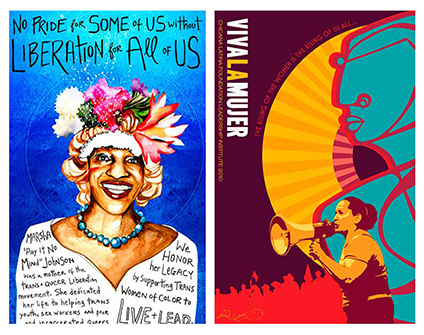
L-R: Visions2-Ch5-72-1 “No pride for some of us without liberation for all of us” Micah Bazant, 2015; Visions2-Ch4-52-3 “Chicana Latina Foundation leadership institute” Favianna Rodriguez, 2010
Inkworks was an integral part of a rich progressive publishing ecosystem. It served nobly and well, fueled by a dedicated collective. Another link in the long tradition of printing to make a difference has been closed, and surely others will open.
Behold these paper bullets. Behold the thunder of the press.
-Lincoln Cushing, Inkworks collective member 1981-2001
___________________________◊◊◊___________________________
Transformative Politics : German Left/US Left Same Challenge/Same Fight
By Kurt Stand
Part Two
“…the question is not about an individual, the question is how social movements act upon opportunities as they emerge.”
Effective action to build such a democratic society, to bring about that greater freedom, in Germany as in the United States, is only possible through a political movement that connects social and economic rights by creating alternatives centers of power within society. Elsewhere, Sohn builds upon this analysis through a socialist-feminist analysis which sees the particular form of the exploitation of women’s labor as central to capitalist development and as anticipatory of the formation of the “precariat” in today’s era of financialization, corporate globalization, and stagnation — and also sees the centrality of women’s organization and leadership as indicative of the ability of socialist movements to fully break with capitalism when in power. What is essential is a form that challenges the structural basis of inequality within the working class as within society at large and thus creates the basis for meaningful solidarity and unified action.
The challenge his strategy addresses is how to seize on the possibilities opened up by current crisis within a framework in which coalition politics, parliamentary and extra-parliamentary actions are mutually reinforcing; grounding alternative power in a manner that points to a possible path out of the trap of marginalization vs. cooptation. It provides a projection of political action that builds on the existence of an alternative national political party such as Die Linke, but has a relevance even where such does not exist.
As in the United States. Under prevailing conditions, a principal challenge is to develop the means to integrate different forms and groupings of political engagement in order to move beyond scattered resistance to reaction and pose a systemic alternative utilizing the tools at hand; creating the prerequisites Sohn discusses. This is why the opportunities and contradictions that followed Obama’s election remain so crucial today — for the question is not about an individual, the question is how social movements act upon opportunities as they emerge. A position paper issued by US Labor Against War (USLAW) in 2008 spoke to the issue of understanding and choice:
Some people will naively expect and believe [Obama] will do the right thing and never challenge his choices or criticize his decisions. Others will sit on the sidelines and do nothing but criticize, finding fault with every decision. Both positions lead to the same result: a powerful elite and insiders who serve them will shape the Administration’s agenda. [The New Terrain for Labor’s Anti-War Movement, On-Line posting, December 6, 2008].
Eight years later, and that critique of two forms of passivity remains valid as does the continued need for pro-active program and policy, working for the change those who voted for Obama hoped or expected he would help bring about. Progress is dependent not on government action per se, but rather on how popular action able to use the space that those expectations (“change you can believe in”) to push government and create more space for action. Looked at today, a critical weakness in liberal/progressive national politics – from Obama to Sanders — is the limited critique ideologically and practically of US overseas policy and militarism. Attacking that lack in a vacuum, however, does little to change it, instead anti-war politics needs to reintegrate itself within struggles taking place in other arenas. Such an understanding was further developed in USLAW’s call to action:
… the labor movement … must not focus exclusively on domestic reform because the domestic crisis cannot be resolved so long as the US is straight-jacketed by a foreign policy that puts us at odds with the rest of the world, and military spending that actually undermines our economic security. This depends on successfully challenging the notion that the United States must be and has an inherent right to act as a global cop and bully, dictating to the rest of the world.
But the implementation of that call is possible only by working on multiple levels, around multiple concerns, in multiple arenas:
While it is important that we continue to manifest our demands in the street, we should think beyond just demonstrations. We need to broaden our alliances with those seeking health care reform, with the environmental blue-green alliance, with movements for immigrant rights and to all those responding to all the many manifestations of the “war at home.” [USLAW, ibid.]

And that brings us to current political possibilities. Bernie Sanders campaign offers an opening even though his political positions are not radical relative to those being debated by the left in Germany. Yet given the US context in which capitalism has become a virtual state religion, even a partial critique of the dominant system that reaches millions of people opens up avenues for debate and organization otherwise largely closed. And his politics and campaign – rooted in a denunciation of corporate capitalism, demand for universal social insurance, opposition to the Iraq war in all its implications, and a focus on climate change as the key issue in our time – pose a distinct and definite challenge to the existing political system. But the most significant part of Sanders’ presidential run is in his focus on mass action, on public pressure, being the means to bring about progressive change. For here the divide in US politics is not defined as being between Democrats and Republicans, rather it is defined as being between working people broadly defined and the corporations.
In this his politics runs parallel with those of Jesse Jackson whose campaigns developed a theme of community consistent with the character of the people of the United States as opposed to the definition of community used by Ronald Reagan: white, well-to-do, and intolerant of difference. So too it is consistent with and builds upon Occupy, with its denunciation of the 1%. And it is consistent with the demands of Black Lives Matters. Sanders campaign gives space to articulate a radical notion of inclusion, implied but left undeveloped by Obama; inclusion based on working people and labor, not by hands across the aisle compromises with those now in power.
Transformative politics is therefore not a question of program or platform as an abstraction, it is a question of mobilization and organization that relies on the solidarity of the excluded. If the possibilities his campaign demonstrates becomes the basis of a more unified alternative politics already put forward by Democratic Party reform movements, by the semi-independent Working Families Parties, by rooted third party groupings, by progressive community and state organizations, and the wide array of organizations fighting for justice in distinct communities or arenas across the country then a way forward can be found that avoids the trap of too much emphasis on elective office, avoids the marginalization of satisfaction of opposition without impact. The fluidity of US politics, often a source of weakness can be turned into a strength.
A kind of strength needed in Germany so that the question of a coalition of the parliamentary left is conceived and developed as a coalition rooted in the direct engagement of working people, migrant communities, the disposed, putting forth an agenda of social solidarity – so that the definition of what lies inside or outside a putative national consensus is itself transformed, so that those whose legacy and current practice lies in the domination of the few over the many are the ones who are defined as being outside. To achieve that is to organize at the points of interconnections of various strivings for those rights once proclaimed as self-evident, toward “justice for all.” In both countries, finding the path toward building a rooted socialist presence in society, within social movements, within labor, requires reconstructing an open Marxist presence, a presence that is critical and popular, a presence that is creative and engaged with other ideas, other conceptions.
The challenge for the socialist movement is to integrate the near and the far. Creating organic links between each partial reform and between those reforms and forms of collective self-organization can provide the basis for a needed fundamental change. An assertion of equality requires an assertion of freedom that flies equally in the face of capitalist exploitation and capitalist alienation — potentially allowing one challenge to lead to another and another and another carried along by a utopian impulse made concrete by roots in what is possible. This brings us to the question of self-determination and the connection between individual self-awareness and social activism, to a critical resistance which combines the personal and the systemic – which is at the heart of any radical politics be they electoral or non-parliamentary.
Today questionings and actions, are being taken amongst those who have done well yet still feel insecure about the future because of economic volatility, because of awareness of social fragmentation, because of awareness of the fragility of nature due to climate change. Questions that are a form of rethinking of matters that had previously been taken for granted. So too questions are asked, actions taken by those impoverished, by those directly assaulted in the present and who in their vulnerability see only uncertainty on the road ahead if society continues on its present course. People who are increasingly looking not just for immediate improvements, but for changes that can make for a qualitatively better future. Combined these developments can lead to cultural shifts, new ways of seeing and looking that enable a different future to become graspable, can turn what necessity had made acceptable into a reality become burdensome. A cultural shift that is itself a political shift that can lead into social engagement by those who had previously seen life’s options only in the realm of the private. Such changes, stimulated by organization and action, stimulating further and wider organization and action is the means by which a genuine class consciousness, a socialist consciousness can emerge. Consciousness which connects the struggle over power in the present with a realizable alternative vision of the future.
Angela Davis in an introduction to a new edition of her 1969 pamphlet Lectures on Liberation commented:
Many of us thought [in the 1960s and 70s] that liberation was simply a question of organizing to leverage power from the hands of those we deemed to be the oppressors. Frederick Douglass certainly helped us to conceptualize this, but this was not, by far, the complete story. Today readers of Douglass, scholars and activists alike, do his text justice by bringing a much more expansive sense of what it means to struggle for liberation, one that embraces not only women of color, but also sexually marginalized communities as well as those subject to modes of containment and repression by virtue of their resident status as immigrants. Equally important, as we recognize the extent to which Douglass sustained the influence of the ideologies of his era, we might better learn how to identify and struggle with those that limit our imagination of liberation today. [Ibid. pp 36-37]
We act to be free, but freedom can’t be obtained if for oneself alone, if for some if not others — let alone if bought at the expense of domination of those without. The control by some of the labor of others, the layers of power and hierarchy that flow from or are furthered by the segmentations intrinsic to such control, can only be overcome through the linkages that connect everyday experience to the broad array of political and social issues within which that experience is lived. The rebirth and renewal of democratic systems that have become broken as much as the rebirth of socialist movements pushed to the margins lies in the strength of those linkages. Socialism as movement and goal is built around a program of equality and freedom, is built around a program of asserting public control over the economy and over public institutions, is built around creating the basis for ever greater self-realization. What we do in the political realm can give content to what has become hollow and help create a world in which actual choices, actual possibilities belong to the vast majority.
___________________________◊◊◊___________________________
To The Clinton and Sanders Campaigns
By Len Shindel
The Supreme Court is too vital an institution to our democracy to be subjected to election-year brinkmanship. As the highest court in the nation, it shapes the very foundation of our laws and liberties. This process is not about the politics of Democrats or Republicans, but about the solemn responsibility that our Executive and Legislative branches share under the Constitution.
President Barack Obama
Americans love firsts. The first woman president. The first primary candidate to garner more than one million individual donors. The first reality TV narcissist to position his moniker above the White House. Heaven forbid.
Here’s another idea: the first time opposing candidates in a hot presidential primary mobilized their supporters in a common movement to protect the U.S. Constitution, the legitimacy of a president and the future of our planet.
Secretary Clinton, stop talking for a minute about how much you love President Obama and show it. Sen. Sanders, stop talking for a minute about the people’s revolution and put it to work right now to stop Mitch McConnell’s counter-revolution against the U.S. Constitution dead in its nasty tracks.
A massive confrontation between liberals and conservative activist constituencies over Justice Scalia’s vacancy is already underway. Several online petitions have gathered hundreds of thousands of names supporting the president’s authority to make a nomination.
This movement will inevitably swell without the imprimatur and direct participation of Secretary Clinton or Sen. Sanders. In my mind, that would be missing a great opportunity.
Between the strident Facebook memes and narratives blasting each Democratic Party candidate are tens of thousands of serious, experienced progressives who understand the need for the broadest unity to confront and defeat an ascendant right wing that has already swept through many of our states, taking a hatchet to hard-fought for legislation protecting everything from worker safety to the right of women to control their own bodies.
And between the Democratic and Republican Parties are tens of thousands of Americans who blame Republicans in Washington way more than Democrats for obstructing the wheels of progress.
Kentucky Sen. Mitch McConnell made it through his last election. But his solemn vow to put the defeat of President Obama at the top of his legislative priorities solidified his standing as one who puts party above nation. Today, that reputation is vividly compounded by his refusal to sanction hearings of President Obama’s nominee.
Media folks talk incessantly about the need for candidates to “draw contrasts.” Here is a chance for broad numbers of Americans to see the contrasts between political leaders who want positive change and constructive civil discourse and those who play upon our divisions and fears.
Secretary Clinton and Sen. Sanders: Let’s do it! Hold a joint press conference. Lift your hands together. Stand up, side by side, for everyone in America who is sick and tired of obstructionism, demagoguery and intolerance.
I’m no tactician. But how about our candidates proposing and sponsoring a day of protests at state capitals across the country? Bring on the Hillary and Bernie troops to join folks mobilized by dozens of groups across the progressive landscape. Call it a truce day for justice. The struggle for the high court demands just such a serious, dramatic response.
Maybe a Talking Points Memo story, “Why the Most Urgent Civil Rights Cause of our Time is the Supreme Court Itself,” by law professor Richard Hasan, is hyperbolic. But, at this moment, when Donald Trump flaps his gums about “opening up libel laws” to muzzle responsible investigative journalists, a time when others on the right lecture about the need to have “originalists” on the court who will resist the grasp of law cherished by our president, a little alarm is not a bad thing.
These are no ordinary times. Politics as usual won’t defend our cherished democracy.
Hillary and Bernie, just do it. Once President Obama announces his nominee, make the call. We will be there.
Editor’s note: We felt the urgency of this piece warrented pushing back posting of part 2 of “Transformative Politics: German Left/US Left – Same Challenge/Same Fight” until next week.
___________________________◊◊◊___________________________
Transformative Politics: German Left/US Left – Same Challenge/Same Fight
By Kurt Stand
Part One
“Maintaining principles should not be confused with rigidity.”
Corporate domination of elections, media, public space; economic relationships constantly reproducing and expanding inequality; U.S. global hegemony backed by trade and investment rules, backed by force of arms – these are realities that don’t change no matter who is in office, Democrat or Republican. A truism from one level of observation that appears contradicted by a different truth: the increasingly bitter partisan divide of mainstream politics, a divide which finds millions identifying with one side or the other. A serious divide as seen in the stolen presidential election of 2000, by the level of hate and invective promoted by McCain-Palin in 2008, by Republican-led government shutdowns designed to subvert federal authority, by the difference in tone, tenor and content between this election’s Democratic and Republican presidential primary debates. That divide, in direct and indirect forms, is reflected in the tensions and undercurrents of violence in abortion rights, health reform, and immigration debates. It is seen in the political and legal assault on voting rights. And it is evident in the Republican led Congressional obstruction of the Obama Administration’s domestic agenda since regaining a majority in 2010.
Two truths which if posed in opposition to each other, contribute to millions withdrawing from all forms of public engagement, itself a sign of the weakening of democracy. Equally, they contribute to the organized left’s lack of direction, lack of unity. Two truths which, if taken separately, seemingly trap political activism between ineffective posturing or compromised pragmatism, with little space for organizing action impactful beyond the moment. And that trap, that lack of space, is manifested by the left’s inability to move out of the margins of national life, notwithstanding a meaningful presence in most spheres of social engagement. If, however, both sides of those truths are seen as comprising a unity, if their linkage is grasped, it may be possible to construct a path through which socialist politics can assert its independent perspective within even the narrowest of those visible divides. A path which would situate the left in movements that are both part of and apart from the divides within/between the Democratic and Republican parties; a path through which the left can build transformational politics within and outside society’s existing institutional structures.
In Germany similar contradictions/possibilities manifest themselves even though Die Linke, represented in the country’s federal, state and municipal legislatures, has a rooted national presence left-wing organizations in the United States do not have. Greater political strength, however, has not lessened internal disagreements. Underlying tensions within its ranks over how to connect day-to-day challenges with socialist strategy bump into the same structural limits as in the US.
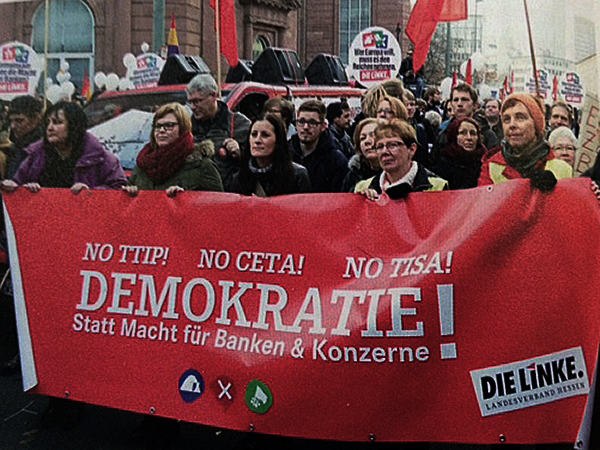
Tensions that come to the fore after each national and state election sharpens a dilemma as yet unresolved – should a policy of maximum flexibility be pursued in order to coalesce with the Social Democrats (SPD) and Greens and open the way to a “Red-Red-Green” coalition or should clear and uncompromising pre-conditions on coalition be set; the potential short-term consequence of a more conservative governing coalition taking office balanced by greater independent non-electoral activism.
Political accommodation to coalition politics means that only a narrow range of policy choices are possible. And from that stems the objective basis for many of the divisions in Die Linke and more widely within the German left. Relative economic success in an era of generalized insecurity leads some sections of working people to limit their horizons out of fear that the decline visible elsewhere will soon overtake them at home. De-politicization sets in when neither government nor civil society appear to be of help in the efforts to make ends meet or maintain a standard of living achieved after a lifetime of hard work. This can lead to support for conservative parties and to far right politics, with a “leave us alone,” mindset combined with a desire for a “strong hand,” to deal with problems blamed on those deemed “outsiders.”
Narrowly conceived reformist politics such as those put forth by the SPD, Greens, and a section of Die Linke take those trends into account. Incremental policy changes appear to be the means whereby the value of government action and social reforms is demonstrated in daily life. Such immediate reforms are meant as a counter to right-wing demagoguery directly and indirectly – by being undertaken by parliamentary compromise and thus avoiding instability that conservative authoritarian forces would exploit. In this lies the not inconsiderable base of support such politics continues to have. Yet the very narrowness of that kind of politics during a time of loss and fear, is insufficient and inadequate.
Current conditions can (and do) lead many others to recognize that self-limitation and programmatic retreat are not adequate to address personal need or social want, requiring activism able to pose demands beyond those attainable through parliamentary compromise. Individual and broad sectors of society committed to rights and protections deemed by those in power as no longer “affordable,” are the primary basis of Linke support, as it is the basis of support for militant sections of the labor movement, social justice organizations, migrants and asylum seekers. Yet the number of people who see the necessity for transformative politics remain too few to overcome the hesitations in the face of radical initiatives still felt by a greater number. Thus, to maintain anti-war, anti-austerity principles necessitates building outward, demonstrating that the concrete answers to issues of the day will only be found through class and social solidarity that redefine what is “affordable,” what is possible. Absent the ability to do so, German politics steady drift to the right will continue. As will happen in the US.
“To become meaningful, socialist politics has to find a way to combine program with practice”
Maintaining principles should not be confused with rigidity. Left political programs that fail to find popular resonance, that ignore those in whose name they seek to speak, are as incapable of contesting existing power as are social movements that accept what exists as unchangeable. Organizations that do accept such limits typically garner more support than radical alternatives because under ordinary circumstances most working people also see those constraints as unchangeable and thus accept moderate potential reforms, shying away from the supposed impracticability of fundamental change (it is a similar layer of acceptance that leads others to belief in and support conservative myths of an “ideal” social order in which each finds a place in a “natural” hierarchy). Yet that support tends to dissipate when in office because it leaves political initiative in the hands of the right, which has a more clear cut agenda that uses the lack of substance of narrow reform against itself. This is seen in Democratic congressional losses following Obama’s (and, previously Clinton’s) election victories — and seen in the losses suffered by SPD, Greens and Die Linke after serving in office. And thus the aforementioned box of compromised pragmatism or marginalization.
To become meaningful, socialist politics has to find a way to combine program with practice – or, put in other words, the politics of governance with the politics of public action and organization. And so too, it has to find a way to create a national consensus opposed to existing property relations and structural inequities as opposed to a national consensus based on the acceptance of current relations of power, of the existing “natural/ideal” social order. For Die Linke that possibility lies in a practice that simultaneously challenges the SPD and Greens as part of the basis for building for transformative politics around which they could coalesce with them — just as anti-capitalist groupings within and outside all parliamentary parties and mainstream organizations need to develop politics, that simultaneously organizes and confronts the totality of existing power while also engaging with those beyond their ranks whose critique of that power is narrower and more specific.
Die Linke’s current program represented a step toward that end. Many further steps, however, have to be taken; a truism underscored by an historical parallel. The SPD’s 1890 convention adopted a Marxist program which cemented organizational unity and set the stage for the rapid growth that made it Germany’s largest political party. But the principles accepted in 1890 did not survive the pressure to conform that accompanied rapid growth. Moreover, prioritizing election results as a sign of strength or weakness meant that the SPD’s one electoral setback in that era — in 1907 after having challenged the Kaiser’s brutal colonial policy — was used by conservative leaders in the Party to adopt an ever more nationalist orientation and an ever narrower domestic reform agenda. Luxemburg in her The Mass Strike (1906), Liebknecht in his Militarism and Anti-Militarism (1907), the SPD left more widely, rejected such a course, and the divide then revealed grew deeper each subsequent year. Organizational unity was maintained by papering over differences while the gap between proclaimed beliefs and actual practice intensified.
In consequence, cracks in working-class unity still not fully visible were reinforced, class unity replaced by an ever-more fragile Party unity. Gains made by some through incremental reform were not gains made by all, unwillingness to acknowledge that change contributed to a breakup of class solidarity within Germany itself and in relation to workers abroad. If radical words are to have meaning in action, unity needs to be established in practice around egalitarian inclusion on both the social and economic realm. This can root left politics in everyday life, the best means to withstand the lure of partial opportunity as well as the fear of repression.
The understanding, however, can only be made concrete when electoral and non-electoral action are intimately connected. Governing coalitions, on whatever basis they are established, almost inevitably face the pressure of events and the pressure of the dominant system to pull away from solidarity. A trend which can only be counteracted when those most excluded, most exploited, form an integral part of the process of change, only when hegemonic institutions are seen as objects of contestation. Manfred Sohn, from 2008 – 2013 co-chair of Die Linke’s parliamentary caucus in Lower Saxony, put forth a perspective germane to this task. Citing the experience of Communist-Social Democratic coalitions in Saxony and Thuringia in 1923, the 1930s French and Spanish Popular Fronts and Chile’s Popular Unity from 1970-1973 as instances of radical public policy initiatives driven equally by broad mobilization outside parliament and within government office, he wrote:
“A principal lesson of past struggles: there is nothing more pitiful and hopeless than a left government without an active left mass movement. … a party oriented toward systemic change must have as a goal of the government it puts in place the intervention of large numbers of people in on-going debate.”
Sohn continues later in the same article:
“. . . attempts to gain power [such as in Chile] were anticipated in Antonio Gramsci’s theoretical writings. His core understanding can be summarized as follows: socialist oriented change in our time … requires a whole series of building blocks in the struggle to overcome the defenses of the capitalist system before a qualitative break — the abolition of private property in the core means of production — can be successful. It is because these immediate struggles are necessary, because the conquest of one political position after the other lies before us, that to counterpose government participation and opposition as a supposed question of principle is completely superficial. It is a diversion from the prerequisites that need to be created before the question of government can be posed. [Junge Welt, August 31, 2010]”
___________________________◊◊◊___________________________
Next week: Part 2 of Transformative Politics: German Left/US Left Same Challenge/Same Fight
OFF TO TEACH THE POOR IN 1968
By Gene Bruskin
I was young and I believed
I didn’t know I was naive
But if you don’t know what’s coming down
You can’t turn this world around
(But if you never even try
You’ll never ever learn just why)
Since I wouldn’t go to war,
They said, go off and teach the poor
To a town that’s mean and gritty
Go on down to New York City
I left in the blistering summer heat
Cruised on down to East 10th Street,
On my first post-college road trip
Thought, this place is really hip
Grabbed my bag and up the stairs,
Saw my good friend Eric there,
Bounded down to the first floor
Out the door to get some more
But my bags had disappeared
No, I cried, this is too weird
No one there had seen them taken
I was stunned and badly shaken
Eric’s place was barely able
Bathtub doubled as a table
Eastside people weren’t so pretty
Blown out minds and looking shitty
Even worse than digs so shabby
Was a neighbor very crabby
Raging, drugged with muscled body
He tortured Eric with Karate
Eric, sad, but we were buddies
Partners from our Princeton studies
Black and small and somewhat fried
Eventually fell to suicide
Off to find a place to live
$300 bucks I had to give
10th street living wasn’t right
Settled down in Washington Heights
Went on over to the Board of Ed
Packed with draftees filled with dread
Used my letter of introduction
Got my South Bronx-bound instructions
Off to work, my shoes all shined
Arriving to a picket line
“Wow” I thought with satisfaction
Teacher striking, lots of action
Joined the teachers on the line
Seeking justice felt just fine
Didn’t know, amidst the strife
This type of fight would be my life
Meanwhile back at my new pad
Lack of food, cockroaches bad
Just a mattress for my head
Borrowed bakery day old bread
The first strike ended, stopped the duel
All the kids went back to school
Time to teach, my new found skill
Where was Ocean Hill Brownsville?
Kids were sharp and very cute
But didn’t like their substitutes
Every day they drove me mad
Good was boring, they liked bad
School was lousy, not well done
They were looking for some fun
They were black and we were white
We all knew this wasn’t right
Then the strike broke out once more
Teachers marching out the door
Once again I walked the lines
Teachers’ rights were on our signs
Soon it ended, back to teaching
Time to try more children reaching
But the contradictions raging
Forced my mind to start engaging
Then a teacher caught my ear
Tried to make the picture clear
None of us would have immunity
When teachers struck against community
How could a fight for teachers’ rights
Be separate from the awful plight
That drowns our students with its tides
And yet we stand on different sides
This wisdom struck like bolts of thunder
Removed the fog that I was under
Somewhere I heard my father say
We’re all equal in every way
I tried for days to reach the others
Draft dodging men, I called my brothers
But not a one would make a break
All looking out for their own sake
When the big strike three came to pass
We decided to teach our class
Six of 100 made up our mind
Defy the union picket signs
First we canvassed door to door
Inviting kids to a school house tour
Contradicting their teacher perceptions
Getting a friendly community reception
Every morning we formed our troop
Parents and children in our group
Just as the daily clock struck nine
We marched across the picket line
Teachers booed and shouted “scab”
Taking names and keeping tabs
Don’t know from whence my courage came
But I was proud, eschewing shame
For many days the strike endured
My classroom filled, my will inured
Without supplies or books or training
I learned to teach, my skillset gaining
The halls were quiet as could be
The classrooms practiced ABCs
Each class was made of many ages
But they seemed happy turning pages
Five weeks the routine carried on
The tensions high, battle lines drawn
It wasn’t how I pictured teaching
But here were kids that I was reaching
We braved the conflict all together
Standing strong in stormy weather
I let the kids into my heart
My new career, a fateful start
But then the bitter strike was done
And daily classrooms had begun
I faced the union teachers’ glare
They didn’t want me teaching there
When other teachers got a class
I was always left to last
They vowed to leave a deep impression
They wanted me to learn a lesson
I remained a daily substitute
Living down my ill repute
I couldn’t keep the kids in line
They kept messing with my mind
I couldn’t sleep night after night
Each day my stomach wasn’t right
My days ended with me screaming
The kids were laughing, even beaming
Once again I was dependent
On my friendly district superintendent
When I told her of my plight
She agreed to set it right
I began the new semester
A fourth grade class I had sequestered
On Fox Street Bronx I found a school
Principal Lonoff made the rules
A delightful group of fresh fourth graders
Confronted with a new invader
But I brought forth my youthful passion
With all the tricks that I could cash in
Some came to class with ragged sticks
I said I won’t fall for your tricks
Oh no, they cried, it’s for the rats
On Fox street you’ll find lots of that
One contingent spoke only Spanish
My earnest lessons quickly vanished
My class was just their latest fate
Our school had no one to translate
The books were few
No lesson plans
There were lots of can’ts
And too few cans
Principal Lonoff told us all
There shall be silence in the hall
All that he wants is law and order
In case of visits from headquarters
I once played Puerto Rican songs
And by their desks kids danced along
Then in stormed Lonoff in a rage
To subject us to the printed page
Nightly through our windows passed
School yard rocks and shattered glass
Early mornings with my broom
I daily swept glass from the room
With winter winds ferocious breezing
The kids wore coats to forestall freezing
Lonoff declared the issue dead
Without word from the Board of Ed
Wilfredo, bored with class room dreck
Looked out the window, cut his neck
Lonoff freaked out at the blood
They covered windows all with wood
One young girl, her arms all bitten
Said with bedbugs she was smitten
I went to visit with her mother
But the landlord said he wouldn’t bother
I had grown up working class
Never had a lot of cash
But I never knew much more
About the suffering of the poor
I tried to paint a hopeful arc
Once took the kids to Central Park
I fell in love and tried my best
To undo how they were oppressed
Next year to remain in compliance
Lonoff had me teaching science
I said of science I knew shit
Lonoff said just use the kits
I decided to be a radical padre
And found myself some 6th grade cadre
We studied weekly from the text
The autobiography of Malcolm X
Then with my cadre, bold and hearty
We went to see the Panther Party
With old strike friends in the community
I developed power and immunity
Lonoff, in the liberal tradition
Gave me time and his permission
To do the outreach and explore
A Bronx-wide march against the war
Of the charts and in my glorium
I led a Bronx-wide moratorium
While Thousands gathered in DC
The Bronx Students marched with me
But yet the teaching took its toll
I hated how I lost control
Without much help and absent training
I had my doubts about remaining
One kid hid in the cloakroom there
I found by grasping for his hair
Next day his mom said “please sir please sir”
My son was up last night with seizures
One day Jeff Perry came to see me
Actually intent to free me
Leave he said and follow me
It’s nothing but a colony
Forget the draft
Walk out the door
We’ll keep you from
That awful war
There’s a place to go
And not for scuba
But revolution
Viva Cuba
That was the end of my teaching career
My mind was blown, my spirit clear
It radicalized me to my core
I knew not what, but I wanted more!
August, 2010
_______________________________________________________________
OFF TO TEACH THE POOR in 1968- A POEM BACKGROUNDER
This poem is about my personal journey as a working class Jewish kid form Philadelphia who traveled to NYC in 1968 to get out of the draft, not knowing that I was stepping into a tornado of social conflict. As a graduate of an elite college I found out that I could avoid the draft if I was willing to do what was considered by many as unthinkable – teach in a poor neighborhood of NYC.
Thousands of young NYC men had the same idea and the same war-avoiding desperation, but through good fortune I had a letter of introduction from an African American NYC District superintendent. I got a job at an elementary school in the South Bronx. This began an intensive year and a half coming of age for me and an education about poverty, racism, public education unions and power.
What I didn’t expect was that on my first day on the job I would arrive to a picket line – the vast majority of teachers in NYC were on strike. It was my first union experience and, at first, I enthusiastically joined the picket line.
The NYC Ocean Hill Brownsville struggle, as it is often referred to, was a historical moment: for NYC, for teachers, public sector unions, Jews and African Americans in NYC and beyond, as well as for public education. (There has been a lot written about it – one thorough overview is the book titled The Strike that Changed New York by Jerald Podair and for more here and here)
Ocean Hill Brownsville was the Brooklyn community where the district board fired and transferred teachers, demanding more control over who teaches and what is taught in their mostly African American neighborhood. The United Federation of Teachers (AFT) led by a rising star of the labor movement, Albert Shankar, struck to protect the union contract and due process rights of teachers above all else.
In its essence the struggle was between communities of color wanting control over their failing local schools and a union wanting to defend policies that protected predominantly white teachers, many of them Jewish, who lived mostly in the outer boroughs and the suburbs. This is all in the context in which the NYC Department of Education in Brooklyn rigidly controlled every single operational aspect of schools throughout the five boroughs.
The conflict brought to a head the Post WW II growth of “middle class” whites many of whom migrated out of the inner cities resulting in a shrinking urban tax base and the deterioration of schools, housing and public services. In the case of Jews in NYC, and elsewhere, they had gone into to teaching since the 30s for its rewards and because of the continued exclusion of Jews from parts of private sector employment.
This strike followed the ’68 riots that broke out across the country after Kings assassination and the emergence of movements among African American and Latinos seeking economic equality beyond the legal progress gained from civil rights legislation.
The three UFT strikes in the fall of 1968, the third lasting for five weeks, fractured a long standing solidarity between Jews and African Americans. Jewish teachers and communities joined a citywide white alliance with Irish and Italian Catholics. African American joined with Puerto Rican communities. Ford Foundation, ironically, funded the experimental district in Ocean Hill that led the community control struggle.
The lessons from the Ocean Hill Brownsville struggle are still being learned. Teacher unions are struggling to build community alliances while corporate funders promote privatization of education while posing as the champions of the poor. Off To Teach the Poor is my reflection on this moment in history.
Olney Odyssey #18: Minding the Morgue
By Peter Olney
“Morgue work takes a certain personality.”
When I made the decision to become a refrigeration technician I figured that was a way to get off the elevator and into a better paying and less alienating occupation. Our City Hospital AFSCME union local represented the workers in the physical plant at the hospital who did all the routine maintenance work. The maintenance chief told me that he would give me a look if I completed a tech course. I enrolled in the Heating Ventilation Air Conditioning (HVAC) program at the Northeast Institute of Industrial Technology, which was located on Phillips Street on Beacon Hill. I was carrying two study commitments: pursuing a Spanish degree at U-Mass Boston on Columbia Point in Dorchester and splitting time with an evening vocational school.
Northeast was founded in 1942. It was a poor second to the much more prominent Wentworth Institute which granted engineering degrees and had prestigious vocational programs some of which are used today by the unionized building trades. Northeast at its height had 400 students in a two year day program and an evening certificate program. In the nineties enrollment declined to about 100 as real estate values increased. The property was sold for a fortune in 1998 when the school closed.
I was in the evening HVAC program with about 20 other students most of whom were from the working class Boston suburbs of Revere, Medford, Braintree and Quincy. There were two of us from Boston. I lived in Jamaica Plain at the time and the other Hub student was an African American named Tom Mack from Dorchester. Most of the other students in class were already working in the trade but needed to up their game. I immensely enjoyed the “theoretical” training on heat and pressure, but I was not too swift when it came to “sweating” joints with solder. That was a big problem because lots of the service calls involving malfunctioning reefers or AC units involve leaky pipes and joints.
I had nothing to compare the training with so I can’t vouch for its quality, but there were some entertaining instructors. One teacher named Tom Glavin took it upon himself to school us in all the ways to get rid of overly inquisitive and attentive customers who were shadowing our work. He told us to always carry an old screwdriver that you could use to “make” a 220 circuit produce a fireworks display of short-circuiting sparks. If that didn’t work to drive away the nosey customer he showed us how to drop a toolbox “accidentally” on the customer’s toes.
My lack of facility with tools and the basics would haunt me a few months later when my classmate Tom Mack and I set up our own little business, T&P Refrigeration. One of our first service calls was to a high-end pastry cafe called Just Desserts in Somerville. The principal cooler for all their foodstuff was not “pulling” down the proper temperature and there was a danger of spoilage. We identified a leaky line and recharged the system with refrigerant and collected our fee. Later that evening I got a dreaded “call back” that the cooler was not cooling. I went to Just Desserts and found a leak and repaired it, but the cooler wouldn’t work properly. I decided to spend the night sleeping next to that cooler and repairing and recharging whenever the temperature would inevitably start to rise. After that night sleeping with the fine pastries I decided that T&P (at least the P part) was not a viable business model and we closed shop.
“Sometimes bodies would arrive at the morgue and stay there waiting for next of kin to claim them”
Once I demonstrated in 1981 to the BCH maintenance shop that I was enrolled at Northeast they gave me a job as a maintenance helper. I was out of the elevators and into the power plant. I was assigned to work with an outside HVAC contractor named Phil Doyle who was a member of the Plumbers Union and who was permanently stationed at City to handle all their big cooling issues. He was a fabulous teacher and a fabulous human being, a white Irish-American who refused to leave his Mission Hill neighborhood as it became increasingly Black and Puerto Rican. Most of his brother plumbers had fled the city of Boston, but Phil was committed to his neighborhood and befriended his new neighbors. I became very close to him, and he treated me like a son. Daily he urged me to let him get me into the Plumber’s Union “Frosty” program, but I was committed to hanging in there at City.
In the beginning my workday consisted of following Phil around and doing the simple tasks that he would assign. We handled everything from the giant “chillers” that air-conditioned the whole hospital to a little icebox that was cooling blood vials in the Intensive Care Unit. One location in the hospital where cooling is of the utmost importance is the City Morgue, and that was part of our daily rounds. We would walk in on autopsies and the stench of human blood and guts. Phil handled the overall cooling of the autopsy room.
My assignment was to make sure that the bodies being stored on the slabs were kept cool. This meant that the “heat exchangers”, cooling coils, inside the compartments had to be constantly cleaned or they would be choked by dust and other waste and rendered non-functional. City of course was the final resting place for the poor, indigent and homeless when they passed. Sometimes bodies would arrive at the morgue and stay there waiting for next of kin to claim them. Attorneys were paid by the City of Boston to track down blood relatives, but if after 6 months no one was located the corpses were given public burials in potter’s fields. Many of the bodies on the slabs were in advanced stages of decay and rot.
My work was to get inside the giant chest of drawers and straddle the slabs and use forced air to blow the coils clean. That meant that I often had very close encounters with the deceased. There was one cadaver that Phil and I called “the man with the fur coat” A male body had been lying in the morgue for so long that a whitish green mold had covered his whole naked body. The ringlets of mold were so pronounced that it had the look of a giant white stole.
Morgue work takes a certain personality. There needs to be a combination of sensitivity because you deal with next of kin, but also a certain hardened callousness so that you can find humor in the grimmest of circumstances. Who would have thought that over thirty years later my dear friend and comrade Gene Bruskin would write a brilliant musical play about morgue workers rebelling called “Pray for the Dead: A Musical Tale of Morgues, Moguls and Mutiny”?
As I roamed the corridors of BCH on my refrigeration rounds I would meet up with Steven Eurenius, a fine human being who became a lifelong friend. He was a bio-medical technician charged with fixing the cutting edge electronic equipment necessary to save patients and keep them alive. We had initially bonded on my elevator when he saw me doing a crossword puzzle and peered over my shoulder to give me the solution for “44 Across, Poet Lazarus”, 4 letters. “EMMA”, he said. We decided in the spring of 1982 that we would do a drive away together out to California for our vacation. An elderly Italian American man in Framingham, Massachusetts wanted his car driven to Scottsdale, AZ where he was retiring. We decided that was a good fit for us and would bring us within striking distance of California. In early August of 1982 we picked up the car, and my friend Steve and I, like so many before us headed West.
Next: OO# 19 – Christina and California – A Game Changer
___________________________◊◊◊___________________________
Olney Odyssey #17 – Going Up – Adventures of an Elevator Operator
By Peter Olney
My brief tenure at NECCO in the fall of 1972 had gotten me more that an abrupt discharge for defacing company property with radical political slogans. In order to operate the freight elevator at the candy company in Central Square, Cambridge, I had become licensed in the Commonwealth of Massachusetts to operate an elevator. A state inspector boarded my elevator, rode up and down with me, and scrutinized my ability to level the elevator by releasing the control knob just as the car approached the desired floor. Through a friend and comrade I found out that Boston City Hospital has an opening for an elevator operator. I had the license and I got the job in September of 1979. When I presented my self to work at the office of the elevator department, which was situated in the Housekeeping Department, I met my supervisors Peggy and John. Peggy had bright red hair and she staffed the office and took calls from angry hospital personnel looking for an elevator that was late in arriving and from operators who were calling in absent or late. John was the relief operator, and he was my trainer. He was very short; in fact he was a dwarf. I soon discovered that a prominent Harvard neurologist had decided in the 50’s that he wanted to study dwarfism. He needed his subjects to be near at hand for observation and so he prevailed upon BCH to hire dwarfs as elevator operators. I was therefore a hulking giant among my co-workers, at least the males, many of who were very short.
It was the one place in the city where Black, brown, Asian and white were patients and workers.
John trained me on the elevators in Dowling North and South. These were the two wings of the main surgical building at City Hospital. I spent most of my two years as an operator running these elevators. Occasionally I was stationed in pediatrics, the medical building or the laundry, but Dowling was where the action was. The emergency room was ground floor for Dowling. Boston’s knifings, gunshot wounds and catastrophic industrial accidents came to the Dowling for triage, and then if the patient was stabilized I transported them up to surgery or an ICU or recovery room. Dowling and BCH were Boston’s melting pot. It was the one place in the city where Black, brown, Asian and white were patients and workers.
I greeted them all at the door of my elevator with a cheerful, “Going up” or “going down”. I carried visitors, patients and hospital staff. I would transport deceased patients down from surgery often accompanied by their family and visitors seeing their loved ones on other floors. There wasn’t much privacy at BCH. It was raw.
I transported the famous “Steve Martin arrow man” up to surgery. A laborer had been driving his utility truck in Southie one night after downing a few too many at the tavern, and he had run head first into a tree. His crow bar had come thru the window of his cab and gone straight through his head. He came into City and was brought onto my elevator on a gurney, but the paramedics had to tilt his head impaled by the crowbar in order to get through my elevator door. He went into surgery and the doctor, a Harvard trained African brain surgeon, successfully extracted the crow bar and saved the man’s life.
The job afforded me considerable flexibility because we were constantly being relieved to take breaks and lunch. In an eight-hour shift we probably were on duty a total of 4 hours. The job gave me a chance to do my studies as I had recently enrolled at U-Mass Boston to complete my college and learn Spanish. I could do my homework on breaks sitting in a secluded spot on an abandoned surgical floor. On weekends and evenings I could even read my Spanish literature while operating the elevator. That led to several interesting encounters. Young resident male surgeons had little interest in befriending or inquiring of the work force. They were blessed beings that had often grown up far from the grit of Boston’s working class. They would brusquely enter the elevator car and call out the floor they wanted often not even looking at the operator. They were however cognizant of the size and demeanor of most of my colleagues. Many of them as I mentioned were short and some had physical disabilities and missing limbs. One evening a young Harvard med-surgical resident entered my car. I was sitting on my stool reading Don Quixote by Miguel de Cervantes. This was the basic text for my introduction to Spanish literature. The surgeon scanned my limbs and looked at the text and made a quick decision that I must have some disability and because everything else looked in order he decided I was deaf. He promptly thrust 5 fingers in my face to signal that he wanted the fifth floor. Up we went. When we got to five I called out the floor and the Intensive Care Unit. He left befuddled.
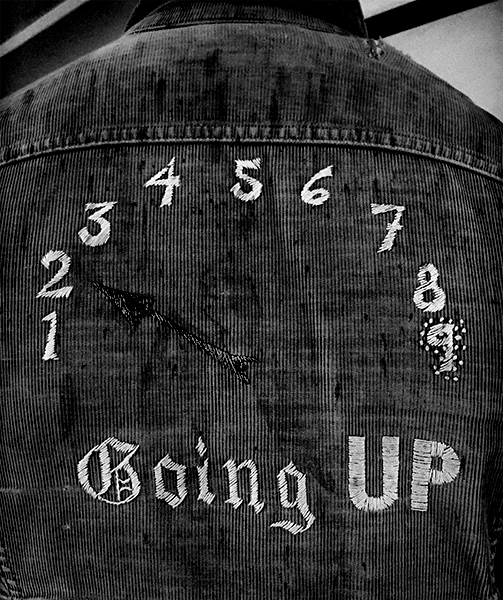
I was not at the hospital to perfect my “altitudinal technician” skills or to bring good humor to the hospital community as a “vertical digital analyzer”. There is considerable lore about elevator operators being the spiritual lifeline for apartments buildings, manufacturing lofts and courthouses. The constant contact with people often in emotionally distraught or jubilant states, means that the operator is a force in people’s lives. I was at The City to organize workers. This workplace was already unionized in American Federation of State County and Municipal Employees (AFSCME) Local 1489 for my job and those of the housekeepers and other blue-collar workers. The techs, ward clerks and nurses were all in the Service Employees International Union. Local 1489 was a colorful collection of people, the most diverse workforce in Boston. The President was a gay Italo-American security guard from Southie. The VP, a black nurses aid from Roxbury and the Recording Secretary a Chinese American woman from Michigan. I picked up the task of publishing the 1489 newsletter and made sure that it was translated into Spanish. I also became the steward for the elevator department and represented the grievances of my fellow operators. The City was tight knit community, and I spent a lot of time roaming the hospital at all hours and every day of the week. I remember returning to the hospital three years after I had left Boston for California. I was walking in one of the underground tunnels that linked the various buildings of the facility when I happened on an orderly who was pushing a gurney with a patient on it and a saline bag hanging hooked up to the patients’ arms. He abruptly stopped his gurney and said to me, “Where you been I have been looking for you for ages. I got a grievance I want you to handle!”
The elevator was a great organizing platform. I could transport groups of workers up to their designated areas and abruptly stop the elevator between floors and conduct a true captive audience meeting to review the issues of the day and encourage their participation in whatever activities the Local; was promoting. While I enjoyed the human contact, the union work and the flexibility I soon decided that I wasn’t cut out for a lifetime career as an operator. Plus it didn’t take a Marxist analysis to know that technology replace our department with automated lifts. I enrolled at the Northeast Institute of Industrial Technology on Beacon Hill. I was pursuing certification as a “frosty”, a refrigeration mechanic. This training would lead me to new adventures at The City and beyond top California.
Next: OO #18 – Minding the Morgue
Star Wars, Race, and American Imperialism
By Lincoln Cushing
The opening scene of Star Wars Episode VII: The Force Awakens shows an Imperial Stormtrooper who is ordered to fire on a group of innocent villagers. Instead, he has a crisis of conscience, escapes, and poses as a leader in the Rebellion. His conversion, though lightly sketched, is genuine, and Finn is elated to have found a home with those fighting the repressive Dark Side brutality.
Jamal Igle wrote in a blog post on The Nerds of Color website, “For the Love of FN-2187: Why John Boyega as Finn is one of the Best New Characters in Star Wars”:
“Finn is a character without an identity when we first meet him. One of the many faceless drones amongst The First Order, Finn is the first Stormtrooper we ever see remove his helmet in any of the films. We’re witnessing a birth in a way. All he wants to do is get away from the people who have oppressed him, as far as possible and never return. He’s never known a life outside of being a Stormtrooper, the mission on Jakku possibly being the first time he’s seen actual combat. What he saw shocked him so much, it shook his programming and for the first time, he saw things for what they truly were.”
The ironic thing is, this scenario already happened, in 1899.
In 1898 the United States leapt into the Spanish-American War, a heavy-handed campaign of opportunity that was so grotesque that its centennial was barely celebrated, let alone mentioned. (It urged me to post my first web article, in 1998). The second part of that campaign, the Philippine-American War, was even more loathsome and less remembered. It’s beyond the scope of this essay to delve into those wars, but suffice to say they established our young nation as an imperial force to be reckoned with. It’s where our military refined such as tactics as “waterboarding” and “strategic hamlets,” and gave rise to the American Anti-Imperialist League.
“He wouldn’t take it any other way,” cover illustration from Judge magazine, March 4, 1899.
From The Forbidden Book: The Philippine-American War in Political Cartoons, 2004.
Four regiments of “Buffalo Soldiers,” who had earlier been assigned to fight American Indians and served in the Spanish-American war in the Caribbean, were joining that bloodbath in the Philippines. But many of the black soldiers became so upset with their treatment by white officers and soldiers, as well as resisting their role in enforcing a white national military policy on other people of color, that six took the extreme step of desertion. In addition, as many as 24 white soldiers deserted for various reasons.
Desertion during war is a high enough crime (all were sentenced to death, but only two were executed), but at least one took the extra step of joining the Filipino resistance.
David Fagen was an African American soldier sent to fight in the Philippines in the summer of 1899, and on November 17 he left his post and joined the guerilla forces. Scholar E. San Juan, Jr. described his commitment to the cause:
“Instead of simply escaping to an isolated native community and withdrawing from the conflict, Fagen embraced the revolution with such boldness and energy that no one could be blind to the depth of his commitment to the Filipino cause, especially in the light of George Rawick’s reminder that Afro-American slaves ‘do not make revolution for light and transient reasons.’ “
Efforts to capture Fagen proved challenging, and he was never caught. A bounty of $600 collected by a Filipino defector, but the partially decomposed head was never positively identified.
Fagen’s conversion did not sit well with the establishment black press, but even they had a hard time ignoring the fundamental racism of that war. The Indianapolis Freeman, editorialized in December, 1901, “Fagen was a traitor and died a traitor’s death, but he was a man no doubt prompted by honest motives to help a weakened side, and one he felt allied by bonds that bind.”
Finn was following in some very heavy footsteps when he doffed his bloodied storm trooper helmet and joined the people he’d been trained to consider the enemy. Perhaps the next episode of Star Wars will feature a Stormtrooper rights movement, Stormtrooper underground newspapers, and Stormtrooper coffeehouses.
Probably not.
___________________________◊◊◊___________________________
Further links:
“An African American Soldier in the Philippine Revolution: An Homage to David Fagen” by E. San Juan, Jr., 2009