A Union Wave:Democrats Just Made Their Comeback. Will Labor Be Next?
By Steve Early
Among the many signs of post mid-term election elation this month was a press release from the national AFL-CIO. The labor federation was pleased to report that 639 card-carrying union members had been swept into public office, high and low, across the country. “The blue wave was union-made,” declared AFL-CIO President Liz Shuler
Nationwide, voters in union households favored Democratic candidates over Republicans aligned with President Trump by a 21 percent margin; just two years ago, when Trump was seeking a second term, Democrats out-performed Republicans by only nine points in the same demographic.
The defeat of so many anti-union Republicans—and the success of candidates who faced enormous billionaire class spending against them—raises the question: is a union wave in the offing next? If powerful corporate interests can be overcome at the local, state, and federal level through electoral politics, will workplace organizing, particularly in the private sector, soon experience a similar uptick? And what kind of changes in their own approach do unions have to make for that to happen, sooner rather than later?
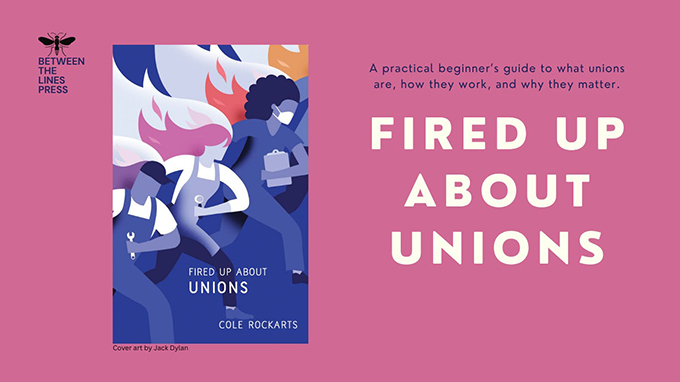
These are big question addressed in four new books by authors, young and old, including Cole Rockarts’ Fired Up About Unions (Between the Lines); Daniel Gross’s Unions of Our Own (Haymarket Books); Fred Glass’s Labor 101 (PM Press) and Nelson Lichtenstein’s Why Labor Unions Matter (Yale University Press).
Why Unions Still Matter
These four works collectively provide much timely advice on organizing tactics and strategy, basic information on how unions are structured and function, their historical development, and case studies of recent union breakthroughs in higher education and other sectors. The authors tackle their separate and overlapping topics from the perspective of their past or current roles as workplace organizers, union staffers, or academic researchers.
Bay Area readers can learn more about Rockarts’ book at a labor-related panel at the Howard Zinn Book Fair on Sunday, Dec. 6, at City College.
Fired up About Unions draws on the author’s labor education and organizing work in two countries, with unions ranging from the Canadian Union of Public Employees to the California-based National Union of Healthcare Workers. Unions of Our Own reflects Gross’s own varied experience as a rank-and-file leader of an earlier effort to rally Starbucks baristas under the banner of the Industrial Workers of the World. (The currentStarbucks Workers United effort is backed by Workers United/SEIU.) The author then became a labor lawyer and founder of an immigrant workers center in NYC; he now aids independent union organizing efforts through the Solidarity Union Network (SUN).
A decade ago, Fred Glass, longtime communications director for the California Federation of Teachers, wrote adefinitive history of labor in the state for UC Press. His latest work is a slim but highly readable volume called Labor 101: Socialism and the Labor Movement; like Rockarts and Gross, its target audience is younger workers. As a Democratic Socialists of America (DSA) member and editor of its statewide newsletter,California Red, Glass wants to help DSA’s labor-oriented activists become as effective in their union work as some have been lately electing DSA candidates around the country.
Why Labor Unions Matter is labor historian Nelson Lichtenstein’s seventh solely-authored book. Fans of the UC-Santa Barbara professor’s previous works– like Walter Reuther: The Most Dangerous Man in Detroit, State of the Union, and Retail Revolution, about the challenge of organizing Walmart—will find similar subjects and themes explored in his latest volume.
In Lichtenstein’s view, organized labor’s surging approval ratings, particularly among workers under the age of thirty, has been reflected in “a series of attention getting strikes and contract campaigns among teamsters, autoworkers, academics, and Hollywood writers and actors,” plus new organizing drives in “coffee shops, warehouses, and retail stores, and, among cultural workers, grad students, nurses and interns…during the pandemic years and afterwards.”
Header Labor Law Reform Not Imminent
However, for the next two years, with Donald Trump promising to be “Mr. Veto” and Senate filibuster rules still in place, Congressional action on private sector labor law reform will be limited to safe, performative votes by the new Democratic majorities on bills to strengthen the National Labor Relations Act that will definitely not be enacted. Meanwhile, Trump appointees at the NLRB will continue to undermine the stronger sanctions against employer unfair labor practices introduced by itsgeneral counsel under Joe Biden.
At the state level, it may be a different story, to varying degrees, due to Democrats gaining more state government influence, by winning governor’s races or more seats in legislative bodies previously dominated by Republicans. Among the labor backed candidates who won on Nov. 3 were two union members from Texas– James Talarico and Gina Hinojosa, the state’s new US senator and governor respectively.
Both belong to the Communications Workers of America (CWA), by virtue of its four decades of support for the Texas State Employees Union (TSEU). This one big union, now about 8,000 strong, fights on the job–in the community, and the state legislature—but without the benefit of collective bargaining rights (which are denied to state workers, not just by statute, but by the constitution of Texas).
TSEU got its start, as a CWA-backed organizing project in the early 1980s, when most other unions representing public workers in the U.S., displayed little interest in devoting resources to union building in states without an existing public sector bargaining law or the possibility of enacting one with the help of union-friendly state legislature.
This was the route that most easily facilitated legal recognition by state government agencies, formal contract negotiations, and resulting union security agreements that required everyone covered to pay union dues or agency fees for the representation they received. Such arrangements became unlawful in 2018, due to a Supreme Court ruling in the Janus case; now, the entire public sector in the U.S. operates under the same “open shop” conditions that have long existed in the private sector in 26 “right to work” states.
Alternative Union Models
Before and after this legal setback, TSEU/CWA was recruiting white-collar and blue-collar workers—even university professors and elected stare officials—to be part of a statewide labor organization, that has rarely had any legally recognized bargaining units. One of its many creative initiatives was an unusual state worker challenge to Greg Abbott, the right-wing Republican governor just defeated by Hinojosa.
To secure re-election four years ago, Abbott relied on political stunts like calling out the Texas National Guard to police the U.S.-Mexico border during the Biden Administration because of the latter’s alleged failure to do so with federal agents. When that unpopular deployment unfolded and unnecessarily disrupted the lives of many Guard members, the latter were encouraged to sign up and become active in TSEU’s Military Caucus. This became the first effort to unionize “citizen-soldiers” anywhere in the U.S. since some members of the GI anti-war movement tried to do the same thing during the Vietnam War.
Although their numbers were small, these citizen soldiers were–in the usual TSEU member fashion–able to speak out to the press, lobby in the State Capitol, and seek benefit improvements (in their case, for families of Guard members who died during state duty like Abbott’s controversial “Operation Lone Star,” which led to one drowning in the Rio Grande and a number of suicides.)
Readers of Rockarts, Gross, Glass, and Lichtenstein will find many longer lasting, larger scale, and less exotic examples of worker self-organizing, in more familiar settings. One common message of their books is that workers don’t need to have majority support, legal recognition and/or a union contract to make positive workplace changes (although all of those conditions certainly help!)
Schools for Democracy
When any workplace organizing gets underway, there are options other than joining established unions, which can sometimes prove disappointing in areas like militancy and internal democracy. As Gross reminds his readers (while paying homage to his IWW roots):
“You and your co-workers are the only people who can change your job for the better and keep it changed. Nobody else has the wisdom to do it…because no one knows your own job better than you and your community of co-workers. Alongside that unique wisdom, your collective power to change your job is unlike any other force. The reason is simple: without you, nothing would get done.”
From Rockarts, we get a similar warning that winning collective bargaining coverage, as important as that is, does not always insure sufficient worker voice in internal union decision-making. “In too many unions,” they note, “power is concentrated in the hands of a small group. Leaders often have no term limits, rarely face challengers, and make decisions without real rank-and-file input. That kind of top-down control doesn’t reflect the democratic values that unions claim to stand for. It holds back what unions could be.”
In Labor 101, Glass agrees. He points out that recent rank-and-file insurgencies—from red state teachers’ strikes to democratization of the United Auto Workers–owe much to “new militant leaders replacing corrupt old-guard bureaucrats,” often with “a growing cohort of young socialists playing a significant role in those efforts.”
In his latest “look at how unions matter—or fall short,” Lichtenstein reminds his readers that “the class struggle is a long haul, punctuated with more setbacks than victories.” At their best, “when mobilized for a contest with management or seeking to organize the unorganized, unions are schools for democracy, educating and generating participation and voice within workplaces” in which employer power has previously been unchallenged. “The very specter of worker organization, as much as any actually existing union, can motivate managers to improve pay and benefit practices.”
Like Rockarts, Gross, and Glass, Lichtenstein makes the connection between internal and external organizing, throughout his book. His conclusion is similar to theirs in its marching orders. For unions to rebuild their workplace and political clout and win more of the time, “they much transcend themselves, casting off old leaders and constraints in order to become a mass movement of workers and allies powerful enough to confront and defeat the politicians, parties, and corporate interests that control the state itself.”
…