Jack Metzgar
By John Womack
“…working-class culture is not the problem. Thinking that it is the problem is the problem.”
Born in the steel town of Johnstown, PA, in 1943, graduated from its high school in 1961, Metzgar (born John Newton Metzgar) had by then lived through the years he would later describe as “the golden age of the American working class.” His father was a total union man, a local stalwart of the United Steelworkers (USW). Metzgar fought with him, sometimes angrily, and left Johnstown and the working class for the New School of Social Research for a B.A. in 1968, a Northwestern, Ph.D. 1975, and a professorship at Roosevelt University in 1977. But his years in Johnstown and his deep conversations with his parents over the years planted rich memories. He never forgot where he came from and how it mattered, not only to his family but in American history. He died October 15, 2026.
In his childhood and youth the USW conducted six major strikes – 1946: four weeks- 800,000 workers; 1949: seven weeks – 500,000 workers; 1952: almost eight weeks – 560,000 workers; 1955: 12 hours, – 400,000 workers; 1956: five weeks – 500,000 workers; 1959: almost 17 weeks – 519,000 workers, 116 days without a paycheck. The union did not win everything it wanted in every strike, but it did win wage gains, some substantial – retirement security, compulsory membership for new hires, new benefits, and job -and- staff protections. And Metzgar’s father was in the thick of the local struggle. He understood it, and he took immense pride in how much the union had done for his family, and all steelworkers’ families. After the war life for a union steelworker seemed to improve every year. His son took the understanding and the pride to heart.
At Roosevelt Metzgar founded the Midwest Center for Labor Research, the Labor Research Review, the Chicago base of the International Working-Class Studies Association, and for 30 years led the university’s Labor Leadership program–and when the university ended the program, relocated it safely to DePaul University. Along the way, because they wanted him, he often taught courses for unions and the Illinois AFSCME.
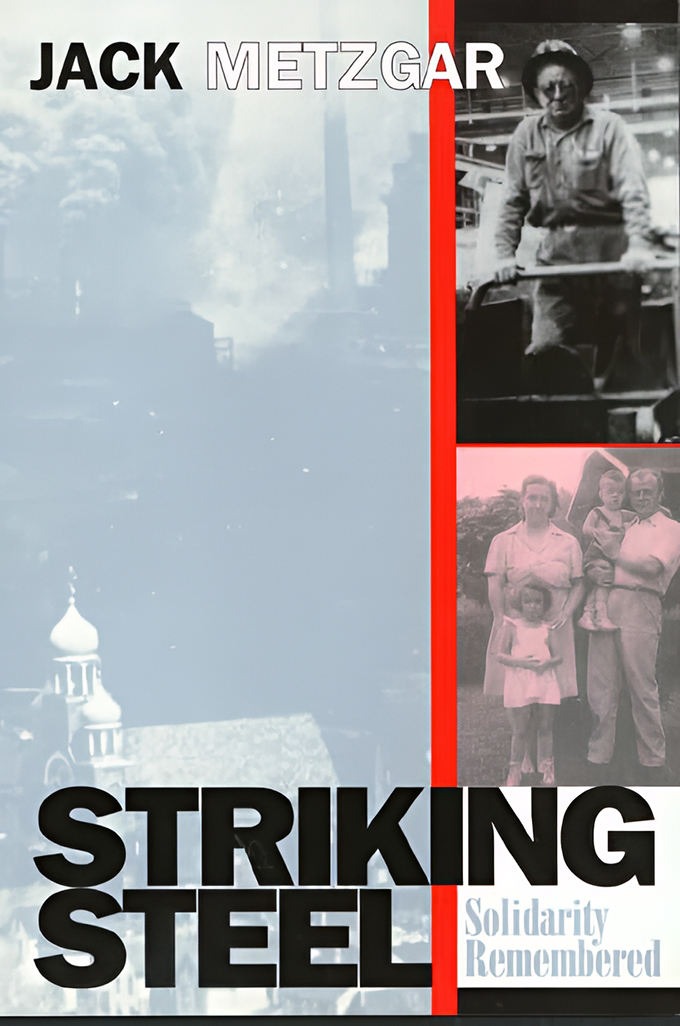
After so much service for labor, in 2000 he published a kind of memoir, Striking Steel. It is a wonderful, moving book, mostly about the 1959 strike, but also to get back into his father’s mind, to examine the sociology of class in the USA and the culture of classes here. He wanted, he wrote, to explore “a classic working-class philosophy of life and a considerable ability to communicate it, reason about it, and argue for it.” He articulated “that philosophy, the conditions out of which it grew and the institutions–the family, the church, the federal government, and above all the union–that sustained it.” He made no great claims for it nor fully endorsed it. But he showed its depth, complexity, and integrity, which “is easy for the professional, middle-class observer to overlook or distort.”
Most sharply Metzgar pinpointed the Liberal conception of the social order, that “the middle class” is the only class; everybody else is a “victim” or a “perpetrator.” For a while workers were victims, deserving sympathy and support. But in the 1970s and ‘80s they became perpetrators, “deplorables,” deserving scorn. Liberals, all the more Neo-Liberals, still think that way. The book remains very timely.
Five years ago Metzgar published his second book, Bridging the Divide: Working-Class Culture in a Middle-Class Society. Another illuminating study, it treats many of the same issues in American history and society as Striking Steel, but from a significantly different angle, the “middle-class” principle of “individualism,” the working-class principle of “solidarity.” His examination of the idea of “mediocrity” in American history is especially revealing. The book’s best lesson may be: “…working-class culture is not the problem. Thinking that it is the problem is the problem.”
…