Union Fight is Unfolding Aboard Oil Tankers
By Daniel Ginsberg-Jaeckle
Ship’s “mates,” must have a union voice on pay, benefits, scheduling, career opportunities and working conditions
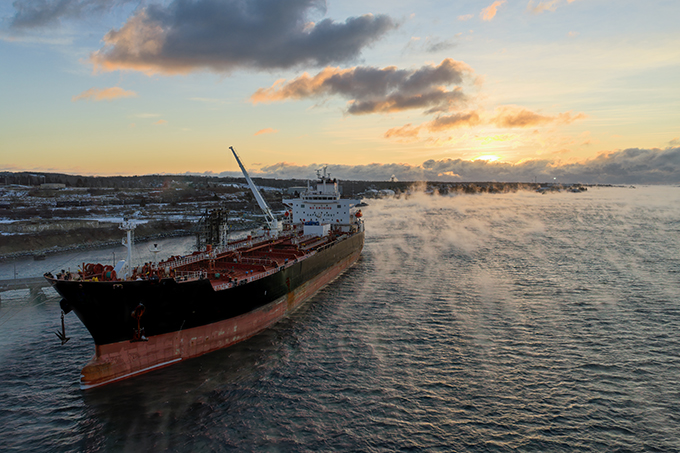
When people hear about union fights at Starbucks or Amazon, they know the familiar pattern of workers organizing, voting for a union, and then facing company stall tactics on the way to a first contract. The maritime industry has its own version unfolding aboard 17 oil tankers operated by Alaska Tanker Company (ATC) and Overseas Shipholding Group (OSG), both part of the Saltchuk family of companies. The same post-vote stalling is underway as both companies have refused to bargain for first contracts, even after the NLRB ordered them to do so.
In January 2024, ATC’s licensed deck officers voted for representation by the International Organization of Masters, Mates & Pilots, AFL-CIO (MM&P). OSG’s officers voted for MM&P in October 2024. These were major organizing victories in an already highly unionized maritime industry. In fact, these are the largest successful bottom-up organizing campaigns among licensed deck officers in the U.S. merchant marine in at least 50 years. The officers, also known as ship’s “mates,” must have a union voice on pay, benefits, scheduling, career opportunities and working conditions.
The 125 officers employed at ATC and OSG are highly trained professional personnel. They are responsible for the safe navigation, loading, discharge and transport of the ship’s cargo, care of the ship’s crew and overall operation for the ship under the authority of the vessel’s captain. ATC’s tankers were designed to carry crude oil from Alaska to refineries, primarily on the West Coast. Each can carry about 54 million gallons. OSG’s 13 tankers carry crude oil and refined products such as gasoline and jet fuel through U.S. and international trade. The safe transport of their cargoes is critical to America’s environment and security.
That work can place civilian mariners close to geopolitical conflict. In August 2026, Iranian state media named OSG’s Overseas Mykonos among vessels under review for alleged links to U.S. military logistics, while cautioning that inclusion did not establish the same role for every vessel. Attacks and disruptions around the Strait of Hormuz, the Red Sea and the Black Sea have since underscored the risks to commercial crews.
“ATC, OSG and their parent company Saltchuk are following the standard union-busting playbook familiar to all in the union movement: delay, deny and obfuscate“
ATC and OSG challenged whether Chief Mates could be included in the bargaining units, arguing that they are supervisors under federal labor law. The National Labor Relations Board rejected those challenges. Then, in separate decisions in May and August 2026, the Board found that ATC and OSG had violated federal law by refusing to recognize and bargain with MM&P, and ordered both companies to bargain. [Here, Here, and Here]
Rather than abide by these decisions, and their pledge to abide by their officer’s’ vote in the elections for certification, ATC, OSG and their parent company Saltchuk are following the standard union-busting playbook familiar to all in the union movement: delay, deny and obfuscate. The companies have taken the cases to the Eleventh Circuit Court of Appeals. Their appeals repeat the same failed arguments at the NLRB. The cases are moving through the lengthy federal appeals process. More than two years after ATC’s officers voted, and two years after OSG’s vote, the companies continue to refuse to bargain for a first contract.
The officers have continued organizing aboard the ships while they wait. As Labor Notes reported, they pushed back when management sought to cut healthcare coverage and raise premiums and co-pays. After officers challenged the changes and MM&P demanded bargaining, the companies reversed course within two weeks, preserving the existing plans and costs. The officers have also secured a training reimbursement program, improved travel conditions and distribution of an Officer Handbook. These wins show what coordinated action can accomplish even before a first contract is in place.
In addition, the officers launched the Mates United campaign to bring that fight to supporters across the country. They are building a national coalition that includes fellow unions and labor organizations, academics, faith leaders, elected officials and community supporters. A public petition and solidarity letters call on Saltchuk and its tanker companies to respect the officers’ votes and begin bargaining.
Meanwhile, Saltchuk is growing. The company completed its roughly $1.5 billion acquisition of Great Lakes Dredge & Dock in April 2026. Saltchuk said the acquisition brought its workforce to nearly 10,000 people across more than 30 companies. The company also says it is actively seeking new acquisition opportunities. OSG joined the Saltchuk family in 2024.
Saltchuk may keep adding companies, but the tanker officers are still waiting for their employers to sit down with them and MM&P. Their work moves crude oil and petroleum products such as gasoline, diesel fuel and heating oil, through U.S. ports and across the economy. They have organized, voted and kept building support through years of delay. Their work hasn’t stopped.
While the irony will be lost on no one reading this editorial, the Salchuk Code of conduct is quite explicit:
“Saltchuk companies abide by all applicable hour, wage, labor and employment laws in the locations where we do business.” (Saltchuk Code of Ethical Business Conduct, p. 10).
There are no stated for exceptions to the above or elsewhere in their corporate credo of being “absolutely committed to integrity” and “mutually respectful” for those who earn their living in the lonely, austere and often dangerous occupation of seafaring.
…
Visit www.MatesUnited.org to learn more about the campaign and find ways to support the officers’ fight for first contracts.