Review of the 2026 Book by Chuck Klosterman, FOOTBALL
By Gene Carroll
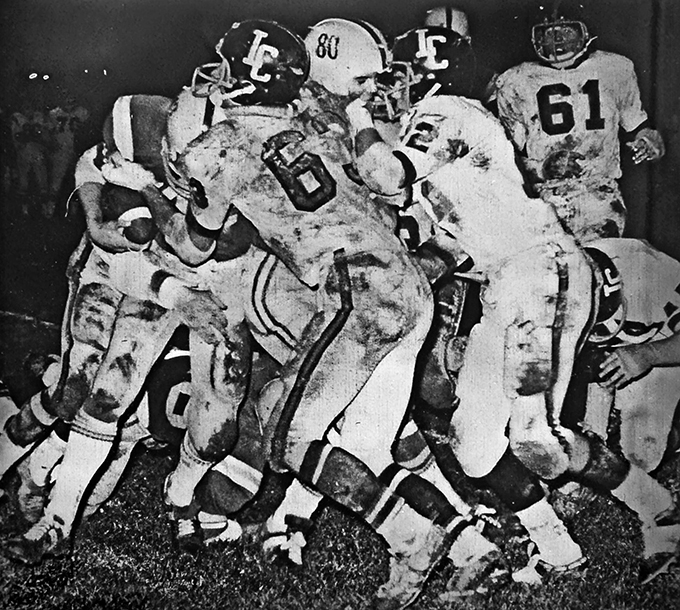
“Jesus, Mary, and Joseph. Look at you,” said my father. “You’re done. Done!”
Those words were spoken to me late during an autumn night back in 1973 at Lock Haven hospital in the north central Pennsylvania river town by the same name that hugs the west branch of the Susquehanna River. My hard-working father drove four hours to witness the consequences of the vicious hit I absorbed at football practice earlier that day as a member of the NCAA Division III Lock Haven State College Bald Eagles. It was my final play as a football player. I had been injured before playing football—in little league and in high school—but this time I was lying in a hospital bed with a severe concussion and my head in traction due to pinched nerves in my neck.
Blows to the head are at the center of Klosterman’s rigorous new book, FOOTBALL. Reading it unlocked this painful, momentous memory of a football injury that changed the direction of my life. The author critically explores the cultural and social power of the most popular sport in the country. American football attracts more viewers than, well, than anyone or anything else. And while the game is a dominating force in American culture, the author believes there’s evidence sufficient to conclude that all the football fuss is going to fade over the next few generations—and for a reason akin to what happened to me in 1973.
Here’s the hurt (pun intended): despite all the hype and the billions and billions of dollars; the extravagant new stadiums (a few years ago, NYS Governor Kathy Hochul strong armed the NYS legislature to hand over $500 million in tax-payer dollars to help her hometown Buffalo Bills build the new stadium they are about to occupy); the political, economic and social media power and influence of the owners; the high-profile of star players; the zillions of dollars in broadcast contracts; the fading away of the old-school mentality (“no pain no gain”); and all the modern training techniques and game rules implemented to prevent and reduce injuries, the consequences of the game’s physical violence are profoundly more brutal than was understood until the past few years.
Ever hear of a disease of the brain called Chronic Traumatic Encephalopathy (CTE)? It’s caused by—how to put this?—repeated blows to the head! It is a direct consequence of the violent way the game is played. Klosterman provides dramatic data on the first page of the book’s Chapter 9 that plainly put just zeroes in on the problem:
“As of this writing, 376 deceased NFL players have had their brain autopsied and 345 of those brains showed evidence of CTE.” (page 223)
Is it irony? Recently, just as I was close to finishing FOOTBALL and began to draft this review essay, a new study about CTE, beyond the data provided in the book, was described in the August 26, 2026 New York Times in an article by John Branch, “Study Links Brain Disease To at Least 1 in 4 in N.F.L.”
Here is a key passage from Branch’s reporting:
“If the new study’s statistics were applied to today’s players—1,696 on the league’s 32 regular-season rosters, not including more than 500 members of practice squads and those ineligible due to injury—at least 400 of them would be diagnosed with C.T.E.
Experts say that the rate of brain disease represents an occupational safety hazard with little comparison in the American workplace.”
The article went on to quote former Obama Administration OSHA Director David Michaels who said, “I’ve never seen anything comparable” to the data about degenerative neurological disease even when referencing the high rates of coal miners succumbing to black lung disease or workers exposed to asbestos.
Corporations making lots of money while their employees, admittedly willingly and well paid, take huge risks with their health. Nothing new here.
What is not quite new but is on the rise, and it gets to the main reason Klosterman sees football’s future in decline, is the question at the grassroots of it all, the kitchen-table question which contains power sufficient to bring the entire enterprise down with it over time.
What’s a parent to do?
Klosterman’s main proposition is that American football is poised to decline over the next generation or two in a way similar to the reason for the steep decline of horse racing over recent generations. That is, people do not use or own horses anymore, as much as these beautiful creatures are admired and often loved. In the case of football, fewer teenage boys are playing it, and the reason is that it is demonstrably more dangerous than we knew. The blinders are coming off.
And this issue hits home again. An increasingly recognized family dynamic happening across the country is reflected in this interaction with my one of my dear sisters (I was blessed with three) some 15-18 years ago. Her son was about to become a teenager, and I began to gently pester him about signing up for football. His broad shoulders had me thinking “linebacker.” He was not a large boy, but solid, strong, healthy, and apparently with the intelligence and athletic skills and attitude to play a physically demanding sport. At some point my sister called me. Let’s say it was not a long discussion as she ripped me a new one by making it absolutely clear her son was not going to play football and I was to shut my face about it. Plainly, she said to me, “After I saw what my brothers endured playing football, especially you, there is no way I am going to allow him to play.” This is the power dynamic in our society that cannot be stopped if it continues.
There’s one passage in Klosterman’s tome that speaks to me now as I ponder whether or not to continue active fealty to my favorite NFL team, the Philadelphia Eagles—(or Iggles in southeast Pennsylvania and south-central New Jersey parlance):
“The risks inherent in football do not make football unique. What makes football unique is the colossal audience that views it as entertainment, making millions of seemingly uninvolved people complicit in whatever damage it incurs. (page 225)
The other major issue Klosterman deserves credit for diving into is the continuing racism within the NFL, despite the fact that a majority of active players are Black. True, the NFL has moved beyond the racist trope that prevented Black players from becoming NFL Quarterbacks. Their excellent play speaks for itself. But Klosterman’s identification of a certain caste system that still remains with regard to certain positions demonstrates how deeply he has studied the financial and racial politics of the NFL. Most NFL cornerbacks are Black, and corners are the most high-profile players on defense. When they make a mistake and a receiver they cover scores a touchdown, they are exposed. Everyone can see they were beaten on the play. As a former corner myself, I know this dynamic well. But unfortunately for me, millions of dollars of pay were not at stake. Many of the NFL’s defensive safeties are white. Their vulnerable high-profile position is the same as the corner. Yet their salaries are higher. Why? Fortunately, the players have a strong union, the NFL Players Association, which is seeking redress for this inequity. One passage from Klosterman’s text in which he examines race is one of the sharpest statements I’ve come across about the absurdity and stupidity of racism—one of the highlights of the book:
“Part of what makes social prejudice so demoralizing is the assumption that it’s inherently built in to human nature, and that the power of an illogical bias is the way it’s immune to all evidence contradicting its illogical premise. This is also why the volatility increases whenever a bias is overcome.” (page 177)
Another example of how the world is changing that may have negative long-term implications for American football has to do with the influence of language. Klosterman does not address this question, but I think it fits into the discussion. This summer I watched a soccer match for the very first time. Or is it a football match? It was the July 19 World Cup Final in which Spain, as literally the whole world knows, defeated Argentina 1-0. I was hesitant to do this. Because I once played football in high school and college—the serious head-bashing American version—I could care less about the World Cup.
Coaxing me to sit down and watch the game with her was my wife. Though not an active fan, she felt the World Cup electricity in the New York City air generated by the millions of soccer fans—sorry, I meant football—who reside here. (Indeed, a little more than one-third of NYC residents are foreign born. Over the three-week stretch of the World Cup games, I began to take notice. At my neighborhood bodega, the country-specific (Colombia) soccer—or rather football—regalia worn each day by the proprietors left no doubt about their sympathies. This vibe was everywhere in New York City. Taking a constitutional over the Brooklyn Bridge’s narrow walkway during the weeks of the World Cup (part of my exercise routine) involved squeezing by aggressive hawkers selling $30 t-shirts emblazoned with the football (soccer?) team logo of whichever UN member nation you fancied. Business was brisk; they operated on the bridge most days though it’s a no-no to do so according to NYC regs. Because of the joyous World Cup, no one cared, including New York’s finest. NYPD presence was at low tide on my walks, that’s for sure.
Since the constituencies of the World Cup represent the immense majority of humanity who describe the game they play as kicking a football, not a soccer ball, what do we do with the word football? In former times, where my roots are laid, football meant the American game played with the leather spiral. Are those days over here in the good ‘ole US of A? When referring to the stateside version of football, do we need to make “American” the adjective, as in, American football? Is this a subtle example of the waning influence of our post WW II global cultural and economic dominance? It’s just a question, but a new one to be sure.
It gets personal yet again. I am blessed with three granddaughters, two of whom live near the German city of Hamburg. The oldest, Jonna, who enjoyed playing football, told me that the word soccer is not used in Germany (or anywhere else in Europe). She was emphatic that the name of the game she was playing is called Fußball. To her, and again, for the vast majority of residents of planet Earth, the game I know as soccer is what is known elsewhere as football. Yes, the NFL is trying to develop a fan base in Europe and South America by showcasing occasional NFL games in major cities like London or Rio. What the heck does the NFL call the game when played overseas? Football? What? But the population outside of the US plays their version of football, not the NFL’s. If they don’t play the NFL’s game in their own communities then it is only a spectacle played in the soccer stadium—I mean in the football stadium. And it is only on television and streaming services, not backyards or playing fields.
Will that lack of personal, cultural and grassroots connection be sufficient to cement a fan base outside of the US? I think not. What, then, will be the long-term strategy of NFL marketing planners? And what then will parents do in Brazil or Germany or Ireland or Mexico or Australia when the version of football that requires repeated blows to the head wants to set up shop in schools and communities?
…