Comeback of the Billionaire Tax and Lessons for the November election
By Fred Glass
After six months of nonstop right-wing bloviating about the Terrible Horrible No Good Billionaire Tax (Proposition 40 on the upcoming November California ballot) and an accompanying “No” campaign supported by some leading liberal allies, there is new wind in the sails of progressive tax politics.
“I don’t know how to lead a labor organization that stands to the right of the Democratic Party on economic issues”, said Lorena Gonzalez, president of the California Federation of Labor Unions, the state affiliate of the AFL-CIO, just before her convention voted on August 4 to support the Billionaire Tax.
Representing some two million plus workers within fifty unions, the CFLU wasn’t the only major organization to come out for Prop 40, a temporary 5% wealth tax on 250 California individuals, earlier this month. Gonzalez was referring to the endorsement delivered just days before by the California Democratic Party (CDP), which raised a single digit-laden hand at Governor Gavin Newsom, one of the most prominent opponents of Prop 40 (along with probable next Governor Xavier Becerra).
Newsom seemed to think he could play it both ways, opposing the actually existing billionaire tax proposal in his own state, while calling for imaginary/aspirational higher taxes on billionaires and corporations at the federal level in preparation for his all-but-announced run for president. This transparently opportunistic ploy didn’t cut it with either the CDP or the delegates to the labor fed convention. As icing on the cake, the 100,000-member California Nurses Association also came out for Prop 40 the day before the CFLU convention.
But as promising as all this movement may be for progressive tax advocates in the Golden State, the greater lesson may be in what it portends for messaging strategies more broadly in the midterm elections.
Slow drip
For the past two months, directly after the California Democratic primary eliminated Tom Steyer— the only major gubernatorial candidate supporting the Billionaire Tax—a slow drip of labor and liberal organizations trashed the proposal with reasoning ranging from somewhat principled to proven lies curated by $100 million in billionaire PAC monies. A week after the primary the 300,000-member California Teachers Association (CTA) and the state Building and Construction Trades Council (BTC) went public with their opposition, followed by Planned Parenthood, the California Medical Association and others. The San Francisco Democratic County Central Committee, currently under control of the tech billionaires, recently changed its bylaws, presumably to allow it to vote to oppose Prop 40.
Why did the CTA—a leading advocate of the other progressive tax on the ballot, Prop 3—oppose a temporary tax meant to backfill a $20 billion per year hole in the state’s Medicaid budget created by Trump’s Big Ugly Bill? Some 14 million Californians are supported by Medi-Cal, the state version of Medicaid. The coming massive reduction in federal Medicaid funding, which pays for tax cuts for the richest Americans, directly impacts the students and families served by CTA members. As most teacher unions ritually announce in defense of their students every time a state public health budget is slashed, “You can’t teach a child who comes to your classroom sick.”
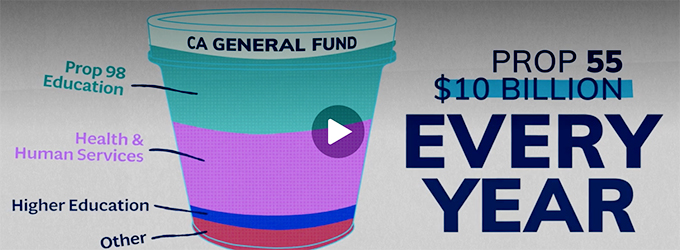
The answer is complicated, and I have addressed it in detail elsewhere. The short version is that the union that sponsored the Billionaire Tax, SEIU-United Health Care Workers, designed the tax to send 90% of its revenues to address the Medicaid problem, and the remaining 10% to be split among other services. This violated the understanding in Sacramento that 40% of general fund revenues should go to public education. It also raised, possibly, a hurdle to passage of Proposition 3, the Education and Health Care Act, planned by the longstanding progressive tax coalition CTA is part of before UHW launched the Billionaire Tax.
Prop 3, an income tax on the top two percent of taxpayers in the state, has no lack of supporters. The coalition did its homework and by last year everyone to the left of Attila the Hun was on board its project, which is to make a temporary tax that currently brings in upwards of ten billion dollars a year for schools and services permanent.
DOA?
As the organizations, or at least their leaders, were piling onto the anti-Billionaire Tax train, pundits rushed to pronounce Prop 40 dead on arrival. Mainstream media reportage breathlessly announced the “split” in the labor movement. Op eds in major newspapers by right-wing think tank wonks distorted the numbers to “prove” that the mechanism of the tax couldn’t work. Political newsletters pondered the arcane mysteries of Proposition 98, the ballot measure passed by voters in 1988 that mandates 40% of the California state budget to education.
Undeterred, SEIU-United Health Care Workers (UHW) plugged away. Bernie Sanders and Ro Khanna splashily supported the tax. It collected signatures and courted coalition partners like California Democratic Socialists of America (DSA), which provided a dual endorsement of the Billionaire Tax and Proposition 3 early in the year. California Teamsters and California AFSCME (American Federation of State, County and Municipal Employees), along with two large hotel and restaurant union locals, came on board both taxes as well. UHW suffered and survived negotiations with Newsom’s office to relinquish the ballot measure if the Governor and Legislature would agree to a reduced 2% tax, an offer that Newsom rejected. It sent its organizers to talk with California Democratic Party delegates and unions in the labor federation.
Molten Reservoir
The persistence paid off. Rumblings of discontent bubbled up within labor at top-down leadership maneuvering against what seemed to most rank and filers a righteous cause. One sign of what was to come emerged a week before the CFLU convention, when the local San Diego labor council and building trades council both voted to support the Billionaire Tax.
This points to a more significant issue than the infighting within labor and purportedly progressive organizations over a couple taxes. It should come as no surprise that a year and a half into the ruinous Trump 2.0, there is an enormous molten reservoir of electorate anger at billionaires— especially the insufferably arrogant tech bros leading the charge against the Billionaire Tax—ready to be tapped.
Shifts in the electorate
Much of the attention around shifts in the electorate has been focused on the war inside the Democratic Party between youthful DSA and other left candidates for office versus old guard centrist Democrats. But equally significant to understanding what is and isn’t going to work in the mid-term elections is something that has always been the case: that the voters, when given the opportunity to vote to tax the rich, generally do so with enthusiasm. And when the theme is folded into the campaigns of left candidates—as in Mamdani’s in New York—it helps, both because of what it promises to fund on behalf of working people, and because it puts meat on the bones of populist economic appeals.
An opening now exists in the Golden State, three months before the election, to craft a united tax the rich campaign with national implications. California, launchpad to neoliberal tax politics with Prop 13 in 1978, can redeem this stain by passing the first state level wealth tax in the nation’s modern history at the same time as making a more traditional top bracket income tax permanent. Passage of both will not erase California’s vast economic inequalities overnight. It will not even mean that the rich are paying their fair share of taxes—just a fairer share. What it can do is firmly underscore the immense importance in elections of acknowledging economic inequality and doing something about it.
What will be needed to win both Props 3 and 40, against the tsunami of fascist billionaire anti-tax spending, is a common progressive tax message and grassroots campaign, an approach that will more likely bring victory to both measures than separate campaigns that ignore their commonalities. This common messaging should contain at its center the idea that education and health care are rights, not privileges, and that passage of both measures would represent the wealthy finally paying a fairer share for that common good.
…