Mimosa Is Not a Flower
By Carlo Banchieri
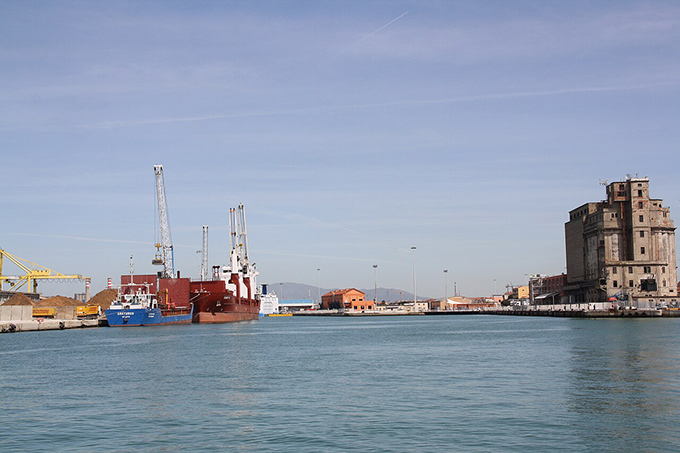
This excerpt is taken from my novel “Mimosa Is Not a Flower” (Edizioni La Gru), which draws inspiration from the tragic 2017 flood in Livorno to tell the story of single women who were able to respond with tenacity to trauma, hardship, and life itself.
The Livorno flood claimed the lives of eight people. I don’t know who is to blame, but the morning after that tragic night, many ordinary people went out to help clear the mud from the streets. Even the dockworkers.
I wanted to dedicate this short passage to them.
On Monday, September 11, Cristian went to work early. He left home early. He already knew what had happened and had already agreed with some colleagues that once their shift was over, they would all go together to help.
They didn’t know who they would encounter once they arrived, but they certainly weren’t going to stand idly by.
Once at the cargo terminal, it seemed to him like a morning just like any other. In fact, that morning, the news of the ship’s delay gave everyone a chance to rest a bit and recharge their batteries.
It was already seven o’clock, but some were still dozing in the locker room, lulled by the triumphant notes of a dream they’d abandoned just moments before and had only just rediscovered.
Cristian had been on the dock for quite a while. He couldn’t sit still, even when there was nothing to do.
A few young men, standing by the dock and chatting among themselves, cast fleeting glances through the thick fog.
Someone with a cell phone in hand was trying to reach acquaintances in the southern part of town to make sure they were all right.
Others were joking around as if nothing were wrong, while still others were engaging in their usual conversations about their paychecks.
Cristian stared at them.
For a moment, they looked to him like little pebbles.
They resembled the very fragments of asphalt and tar that they themselves were kicking as they walked through the puddles of rainwater, oblivious to the dampness that permeated the air, while they continued to discuss the previous night’s shift.
Perhaps he had that strange impression because he, too, felt that way that day—passive and confused—as he made his way between the wheels of the trailers and a few containers, hopping over potholes and pieces of sheet metal abandoned by truck drivers, moving from trailer to trailer in the silent yard, while the cargo ship slowly made its way into the harbor on the misty, hazy waters.
In the distance, through the mist, the skyscraper in Piazza Roma watched over them all, breathing its maternal breath slowly over a Livorno still half-asleep, and, like a lighthouse, it soon decided to reveal its peak, rising above all the grayness.
Out of the mist, the dockworkers gradually began to make out the outline of a whitish stern, but the waters remained still.
Seagulls circled overhead as if to greet them.
The mooring crew waited, bundled up in their heavy jackets.
A few sailors were already waving from the aft deck. The mooring went off without a hitch, and once the last line was pulled in, two of the sailors went ashore to meet them, while one of the two ramps was still moving.
Once it had been lowered, its dull scraping against the dock immediately drew everyone’s attention, pulling them away from their conversations or thoughts. Someone shouted, “Come on, kids, let’s get started!”
In Livornese: Andiamo bimbi, si ‘omincia!
And so that hoarse call rang out sharply through the air, and the work began.
As he set off on board, someone was still laughing, and as the boys’ jokes and their faces slowly receded from Cristian’s view, swallowed up by the ship’s hull, the clatter of the first chains being dropped onto the ground provided the missing piece to complete the picture. In that gray, timeless Livorno, where the pale daylight was beginning to dispel the fog, the subdued chatter of the deckhands became, for an instant, a fierce, rumbling buzz, before disappearing entirely.
In the hold, on the barges, on the dockside. It was the hard work of the port.
But there were always those who felt like joking around to make it all a little easier to bear.
All of that was good for the heart.
For Cristian, this was an integral part of a perfect postcard—unlike any other, yet simple and powerful, like the sea that brought something new every day amid the murky waves: the shouted phrases, the friendly faces, making him forget his swollen, grease-stained hands. A heavy, age-old job.
For him, it was entirely part of a poem.
For him, it was all part of Livorno.
And Livorno needed help. Somehow, he was going to do something he’d always dreamed of doing.
He already understood what had happened: the photos circulating on the internet were pretty clear. His dream was a simple one, but something he’d longed for for years.
That is, having the chance to be there in a time of need—when his city was calling for help—was, for him, something priceless and once-in-a-lifetime.
Cristian spent the last few minutes of his shift with one foot already out the door. He couldn’t wait to leave, and when he finally hopped on his scooter, he opened the throttle wide and sped toward Via Mondolfi. Once he arrived, he didn’t have to ask anyone anything.
He already knew what to do.
…