Orgreave – Justice Delayed Is Justice Denied
By Marc Davenant
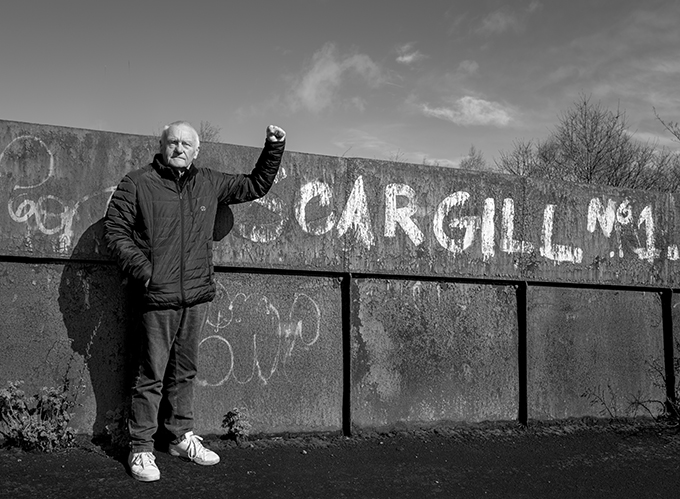
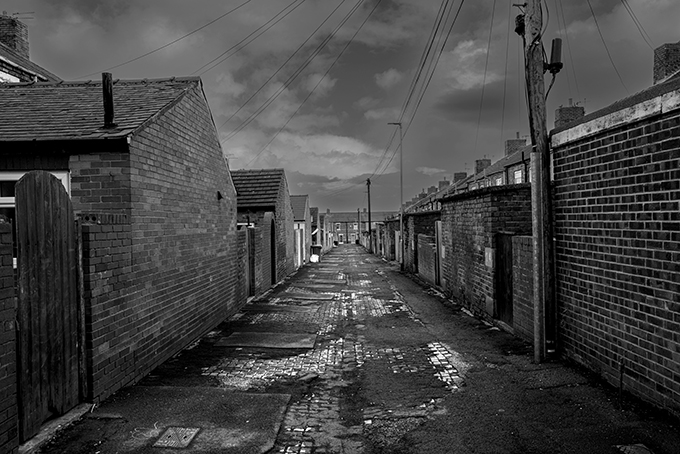
There are few more poignant sights in Britain than a mining village or town with no colliery. One legacy of the government of 1979 has been the proliferation of blighted post-industrial communities and the creation of a poverty, housing, and homelessness crisis on an unprecedented scale. Entire communities were abandoned to their fate, sowing the seeds for a breakdown of social cohesion and the casual disregard of the social contract with working class people. None of this happened by accident and the scars in these places, caused by the actions of Thatcher and her successors, will never be healed.
On June 18, 1984, in a small village in South Yorkshire, England, a serious crime took place. Thousands of police officers in riot gear, with horses, shields and truncheons engaged in what could only be described as a ‘state-sanctioned police riot’ during which they attacked and brutalised striking miners who were there to picket the Orgreave coking plant. Nobody has ever been held to account for the events of that day. It was to become known as ‘The Battle of Orgreave’ but it wasn’t a battle it was a rout and was a turning point in the social history of Britain. From the perspective of organised labour, the country would never be the same again.
Much has been written about the Miners’ Strike of 1984, but one thing is clear, the strike was deliberately engineered by the then sitting government as part of a wider strategy to permanently degrade, and ultimately destroy, the power of organised labour across Britain. To a large extent they succeeded, and we are still living with the consequences of decisions made, by what can only be described as a group of neoliberal fundamentalists, nearly five decades ago.
What happened at Orgreave on that June day was long in the planning from the government’s perspective but just another picket as far as the miners were concerned. The strikers attended the picket completely unaware that the government was planning to deploy the full force of the State against them and had been preparing for this moment for years.
Speaking of the events that day one miner said ‘Orgreave was planned because we were allowed in, cars coming from all over, down the M1 and M18 heading for Orgreave, they [the police] told us where to go and even where to park.’ Another miner who was there added ‘Nottinghamshire was like a police state, you were stopped every time you tried to get to a picket, but on the day of Orgreave we arrived at Junction 33 and when the police asked us where we were going, and we replied “Orgreave” they actually directed us where to go. They wanted to get all the miners there and then defeat us in that battle.’
One Welsh miner who travelled from South Wales to picket Orgreave said ‘it’s the only time I can remember being shown the way to a picket line. Prior to that we were being stopped in our cars, having to take wild detours over the mountain and back roads. That day we were like lambs to the slaughter.’
In May 1948, Nye Bevan, the Labour politician and architect of the NHS, described the UK press as ‘the most prostituted Press in the world, most of it owned by a gang of millionaires.’ He wasn’t wrong and when the Miners’ Strike began the right-wing media in the UK took every opportunity to discredit the strikers, deliberately spreading disinformation to undermine their cause with the general public.
The myth that the miners attacked the police first at Orgreave has become the established narrative in many media accounts of the events that day. Nothing could be further from the truth. The BBC reversed the footage in its news broadcasts to create a false impression of where the fault lay, and many people accepted this as the truth and have believed it to this day. What actually happened at Orgreave and subsequently can be seen in Yvette Vanson’s powerful documentary ‘The Battle for Orgreave’.
The miners’ accounts of events are very different from those reported by the press ‘it were glorious weather, that’s why the miners were in T-shirts and plimsoles. The police were there in riot gear with horses, helmets, shields and truncheons, thousands of them.’ The idea that unarmed miners dressed like that would attack thousands of riot-geared up police is beyond the bounds of credibility but the false accounts in the media were never challenged at the time.
Following the police violence at Orgreave, 95 strikers were arrested and charged with riot, which carried a potential life sentence. Multiple police officers then perjured themselves by colluding and signing false witness statements to secure trumped up convictions. The miners were vilified by the press, labelled thugs and bully boys and the police were presented as the victims rather than the perpetrators. The criminal trials subsequently collapsed when the police account of events was shown to have been falsified but by then the damage had been done.
What did come out in the trial was that the police had secretly developed a new manual on riot control, had purchased new equipment and had trained intensely for a prolonged period to facilitate the violent suppression of strikes across Britain. Orgreave was the first opportunity to deploy this State-sanctioned violence, and it is simply not credible to argue that the sitting government was not deeply involved in the planning.
The police realised from the events at Orgreave that they could now act with impunity, falsify witness statements, commit serious assault, pervert the course of justice and they would never be held to account. This was the very same police force (South Yorkshire) which was implicated in the Hillsborough disaster five years later in 1989 and who once again falsified their account of events. Michael Mansfield QC, who successfully defended the pickets in court described the trial as ‘the worst example of a mass frame-up… this century.’
The real truth of what happened behind the scenes in government, in the build-up to Orgreave and subsequently, has been hidden behind a veil of secrecy. After a long and hard-won campaign over decades by the Orgreave Truth and Justice Campaign a public inquiry has finally been granted, with the power to compel witnesses to attend and give evidence under oath. This includes senior politicians who were members of Thatcher’s government, like Michael Heseltine.
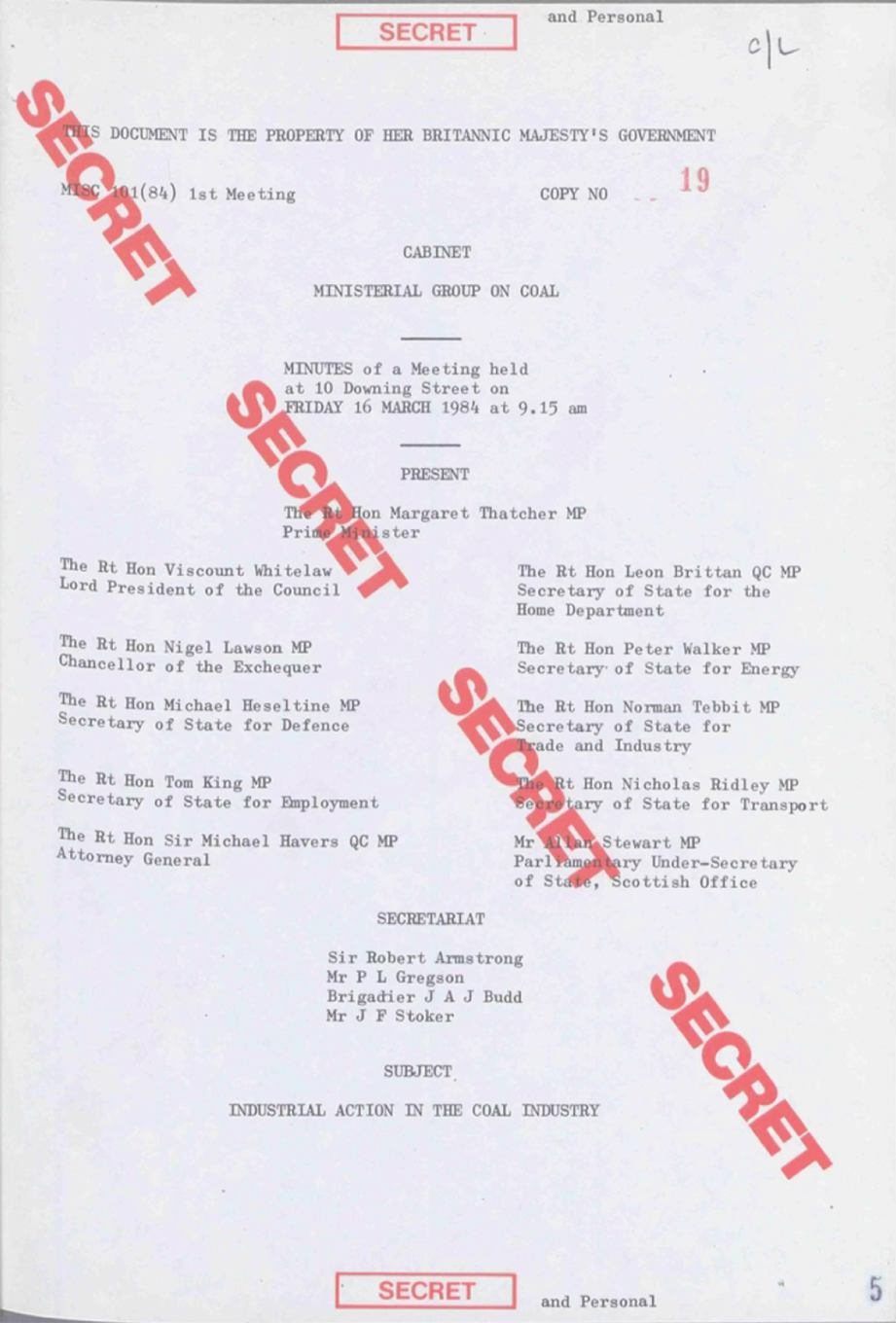
Heseltine, who is now in the House of Lords, has long opposed any inquiry into what happened at Orgreave and when news of the inquiry broke, he called it ‘ridiculous’ when speaking to the BBC. He is certain to be required to attend as a witness having been a member of Thatcher’s secret ‘Misc 101 Committee’ which directed the government’s strike breaking strategy and drew up plans to declare a state of emergency and deploy the military against both the miners and the dock workers who were also on strike.
Many of the key players in the government of the day have now died as can be seen from the declassified secret papers which can now be viewed at the UK National Archives, an extract from which is below.
In addition, at least one police force has deliberately destroyed all of their records relating to the Miners’ Strike after it became clear that a public inquiry was likely. Whether the truth will finally come out remains to be seen.
When writing something like this I always try to present a balanced view. With Orgreave this is very difficult as the video and witness evidence are unequivocal and the South Yorkshire Police as well as the government made statements at the time, and subsequently, which have been shown to be untrue or misleading.
Speaking after the police brutality at Orgreave Margaret Thatcher said “You saw the scenes that went on in television last night. I must tell you that what we have got is an attempt to substitute the rule of the mob for the rule of law, and it must not succeed. It must not succeed. There are those who are using violence and intimidation to impose their will on others who do not want it. They are failing because of…the magnificent police force well trained for carrying out their duties bravely and impartially… the rule of law must prevail over the rule of the mob.” This statement reinforced the lies already spread by the media and shortly afterwards she made her infamous speech describing the miners as ‘the enemy within’. The scenes on television which she referred to here were the scenes where the BBC had reversed the footage to make it look like the miners attacked the police as mentioned previously.
The South Yorkshire Police fabricated a narrative that their officers faced a barrage of missiles from the strikers and responded to that attack. They claimed that ‘the sky was black with missiles’ – a claim which was proven to be untrue in court when their own film footage of the day came to light and virtually no missiles were visible in advance of the police charge. In 1991 the South Yorkshire Police paid compensation of £425,000 to 39 miners who had sued for false arrest, assault and malicious prosecution but the police never admitted liability.
Whatever happens one thing is clear – none of the people who engineered the police violence at Orgreave, brutally assaulted the miners, lied to the media or broke multiple laws by falsifying evidence and committing perjury to secure the criminal conviction of innocent strikers will ever be held to account.
Footage and stories from the events at Orgreave can be seen in my exhibition Rebellion! which is currently on tour across the UK.
…
You can see work from photographer Marc Davenant’s “Rebellion” and “Outsiders” projects HERE