The Rise (and Fall?) of the Billionaire Tax
By Fred Glass
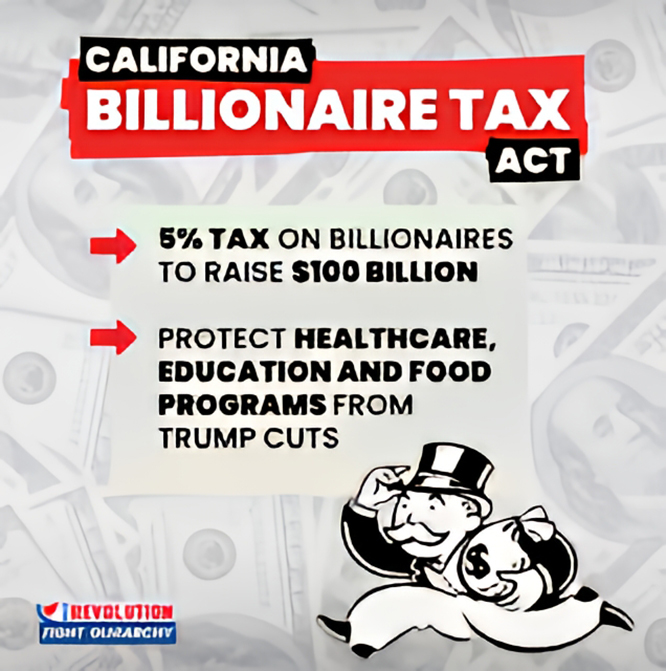
“The Billionaire Tax would affect a grand total of 250 people in the state who collectively hold two trillion dollars in wealth.”
A political storm has been sweeping through the Golden State for the past half year. It’s called “The Billionaire Tax”. Its detractors, until now, have mostly been a handful of the ultra-rich conservatives targeted by the proposed tax itself, and their ostentatious shoveling of millions of dollars into a “No” campaign has helped buy them the public anger that these sociopathic tech bros so deeply deserve.
On the other side, along with SEIU-United Healthcare Workers (sponsor of the measure), were to be found progressive stalwarts like California Congressman Ro Khanna, Senator Bernie Sanders (Vermont), and several unions. To all intents and purposes—at least from the outside—it had the look of a class struggle in political form.
But with the elimination of the lone gubernatorial primary candidate who supported the measure, Tom Steyer, from contention in November, things have pivoted quickly, revealing complex dynamics largely unseen in public view until now.
There are in fact two ballot measures seeking to raise state revenues via progressive taxes in November, the Billionaire Tax (a wealth tax), meant to fill the massive budget hole created in the state’s Medi-Cal system due to federal funding reductions, and the Education and Health Care Act (an income tax), which already exists, but is a temporary tax, the revenues of which go to schools and services. Its principal backers, public education unions, are seeking to make it permanent.
You might think that it would be a no-brainer for unions to stand united on these measures. The Billionaire Tax would affect a grand total of 250 people in the state who collectively hold two trillion dollars in wealth. They would pay out five percent of their hoard over five years, and then the tax would sunset. This would amount to one hundred billion dollars, or twenty billion dollars a year, so that millions of working class Californians, mostly children, would keep their access to health care.
The initial proponent of the Billionaire Tax, SEIU-United Healthcare Workers, was joined along the way by AFSCME California, the California Council of Teamsters, and UNITE HERE Local 11 in Los Angeles, among others, because they recognized that the outrageous economic inequality symbolized by the growing wealth of a tiny fraction of the population, making Gilded Age inequities of yore seem quaintly egalitarian, contained the seed of a solution. More importantly than the symbolism, they also understood that many of their own members’ families are served by Medi-Cal, which covers close to 15 million state residents.
The Education and Health Care Act is likewise a progressive tax. Since its enactment as Prop 30 in 2012, and renewal as Prop 55 in 2016, it has raised over one hundred billion dollars for the state’s general fund through its creation of three high end marginal income tax brackets, affecting roughly the top two percent of income earners. Last year it brought in 14.5 billion dollars, or six percent of the state general fund. Here the charge is led by the California Teachers Association, the California Federation of Teachers, and the SEIU State Council, all of whom have been involved in a progressive tax advocacy coalition since the 2012 campaign. The Secretary of State’s office has recently announced that it has validated the signatures for ballot qualification of both measures.
Strange bedfellows?
Last week CTA came out against the Billionaire Tax. So did the state Building and Construction Trade Council, the umbrella organization of construction unions. What was their reasoning? For CTA, the opposition was not entirely surprising. The Billionaire Tax represents a violation of their prime objective: defense of Proposition 98. Passed by voters in 1988, it sets aside 40% of the state budget for K-12 schools and community colleges. The 300,000 member association considers this a bright red line and marshals its considerable resources every time legislators or opponents seek to cross it. As written, the revenues of the Billionaire Tax are tightly aimed at saving Medi-Cal, with just ten percent allocated to education.
“… echoes the transparently false propaganda of the right-wing billionaires opposing the Billionaire Tax, i.e., that all the “job creators” will flee California and take all the jobs with them in their suitcases.”
Fair enough. There is principle involved here for CTA. Not so much with the building trades, whose public justification echoes the transparently false propaganda of the right-wing billionaires opposing the Billionaire Tax, i.e., that all the “job creators” will flee California and take all the jobs with them in their suitcases. This was the line offered by opponents of Prop 30 in 2012, as it is always the first line of defending ultra-privilege every time any progressive tax is ever offered anywhere. Copious research has shown this to be untrue. Here in California by 2015, three years after passage of Prop 30, 1.5 million new jobs had been created, and tax records demonstrated that ten thousand new millionaires had been minted. (Let’s set aside for now the question of where the current California “job creators’” point their investments: at AI, which destroys fewer jobs than it generates.)
But as one of the big dogs in California politics, CTA’s position also merits a deeper look. As part of its rationale, the union claims it opposes the Billionaire Tax because “this policy will not provide the sustainable and long-lasting funding that our schools and communities deserve”, i.e., it is temporary. Ahem, so was Prop 30 and 55, which didn’t stop CTA from supporting the earlier temporary iterations of the measure it’s backing now.
Worse, and bizarrely, the only visible sign on CTA’s website about its position on the Billionaire Tax is to be found in its November election recommendations, where alongside the “Oppose” notation, a link is posted to the “Building a Better California” website, which says nothing directly about the Billionaire Tax, but happens to be the minimal web footprint of a front for the right-wing billionaires dumping their couch cushions into the anti-Billionaire Tax campaign, a PAC whose contributors are headed up by tech bros Sergey Brin, Eric Schmidt and Peter Thiel. Strange bedfellows—along with Governor Gavin Newsom, who has never met a progressive tax he likes.
So what’s really going on? Before SEIU-UHW launched the Billionaire Tax its leaders briefly consulted with the members of the progressive tax coalition. That coalition had a plan: get Prop 55 renewed and made permanent in 2026 before it expired in 2030, and then go after a wealth tax or take another swing at commercial property tax reform (narrowly lost due to COVID in 2020) in 2028. This plan was disrupted by the UHW, leading to the fear (plausible, but debatable) that another progressive tax on the ballot would muck up the works. Even SEIU State Council, the parent organization of UHW, isn’t on board the Billionaire Tax. When UHW went ahead on its own, nearly every member of the coalition that had been doing this work for fifteen years was pissed.
Where is an alternative solution?
California DSA, a small mammal scurrying around the ankles of the dinosaurs duking it out, and supporting both measures, is one of the few exceptions to the side-taking (AFSCME California and the California Teamsters Council are others), which is now becoming increasingly contentious.
The Billionaire Tax was addressing a problem no one else was: a gutted Medi-Cal means people will get sick and die. The CTA in its opposition statement remained silent on this end of things. As communications director for the California Federation of Teachers, sometimes rival and sometimes partner with CTA, through a fair amount of this history, I can attest that this is not new. The fierce defense of Prop 98 guarantees tended, for CTA, toward rigidity, while CFT, part of the AFL-CIO, and likewise a strong defender of school funding, nonetheless always bent one principle against another, acknowledging at moments like this, “We can’t teach children who come to school hungry or sick.”
In fall of 2011 and 2012, CFT was leading a labor-community coalition effort to get a Millionaire Tax on the ballot to address the giant state budget deficit left in the wake of the housing crash and Great Recession. Governor Jerry Brown, with a rival ballot measure, a mix of progressive and regressive taxes, refused CFT’s offer to come aboard the millionaire tax. Instead, he stripped away the other unions in the coalition (including CTA) by threatening to withhold his signature from their legislative programs. The pressure on CFT was enormous to cave, much like what UHW is undergoing right now.
But CFT prevailed, due to its careful coalition building over several years. It had solid allies in the community who weren’t stepping away. Many union leaders told us in private that while they couldn’t publicly resist Brown’s blackmail, they were with us in spirit. After a half dozen straight opinion polls showed the Millionaire Tax likely to win, and following a massive rally in front of the state capitol, Brown capitulated, merging his measure with CFT’s, which became Prop 30, the largest bump in state income taxes on the rich since WW2.
The same gubernatorial agreement is unlikely for UHW, because in place of the spadework of coalition-building over time that builds trust and loyalty, its leadership accomplished precisely the opposite. Let’s sum up: good cause, bad process. And now we approach midnight.
Possible outcomes
All might not be lost for the Billionaire Tax. The California Federation of Labor Unions, AFL-CIO hasn’t weighed in yet. This is an important factor in how things will play out. The CTA’s opposition, while significant, is not the final word. As an independent union outside of the labor federation, it has no direct say on Labor Fed policies. If the UHW can rally an endorsement from the fed there will be new life in the measure. But the CFLU doesn’t convene until August 4. That might be too late.
Another possibility is a legislative compromise. The Sacramento rumor mill has it that the Governor might shift some funding around to help bridge the Medi-Cal funding gap if the UHW agrees to rescind the measure. But it won’t amount to the $10 billion per year needed.
One of the arguments that makes the Billionaire Tax a problem for CTA is also why CTA should let it go: it’s temporary. True, if pieces of the budget are carved away for more health care, that will not help education’s forty percent. But the tax as written does not compete for state budget dollars, it augments it with a five-year tax on billionaires that will expire after Democrats are in control of Congress and the White House, and the federal government will be able to resume paying its way in California. If that’s not true, and the fascists are still running the federal government in 2030, we will all have bigger problems than preserving Prop 98.
…