Maritime Workers Under Attack
By Captain Don Marcus

Relatively low on the scale of Presidential abominations, but of potentially great impact, is a development that threatens the existence of one of America’s oldest and, in centuries gone by, most celebrated industries. America’s prosperity as far back as colonial days grew in no small measure due to the creation and rapid expansion of a vibrant colonial and, later, national merchant marine. Merchant ships built in the thirteen colonies and crewed by Americans were essential to the economic growth of the colonies, their prosperity and the establishment of the United States as a great trading nation.
In fact, one of the first actions taken in the first United States Congress of 1789 was the enactment of cabotage laws reserving U.S. waterborne domestic trade to U.S.-flag vessels and other provisions promoting the use of U.S.-flag vessels in America’s foreign trade. This was a principle recognized by the celebrated free trader Adam Smith. He understood that exceptions to his theory of international free trade were necessary in the case of a national merchant marine and supportive navigation laws as a nation’s military and economic security relies on its ability to engage in and protect its seaborne trade.
The United States remains a nation dependent on ocean commerce. However, our maritime industry and its small fleet of approximately 190 U.S.-flag ocean-going merchant vessels is threatened with extinction. The demise of the U.S.-flag merchant marine is something that the Royal Navy of King George III and Nazi U-Boats of W.W. II were unable to accomplish. Nor can Chinese industrial policy which has subsidized the establishment of the world’s largest national merchant fleet of over 5000 Chinese-flag vessels as well as creation of the world’s greatest shipbuilding complex (over 50% of total world capacity) be blamed for what could become the imminent death of one of America’s oldest and most essential commercial enterprises.
Like other disasters in the making as the U.S.A. approaches its 250th anniversary, ignorance, greed, hypocrisy and simple neglect are at the heart of the peril facing the US Merchant Marine. On May 22, 2026, as has been done on every May 22 since the observance was first established by Congress in 1933, “Maritime Day” was acknowledged by the White House. A memorial event was conducted at the U.S. Department of Transportation as well as elsewhere in various ports around the country. Bells were tolled and wreaths cast into local waters to commemorate the sacrifice of countless U.S. seafarers in the performance of their duties in times of both “Peace and War” as is the credo of the U.S. Merchant Marine.
In his White House statement, President Trump honored “the brave Mariners who have borne our nation’s strength across the seas, and we recommit to restoring and expanding America’s maritime dominance.” After recognition of many conflicts dating from the Revolutionary War through World War II during which the Merchant Marine played a critical role, and noting the essential mission of seaborne trade in supporting our national economy and security to this day, President Trump stated:
“Last year I signed an Executive Order to expand our shipbuilding capacity, strengthen our maritime workforce, protect our industrial base and ensure America’s shipping capabilities can support both military operations and economic independence. As a result of these decisive actions, our nation is securing unprecedented investments in port and maritime infrastructure, boosting American industry, driving economic growth, and protecting national security.”
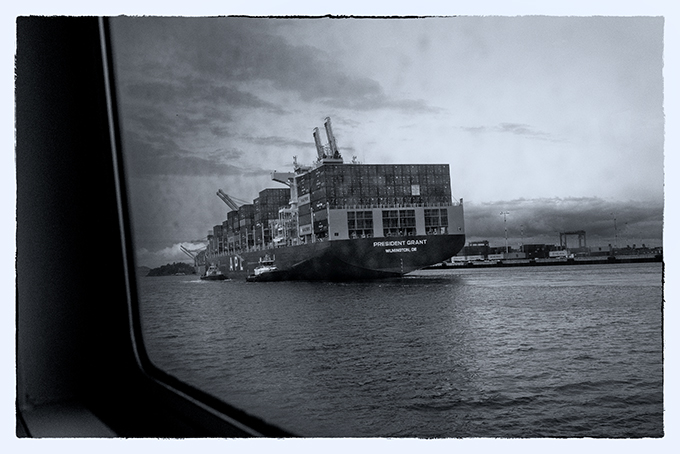
President Trump did sign Executive Order 14269 “Restoring America’s Maritime Dominance,” on April 9, 2025. Unfortunately, virtually nothing of this plan has come to fruition. In fact, quite to the contrary, the moral and strategic debacle of the unauthorized war against Iran has given the President the opportunity to carry out one of the pledges stated in Project 2025: that is, the effective repeal of the Jones Act. This law requires, among other features, that U.S., crewed, U.S. built and U.S. owned vessels be utilized exclusively to load and discharge cargo for carriage between U.S. ports. The law is essential in maintaining U.S. commercial shipbuilding capacity (now at less than 1% of world capacity), a domestic fleet of merchant vessels (approximately half of the total U.S. fleet) and a trained American-citizen mariner workforce.
The Jones Act is now being circumvented using what amounts to a blanket waiver process imposed by the Trump administration. Jones Act waivers, intended under the law only when necessary for national defense, are now being granted without justification. This is allowing foreign vessels into U.S. domestic trade in contradiction of the law which authorizes waivers only when “necessary in the interest of national defense to address an immediate adverse effect on military operations,” [46 U.S.C Section 501(a)] or “if the President determiners it is necessary in the interest of national defense” [46 U.S.C. Section 501(b)].
Waivers were granted initially for 60 days on March 18, 2026, and for another 90 days on May 18. If these waivers continue, U.S. companies and the industry itself will be undermined. The livelihoods of thousands of U.S. citizen workers aboard vessels of all types, shipyard workers and workers in a multitude of related industries will be jeopardized.
According to the U.S. Maritime Administration, as of June 15, 2026, 109 foreign flagged movements have operated in U.S. waters under the waiver process since the waivers were established by the President’s order on March 18. There has been no showing of necessity for the purpose of national defense nor, contrary to the statements of President Trump has there been any evidence of a lowering of gasoline prices on a nation-wide basis because of the waivers. What is happening is that the industry is being undermined as maritime contracts with U.S. carriers are being shifted to foreign carriers and shipbuilding contracts in U.S. shipyards are being put on hold as confidence in the future of the industry dims.
If this continues and the Jones Act is neutralized or ultimately repealed, the central pillar of the U.S. maritime industry will crumble. Once scrapped by the destruction of the domestic core of the industry, rebuilding maritime skills and shipbuilding will be a multi-generational process if it is ever attempted. Skilled workers at sea, in our inland waters and in our shipyards are not developed overnight.
In the short-term oil and commodity traders and foreign shippers will prosper, not consumers. National defense has not been enhanced in any manner by the ongoing Jones Act waivers. Among the longtime supporters of these expansive waivers and of the outright repeal of the Jones Act are interests including Koch Industries, the Heritage Foundation and the CATO Institute all of whom have no regard for the jobs of thousands of American maritime workers, their health or safety, the integrity of the marine environment, or, at the end of the day, national security other than to the extent their financial interests are threatened. If this is allowed to continue, foreign-built vessels and workers will be flooding our ports, debilitating national security, safety, environmental standards and our country’s economic independence.
While the White House lauds the contributions of the men and women of the U.S. Merchant Marine and the maritime industry over the last 250 years, the legal foundation for the preservation of that industry is being undermined. Workers and their families will be discarded, and an essential U.S. industry will be outsourced to the detriment of the nation.
…