Back to Back – Outside and Inside- Labor and Industry
By Peter Olney
In March of 2025 I had participated in the Shunto wage offensive. All of Japan’s labor unions propose their annual wage settlements to the employers and the employers respond to the major industry groups by the middle of the month. Shunto originated in the 60’s as a way to prevent corporate whipsawing of union demands – a kind of mass sectoral approach to bargaining over wages even though most Japanese unions in the private sector are company based.
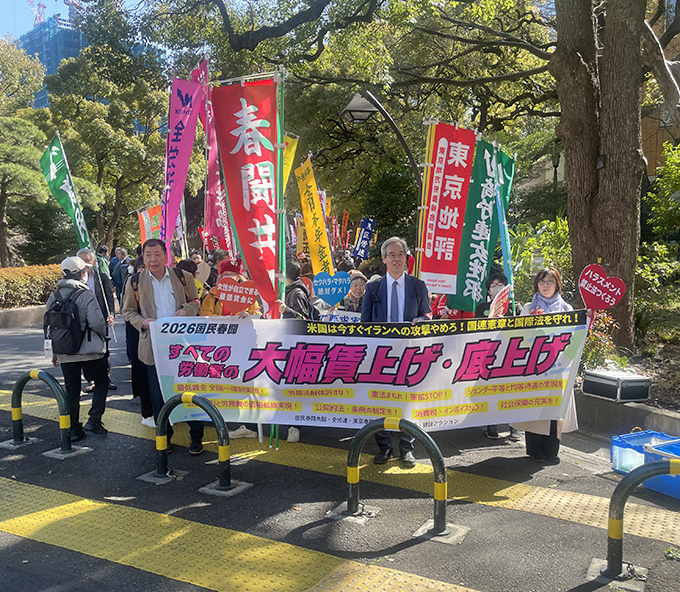
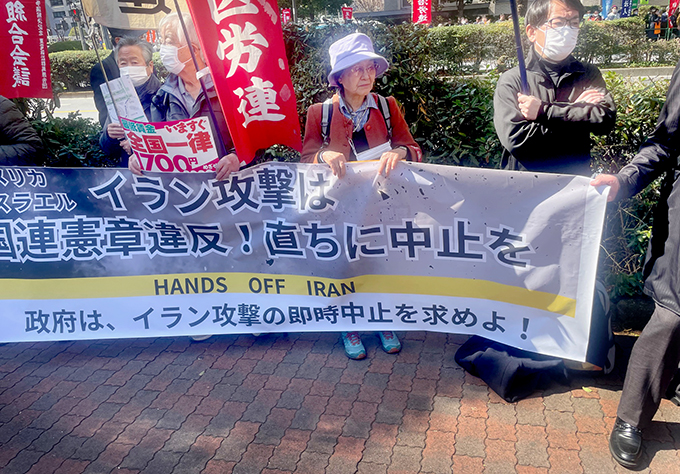
This visit I attended a very spirited multi labor confederation rally outside the Ministry of Education and Labor on March 5 in Hibaya Park. A few thousand workers and union leaders lined the avenue in front of the ministry. I was energized by meeting up with the leaders of Zenroren and particularly happy to see that Secretary General Kurasawa was in the center of a contingent holding a banner denouncing the barbaric US/Israel war on Iran.
The results of the wage negotiations have come in for some key sectors, particularly auto. Despite the Trump tariffs and the Iran war’s impact on energy, Toyota for instance has agreed to the 5% increase that the unions were demanding. As of March 23rd, an average wage hike of 5.26 % was achieved for 1,100 unions representing 1.42 million workers. Settlement for smaller firms will continue into the summer. The willingness of management to agree to union demands is largely explained by labor market challenges around retention.
On March 6 I met with Sho Tayeda, a staff person at the Ministry of Economy Trade and Industry (METI) . He explained that his area of responsibility was human resources and the investment in “human capital”. I asked his explanation for the astoundingly low 13/1 CEO to worker pay ratio in Japan. He said that the Japanese capitalist economy in promoting human capital investment, had a tinge of socialism.
He also explained that in his country Amazon is second to Rakuten, a Japanese firm. Amazon and related firms employ about 15,000 in Japan, whereas Rakuten employs upward of 29,000. Their business models are starkly different. Amazon acts as a closed ecosystem controlling logistics and inventory, whereas Rakuten generally offers an open platform for third party sellers to manage their own operations.My two days on Ministry Row near Hibaya Park brought me a little closer to understanding Japanese labor relations. All of those understandings would be tested when I presented to the comrades of Zenroren on March 16th!
…