“I Don’t Want Your Millions (Billions), Mister,” – Art and the Working Class
By Jay Youngdahl
Production and enjoyment of art is one of the constants in the human condition. From cave paintings, to the art of ancient Greece, to the posters from the Black Panther Party, all humans participate in art.
Unfortunately, contemporary art today is closely tied to the vagaries of capitalism. Museums are locations for the production of tax breaks for billionaires. “Fine art” is an asset class for speculation for those whose wallets are swollen with the harvests of exploitation of the working class. Determination of what is worthy to be exhibited and what is not is enforced by a neoliberal ideology which performatively lauds “identity” while ignoring class.
But outside of this ideological strait jacket much art making occurs in the working class. Often not recognized as such, training in art theory and history can reveal such art as important as any that is being exhibited in the galleries of New York City. Over the last few years, I have worked on bringing this to light.
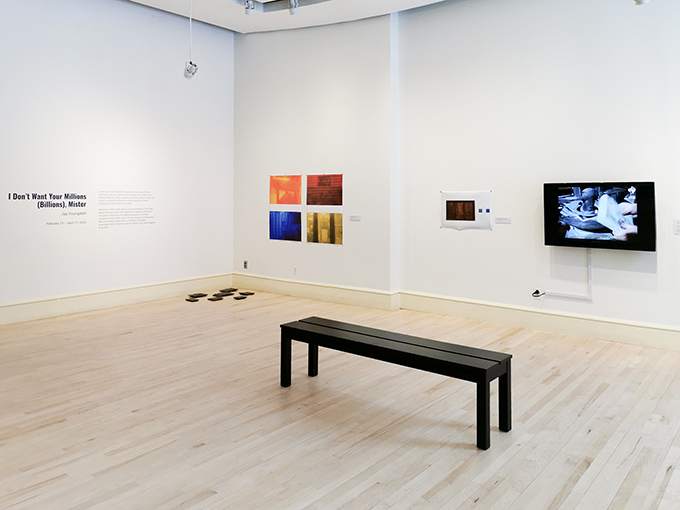
On February 13, 2026, I was able to open an exhibition “I Don’t Want Your Millions (Billions), Mister,” (running until April 11th 2026) at the Workers Art and Heritage Centre (WAHC) in Hamilton, Ontario. The theme of the show is the innate creativity of workers, and the commonalities that exist within the working class.
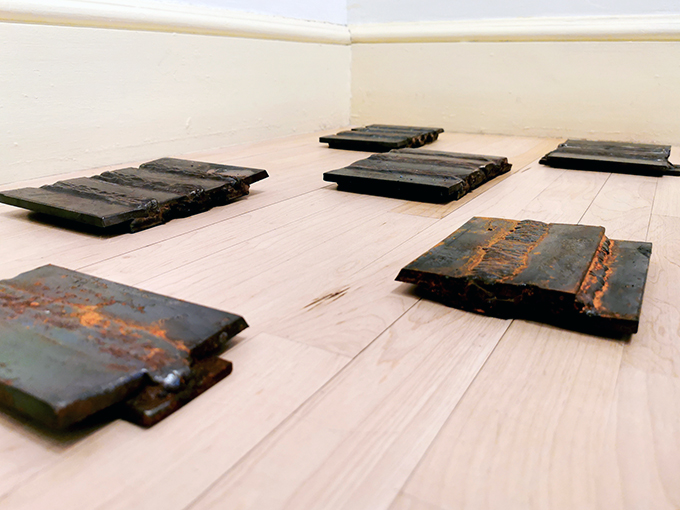
Through documentation of worker-made objects from union training and apprenticeship centres in Alberta’s oil sands, the high rises of New York city, the American Deep South, and locations in between, this exhibition showcases the creative expression of workers, recognizing their labor as art. It does so not from a journalistic or historical perspective, but through the lens of conceptual art.
The name of the show comes from a song written by a Harlan County, Kentucky labor activist, Jim Garland, in 1941. This song was sung in my home in my youth, and verses from it are interspersed in this essay. The core of the show emanates from worker training centers, apprenticeship schools. Sponsored by unions, I visited many of these taking photos in each. An historical outgrowth of concepts of guilds which have existed throughout the world, these schools teach skills which society needs taught. They are sites of social reproduction. For those in them, they impart a sense of pride and a concrete response to the insecurity of wage labor.
In my day job, I am a union and civil rights lawyer in the South. While I have represented nearly every union over my career, much of my legal work today is for the Southern District of the United Brotherhood of Carpenters and Joiners, I represent their Apprenticeship Fund which covers eleven southern US states.
The following is written in conjunction with this exhibition. All of life is nuanced, and this is especially important when considering art and considering the working class. Here I attempt to make a number of discrete points which were important to me in building this exhibition. None of these theses are fleshed out.
INTRODUCTION TO EXHIBITION
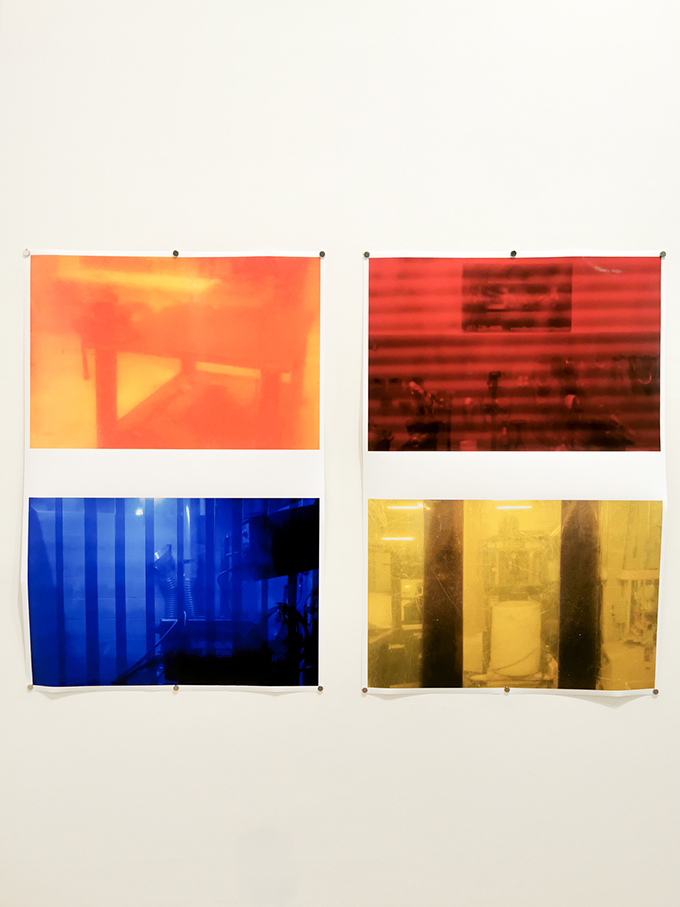
The pieces which comprise the show all began with the efforts of workers while in training and at work. I then applied my interpretation. To take one example, photographs entitled, “A Welder’s View, Numbers 1 and 2,” were taken from inside welding booths. To me, they represent what an apprentice welder sees of the outside world as they learn their craft.
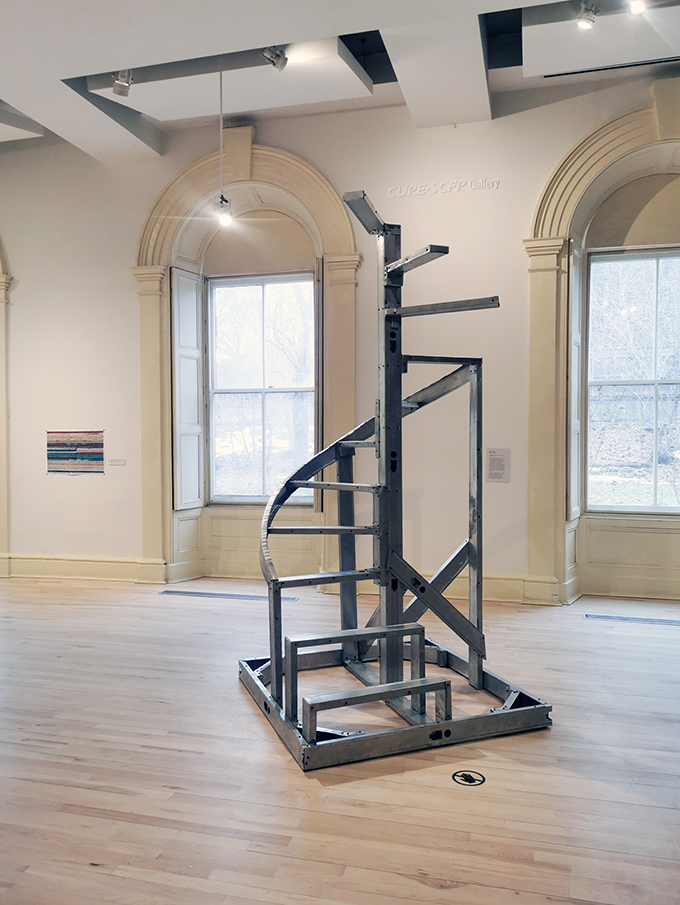
A special piece in the show, “Workers’ Staircase,” is a large metal sculpture, constructed from materials used in contemporary building construction, The sculpture was built by three apprentices, working with their instructor, at the UBC Local 18 Training Center, in Hamilton. With the conclusion of the show it will move to the union hall. I provided a design that was influenced by a famous post-revolutionary conception of a Soviet Ukrainian artist, Vladimir Tatlin, known as “Tatlin’s Tower.” Though never constructed, Tatlin’s Tower was to be erected in today’s Saint Petersburg, and to serve as the headquarters of and a monument to working class political parties throughout the globe. While workers vary through historical time, location, and context, certain strands are permanent I believe.
THESIS ONE
The working class is eternal.
With precious few exceptions, this underclass has existed throughout humanity. It has subsisted in all locations, historical times, ethnicities, and genders. It has taken the form of human slavery in ancient Greece and the Americas as well as laboring over computer code in Asia and Africa.
Subject to oppression, exploitation, and discrimination, the fruits of their labor have gone first to the reproduction of itself as a class and second to those who have the power to exploit it.
Except for a few shining historical moments, this class is always in contradiction with their wealthy global citizens who have amassed assets and power.
This power to exploit is often physical. Also, the rules of governmental power uphold exploitation through the rules and regulations of the operative system. These rules, regarding the legality of collective action by workers, or the handling of debt, for example, ensure an exploitative web. This web is maintained by a professional managerial class, lawyers and financiers and judges, which serves those who benefit the most from this exploitation.
Dominant ideas and ideology taught in schools and the media are determined by the economic bases of society at the time. Ideologically, a systemic philosophy of “possessive individualism,” is lauded today, a phrase coined by the Canadian philosopher, C.B. MacPherson.
Those with the hard or soft power to exploit engage in a constant effort to split this class, an effort that is not always recognized by those who suffer from these efforts. In my youth in the southern US, employers encouraged activity of the Ku Klux Klan to split solidarity of white and Black workers in rural paper and wood products factories. Today, many of those plants are owned by Canadian companies who use similar tools to ensure their profits.
This same effort to split the working class is assisted by the denigration of many workers as being “deplorables” and by an ideology that seeks to weaken understanding of class by upholding certain gender and identities, even of the wealthy, over conceptions of class and of the struggles of workers.
I don’t want your millions, Mister,
I don’t want your diamond ring.
All I want is the right to live, Mister,
Give me back my job again.
THESIS TWO
Each class produces its own morality. Due to their lack of individual economic power, workers’ morality must stress the common good. Regardless of location, gender, race, ethnicity, or historical time, most of the global population shares a commonality of work.
To improve the lot of their lives, workers must practice “solidarity forever,” whether we like it or not. One must work with others, so the actions that come out of it must benefit your fellow humans and yourself. Individualistic endeavors in which all is competition. and for you to win, others must lose, is embraced by some, but for this class such a philosophy can only be transitory.
It is from this that the title of the show emerged. The love and humility in the song has always been an inspiration to me. It is an antidote to the individualism of “look out of number one” that has been the mantra of the global elite in my lifetime, as well as the Silicon Valley religion of the “joys” of disruption, to “move fast and break things.”
Workers are forced into finding their distinctiveness from work. There is pride in production, a wholesomeness. The pride of a clean kitchen after the lunch rush; the pride of a completed building by those who constructed it; the pride of recovery by patients in a hospital ward; the pride of a well-maintained family home which allows a wholesome family to function.
I don’t want your Rolls-Royce, Mister,
I don’t want your pleasure yacht.
All I want’s just food for my babies,
Give to me my old job back.
THESIS THREE
Art and labor, and art and workers and their class, are multi-layered concepts. This show focuses on one of these layers, art made by workers while at work, as part of their work. A short exposition of several other layers is useful.
Generally, the concept of art by workers or labor art, is often connected to labor heritage. Much of it celebrates and helps us remember struggles of the past. Rob Kristofferson and Stephanie Ross in their book “The Art of Solidarity: Labour Arts and Heritage in Canada,” argue that “labour arts and labour heritage are especially key to sustaining and valuing working people, and their communities and movement, in difficult times.” (P1) These authors see this labour art and labor heritage as illuminating and sustaining “the oft-hidden realities of working people, and their contributions to and aspirations for social and economic justice, equity, and inclusion that capitalist structures of domination seek to block out.” (P2)
These authors, like many others, have recognized that art is generally mired in the economics of art in contemporary capitalist society. The gallery/museum system in North America has become a plaything for performative action by billionaires and their families. Art exists and is produced in and for the market, with its financial exchange value reified as a Wall Street commodity. Art made specifically for this system even has its own name today, “Zombie Formalism.”
In contemporary art practice, as in other sectors of society, workers are being squeezed out of the field. ”Class Ceiling A Review of Working-Class Participation in the Arts Across Greater Manchester,” released in January 2026, documented that workers losing the ability to participate in the arts. They are being pushed out of theatre, music, and literature, a trend that has accelerated over the last few decades.
Much of what is called worker art is made by workers using traditional techniques. These include painting and sculptures often known as “outsider art” in the academic art canon. Some recognized famous artists were laborers prior to becoming fulltime artists, such as Jean-François Millet. Prior to the middle of the nineteenth century in Europe, depictions only of the wealthy and powerful, or those favored by them, were allowed as subjects in figurative paintings hung on gallery walls. In the 1850’s, however, French painters like Jean-Francois Millet and Gustave Courbet heroically anchored a turn toward “common” people when they scandalized the Parisian art establishment with their paintings of ordinary French men and women. For example, Millet’s painting, The Gleaners (Les Glaneuses), portrayed widows in the countryside forced to gather leavings in the fields to survive, combining skilled artistry with a political position favoring ordinary French people.
Representations of workers was a favorite topic of artists during and after the Great Depression of the Twentieth Century. Further, many artists have used workplace locations as a theme, including some work by Canadian painters known as the Group of Seven.
The show at the WAHC, however, asks the viewer to consider another kind of labour art. While worker’s art is often thought of as art produced by workers who are consciously producing art and craft, my point is that there is a subconscious layer to this too, in which the creations by workers are art. This layer can be accessed by artist and viewer alike. One hundred years ago the Soviet artist, Boris Aratov, wrote “it is in the factory and the workshop where the erosion of the distinction between workers (as culturally excluded) and artists (culturally privileged), individual ideas and collective creativity will be tested and challenged in practice, and the real work of a new egalitarian culture created.” I hope to add in the revitalization of this concept.
Work and workers produce art. This art I am presenting as art is produced in worker training centers, often wholly unrecognized as art by the viewer or even by the producer. When I showed my first album of photographs to Paul Jones, the lanky director of carpenter union training centers in Texas, he replied, “It looks like work to me.”
To be sure, these pieces are my interpretation, influenced by art history and contemporary art practice. Yet they could not exist without the underlying work and efforts of these crafts people. Pieces in show are vignettes – only some of many. I mean for the pieces in the show to be conceptual entryways for the viewer to consider the working class, as a class with deep meaning and talent.
I am influenced by the work of Fred Lonidier, a union leader and photography teacher from California. Lonidier, along with his fellow students at the University of California, San Diego Martha Rosler and Alan Sekula, translated the movements of the 1960’s into conceptual art. Lonidier’s exhibition “The Health and Safety Game,” premiered at the Whitney Museum of American Art in 1976, and considered the horrific yet mundane injuries incurred by workers through a lens of conceptual art.
THESIS FOUR
When I began photographing union training centers, I presented them as zines, with each zine focusing on a specific location. My zine, “1901 Susan Drive,” features a training center for carpenters and millwrights in Arlington, Texas. In it I included an essay entitled, “The Democratic Working-Class Possibilities of Art.” Ideas from that piece are included in this essay.
As discussed above one of my influences in producing this exhibition was the explosion of artistic methods in the revolutionary period in the early decades of the Twentieth Century. In the early years of the Soviet revolution, the issue of workers and art was on the front burner in a society which expressed its dedication to worker well-being and agency. An artistic socialist alternative, bringing art into factories and workplaces, was advocated by leaders in the artistic community. Arvatov, an avant-garde artistic activist, promoted the conscious implementation of art into factories in the young Soviet state. Artists would be part of the industrial process, working alongside production workers, as do those with other skills such as logistics, shipping, and accounting.
Recently published in English, Arvatov’s 1926 book “Art and Production” encouraged an artistic movement called “Productivist Art.” He wondered how artists, with their skills and attention, could contribute to the building of a new society by supporting collective processes of industrial work. Arvatov, his translators wrote, believed that “artists should subordinate their technical skills to the greater collective discipline of the labour process and the workshop. For it is in the factory and the workshop where the erosion of the distinction between workers (as culturally excluded) and artists (culturally privileged), individual ideas and collective creativity will be tested and challenged in practice, and the real work of a new egalitarian culture created.” (Art and Production, translated by John Roberts and Alexei Penzin.)
Arvatov and his contemporaries attempted to separate the division between art and life. They examined materials in a new way, arguing for a “culture of materials.” Christina Kiaer, Imagine No Possessions: The Socialist Objects of Russian Constructivism.” Christina Kiaer (2005)
There are many ways to consider this conception of the relationship between art and working life, and mine is one which emanates from this tradition.
We worked to build this country, Mister,
While you enjoyed a life of ease.
You’ve stolen all that we built, Mister,
Now our children starve and freeze.
THESIS FIVE
A number of pieces in the show could be called “conceptual art.” Why use techniques of conceptual art for presentation in this exhibition?
The French painter Fernand Leger wanted access for workers to fine art. Leger observed that the problematic issues in art came from our economic system, not from the art itself. Because the poor and working classes must use their time and labor power to produce enough for the reproduction of their lives, working inside and outside of their living spaces, little time existed for this pursuit. Art’s main problem, Leger argued, is that regular people cannot fathom it; anyone without an academic art degree who has visited a conceptual exhibition in a big city art museum or gallery has experienced this feeling. “One of the most damaging charges that can be made against contemporary modern artists is that their work is accepted only by a few initiates. The masses cannot understand them.” The issue for working people, Leger argued, was not their inability to grasp the concepts and beauty in the art but that an economic structure of work allowed workers little time to gain access to the works or to contemplate them. “Everything is organized to keep them away” from galleries and museums, he wrote.
In addition to Leger’s argument, it is my intention to encourage an expanded way of seeing. Conceptual art can do this.
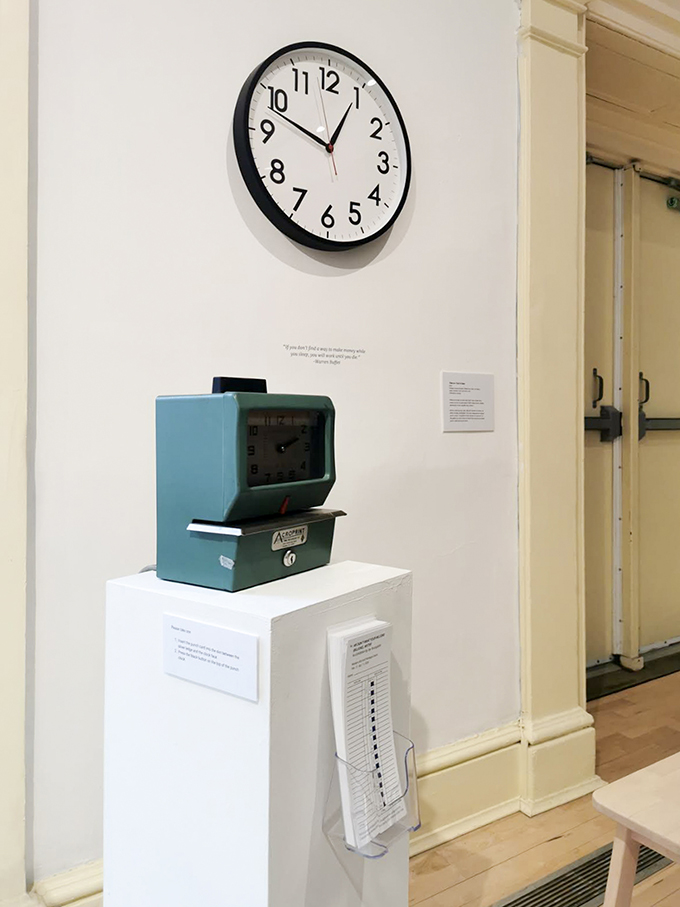
One way to show the philosophy of this exhibition is to show the relation of workers’ spaces and my manipulation of their work art to the artistic canon. The sum of writing about art history is not simply an endeavor to support art as a function of an exploitative system. Many interesting concepts and much beauty have arisen from it. So, one attempt of this show is to show relations between such high art and my presentation of art from working-class locations. I nod to the artist Michael Asher and his “institutional critique,” and New York’s “abstract impression,” and everyday working-class objects.
Workers are taught there is little beauty in what they make. Most know differently. They are proud of the beautiful buildings in which they hang the dry wall and wire the rooms. They recognize the beauty of a well-adjusted turbine in a power plant that serves their community. But thinking of additional ways to consider their tools and their labor, is a goal of this show.
THESIS SIX
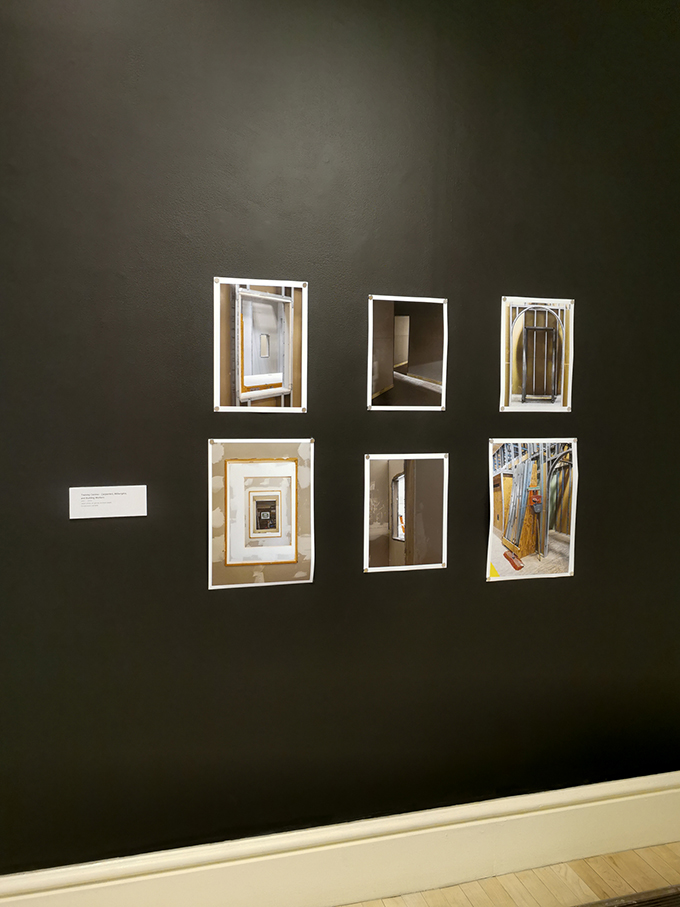
In a somewhat controversial move, I did not include individual portraits of workers in this show. There were several reasons for this. To begin, there are extraordinary photographers and artists who have done important portraits of workers for centuries. While I have taken such portraits, I felt I had little to add.
Such portraits of workers generally focus on individual workers in sympathetic poses or highlights important struggles in which they feature. A number of struggles are part of this show, but showing the class as a class will limit the number of individual portraits. My goal was to show the commonality and collectivity of workers, as a group. This is not to understate the beauty and dignity of depictions of individuals workers.
Further, today too many emphasize difference within the working class, and try to elevate identity over class. This is a mistake. In this cultural period, with the social media mantra of “look at me, look at me,” individualism is the coin of the realm. It is antithetical to the solidarity of the working class. Working with groups of white, Black and Hispanic workers in the south, my personal experience is that once a struggle begins, these differences of identity fade away. The focus on the unity of the class and the contradictions of being with a boss who has an identity similar to yours become clear.
As a writer on labor issues for years, one of my most cited article (thought in a negative way), contains my view that shoehorning the struggles of workers into a narrative of individual rights eviscerates solidarity. Given the predominance of the “human rights” framing in our progressive struggles today, this view is not a popular one.
For this show my attempt is to lead our eye away from individual portraits which can lead our concentration into individualism. Here, I am influenced by the philosopher of photography, Alan Sekula. Coming out of an artist grouping at the University of California, San Diego with Martha Rosler and Fred Lonidier, Sekula works are under appreciated.
According to Sekula, the celebration of abstract humanity featured in individual portraits of workers becomes, in any given political situation, the liberation of the dignity of the passive victim. This is the final outcome of the appropriation of the photographic image for liberal political ends; the oppressed are granted a bogus subjecthood.
Real “subjecthood” comes from an understanding of class, not from a performative rendering of “The Family of Man.”
CONCLUSION
These are “high concepts” and “everyday” labor.
So, I don’t want your millions, Mister,
I don’t want your diamond ring.
All I want is the right to live, Mister,
Give me back my job again.
…
Thanks, it’s always good to see more thought and exposure on the relationship between “art” and working class culture. As you assert, workers do make art. Just last week I was at Brooklyn’s Botanic Garden admiring the temporary wooden supports reinforcing giant trellises groaning under the wisteria’s spring growth. They were crisp, effective carpentry in the service of public aesthetics, yet their makers unacknowledged. I was also at UC San Diego along with Lonidier and Sekula, and admired their academic efforts to honor labor. I went on to make my own contribution via my book Agitate! Educate! Organize! – American Labor Posters (Cornell University Press, 2009) exploring images by and about workers. (BTW, a good essay by Allan Sekula was in the 1979 group show catalog “Social Works” at the Los Angeles Institute of Contemporary Arts, impossible to find, so I’ve posted here: https://www.docspopuli.org/pdfs/Sekula-1979.pdf )
Great article by Jay Youngdahl — I re-posted it on Portside on Saturday. I just wish I could have seen the exhibit. The whole discussion around the “physicality” of art, of the beauty of what workers produce is too often missed. And his reference to Leger is spot on — conceptual art can be appreciated by working people. We need to encourage an “expanded way of seeing,” a truth that has relevance beyond the gallery. Finally, Youngdahl’s point about the danger of individual portraits leading to a view of abstract individuals as “passive victimes” contains an important truth. Yet I will also say that I treasure the photos in “The Family of Man,” from looking through my parents’ copy when a child to returning to it now and again up to the present for the spirit of optimism in shared humanity it contains, and the cry against war implicit on every page. Kurt Stand