“Show Some Guts”
By Captain Don Marcus
Seafarers Are Not Expendable
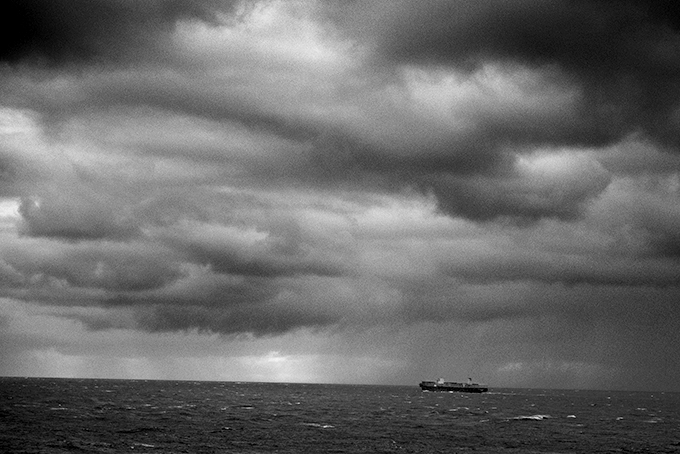
The recent bluster from the President of the United States about “showing some guts” to run the gauntlet of the Strait of Hormuz, had to strike a nerve in every merchant seaman, regardless of nationality or location on the globe. As of this writing there are approximately 100 merchant ships and an international community of some 30,000 civilian seafarers stranded in the Persian Gulf. Depending on the source, up to 19 vessels have been hit by missiles or drones and at least eight seafarers killed since the start of the war against Iran on February 28, 2026. One of those vessels was the U.S.-flag Stena Imperative, which was struck by two projectiles on March 2 while in port in Bahrain causing the death of one shipyard worker and wounding two others.
Numerous U.S. citizen merchant mariners, including the crew of the Stena Imperative and other U.S.-flag vessels, are among the 30,000 seafarers stranded in the Persian Gulf. Others are in or near ports outside the Gulf awaiting developments. None of these seafarers could have been assured by the contradictory and sometimes delusional statements of Defense Secretary Pete Hegseth in his March 13 press conference when he said that with regards to the oil trade and the attacks on tankers in the Strait of Hormuz: “we have been dealing with it and don’t need to worry about it.”
“… in virtually every U.S war, declared or undeclared, supported by Congress or the American people or not, the guns start firing first, followed shortly thereafter by the U.S. government’s realization that seaborne military logistics, U.S. foreign commerce and, finally, the U.S.-flag merchant marine and the seafarers that deliver the cargoes have to be taken into account.”
The supply chains of the world depend on transport by sea. Approximately 80% of world trade is carried by sea. Observers of recent events, not to mention students of history, are well aware that global choke points such as the Strait of Hormuz, the Suez Canal, the Panama Canal, the Strait of Malacca, the Strait of Gibraltar and half a dozen other key waterways around the world can have a drastic impact on the world economy if closed to commence.
For the U.S. seafarers standing by aboard their vessels inside the Persian Gulf or diverted away from the Gulf by the present war, uncertainty is a given. Since at least the Spanish American War in 1898, in virtually every U.S war, declared or undeclared, supported by Congress or the American people or not, the guns start firing first, followed shortly thereafter by the U.S. government’s realization that seaborne military logistics, U.S. foreign commerce and, finally, the U.S.-flag merchant marine and the seafarers that deliver the cargoes have to be taken into account.
Within the last two years, prior to the attack on Iran, the crews of U.S. and foreign merchant vessels have faced attacks by Houthi missiles and drones in and around another global choke point, the Bab al-Mandeb Strait. At least half a dozen U.S. flag vessels experienced near-miss attacks. This key waterway is located at the southern entrance to the Red Sea. Missiles, drone attacks, gunboat and uncrewed surface vessel attacks in Middle Eastern waters are not a new phenomenon to U.S. or foreign seafarers. The attacks, crew fatalities and vessel seizures in and around the Red Sea, Gulf of Aden and Arabian Sea have proven to be only a prelude to what is now taking place in the Persian Gulf and Strait of Hormuz.
History Is Repeating

In fact, history is directly repeating itself in the Persian Gulf. Few will remember the “Tanker War” which took place during the closing years of the Iran-Iraq War in 1987-88. During this time the U.S. decided to re-flag a number of Kuwaiti tankers to the U.S. flag to inhibit Iranian attacks on these vessels as they transited the Persian Gulf and its outlet at the Strait of Hormuz. Two of these U.S. flag tankers, the M/V Bridgeton and M/V Sea Isle City crew were attacked and seriously damaged. The M/V Bridgeton was struck by a mine off Farsi Island in the Persian Gulf, and the M/V Sea Isle City was stuck by a Silkworm missile fired from the Al Faw peninsula in Iraq which at the time was occupied by Iranian forces. Both attacks were launched by Iran. U.S. Captain John Hunt was permanently blinded during the attack on the M/V Sea Isle City, and eleven other members of the crew were hospitalized. Ultimately, some thirty U.S. naval vessels were engaged, U.S. attacks on Iranian facilities were undertaken which included ground attacks by U.S. Special forces as part of the vessel escort operations. This effort was dubbed “Operation Earnest Will” which is in itself a telling distinction in tone from “Epic Fury.” Operations ended with the peace between Iran and Iraq in 1988, but it should be noted that some 64 seafarers from many nations were killed through the course of the “Tanker War.” Notably, the entire effort was done under sanction of UN Resolution 598 and in conjunction with the French and British Navies.
Military technology has advanced exponentially since 1988. Seafarers remain on the front line of war, however. Today they are more lethally exposed than ever. Seafarers do, in fact, have something to “worry about,” as do shipowners. Whatever their concern for their crew, shipowners will protect their investments. The price of oil may be going up, but War Risk insurance for vessels entering the Persian Gulf is priceless – it simply cannot be had. “Nothing to worry about,” indeed.
Therefore, U.S. merchant seamen in and around the Persian Gulf, Red Sea, and Eastern Mediterranean and thousands of other seamen, have reason for grave concern. Of course, so do millions of innocent civilians throughout the region. The men and women of the U.S. Merchant Marine, 90% of whom are card carrying Union members, require more for assurance than facile bombast from the current administration in Washington DC. As the motto of the United States Merchant Marine Academy states: Acta Non Verba. “Deeds, not Words,” — least of all imbecilic ones from triumphalist and “merciless” U.S. government officials.
Those who go to sea for a living must deal with the hazards of their job just like firemen or mineworkers do. In wartime, merchant seamen know they are at risk. They must make their personal decisions accordingly.
In making their decisions certain basic needs must be met by all maritime employers. These needs were cogently expressed by the Nautilus Federation, an international federation of over twenty maritime unions representing seafarers from sixteen different countries including the U.S.A. Seafarers must be:
· Fully and promptly informed of all known risks before entering war zones or areas of warlike activity
· Provided unhindered right to repatriation and transit should they decline to enter zones or areas of heightened risk
· Protected from disciplinary action, loss of pay, impact on insurance, or detriment where safety decisions are taken in good faith
· Supported with appropriate security measures, welfare provisions, and access to assistance where voyages are disrupted
· At the very minimum, the protections, including pay bonuses and compensation for death or disability agreed to by the participants of the International Bargaining Forum of which the International Transport Workers’ Federation (ITF) is a party to must be met for service in designated “Warlike Operations Areas” which, among other locations around the world, (such as the Black Sea) includes the Persian Gulf, Red Sea, Gulf of Aden, Gulf of Oman and coast of Israel in the eastern Mediterranean.
What U.S. seafarers need for assurances regarding the performance of their profession in wartime are basic to what any prudent seafarer would logically require before voluntarily putting herself or himself in danger:
· Naval Escort/Convoy and oversight system in war zones: This has been the most effective protective measure from the days of the Spanish galleons to the Second World War, to the 1987-88 Tanker War to recent attacks in the Red Sea and Bab al-Mandeb Strait. It needs to be implemented in the Persian Gulf and Strait of Hormuz.
· Proactive countermeasures against shore-based air attack and naval facilities. This appears to be ongoing.
· Effective Mine-Sweeping capability. The U.S. naval minesweeping capabilities are notoriously limited and under-resourced.
· Secure communications equipment aboard ship and, if required, trained communications personnel with direct access to the appropriate military authorities, escorting vessels and surveillance personnel. This need was apparent in the Red Sea attacks and remains to be adequately addressed aboard U.S. commercial vessels in War Zones.
· International cooperation and pooling of naval assets. It has been repeatedly made clear to U.S. merchant mariners that the U.S. Navy does not have sufficient equipment to prioritize escort and close oversight protection of U.S. vessels, let alone the international merchant fleet that transits the Persian Gulf.
· Sufficient War Risk Insurance.
It may be a bridge too far to expect traditional allies who we have maligned and whose forces we denigrated to pool resources in a war the U.S. and Israel have started. However, if the world economy is to be stabilized and supply chains are to remain intact, seafarers must feel safe enough to willingly ply their trade.
In the words of British Trades Union Congress President and Nautilus International Director Mark Dickinson:
“Seafarers are not expendable, and they must not be treated as collateral damage in regional or international conflicts. The current situation in and around the Strait of Hormuz represents a serious escalation in risk for the men and women working at sea, many of whom are simply trying to do their jobs and return home safely. Their safety must come first, and that means clear information, robust protections, and the unequivocal right to refuse to sail into warlike or unsafe zones without fear of penalty.”
U.S. merchant mariners are overwhelmingly members of unions. They are covered by collective bargaining agreements. They are civilians. Opinions about the war vary greatly aboard U.S.-flag ships as they do in our communities.
Few civilian workers of any type have risen to the occasion more patriotically or consistently than American merchant seamen, who have done so since the first United States ensign was hoisted aboard a vessel in 1775. During the Second World War, American seafarers, overwhelmingly union members, suffered a higher proportional casualty rate than any branch of the U.S. armed forces. Close to 10,000 seamen were killed and over 950 ships were sunk.
The tradition of service in the U.S. merchant marine: “In Peace or War” is one that American seafarers are understandably proud of. The fact that they are union members and have the personal agency to make their own decisions about shipping out and putting themselves in harm’s way only enhances their pride of profession. This mindset has not changed. It continued during the Tanker War of 1987-88, the first Persian Gulf War and every war since, up through the attacks in the Red Sea and now the war in Iran. The men and women of the U.S. merchant marine cannot be accused of “lacking guts.”
…
Thanks for this. As you mentioned, WWII was yet another period where merchant mariners were mistreated. Yet shipbuilder Henry J. Kaiser supported them and non-segregated services for them, unlike the military or the USOs. We need to turn this ship around.