No to U.S. Threats and Interference
By Honduras Solidarity Network
November 24, 2025
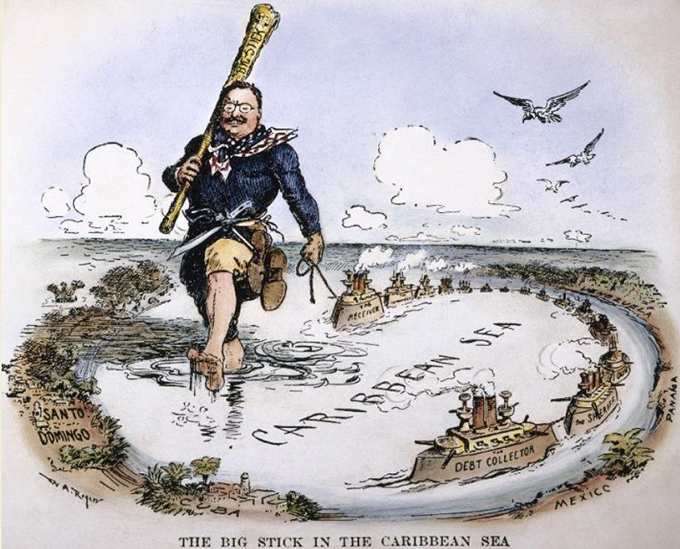
On November 30, 2025 Honduras will hold national elections in the midst of escalang U.S. interference in the region that includes military acons and threats of outright war against Venezuela, Colombia and Cuba from the Trump/Rubio administration. U.S. officials in the White House, State Department and Congress have been nurturing a propaganda campaign by the Honduran right wing press and organizations against the progressive forces in the country reminiscent of Cold War propaganda. This is layered onto the pre-existing challenges for democracy in a country that only four years ago electorally overturned 12 years of narco-dictatorship installed by a U.S. and Canada-supported coup and which has not yet been able to completely dismantle all the structures or policies of that regime.
The propaganda campaign has consistently opposed domestic reforms and international policies that do not line up completely with the U.S., deliberately incorrectly labeling the self indentfied democratic socialist LIBRE party government as “communist.” This is the same inciting language used by the Honduran and U.S. political forces that undermined Honduran democracy and identified as pro-coup in 2009.
For example, Rep. Maria Elvira Salazar (R-FL) and Rep. Chris Smith (R-NJ) have joined conservative Honduran media to consistently echo the interests of the wealthy Honduran families that dominate Honduras, often comparing the Castro government to Cuba, Nicaragua and Venezuela. Rep. Salazar also co-sponsored, with both Democrat and Republican congress members, the Protect Honduran Democracy Act (H.R. 4202). The bill calls for a clear interventionist position disguised with the language of supporting democracy. These calls for intervention were reiterated during the recent hearing by the U.S. House of Representative’s Foreign Affairs Subcommittee on the Western Hemisphere, where Rep. Salazar warned that the U.S. would not allow another country in the region to fall in the hands of socialism. She, too, defended the 2009 coup d’etat by calling on the Honduran military to intervene “once again to save its country from communism.” Now it has been announced that the very partisan Salazar will be heading up a delegation of congress members to observe the elections.
Given the tense situation with U.S. warships in the Caribbean, this polarizing rhetoric is obviously aimed at inciting fears of Honduras sufferring the same military attacks as Venezuela from the U.S. if the LIBRE party is elected. We do not see any of this as coincidental; it is part of a deliberate, broader campaign to undermine and manipulate voters and the electoral process.
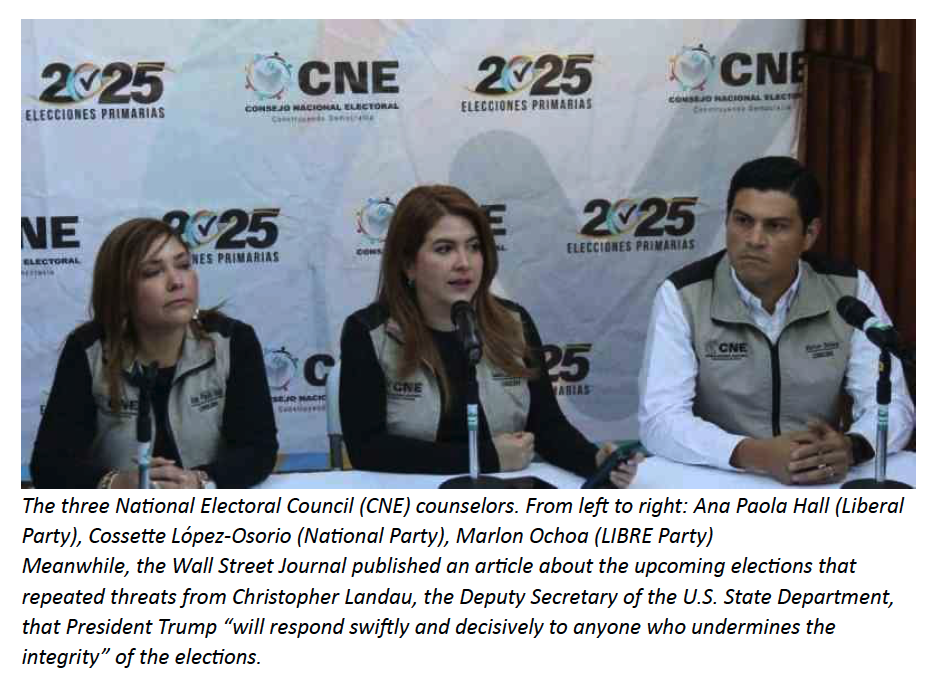
Since at least March 2025, there have been other attempts to undermine the democratic process. The National Electoral Council (CNE), the electoral authority responsible for overseeing and managing the elections, is highly politicized and headed by three counselors, each representing one of the major political parties. Conflicts within the Council have caused concerns for the election. During the March 2025 primary elections, some polling stations in the two largest cities were left without any ballots, while others received the materials many hours late. There were accusations made that the military had not done its job of ensuring that election materials were delivered. There were also accusations that the CNE representative for the National Party, Cossete Lopez Osorio, contracted a private transportation company to deliver ballot boxes, but some deliveries were not made. The conservative pro-2009 coup press then used the crisis to undermine public confidance in the electoral infrastructure and institutions. These mull-faceted and sophisticated efforts continue today.
In late October 2025 information was released by the Attorney General on the existence of audio files of conversations between a major leader of the right-wing National Party and current congressional representative Tomás Zambrano, and the CNE National Party counselor Cossete Lopez-Osorio. The audio files describe strategies – some involving sectors of the military, the media, and the U.S. Embassy – to undermine ballot box transportation and to generate doubt about the electoral results. Zambrano and Lopez claim that the audio files are AI generated, but the discussed strategies are characteristic of the primary election scandal and past strategies being employed by the opposition.
What happens in Honduras is important to people in the United States as well as in the region. Across Lan America, the U.S. government historically works against governments that insist on their sovereignty, especially those that have reform-minded, or radical programs for their own socio-economic development often seen as threatening U.S. interests. This has escalated again in recent years with support for right-wing governments and pares (Honduras’ 2009 coup, Bukele in El Salvador, right-wing candidates in elections in Argentina, Chile, Bolivia). Now the Trump/Rubio administration is both blatantly interfering in elections, economic policy, and is escalating to military action threatening Venezuela and Colombia, murdering more than 83 people, and threatening more violence.
An electoral crisis and instability in Honduras would increase the refugee crisis of Hondurans desperately seeking safety in the U.S. as it would deepen the economic and social crises in Honduras and likely lead to more political violence.
For people in the U.S., the threats of war and political interference by Trump’s government in Latin America and in the Honduran elections also raise the specter of more militarization and political repression inside the U.S. from an administration that has already carried out armed military-style actions in major U.S. cties.
The Honduras Solidarity Network is supporting an electoral observation mission led by Global Exchange, a U.S. based organization together with our partner in Honduras, the Center for Democracy Studies (CESPAD). Follow our coverage from Honduras and be alert to actions supporting the Honduran people and their democracy.
Honduras Solidarity Network: honsolnetwork@gmail.com, X: hondurassol
Facebook: Honduras Solidarity Network
More info: Honduras Now; Global Exchange
…