Warren Mar Remembers Kent Wong
By Warren Mar
Long time labor leader and educator Kent Wong died in the early AM of October 8. Labor councils, community organizations and prominent political leaders are saluting the multiple contributions that Kent made to reshaping Los Angeles and California. Most recently he helped to spearhead the July nonviolent direct action training at the LA Convention Center to promote resistance to the Trump occupation. Warren Mar has a long history with Kent and here he reflects on the loss of this exemplary leader. The Editors
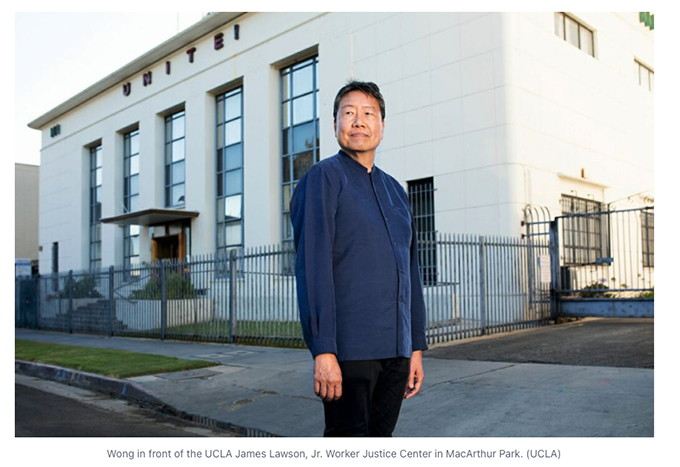
It was with great sadness when I opened my email, which I check less and less these days and saw a posting about the passing of Kent Wong, who served as the Director of the Labor Center at UCLA for over 30 years. Like most baby boomers, I have gotten used to losing friends and acquaintances on a regular basis, but somehow, I thought guys like Kent would just chug along forever or at least longer than most of us.
I heard about his passing from an email from the retiree chapter of the AFT: American Federation of Teachers, Local 2121, and for a period in between organizing stints I was a faculty member of the Labor and Community Studies Department at City College of SF. In a sense it was a notification about the passing of a colleague, and while I also did a stint at the Labor Center north at UC Berkeley, Kent was always more than another labor academic to me.
I became reacquainted with him, when I was hired as the Western Regional Recruitment Coordinator, for the Organizing Institute (OI). Under the Sweeney-Trumka regime in the early and mid-90’s, the national federation was trying to revitalize organizing non-union workers, and the OI was the carrot; the federation would foot the bill (for us) to recruit and train young organizers off college campuses and put them on campaigns with field staff trainers. When they finished the unions had the right to hire them on or throw them back into the pool. It was a bargain for most locals or regional affiliates who had some gumption to organize, often with lukewarm international support. I was lucky or unlucky when I was hired on at the OI, because there was also a hole in the southwest and for a time, I covered all of California, Oregon and Washington state. But covering Los Angeles gave me the opportunity to reconnect with Kent Wong.
Why do I say reconnect? Kent came out of the new left, as did I. He was with a different group of Asian leftists when he was an under-grad and later a law student in the mid-late 70’s. He made his first pilgrimage up to SF Chinatown during this time when we were fighting against the final eviction of the I-Hotel, in 1977. I was a tenant organizer at that time and already a cadre with the I Wor Kuen (IWK) which would later morph into the League of Revolutionary Struggle (LRS). SF Chinatown was then primarily our turf and the other major left group was the Revolutionary Union, later Revolutionary Communist Party (RCP), which had an Asian Community Center in the basement of the Hotel next to the Chinese Progressive Association, which the IWK help start in 1973. But we were full of ourselves as were most left groups those days, and we did not welcome, outside organizers, even those who were from another area of the Asian American left. His group never hung around long, never got a foot hold in Chinatown. They dissolved a couple of years before the LRS, so by the time we reconnected in Los Angeles, in the 90’s, he not only remembered my past, but welcomed it. We laughed about our sectarianism and also how foolish we often were.
I always appreciated that Kent never hid his past politics from me. Even when I worked at the Labor Center in Berkeley he always treated me as a fellow traveler from the left, not just another labor organizer or labor educator. While he could walk the academic tight rope, he never fell into the trap of what was popular to study and write about in a particular year, or the expediency of who was in power in a particular union or the university’s over lords in Sacramento who held the funding strings. He never wavered in the need for UCLA to be involved with immigrant worker centers, the undocumented, dreamers who were his students and the multitudes of unorganized workers of color, who were the parents of his students.
Kent was also a realist about the unions who he was trying to help regain their prominence, and Los Angeles was always a much weaker union town than San Francisco. Yet we both agreed that like the radical history of UC Berkeley both the academy and Labor movement were living off past glories. In the case of S.F., the general strike of the 30’s and in the case of UCB the radical student movement and 3rd World strikes of the 60’s. Kent always said they could not rest on these laurels, and he knew things had to change from the ground up. Like his mentor and fellow traveler from the 60’s, Reverend James Lawson Jr, Kent knew that the main resistance against capitalism would come from the most oppressed: BPOC people, immigrants and slaves from the former colonies. He knew and always fought for immigrants and people of color as a part of the working class. That we had been excluded in the past had more to do with the fault of the unions and U.S. racism, than it was due to our ancestor’s willingness to organize. Kent knew that BPOC and immigrants self-organized in spite of past exclusions from unions and legal policy barriers.
He knew that the shrinking unionized workforce could not be the entirety of the labor movement. It is no accident that much of UCLA’s Labor Center stretches as much into communities of color, immigrant worker centers, black workers centers, Day Laborers. These sectors that have built the United States, have been the focus of the Labor Center’s work under Kent’s leadership. He used the University to give them voice, connections with other workers across, craft, industry and jobs. He made the formal union leadership see solidarity with the communities of color as key to their own survival, a better bet than the past government deals they benefited from. His contributions to multi-national unity here in the U.S. and international solidarity particularly with Asians and Latinos; many former colonies of the United States will be his contribution and legacy. Kent not only made the Los Angeles labor movement stronger by building solidarity with communities of color but forced the past political machines to give labor leaders inroads. While Los Angeles has elected officials directly from unions and communities, San Francisco, has moved further to the right by directly having billionaire tech bros dominate municipal government. A resounding reflection on the North – South divides between race and class. Our state is a reflection of the global mirror. Kent understood this, which is why L.A. stands today as the beachhead for Trump’s federal invasion into California, an invasion meeting constant resistance.. He made UCLA Labor’s Center a real peoples academy, a worker’s academy. It was not an accident that the UCLA Labor Center was built in a largely immigrant/POC community opposite McArthur Park, with programs accessible to the young and working class. Kent not only changed the academy for the better, but the labor movement and municipal government where he worked.
Rest in Peace comrade,
Warren Mar
…