From Florence, Referenda Revisited!
By Nicola Benvenuti
On June 13 the Stansbury Forum published an analysis of the Italian vote on the 5 Referenda that took place on June 8-9.
Frequent Stansbury Forum contributor Nicola Benvenuti[1] wrote up his own brief analysis from his political perch in Florence, Italy
The difficulty in defining a political and trade union strategy
It’s my opinion that the Italian political crisis of the left-wing does not stem from contingent factors, like neglecting old class conquests or avoiding a tough fight for crucial objectives. I think it stems from today’s power relations between classes, but also from a lack of understanding of reality and the misunderstanding of social conflict, and therefore from the difficulty in defining a political and trade union strategy.
In the history of the workers’ movement there are constituent moments of a new identity dictated by changes in objective conditions. I think of Togliatti’s[2] 1944 Svolta di Salerno when national unity was a priority for the construction of the new Italian democracy; or to the SPD’s (German Social Democratic Party’s) 1959 opening to market logics (Bad Godesberg)[3], at a time when economic development made it possible to exchange work quality and intensity, and cooperation (Mitbestimmung) for work stability and high wages. Even Berlinguer’s Compremesso Storico (historic compromise) had the characteristics of a politically mediated social pact, aiming to overcome the dualisms of Italian society (north and south, rich and poor, pre-capitalist relations and advanced industry, cities and countryside) through the full democratic integration of the subordinate classes and a program of social reforms (healthcare, public housing, price controls, schooling etc.)
Attempts to formulate responses at this level, in a moment like ours marked by financial capitalism, a declining rate of industrial profit, and a massive concentration of wealth and power through technology and artificial intelligence, have not been seen either inside or— outside of Italy. This new phase of capitalism is truly disruptive and puts the defense and development of democracy and fundamental freedoms at the center of reflection, because it calls into question the very possibility of coexistence based on dialogue and debate, rather than mere force. This will certainly be the key battleground in the coming decades, and we look with hope to the opposition mounting in the U.S. against Trump, which Olney and Wilson vividly portrayed in a recent article in Sinistra Sindacale.[4]
The Italian labor movement, however, is now fragmented and divided into a myriad of interests, with no political mediation capable of regrouping a majority of citizens around the workers’ program. The construction of hegemony has been replaced by the pursuit of particular interests of one sector or another. As a result, politics is weakened and impoverished, and political participation collapses.
Within this roughly outlined context, the political activism launched by the CGIL through the proposed referendums of June 8-9 needs to be situated. These appear to be initiatives to build a relationship between the union and politics—especially in the absence of a party that would take on this task.
It is worth noting that the last attempt to establish a wide-ranging platform of social and economic agreements was made by the Matteo Renzi[5] (a man who was an outsider from the socialist tradition but able to arouse enthusiasm in the Partito Democratico (PD) electorate) government. While one may disagree with some of its elements, the initiative nonetheless had the stature of a foundational and structured pact. Its main pillars were: a political agreement with the opposition (Berlusconi[6] met Renzi at the PD headquarters), moderate liberalization of labor relations (fewer restrictions on dismissals, increasing protections for newly hired workers, tax incentives for hiring, reform of precarious employment, etc.), and institutional reform to streamline the decision-making process of an inefficient political system (differentiating the roles of the Chamber and Senate, a radical rethink of regionalization, etc.)—all under the benevolent eye of President Giorgio Napolitano[7]. It’s true that hiring decreased once tax incentives ended, that the promised “increasing protections” never materialized, and that layoffs significantly increased. But it’s also true that after Parliament approved the reforms, the “right” withdrew its support and effectively allied with the “left” to reject the constitutional reforms and bring down the Renzi government.
Avoiding blame and oversimplification, the substance is that the pact failed. Since then, Italian politics has largely been characterized by tax amnesties, security propaganda, xenophobia, clientelism, and the dismantling of the welfare state. In the political vacuum that has followed, several political initiatives have been tried, including the populism of the yellow/green government (5-Star Movement and League), and politically discredited: the PD after Renzi’s exit, is divided between a moderate/centrist party apparatus and the followers of the voters’s choice General Secretary Elly Schlein; the Northern League’s shift under Salvini toward building a southern client base; the 5-Star Movement, whose only real ambition seems to be replacing the PD; Berlusconi’s party, Forza Italia, which aspired to unify the “right” in the groove of a moderate right-wing line, now exists only as a subordinate part of the Fratelli d’Italia (Meloni) government. And finally the current “majority-of-the-minority government” led by the true winner of this political period, Giorgia Meloni, the last political force to try to govern but politically extremist and equipped by a low-quality ruling apparatus. And after that?
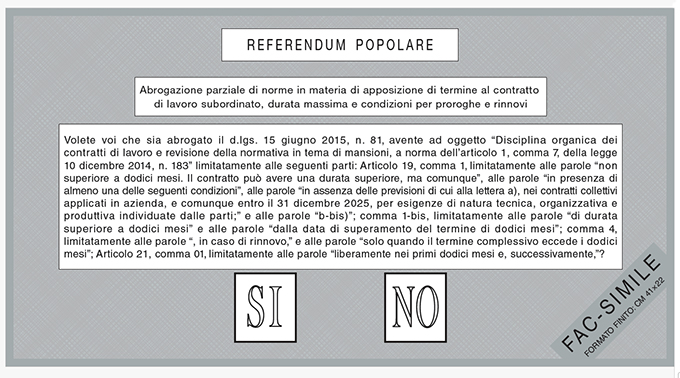
Returning to the specific issue, the union referendums were abrogative and thus lacked positive, detailed proposals. They were necessarily constructed with technical language that made even their actual effects hard to grasp—a bit weak to mobilize an electorate disillusioned by the lack of alternatives to the current state of affairs. Perhaps the union was also held back by its role and didn’t want to encroach too much on the territory of its “friendly” parties, the PD and the 5-Star Movement—or maybe this political task is simply too much at odds with the nature of a union.
However, these referendums also reveal an ideological approach: the defense of prerogatives won in very different contexts, as seen in the:
1. First referendum—against the Jobs Act—which, among other things, eliminated the union’s key instrument for protecting workers: Article 8, which prevented unjustified dismissals, introduced under Renzi. The other referendums concerned:
2. eliminating the cap on compensation for workers dismissed by small businesses, allowing judges to apply stricter penalties in the case of unjustified dismissals;
3. fighting precarious employment—especially temporary contracts that never lead to stable work;
4. workplace safety—by making the commissioning entrepreneur accountable for the often inadequate working conditions of subcontractors.
Given their abrogative nature, these referendums couldn’t propose comprehensive reforms; they were limited to adjusting the system by repealing measures considered harmful.
Sadly, the fifth referendum was also disappointing. This one was proposed by Più Europa, a political group in Parliament rooted in the old Radical Movement of Marco Pannella[8]. It aimed to halve the residency requirement for foreign residents and their families to apply for Italian citizenship—from 10 years to 5—once good conduct was established. Unfortunately, this referendum confirmed the widespread mistrust Italians have toward non-EU immigrants, and underscores the need to move beyond vague ethical attitudes toward concrete policies for legal integration and matching labor supply and demand, eliminating the utility of undocumented workers.
…
[1] Nicola Benvenuti is an Italian political historian who resides in Florence
[2] Palmiro Togliatti 1893-1964 – Leader of the Italian Communist Party for 40 years
[3] Bad Godesberg is a town near Bonn Germany where the SPD convention took place
[4] https://www.sinistrasindacale.it/
[5] Matteo Renzi – Italian Prime Minster 2014-16
[6] Silvio Berlusconi was an Italian media tycoon and Prime minister from 1994-95, 2001-2006 and 2008-11.
[7] Longest serving Italian President and member of the Italian Communist Party from 1945-91.
[8] Marco Pannella 1930-2016 – Italian politician, journalist and activist and leader of the Radical Party