A Path Forward
By Max Elbaum
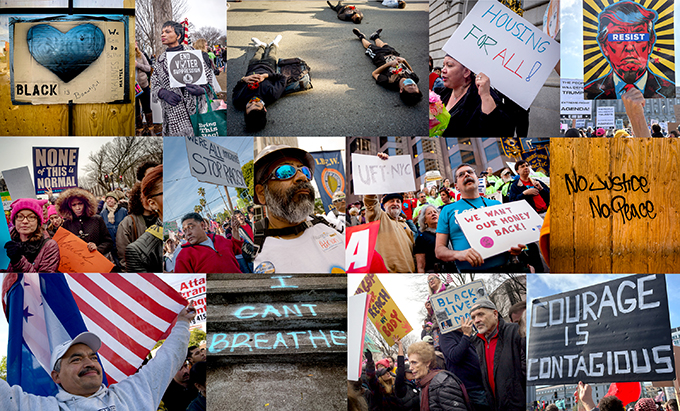
Only a new governing coalition capable of expanding political democracy and beginning a process of structural change can push MAGA back to the margins. Lessons from the 2020 election and the Biden years help show a path toward that goal.
We have a treacherous road to travel before we can push MAGA out of political power. But even as we prioritize resistance to the administration’s daily barrage we need an eyes-on-the-prize vision of a post-MAGA government. What kind of governing bloc is both possible to achieve and capable of providing more than temporary respite from fascism’s forward march?
For determining what is essential in such a government and charting a path to reach that goal, there is a lot to learn from the dynamics of the 2020 election and what did and did not happen during the Biden administration.
There is no going back
The Biden years and the 2024 election made it clear that an administration unable or unwilling to push through major political and economic changes cannot beat back authoritarianism. The pre-2016 status quo (neoliberalism anchored by U.S. global hegemony) was and is unsustainable. An exit from that order either in the direction of autocracy/fascism or robust democracy and people-over-profit economics has been on the agenda since the 2008 financial crisis.
The strategists and power-brokers who laid the groundwork for Trump 2.0 have understood this for at least a decade. That’s why the MAGA bloc, having captured all three branches of the federal government, has been able to move so quickly toward the goal of consolidating authoritarian rule.
The narcissistic obsessions of their demagogue-in-chief (tariffs, vendettas against Bruce Springsteen and Taylor Swift, etc.) are weak points in their blitzkrieg. There-emergence of the anti-MAGA majority and increasingly large protest actions are major obstacles in their path. With a further uptick in resistance—including non-compliance and other actions aimed at the “key pillars” of U.S. authoritarianism—along with heightened popular disapproval, it may be possible to preserve significant democratic space, including enough space for competitive elections and the basic right to protest.
If our resistance efforts achieve that goal, breaking MAGA’s grip on power at the federal level and weakening its strength at the state level is the next urgent step. But even that is not enough. If today’s Project 2025 regime is not replaced by a governing coalition that moves aggressively on a program of political democratization that prioritizes racial and gender justice, pro-working class economic reform, and an end to U.S. forever wars, MAGA will again brand itself as the change agent the country needs and come roaring back.
Elected officials and an energized mass base
The governing coalition we need must have clout both inside and outside the political system.
On the inside, its partisans need to be in elected office at every level. Wielding the power of the presidency and holding majorities in both Houses of Congress is essential, not least to break the power of the current MAGA majority on the Supreme Court. And given the extensive powers reserved for state governments in the U.S. federal system, eliminating some of the 23 GOP state trifectas and winning our own trifectas in 15-20 states by 2028 is a necessary target as well.
The capacity to exercise power outside the formal political system is equally important. No progressive program will make it from policy to law to tangible change on the ground (and no new coalition will come to power in the first place) without constant pressure and active participation by an energized grassroots base. And that energy can only be sustained by a cluster of combative, mass-based organizations implementing a common strategy which their members shape and “own.”
Only this combination of elements can sustain the kind of “co-governance” dynamic necessary for a durable and accountable governing coalition.
A short-lived glimpse in 2020
For getting to that kind of multi-leveled governing bloc, there are important lessons from the 2020 election. That contest put President Biden in the White House, flipped the Senate to Democratic control (with Vice President Harris able to break the 50-50 Senate tie) and expanded the Squad to six as Democrats retained control of the House.
Going into that election, mass protest was at a fever pitch. The day after Donald Trump’s first inauguration saw the massive Women’s March, at the time the largest single-day protest in U.S. history. Militant protests at airports across the country in response to Trump’s “Muslim ban” were the next high-water mark in the stream of anti-Trump protests. The George Floyd uprising at the height of the pandemic then surpassed the Women’s March and still stands as “very likely the largest collective action ever on U.S. soil.”
Much of the energy unleashed by all this grassroots ferment flowed into the electoral arena, the lion’s share fueling Bernie Sanders’s second presidential campaign. Most organized radical groups in the country backed Bernie’s insurgent effort, either participating directly in the campaign structure or using their own distinct structures for electoral work. The result was a leap in the sophistication with which existing and new formations approached electoral work and in the connection and cooperation among different groups.
Though Bernie did not win the nomination, the scale of his support (and to a lesser degree, Elizabeth Warren’s) moved the party leftwards and forced most primary candidates to support Medicare for All. It put Bernie in position to represent U.S. progressives in negotiations with the winning Biden team over the character of the general election campaign and at least some components of administration policy. This took the form of joint task forces which produced a detailed policy statement that included recommendations for funding universal pre-kindergarten, expanding Social Security, raising the national minimum wage, and eliminating cash bail, among many other long-sought progressive programs.
A second factor that produced what amounted to a Biden-Bernie alliance was recognition by at least some sectors of Democratic Party establishment that a shift away from neoliberalism was in their own class and political interest. The Hewlett Foundation’s 2020“ Economy and Society Initiative to support growing movement to replace neoliberalism” was the clearest expression of that sector’s viewpoint.
The result of these two factors was a general election campaign that did not rely exclusively on an anti-MAGA message. The prospect of winning changes that would benefit the majority of workers, poor people, and constituencies facing special oppression was also present. As a result, almost all the organizations that had backed Bernie (or Warren) threw down against MAGA in the general election and provided a big part of the margin of victory in battleground states.
And after the election victory, the Biden administration’s initial legislative priority—the Build Back Better plan—included numerous provisions long advocated by progressives, drawing from, among other efforts, the extensive grassroots organizing for a Green New Deal.
Falling short leads to falling back
The political trajectory after that, however, was downhill. Any brief summary is over-simplified. But the central dynamic is clear enough.
Quick to recover from the wave of disapproval that followed January 6, MAGA practiced all obstruction, all the time. The Biden administration, still trapped in the fantasy that the “traditional norms” of U.S. politics were operative, tried to reason with GOP so-called “moderates” and the reactionary Manchin-Sinema duo within the Democratic ranks. The narrowness of the Democratic majorities in the House and Senate was a real problem; conciliating the obstructors didn’t work and the Inflation Reduction Act and other measures that finally passed were a shadow of the original “Build Back Better” proposal.
The Biden team proved inept even at promoting what they did achieve. And then, starting two years in, Biden made a whole series of right turns. Administration messaging on rebuilding the economy shifted from benefitting the majority to competing with China. Biden and other mainstream Democrats capitulated to MAGA’s anti-immigrant crusade. The President bear-hugged Netanyahu and became the main enabler of Israel’s genocide in Gaza.
Though increasingly unpopular and frail, Biden refused to withdraw until it was too late for a competitive presidential primary, thereby preventing the launch of a campaign that might have energized increasingly alienated progressives as Bernie did in 2016 and 2020. By the time of the 2024 general election, Harris and mainstream Democratic candidates for the House and Senate had little to run on besides anti-MAGA sentiment and abortion rights.
The political situation today is worse than 2016. A cadre of loyal MAGA operatives is running the federal government and implementing a well-prepared plan. Mainstream Democrats, with a few individual exceptions, are in near-total disarray, unable to formulate much less agree upon or carry out a serious opposition strategy. The broad Left has grown in both size and sophistication compared to 2016, and important sections of it are working together and utilizing the “Block and Build” strategic framework. But we are still playing catch-up and only since the Hands-Off demonstrations in April that we are able to draw strength from an outpouring of bottom-up protest. Yet intensifying climate change and the rapid deployment of AI are speeding up the things-must-change calendar.
Stay grounded and go beyond 2020
Digging ourselves out of this hole requires a process that accurately assesses the difficult balance of forces, learns from what worked to drive politics forward in 2020, and goes a lot further.
Turning public disapproval into enough actions and votes to stop MAGA’s advance is the immediate priority…we are in a tougher spot than we were in 2020, so we need to reach for the additional types of protest in our arsenal, such as strikes and other workplace actions, civil disobedience, disruptive protests, and organized noncompliance.
MAGA’s drive for unlimited power is moving fast. But one of the reasons for MAGA’s haste is that its program is unpopular and grows more so by the week. Turning public disapproval into enough actions and votes to stop MAGA’s advance is the immediate priority. Every rapid response to an ICE raid, every town hall calling out those who vote to cut Medicaid, every lawsuit/picket line combination to defend federal workers, every protest against sending arms to Israel makes a difference by energizing those already opposed to MAGA, exploiting the fissures among Trump voters, or both. But we are in a tougher spot than we were in 2020, so we need to reach for the additional types of protest in our arsenal, such as strikes and other workplace actions, civil disobedience, disruptive protests, and organized noncompliance.
If the next 18 months of resistance efforts succeed in protecting the electoral process, big gains are possible in 2026 and then 2028 with an all-out “margin of effort.” For a new governing coalition to be more than a holding action, winning the presidency and larger Democratic majorities in the House and Senate than were won in 2020 are necessary—but not sufficient. The strength of progressives relative to the corporate and centrist factions in the Democratic Party must be significantly greater than in 2020. Protecting every incumbent who will be targeted by AIPAC and the Crypto lobby, and replacing several incumbents with Squad-like progressives, are realistic goals.
It will take longer than four years to build an organizing and media infrastructure and financial base strong enough to make progressives a majority of non-MAGA Representatives and Senators. But we can and should aim to punch above our weight in numbers seated in Washington. Key planks in our program for structural change (Medicare for All, expansion of voting rights and an end to the Citizens United role of money in politics, overhaul of the tax system to tax the rich, PRO-Act and related expansions of trade union rights) command majority support.
As struggles against authoritarianism intensify, participants and their supporters move toward more combativeness and more openness to radical ideas. And though it is dormant, the willingness among mainstream Democrats to explore a shift away from neoliberalism has not completely disappeared.
Toward synergy: a presidential run, Left unity, and grassroots organizing
These factors could give us leverage in contending with the corporate and centrist forces for influence in the anti-MAGA front. A key tactic will be finding a progressive to make a serious bid for the presidential nomination.
Win or lose, an insurgent campaign promoting an anti-oligarchy, pro-working class program will be essential for gaining more influence on the 2028 Democratic election campaign and incoming administration than progressives had in 2020. It will allow us to define the election as a chance to both repudiate MAGA and make the shift away from neoliberalism that was glimpsed but not accomplished in 2020-2021. An insurgent campaign is also needed to increase our influence on U.S. foreign policy, immigration, racial justice, and other issues which are crucial for putting any new governing coalition on a durable foundation.
Maximum Left unity behind the candidate running in the “progressive lane” of the 2028 Democratic primary will be critical. This is another lesson from 2020 (and from Bernie’s 2016 campaign and Jesse Jackson’s 1984 and 1988 Rainbow efforts) that is applicable in 2028 and beyond. Given the undemocratic structure of the U.S. electoral system, a presidential campaign is one of the very few ways to galvanize united action by different sectors of the broad Left and project a distinct vision and program before the country.
Thus, it is no surprise that informal discussions are already underway in progressive circles about potential candidates, with many speculating that AOC is positioning herself to fill that spot.
An equally important lesson from Bernie and Jesse’s runs is that grassroots-based organizations with a clear political strategy operating at scale are needed to consolidate the energy unleashed by any insurgent campaign. It is therefore urgent to seize the opportunities that now exist to make leaps forward on that front. The new stirrings of labor militancy and the shift among major unions toward embracing a broader progressive agenda—including opposition to U.S. backing for Israeli genocide—is especially promising. The UAW-led initiative to align contract expiration dates and conduct united labor actions on Mayday 2028 is a potential focal point for activity that starts today. It also holds out the prospect of synergy with a progressive presidential campaign in spring 2028.
There is also potential for accelerating the motion toward strategic alignment and organizational cooperation in the broad Left, especially between groups that already have adopted a power-building strategy that meshes electoral and non-electoral work.
Everything we have will be needed to protect the results of elections if they are competitive and if anti-MAGA wins. Trump did not accept defeat in 2020 and there is no reason to expect today’s GOP to accept defeat in 2026 or 2028.
Putting the pieces together
The challenges we face are daunting. Progressives alone do not have the strength to prevent MAGA from consolidating authoritarian rule. Even the much broader gathering of all anti-MAGA sectors needs to become more combative and united to accomplish that task. And if we succeed in ousting MAGA, the coalition that comes to power will need to have enough strength inside and outside government to kick-start significant changes that are felt on the ground. It is unrealistic to expect that every part of our agenda can be won quickly. But we must win enough to spark the enthusiasm in the majority of the multi-racial and gender-diverse U.S. working class and broader population while at least neutralizing a sizable number of 2024 Trump voters.
All we can say with confidence today is that the strands that could produce such an outcome exist. The anti-MAGA majority is re-emerging. There is motion toward revitalizing the labor movement at both the leadership and rank-and-file levels. Strategic ideas drawn from the experience of fighting authoritarianism in other countries are taking hold within the anti-MAGA opposition. Power-building progressive organizations have grown in sophistication and are united on most elements of a program that could kick-start a cycle of political and economic change. Important voices within the progressive world are locating that program within the deep patterns of U.S. history, promoting the framework of a Third Reconstruction which highlights the synergy between democratic and working-class struggles and the special role of the Black Freedom Movement.
If all these strands mature, we can achieve what today’s circumstances allow and make 2028 a turning point in the long march toward a different world.
…
All photos: Robert Gumpert
This piece originally ran on Convergence, a site well worth checking out