Where’s The Heat, Where’s The Hammer
By Peter Olney
Worker-led and initiated organizing is certainly positive, but this emphasis is one piece of a much larger analytical framework for success in organizing.
A review of: We Are the Union: How Worker-to-Worker Organizing Is Revitalizing Labor and Winning Big, by Eric Blanc (University of California Press, 2025)
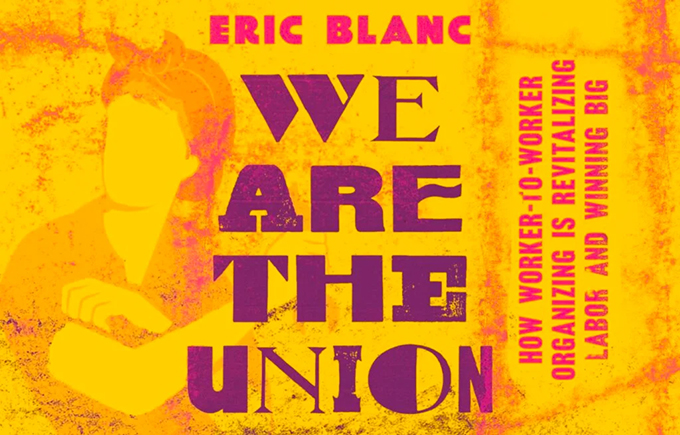
We owe a debt of gratitude to Eric Blanc for his new book We Are the Union, and for his continuing outspoken activism in support of labor organizing. His earlier work, Red State Revolt: The Teachers’ Strike Wave and Working-Class Politics (Verso Press, 2019) documented the 2018 upsurges in West Virginia, Arizona, and Oklahoma. Those battles, and the book itself, brought a breath of fresh air during the first Trump administration. Now Blanc joins a pantheon of other prognosticators who must grapple with what union revival looks like in the second and more ominous Trump administration.
In We Are the Union, Blanc draws on his 2018 experiences, as well as his observations of graduate student organizing, unionizing at Starbucks and other retail outlets, the organizing that revitalized The NewsGuild (CWA), and the 2022 surprise victory at the Staten Island Amazon Fulfillment Center. These led him to some broad conclusions for our movement:
“Let me be as clear as possible: this book’s argument is not that resources and staff are unimportant. It’s that they need to be deployed in a way that’s scalable. In other words, unionizing millions will require the absolute increase in staffing and financial support for organizing, but a relative decrease in the staffing density of most campaigns.” (p. 19)
In Chapter 3, Blanc presents some illustrative case studies of successful worker-led and -driven campaigns. The independent organizing drive at Burgerville brought five stores in the Pacific Northwest fast food chain into the Burgerville Workers Union, an affiliate of the Industrial Workers of the World. The Colectivo Collective organized coffee shops in the Wisconsin/Illinois area with help from the International Brotherhood of Electrical workers (IBEW), a traditional building trades craft union; they won their elections and joined IBEW locals.
The News Guild is a division of the Communications Workers of America. For many years the Guild has run an impressive Member Organizing Program that relies on the talent, outreach and passion of existing members to organize new members. All of these examples illustrate Blanc’s point that staffing ratios, while not unimportant, are not determinative. More staff does not guarantee victory: the involvement and initiative of workers themselves is key. And of course in the case of Colectivo and the Guild organizing, union leaders’ recognizing that fact and supporting worker-led organizing led to impressive victories.
To further bolster his argument for worker-to-worker or, in some cases, “do it yourself” unionism, Blanc describes changes in the terrain since the 1930s when labor experienced its modern upsurge in the US. Manufacturing is a smaller sector of working- class employment and logistics, while important, also does not occupy a huge percentage of the workforce. People don’t live near their workplaces, as they used to: there’s a lack of geographic concentrations in communities surrounding employment.
What gives workers power?
No sooner had I finished the last chapter in We Are the Union than I heard the results of the NLRB election at an Amazon fulfillment center in Garner, North Carolina. Carolina Amazonians United for Solidarity and Employment (CAUSE), an independent community- based union, suffered a defeat: 829 workers voted for the union, 2447 against. This lopsided result was not unexpected and does not negate the excellent work done by CAUSE and the prospects for Amazon organizing, but it does shed some light on the limitation of the thesis that is the subtitle of the book, “How Worker-to-Worker Organizing Is Revitalizing Labor and Winning Big.”
Blanc correctly criticizes a formulaic and stilted staff drive approach to organizing, and proposes that “unlike the staff-heavy, 1 (staff) to 100 (worker) model defended above, only worker-to-worker unionism can leverage union resources in a way capable of scaling up working class power.” (page 63) But this observation is hardly revolutionary or at odds with most of the historic practice of organizing. My experience from over 50 years of organizing in venues from manufacturing and warehousing to janitorial confirms that a staff-intensive approach, while helpful, is not determinative.
But winning an organizing drive and getting to a contract does require “heat and hammer.” Workers must have a deep sense that something is wrong, and organizers—whether they be co-workers or union staff—need to be able to inspire and motivate workers to take action to address it. That’s the heat. The hammer is the source of power that will compel an employer to accede to worker demands; it can be the workers’ own collective actions, corporate leverage, labor and community solidarity, or some combination of these. With an understanding of “heat and hammer” in place, other considerations play an important role in successful organizing:
-Committee-building and staff expertise
An effective committee of workers takes leadership of the drive with skillful guidance from union staff. Such “skillful” guidance can often be deferring to the collective wisdom of workers—or being willing to challenge workers based on staff experience.
-Existing density or workplace power
A high percentage of the industry is unionized or the unionizing workers are linked to sectors and seams that are unionized.
-Community bases – subjective social dynamite
Workers are rooted in communities, often communities of color, with common histories and common language, and those communities have their backs.
While Blanc recognizes the power of a reformed United Auto Workers (UAW) and the dynamic “stand-up strike” conducted in fall 2023, he diminishes the importance of manufacturing and especially heavy manufacturing to building power for working people. The stand-up strike rocked the country precisely because it was in a key manufacturing sector in the second-largest manufacturing nation (after China) in the world. In 1955 there were half a million manufacturing jobs south of 57th Street in Manhattan, so radicals and intellectuals were much attuned to that sector. Now much of manufacturing has shifted out of the Midwest and Northeast and to the Southwest and Southeast. So social being determines social consciousness, and many on the Left do not see the continuing power and importance of manufacturing; it represents a smaller percentage of the workforce but is still key to power. When GM CEO Mary Barra cried to the media about the damage that the strike was doing and whined that her massive pay boosts are tied to performance, it was a clear sign the workers were rocking capitalism.
Logistics too remains key to working class power. Witness Donald Trump pandering to the International Longshoremen’s Association in their 2024 dispute with their largely foreign-based employers. Organized logistics workers have the power to choke off commerce and win significant concessions from capital. These sectors have far more impact on capital than workers organizing in most of the sectors that Blanc discusses. Certainly the organizing of grad students is impressive and important but these campaigns most often don’t confront the scorched-earth resistance of Amazon and its notorious union-busting law firm Littler Mendelsohn in Garner, North Carolina. “Amazon, implacably hostile to worker power, brought its full arsenal of union busting to RDU1,” veteran organizer and strategist Jonathan Rosenblum wrote in The Nation:
“After the union filed for an election last December, Amazon began staging around-the-clock anti-union meetings—brainwashing sessions, in which company lawyers and managers threatened workers with loss of their already-meager benefits, characterized bargaining as a futile process, and engaged in character assassination of CAUSE leaders. Amazon played the race and xenophobia cards to split the workforce: Managers told Latino workers that the union was just for Black workers, and they cynically highlighted the Trump deportation machine to further intimidate immigrant workers, who constitute a quarter or more of the RDU1 workforce.
“Managers roamed the warehouse floor and singled out union supporters for harassment. In break rooms, CAUSE organizers reported, the company played “Vote No” videos on a continuous loop. They posted huge “Vote No” banners throughout the workplace. Anti-union literature was plastered everywhere, even in the bathroom stalls, while pro-union literature was promptly taken down. In the week leading up to the vote, Amazon erected fencing around the warehouse, posted security guards, and even arrested an Amazon worker—a union leader from the JFK8 facility in Staten Island, New York, who had come down to North Carolina to campaign with CAUSE.”
Defeating this kind of anti-worker offensive from one of the largest companies in the history of capitalism will require the marshaling of multiple unions, community forces, friendly politicians, the power of solidarity links in the supply chain and of course the grit and imagination of the workers themselves.
Community is more than geography
Blanc’s equating geographic concentration with community misses the tremendous power of communities of color in organizing if they are properly tapped by culturally and linguistically competent organizers. The Justice for Janitors campaign in Los Angeles, which resulted in a gain of 6,000 new members for the Service Employees International Union, was fueled and powered by a largely Central American and Mexican workforce spread geographically throughout the LA basin. The 1992 drywall carpenters’ strike, which paralyzed the residential construction industry from Santa Barbara to San Diego, was led and organized by immigrants principally from one village in Guanajuato, Mexico. The epic battle resulted in 3,000 new workers joining the Carpenters Union. The concept of community needs to be imagined and therefore acted on far beyond the factory towns of the 1930s.
Find the hammer
The organizing at Starbucks and Amazon raises the question of what hammer will compel an employer to make real concessions. Indeed, the baristas have done some wonderful DIY organizing in spreading their movement through coordinated strikes and site-by-site National Labor Relations Board election victories at 500 out of Starbucks’ 9,000 outlets. But despite Starbucks’ willingness to sit down and negotiate, there is no deal in sight. What are the power points in the Starbucks operation that might help the workers get contracts? Perhaps the warehousing and storage facilities in key ports of entry for coffee beans in the US? Are there warehouses that house the trademark Starbucks merchandise? Where is the hammer and how can it be utilized?
Similarly, have Amazon’s choke points been identified and targeted? Could the inbound cross-docks that receive fully laden containers of imported Amazon merchandise be sensitive spots for labor action that might serve to leverage the whole production system? Again there are no easy answers, but union staff can complement and enhance workers’ organizing by doing the research necessary to identify these vulnerabilities and act on them.
Today only 6% of workers in the private sector in the US belong to unions. In 1955 this figure—the union density—was 35%. Yet and still there is power in certain sectors where union density is high, particularly in port, rail, air, and trucking. It takes money to make money: having density in certain sectors and having an organized and committed workforce can lead to victories in non-union sectors.
A forgotten variable in the dramatic Justice For Janitors victory in Los Angeles is the fact the union had control of the janitorial market in New York, Chicago, and San Francisco, and had contracts with the same employers who were operating double-breasted non-union in Los Angeles. When the dramatic strike happened in June 1990 and the police brutally repressed a march in Century City, the carnage led SEIU leaders to threaten strikes in the major organized markets. So where we have power we need to organize and apply it to win in non-union sectors. The International Longshore and Warehouse Union represents all the major on-dock maritime logistics employers on the West Coast. But all of those employers have subsidiary inland warehousing, including facilities utilized by Amazon. Can we get organized to leverage that power and grow with thousands of new members?
Blanc’s emphasis on worker-led and initiated organizing is certainly positive, and as he points out, certain unions like the CWA have long employed this approach. But this emphasis is one piece of a much larger analytical framework for success in organizing. There are new conditions, but despite the reduction in the percent of workers in manufacturing and logistics, those remain power sectors of the economy. And organizing in those sectors will require the same community-, race- and culture-based approaches, enhanced by social media but not solely reliant on it.
We Are the Union gives us rich stories of worker-initiated organizing, in many cases leading to dramatic victories. But getting to scale power in sectors of the economy that, as in the past, can rock the foundations of capital, requires an analysis of “heat and hammer.”
…
This piece first ran in Convergence – A Magazine of Radical Insights
Peter,
Thank you for your analysis on Heat and Hammer. As always your on the ground experience add insights to otherwise armchair analysis of labor and the problems of organizing in the current situation. As an retired organizer myself, I have had to rethink and reflect on some of the campaigns (even successful ones), I’ve worked on in the 80’s and 90’s, like your campaigns some of what worked for us then, may not work now.
Sadly, I feel that Capital has moved further than Labor/Unions and we have not adapted. Empire and Race were two of the things that kept U.S. unions in lockstep with Capital during our height which we still see as the Golden Age. As you mention in 1955 with density was at it’s peak 35% (probably more for white guys) my father who was in a factory since the 20’s in San Francisco, was excluded. Chinese Exclusion Law was still in affect during most of his work life even in liberal SF and most of the Unions, obliged with Jim Crow, part of their benefit during the new deal. But the deal is off and rather than remake it it would behove the unions to learn that it was not all that good to begin with and now they need to include the global south (where most U.S. factories have relocated). Even our beloved UAW should prioritize working with Mexican auto workers, rather than just affiliations with Canada. There are more GM, Ford, other UAW plants in Mexico than there are in Canada. There is the largest GM office tower I’ve ever seen in the new financial district of Mexico City, right next to another American icon, office tower of Colgate-Palmolive.
Finally on the Amazon lost in North Carolina, racial divisions have always been the golden rule of U.S. Capitals division of the working class and we were both priviledged to have come of age in the 60’s when those divisions were being challenged and broken down by the Black Liberation/Civil Rights movements which not only brought Black and white (the most popular racial paradigm in the U.S.). unity together but also People of Color, which I feel as a POC we need to reknew again now and cannot be taken for granted.
Latino, immigrants of color rightfully feel that everyone is against them and some of the African American Democratic leaders and the mainstream party has been shameless, with few exceptions on deportations and militarizing the border, especially in the areas you rightfully point out, the South East and South West areas of the United States; the largest areas in industrial concentration and growth; pittting workers of color against one another in the lowest labor sectors. These things cannot go unmentioned and unrecognized.
Sorry for my long winded response, but again thank you for your article.
with respect and solidarity, Warren
Thanks, Peter – for adding perspective to an already helpful analysis. There aren’t any “heat and hammer” labor posters, but perhaps there should be.